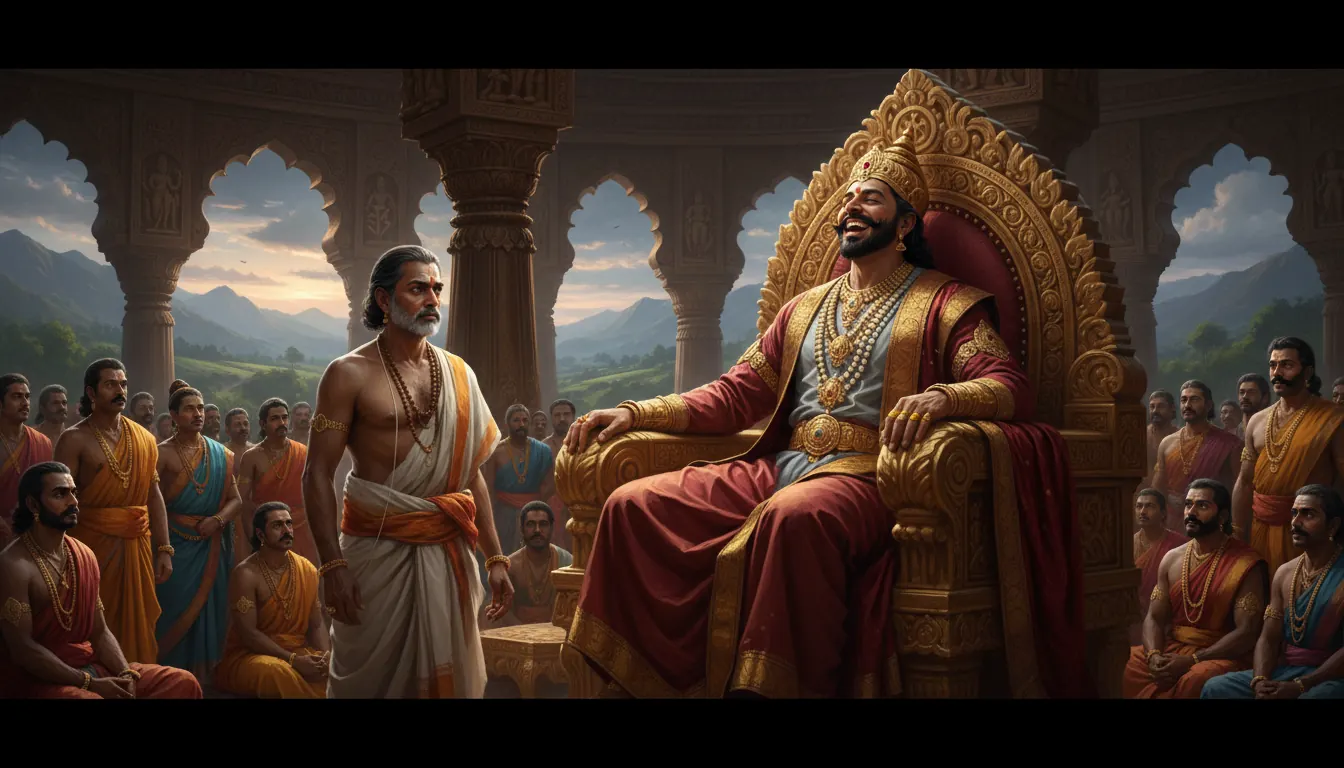
The King Who Only Breathed
Karna answers Drona with the tale of a minister who took everything but the throne
In short
After the Pandavas reappear alive and married to Drupada's daughter, Dhritarashtra asks his court what to do, and Drona seconds Bhishma: give them a share of the kingdom, and sets out an embassy of gifts and agreeable speech to bring them home. Karna answers that Bhishma and Drona have been bought with the king's own wealth, and that counsel changes nothing, since everything depends on destiny. To prove it he tells of Amvuvicha of Rajagriha, whose whole exertion was inhaling the air, and of his minister Mahakarni, who seized the queens, the treasures and the sovereignty and still could not take the throne. Drona replies by daring Karna to say what would be better, and warns that the Kurus will be exterminated in no time.
Told in the Adi ParvaSet in Hastinapura, Girivraja and Kampilya13 min read
The Sitting After the Wedding
Vaishampayana was telling Janamejaya how the Kuru court sat down to decide what to do about a wedding.
The news out of Kampilya was that the five sons of Pandu were not ash in the burnt house at Varanavata after all. They were alive, one of them had bent Drupada's bow in the sight of every king in that assembly, and the five of them had married his daughter. Overnight the family Hastinapura had quietly buried had become the son-in-law of Panchala. So Dhritarashtra called his advisers in and asked them, one after another, what should now be done.
Bhishma had answered first, and under all its courtesy his answer was a single sentence. Make a treaty with those heroes, and let half the land be given to them. It was their father's kingdom. Duryodhana looked on it as his father's property, and by precisely the same reckoning so did they.
Then Drona rose, and it is worth remembering who he was before he opened his mouth.
He was the brahmana who had come to Hastinapura with nothing, who had taught weapons to both sets of princes, Kaurava and Pandava together, in the same yard. He was also the man who had a private quarrel with the father of the bride. Years before, Drupada had told him to his face that friendship exists only between equals, and Drona had sent his students into Panchala to fetch that king back a captive and had taken half his kingdom from him. Of every man in the hall, Drona had the most personal reason to want no alliance whatever between the Kurus and the house of Drupada.
What he said was this.
"King Dhritarashtra, we have heard that friends called in for counsel should always say what is right and true and brings fame. Sire, in this matter I am of one mind with the illustrious Bhishma. Let a share of the kingdom be given to the Pandavas. This is eternal virtue."
Then, having agreed with the old man in two sentences, he did the thing Bhishma had not done. He laid out exactly how it was to be managed.
The Man Sent With the Gifts
Send a messenger to Drupada, said Drona, and send him without loss of time.
He specified the man before he specified the errand. A messenger of pleasant speech, which is not a decoration but the whole point, since what was being sent was an apology that could not be worded as one. Let him carry with him a large treasure for the Pandavas. Let him carry costly presents for both the bridegrooms and the bride.
Then the words to be spoken. Let the man go to Drupada and tell that king how much your power and dignity have grown through this new alliance with him, so that the king of Panchala hears his own value stated aloud by the family that once humiliated him. Let the man make it known that you and Duryodhana are both very glad of what has happened. Let him say it repeatedly, said Drona, to Drupada and to Dhrishtadyumna both, and Drona meant repeatedly, because a thing said once at that court would have been weighed and found light. Let him call the alliance most fitting and pleasing to you, and say that you are worthy of it.
Then the persons, in order, each with what was owed him. Let the man win over the sons of Kunti and the sons of Madri again and again, with fitting words. At your command, king, let plenty of ornaments of pure gold be given to Draupadi. Let proper presents be given to all the sons of Drupada, not to the eldest alone.
Only after all that, said Drona, let the messenger propose the return of the Pandavas to Hastinapura. Not as a summons. As a request made to their father-in-law, to be granted by him.
And when Drupada has given them leave, let Dushasana and Vikarna go out with a handsome train to receive them on the road, two of Duryodhana's own brothers standing in the dust to meet the cousins their family had tried to burn. Let them be received with affection by you when they arrive.
"And then let them be installed on their father's throne, as the people of the realm wish. This, king of Bharata's race, is how I think you should treat the Pandavas, who are to you as your own sons."
Drona finished. Karna did not wait to be asked.
Pampered With Wealth That Is Yours
"Both Bhishma and Drona have been pampered with wealth that is yours," Karna said, "and with your favours. You have always counted them your trusted friends. So what could be more amusing than both of them giving you advice that is not for your good?"
It is a clever opening and a cruel one. He did not say the advice was wrong. He said the advisers had been bought, by the very man they were advising, and that the funniest thing in the world is a king paying two old men to tell him lies. Amusing is the word he chose, in a hall where both of them were sitting.
"How can the wise approve advice that is called good by a man who speaks with wicked intent but takes care to hide the wickedness of his heart?"
Then he moved off the two men and onto the ground under them, because Karna's real argument was not about Bhishma or about Drona. It was about whether counsel matters at all.
"In a time of distress, friends can neither help nor harm. Every man's happiness or misery depends on destiny."
He set out his evidence the way a man sets out coins on a table. He who is wise and he who is foolish. He who is young in years and he who is old. He who has allies and he who has none. All of them, he said, are seen everywhere to become happy or unhappy at times, and there is no rule in it. Wisdom does not protect a man. Age does not protect him. A crowd of friends does not protect him, and the lack of them does not doom him. Look at the world, Karna was saying, and you will find no correspondence whatever between what a man does and what happens to him.
It is worth noticing what that argument would do if the king accepted it. If nothing an adviser says can change an outcome, then there is no such thing as good advice, and therefore no such thing as bad advice, and therefore no reason at all to give the Pandavas half of anything. Karna had found the one line of reasoning that made Bhishma and Drona irrelevant without troubling to answer a word either of them had said.
And to prove it he told a story about a king who did nothing whatever, and kept his throne.
The King Who Only Breathed
"We have heard," Karna said, "that long ago there was a king named Amvuvicha."
He had his capital at Rajagriha, in the hills east of everything the Kurus cared about, and he was king of all the Magadha chiefs. That is a large title. Magadha is not a border province and Rajagriha is not a village; it is the seat from which the eastern kingdoms are held, and the man who sits in it is overlord of a crowd of lesser chiefs who each have their own soldiers and their own reasons.
And Amvuvicha, Karna said, never attended to his affairs.
Then comes the line that makes the story unforgettable, and Karna delivered it flat, without ornament. All his effort consisted in breathing in the air.
That is the whole account of the man's activity. Not that he hunted instead of governing, or drank, or spent his days with women, or was cruel, or was mad. Those would at least be occupations. This king exerted himself to breathe, and the effort of breathing was the sum of his working day. Everything that a court does around a king, the petitions and the revenue and the treaties and the punishments, went on happening in his palace in his presence without ever once passing through him.
So all his affairs were in the hands of his minister.
The minister's name was Mahakarni, and the word Karna used of what he became is exact: he became the supreme authority in the state. Not the power behind the throne, which is a phrase for a man who still has to persuade somebody. The supreme authority. If you had business in Magadha you took it to Mahakarni, and what Mahakarni decided was what happened, and the king breathed in and breathed out on his cushion and did not ask.
And a man cannot live like that for long without drawing the obvious conclusion. Thinking himself all-powerful, Karna said, Mahakarni began to disregard the king.
That is the small hinge on which the story turns. First he was allowed to do everything. Then he noticed that he was doing everything. Then he stopped pretending that the breathing man mattered.
Everything Except the One Thing
What Mahakarni did next, Karna said, was to take everything that belonged to the king.
And he listed it, because the list is the argument. The queens. The treasures. The sovereignty.
Take those in order. The treasury is what a usurper takes first and the easiest thing to take, since it is only a room with a door. Sovereignty is the harder theft and the more useful one, the power to command and to be obeyed, and Mahakarni had that already and simply stopped sharing it. The queens are the third item and the most brazen, because a man who takes the king's women is no longer working quietly behind a screen. He is announcing to the whole court that the king is nothing, and daring anybody in Rajagriha to say otherwise.
Nobody said otherwise. That is the silence at the centre of this story. There was no rising, no loyal general, no chamberlain who drew a knife. The wretch, Karna said, took all of it, and the state went on.
"But owning all these, instead of satisfying his greed, only inflamed it further."
This is the observation that lifts the tale out of gossip. Appetite is not a vessel that fills. Mahakarni had begun by managing a lazy man's correspondence and had ended holding the treasure, the power and the women of a great eastern kingdom, and the effect of having them was not contentment but a sharper hunger than he had felt when he had nothing. Having taken everything that belonged to the king, he even coveted the throne.
Only the throne. The seat itself, the name of king, the last item on the shelf and the only one he had left to want.
"But we have heard that with all his best efforts he could not win the kingdom of his master the king, even though the king paid no attention to business and was content only to breathe the air."
Read that slowly, because Karna built the whole tale for the sake of it. The minister had the money, the army's obedience, the palace and the queens. The king had nothing but his breath and his name. And the minister tried, with all his best efforts, and could not take the last step, and Amvuvicha kept his kingdom.
Judge Then of Your Advisers
"What else can we say, king," Karna asked the hall, "except that the king's sovereignty depended on destiny?"
That was the lesson he had come to deliver, and he turned it on Dhritarashtra without a pause.
"So, king, if destiny has set this kingdom in your hands, it will certainly stay with you, even if the whole world becomes your enemy. But if destiny has ordained otherwise, however hard you strive, it will not stay with you."
It is a perfect argument for a blind man who wanted to be told to do nothing. Give the Pandavas half, or give them nothing, and the outcome is already settled either way, so a king may as well keep what is in his hand. Karna had taken the strongest case in the room, made by the two most respected men alive, and dissolved it in one story about a minister who could not finish a theft.
Then he closed by handing Dhritarashtra a task instead of an answer.
"Learned one, remember all this and judge whether your advisers are honest or not. Find out, too, which of them are wicked and which have spoken wisely and well."
Set an old blind king, who could not see the faces of the men advising him, the work of sorting honest counsellors from dishonest ones. It was the most flattering thing anyone said to Dhritarashtra that day, and the most destructive.
Drona did not let it stand.
"You are wicked, and clearly you say this out of the wickedness of your intent. It is to harm the Pandavas that you find fault with us. But know this, Karna: what I have said is for the good of all and the prosperity of the Kuru race."
Then the challenge, and it is the only reply that can be made to a man who has argued that nothing anybody says makes any difference.
"If you think all this leads to evil, then tell us yourself what is for our good."
Karna had told the court that counsel is worthless. Drona asked him, in that case, to give some. And having asked, the teacher who had every private reason to hate the Panchala marriage and had argued for it anyway said the last word of that exchange plainly, with no image in it at all.
"If the good advice I have given is not followed, I think the Kurus will be destroyed in no time."
Dharma Lesson
Karna uses the tale honestly and draws the wrong lesson from it. Amvuvicha kept his name and lost everything worth having, which is not proof that a king need not act but a picture of what happens to one who will not, and Mahakarni's failure to seize the last inch is no comfort to a monarch who has already surrendered all the rest. The argument that destiny settles everything is the most agreeable thing anyone can say to a man who wants to keep what is not his. Drona's answer is the test to apply to any such counsel: if the advice you are given is bad, say what would be better, and be willing to be judged by it.