The Silent Camp
Arjuna comes back at dusk from the samsaptakas and learns that Abhimanyu is dead
In short
At the end of the thirteenth day of the war, Arjuna and Krishna drive back from the samsaptakas through a country full of evil omens. They reach a camp where no trumpet sounds and no bard sings, where the warriors turn their faces away, and where the one man who always came out smiling to meet him is not there. Arjuna works out for himself what has happened, and then laments his son at enormous length before the men who watched the boy die. He sits down at last with his bow and his sword, and only Krishna and Yudhishthira dare speak to him.
Told in the Drona ParvaSet in Pandava Camp and Kurukshetra17 min read
The End of the Thirteenth Day
Sanjaya said: when that terrible day, so full of the slaughter of living things, had passed and the sun had set, the lovely evening twilight spread over the field. The troops of both sides, bull of Bharata's race, had withdrawn to their tents.
Far out at the southern end of the line, the ape-bannered Jishnu had spent the whole of that day where he had been called. The samsaptakas were the sworn men of Trigarta, warriors who had taken an oath in front of both armies that they would either kill Arjuna or die, and who had no other purpose in the war than to shout for him every morning and pull him away from the centre. He could not refuse them. A challenge answered is a day spent, and that was the arrangement, and it had worked exactly as it had been designed to work.
He had killed great numbers of them with his celestial weapons. Now he turned that victorious chariot of his back toward the camp with the light going out of the sky behind him, and Govinda held the reins, and neither of them yet knew anything.
What Arjuna knew was that something was wrong with him.
It came on him on the road, the way weather comes on. His limbs went weak. His mouth would not shape words properly. He looked at the ordinary evening country on either side of the track, and it was full of signs, and every one of them was bad.
He turned to the man driving him and spoke with his voice choked with tears.
Why Is My Heart Afraid
"Why is my heart afraid, Keshava, and why does my voice falter? Evil omens meet me at every turn, and my limbs are weak. Thoughts of disaster fill my mind against my will. On the earth, on every side, all manner of omens fill me with fear. They are of many kinds, these omens and signs, and they are seen everywhere, foretelling terrible calamity."
Then the question underneath the question, and it is worth noticing that he did not ask about his son.
"Is it all right with my venerable superior, the king, with all his friends?"
He asked after Yudhishthira. Drona had been hunting the eldest brother for three days by then with the whole weight of the Kaurava army behind him, and the one disaster Arjuna had been trained by the last three days to expect was the capture of the king. That was the shape his fear took, because that was the shape his fear had been given.
Vasudeva answered him.
"It is clear that all is well with your brother and his friends. Do not grieve. Some small misfortune will happen elsewhere."
Krishna had been on the field all day. He had a charioteer's view of everything that had passed on the right hand of that army and he had said nothing about it for hours, and here, asked directly, he chose those words. Some trifling evil. In another direction.
Then the two of them stopped, because the hour required it. They stepped down and worshipped the Twilight, the evening rite that a man performs wherever he happens to be standing when the sun goes, and the archer with the omens crowding him and the god holding his horses said the same words to the fading light that every householder in every village between there and the sea was saying at that moment.
Then they climbed back into the chariot and went on, talking as they went of the day's battle, which had destroyed so many heroes. After achieving feats that were very hard to achieve, Vasudeva and Arjuna at last reached the Pandava camp.
No Trumpet Blew
A camp at the end of a day of battle is the loudest place in the world. That is the first thing to understand about what happened next. The wounded are carried in, the horses are led off, the cooking fires go up, and over the top of all of it come the instruments, because the return of the army is an occasion and occasions are announced.
Bibhatsu, that slayer of enemy heroes, came up the track and saw the camp joyless and gloomy and everything in disorder, and he spoke to Krishna with anguish in his heart.
"Janardana, no auspicious trumpet is sounding today, its blasts mingled with the beat of drums and the loud blare of conchs. Nowhere is the sweet vina played to the clapping of hands. Nowhere are our bards reciting or singing auspicious and delightful songs of praise among the troops."
He was listening for particular sounds and naming them one by one as he failed to hear them, which is what a man does when he is trying to persuade himself that he has merely arrived early.
Then he stopped listening and looked instead.
"And the warriors all shrink away from me with their heads hanging. When they see me, they do not tell me of their feats as they used to."
That is the detail that broke him. Soldiers who have had a good day come and tell you about it. These men saw the chariot of Arjuna come in and turned their faces away and got out of his path.
"Madhava, are my brothers well today? Seeing our own men sunk in grief, I can find no peace. Is all well, giver of honours, with the ruler of the Panchalas, or with Virata, or with all our warriors, you whose glory never fades?"
Drupada of the Panchalas and old Virata of the Matsyas were the two allied kings whose houses the Pandavas had married into, and their deaths would have accounted for a camp like this one. Arjuna was going down the list of the men whose loss would explain the silence, and he came to the end of the list, and the end of it was not a king.
"Alas, Subhadra's son, always so cheerful, does not come out today with his brothers, smiling, to meet me on my return from battle."
Pale Is the Colour of Your Faces
Thus conversing, those two entered their own camp. And they saw that the Pandavas, all cheerless, were sitting, plunged in great grief.
At the sight of his brothers and his sons, the ape-bannered Arjuna grew very downcast. He looked along the seated men once, and did not find the one face, and began to speak, and every sentence he said from that moment was a question he already knew the answer to.
"Your faces are all pale. And I do not see Abhimanyu. He does not come to congratulate me."
Then, without waiting, he assembled the thing himself out of what he had heard in the field.
"I heard that Drona had formed the circular array today. None of you except the boy Abhimanyu could break that array."
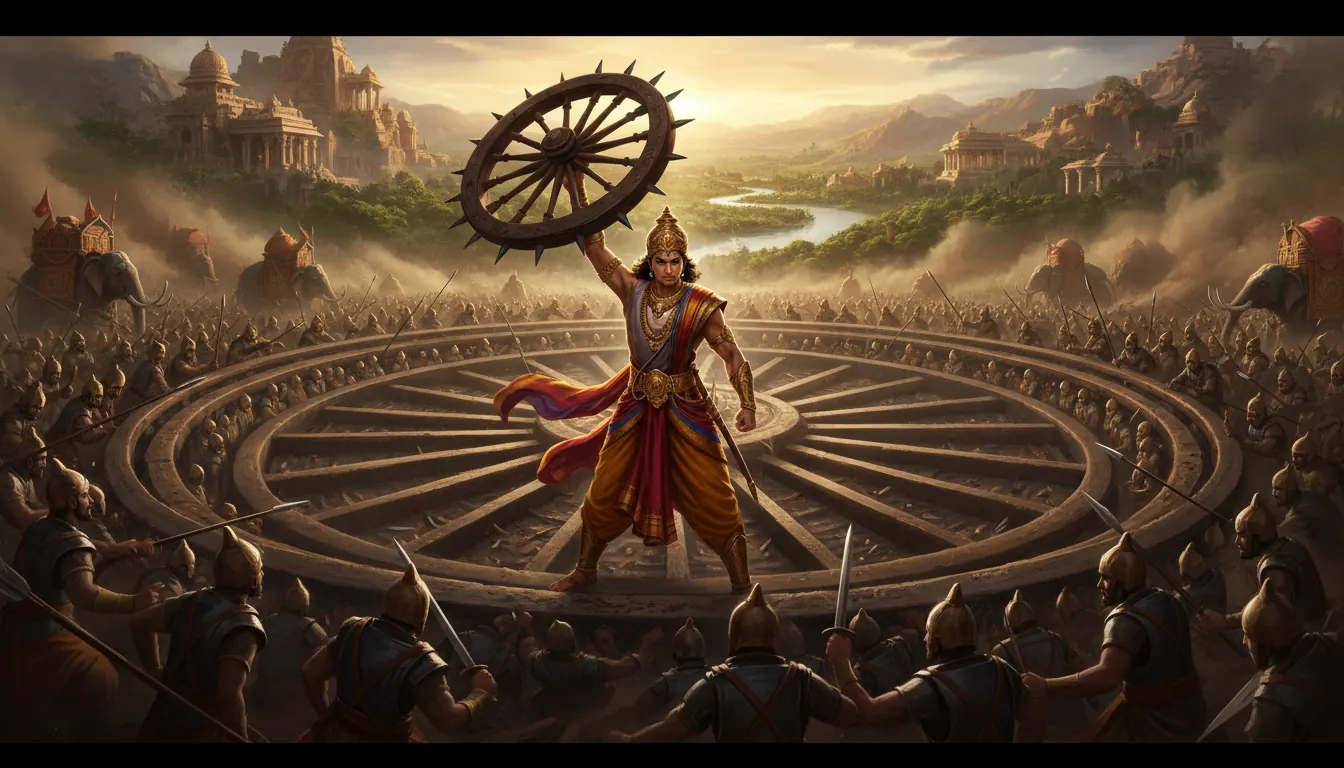
The circular array is the chakra, the wheel, and the knowledge of it was a family matter. Arjuna could pierce it. So could Krishna, and so could Pradyumna. Abhimanyu had the entering of it and nothing else, and his father knew precisely how much of it the boy had and precisely where the knowledge stopped, and he said so aloud in front of all of them.
"I, however, did not teach him how to come out of that array, after having pierced it."
Then the accusation, put as a question, which is the only way a man can put it to his own brothers.
"Did you send the boy into that array?"
Nobody answered him.
"Has that slayer of heroes, the son of Subhadra, that mighty bowman, broken through that array and through countless enemy warriors, and fallen at last in the fight? Oh, tell me, how did that mighty-armed, red-eyed hero, born in our line like a lion on a mountainside, the equal of Indra's younger brother himself, fall on the field of battle? What warrior, robbed of his senses by Death, dared to kill that dear son of Subhadra, the favourite of Draupadi and Keshava, the child Kunti always loved?"
He had named the whole house in one breath. The boy's mother, his father's queen, the boy's uncle, the boy's grandmother. There was nobody in that camp who was not going to be told something tonight.
The Boy He Was Describing
What Arjuna did then was the thing that grief actually does, which is not to howl but to enumerate.
"His hair fell in soft curls; he was young, with eyes like a young gazelle's and the tread of a furious elephant, tall as a young sala tree, sweet of speech and quick to smile, quiet, always obedient to his elders, acting like a grown man though young in years, pleasant in speech, free of vanity, of great courage and great energy, with large eyes like lotus petals, kind to those devoted to him, self-controlled, never stooping to anything mean, grateful, learned, skilled in weapons, never retreating from battle, always delighting in a fight and adding to the fears of his enemies, devoted to the welfare of his kinsmen, never striking first, utterly fearless in battle. Alas, if I do not see that son, I will go to the abode of Yama."
He said that last sentence more than once before he was finished, and each time he had added something more to the list in front of it.
"In the counting of chariot-warriors he was always reckoned a maharatha, one and a half times greater than me, young in years, mighty-armed, dear to Pradyumna and Keshava and myself. Alas, if I do not see that son, I will go to the abode of Yama."
Superior to me one and a half times. That is a technical rating out of the muster rolls, the sort of thing that is read out when the army is counted, and a father was reciting his son's rating to a tent full of men who had watched him die.
"His nose was fine, his forehead fine, his eyes and eyebrows and lips were beautiful. If I do not see that face, what peace can my heart have? His voice was as melodious as the male kokila's, delightful, as sweet as the notes of the vina. If I cannot hear his voice, what peace can my heart have? His beauty had no rival, rare even among the gods. If I cannot set eyes on that form, what peace can my heart have? He knew how to greet his elders with reverence, and he always obeyed the commands of his fathers. Alas, if I do not see him, what peace can my heart have?"
He Sleeps Tonight on the Bare Earth
Then his mind went out of the tent and across the dark field to where the body was, and it began to furnish that place with everything the boy had been used to, and to note the substitution.
"Brave in battle, used to every luxury, worthy of the softest bed. Alas, today he sleeps on the bare earth, as if he had no one to care for him, although he is the foremost of those who have protectors to look after them."
Although he is the foremost of those who have protectors. Four uncles on his father's side, a grandfather in Dwaraka, Krishna himself, and the greatest bowman alive for a father.
"He who used to be attended on his bed by the loveliest women, alas, today he lies torn by arrows and will have ill-omened jackals prowling the field to attend on him. He who used to be woken from sleep by singers and bards and panegyrists, alas, today he will surely be woken by the harsh cries of beasts of prey. That beautiful face of his, so worthy to be shaded by the umbrella, will surely be fouled today by the dust of the battlefield."
Then, quietly, the only line in the whole lament that is about himself.
"Child, unlucky that I am, death is tearing you away from me by force, and I could never look at you enough."
After that he made himself say the other thing, the consoling thing, and he said it in the form men use when they are trying it out to see whether it will hold weight.
"Beyond doubt the abode of Yama, which is always the goal of the righteous, that delightful mansion, is lit today by your splendour and made all the more beautiful by you. Beyond doubt Yama and Varuna and Satakratu and Kubera have welcomed you as a favourite guest and are honouring your heroic self."
Lamenting in this way, again and again, like a merchant whose ship has gone down, Arjuna, overwhelmed by grief, turned to Yudhishthira.
"Son of Kuru's line, has he gone to heaven, after making a great slaughter among the enemy and fighting the finest warriors face to face in battle?"
What Yuyutsu Shouted at Them
He could not stop himself imagining it, and what he imagined was worse than anything he had been told.
"Beyond doubt, as he fought single-handed and with vigour and resolve against countless great warriors, his heart turned to me in the hope of help. While Karna and Drona and Kripa and others tormented him with sharp, bright-tipped arrows, my son, with so little strength, must have thought again and again: my father will rescue me in this crush. I think he was struck down to the ground by cruel warriors while he was lamenting like this."
Then he took it back.
"Or perhaps, when he was begotten by me, when he was the nephew of Madhava, when he was born of Subhadra, he could not have uttered such lamentations."
"Beyond doubt my heart, hard as it is, is made of the very substance of the thunderbolt, since it does not break, even though I cannot see that mighty-armed, red-eyed hero. I grieve for Subhadra, who will hear of the death in battle of her son, who never retreated, and will give up her life in her sorrow. What will Subhadra say to me, without Abhimanyu? And what will Draupadi say to me? What can I say to them in their grief? Beyond doubt my heart is made of the substance of the thunderbolt, since it does not break into a thousand pieces at the sight of my weeping daughter-in-law, pierced with grief."
And then he remembered a sound he had heard that afternoon and had not understood.
"I did hear the lion-roars of Dhritarashtra's sons, swollen with pride."
He had heard that noise while he was killing samsaptakas and had thought nothing of it. Krishna had heard something else in the same hour. Yuyutsu, Dhritarashtra's son by his vaishya wife, who had walked across to the Pandavas on the first morning of the war, stood in the middle of his own brothers' rejoicing and rebuked them.
"You mighty chariot-warriors, you could not defeat Bibhatsu, and you have killed only a child: why do you rejoice? Why are you roaring like lions in your joy, after doing what displeases Keshava and Arjuna, when truly the hour for sorrow has come? The fruits of this sinful deed will soon overtake you. You have committed a monstrous crime. How long can it be before it bears its fruit?"
Then he went away, casting off his weapons, afflicted with rage and grief.
Arjuna turned on the man beside him.
"Krishna, why did you not tell me all this during the battle? I would have burned up all those cruel-hearted chariot-warriors."
The Man Nobody Could Speak To
Then Vasudeva consoled Partha, whose eyes were bathed in tears.
"Do not give way to grief like this. This is the way of all brave heroes who do not retreat, above all of kshatriyas, whose calling is battle. This is the end the authors of our scriptures have laid down for heroes who do not retreat, and death is certain for such heroes. There is no doubt that Abhimanyu has gone to the worlds reserved for those of righteous deeds. Abhimanyu killed many heroic and mighty princes in battle, and he has met the death face to face in battle that heroes long for."
Then the practical part.
"These brothers of yours are all deeply downcast, and so are the king and these friends of yours, to see you sunk in grief. Giver of honours, comfort them with consoling words. You know what ought to be done. You must not grieve."
Thus comforted, Partha turned to his brothers with his voice choked with sorrow, and did not comfort them.
"Lord of the earth, I want to hear how the mighty-armed Abhimanyu fought. You will see me destroy the enemy. You are all skilled in arms. You all had your weapons. How then could Subhadra's son be killed, even if it had been the wielder of the thunderbolt himself he was fighting? You were in your chariots then. You were shooting your arrows. Alas, you have no manhood and no prowess, since Abhimanyu was killed before the eyes of you all. Or else I should blame myself, for I knew that you were all weak, cowardly and irresolute, and I went away."
And then the last of it, said to men he would have to fight beside tomorrow.
"Alas, are your armour and your weapons of every kind only ornaments to deck your bodies? Were you given words only to speak in assemblies, that you failed to protect my son?"
Having said these words, Partha sat down, holding his bow and his excellent sword.
Nobody could look at him, and Sanjaya says it twice so the blind king would not miss it. Bibhatsu was like the Destroyer himself in his fury, breathing heavily, and none of his friends or kinsmen dared to look at him or speak to him. There were exactly two men in that camp permitted, under all circumstances, to speak to Arjuna when he was like this, because he revered them both and loved them both dearly.
One of them had just finished speaking.
Then King Yudhishthira, turning to Partha, who was filled with rage and stricken with grief for his son, began to tell him what had happened.
Dharma Lesson
Arjuna spends this whole episode asking questions whose answers he already has, which is what the mind does when it is refusing an unbearable fact one sentence at a time. The epic does not hurry him through it, and it does not let the consolation arrive early: Krishna's true and correct words about the death coveted by heroes are spoken to a man who cannot hear them yet, and they do not work. What is asked of a kshatriya here is not that he should feel less, but that he should be able to sit down afterwards, still holding the bow, with the grief entire and the duty unchanged.