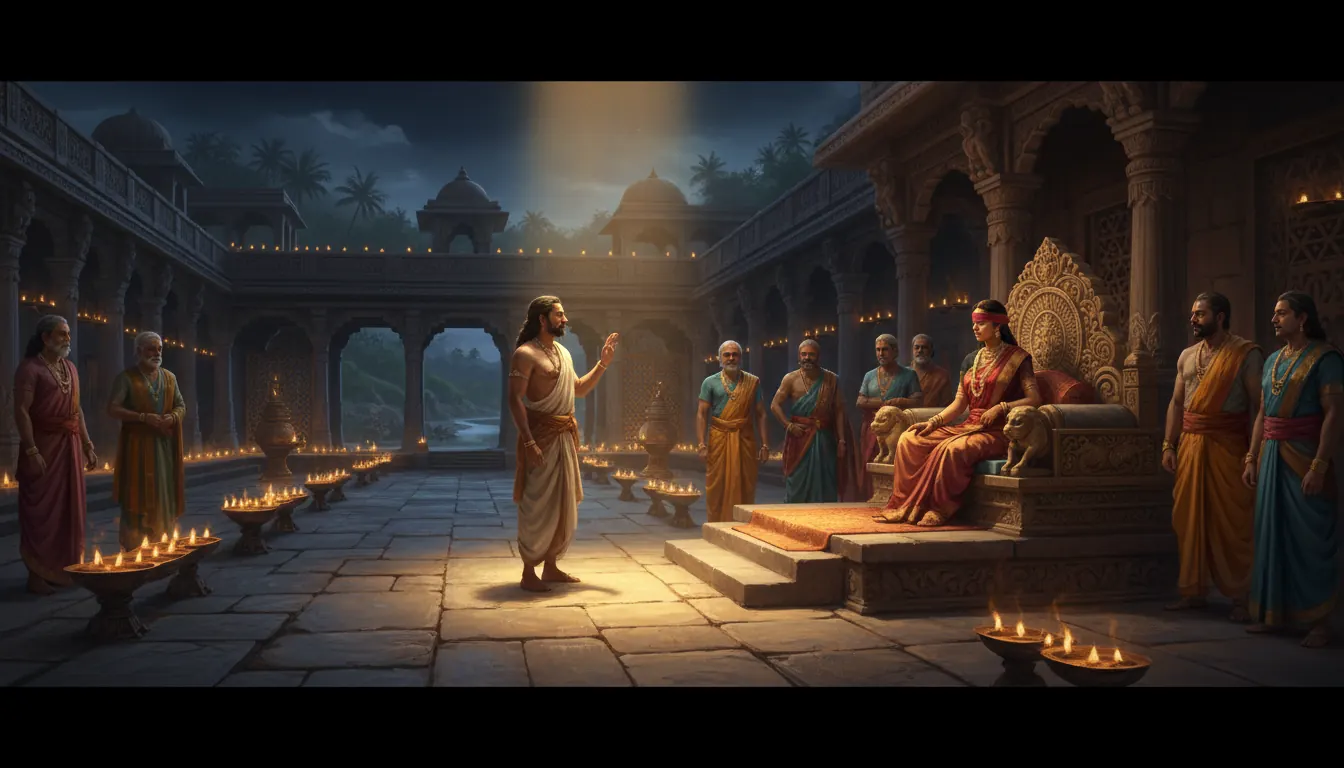
Arjuna's Message to the Kurus
Sanjaya recites the message in open court, and names every man who will die
In short
Returned from Upaplavya, Sanjaya stands before the assembled Kuru court and delivers, word for word, the message Arjuna gave him for Duryodhana. It is not a negotiation but an inventory of the Pandava army, brother by brother and ally by ally, each name attached to the same refrain: then will the son of Dhritarashtra repent for this war. Arjuna names Bhishma's killer in Bhishma's hearing and Drona's in Drona's, explains why he chose Krishna over Indra, and ends with the omens stirring on his own weapons.
Told in the Udyoga ParvaSet in Hastinapura and Upaplavya21 min read
The Question in the White Hall
Sanjaya had come back from the Pandavas at Upaplavya, and the kings of the Kuru court had taken their seats in the great hall to hear what he had carried home. He had already given them the courtesies, the salutations offered by the sons of Pandu to each man according to his years. The old king did not want courtesies. He wanted the one thing everybody in that hall was waiting for, and he asked for it out loud, so that nobody could say afterwards that it had been delivered in a corner.
"I ask you, Sanjaya," Dhritarashtra said, "in the presence of my boy and of these kings: what did the illustrious Dhananjaya say, that mighty man whose strength never wanes, that leader of warriors who destroys the lives of the wicked?"
Sanjaya, who was a suta, a charioteer's son bred to memory and to speech, and who had spent the previous night at home while the old king sat up with Vidura, stood up in front of them.
"Let Duryodhana listen," he said, "to the words that the great-souled Arjuna, eager for battle, spoke with Yudhishthira's approval and in Keshava's hearing."
Then he told them how the message had been given to him, because Arjuna had been particular about that. Fearless and sure of the strength of his arms, the wielder of Gandiva had spoken with Vasudeva standing beside him, and his instructions had been these: say it to Dhritarashtra's son in the presence of all the Kurus, and say it in the hearing of that foul-mouthed, wicked-souled Suta's son, of little sense and stupid judgement and numbered days, who is always eager to fight me, and say it in the hearing of all those kings assembled for battle against the Pandavas, and make sure that king and his counsellors hear every word of it.
Karna was sitting in the hall. Sanjaya did not look away from him.
The Pandavas and the Srinjayas had listened to those words, Sanjaya said, the way the celestials listen to their chief when he stands among them with the thunderbolt in his hand. And now he would give them back, in order, to the men they had been aimed at.
Do Not Propose Peace
Arjuna had begun, Sanjaya said, with his eyes red as the lotus, and he had begun not with a threat but with a diagnosis.
"If Dhritarashtra's son will not give king Yudhishthira of the Ajamida line back his kingdom, then plainly the sons of Dhritarashtra must have committed some sin whose fruit they have not yet reaped. Nothing else could explain it, when they want to fight Bhimasena and Arjuna, and the Ashvins, and Vasudeva, and Shini's son, and Dhrishtadyumna who never misses with his weapons, and Shikhandi, and Yudhishthira, who is like Indra himself and could burn up heaven and earth just by wishing them ill."
The Ashvins here meant Nakula and Sahadeva, the sons of the twin physicians of heaven. Shini's son was Satyaki of the Vrishni line, Krishna's own kinsman and Arjuna's pupil, a man the court knew by reputation and would come to know better. It was a short list, and Arjuna had assembled it the way a man lays out tools before beginning work.
"If Dhritarashtra's son wants war with these men, then everything the Pandavas want will be achieved. So do not propose peace for the sons of Pandu. Have war, if you like."
That sentence went across the hall and settled. After all the embassies and offers and counter-offers, and here was the wronged party saying plainly that peace was no longer being requested, only permitted.
Then he named the price.
"That bed of misery in the woods that was Yudhishthira's, when that virtuous son of Pandu lived in exile: oh, let Duryodhana now have a more painful bed than that, on the bare earth, and let him lie down on it for the last time, without life."
It was an exact answer. The Pandavas had slept on the ground for twelve years because of a game of dice. Arjuna was asking for one night of the same for the man who had thrown it, and was specifying that the man would not get up in the morning.
He made the moral claim once, and made it as a conditional, which is how a man states a thing he considers already settled.
"If they beat us in battle with the very gods under Indra to help them, then vice would be better than virtue, and surely there would be no such thing as righteousness on earth."
The Wrath Kept for Years
"Win over the men who were ruled by the wicked and unjust Duryodhana," Arjuna had said, "to the side of Pandu's son, who has modesty and wisdom, austerity and self-control, and courage and strength governed by virtue."
This was addressed to Sanjaya personally, and Sanjaya delivered it in front of the king whose envoy he was. He had been sent to buy time and to talk of peace without offering any. He was being asked, by the enemy, to change sides.
Then Arjuna spoke about his brother, and the hall heard a description of Yudhishthira that nobody in it could honestly dispute. Humble and righteous, austere and self-controlled, with courage governed by virtue, always speaking the truth. Wronged by many deceptions and having forgiven all of them. Having borne great wrongs with patience.
"When the eldest son of Pandu, whose soul is well controlled, hurls at the Kurus in his indignation the terrible anger he has stored up for years, then the son of Dhritarashtra will regret this war."
That last clause was the hinge of the whole message, and Sanjaya let them hear it as it had been spoken, because Arjuna had used it perhaps thirty times, coming back to it after every image like a drumbeat under a chant. Then the son of Dhritarashtra will regret this war. He never once said, I will win. He said, you will be sorry, and then he described exactly what the sorrow would look like.
"As a fire blazing on every side burns up dry grass in the hot season, so Yudhishthira, ablaze with anger, will burn up the Dhritarashtra host with a single glance."
The point was in the arithmetic of it. A man who has been patient for thirteen years is not a man with no anger. He is a man with thirteen years of anger and nowhere yet to put it. Every wrong that Duryodhana had committed and got away with was still in existence, stored, and it had been drawing interest the whole time.
What He Will See When He Sees Bhima
Then Arjuna turned to his elder brother, and the pictures came faster.
"When Dhritarashtra's son sees Bhimasena, that furious Pandava of terrible force, standing in his chariot, mace in hand, spewing the venom of his anger, then Duryodhana will regret this war."
Bhima, who always fights at the front. Bhima in his mail, hardly to be looked at even by his own followers, cutting down enemy heroes and laying waste the enemy's ranks like Yama himself. Then the vain Duryodhana will remember these words.
"When he sees elephants like mountain peaks brought down by Bhimasena, blood pouring from their broken heads like water from broken jars, then Dhritarashtra's son will regret this war."
Nobody interrupted. There were men in that hall who had seen Bhima work, and the images were not exaggerations to them but predictions with a known basis.
"When the fierce, terrible Bhima falls on the sons of Dhritarashtra, mace in hand, and slaughters them like a huge lion falling on a herd of cows, then Duryodhana will regret this war."
Then the long one, the one Arjuna built out of a workman's labour rather than a beast's hunger. Bhima, fearless in the gravest danger and skilled in weapons, that crusher of enemy hosts, alone in his chariot, crushing with his mace crowds of the best chariots and whole ranks of infantry, catching the enemy's elephants in nooses strong as iron, and mowing down the Dhritarashtra host like a sturdy woodsman cutting down a forest with an axe.
"When he sees the Dhartarashtra host burnt up like a village of straw huts by fire, or a field of ripe corn by lightning. When he sees his vast army scattered, its leaders killed, its men running from the field in terror with their backs turned, and all his warriors brought low in the dust and scorched by Bhimasena with the fire of his weapons. Then the son of Dhritarashtra will regret this war."
Duryodhana sat through it without moving. That was the brother who had promised, in this same hall, to break his thigh.
The Young Ones
He went down through the family in order, and every one of them had a picture.
Nakula first, that warrior of wonderful feats, the best of all chariot warriors, shooting arrows by the hundred with practised skill and cutting Duryodhana's chariot warriors to pieces. And then a second image of the same man that was not about skill at all.
"Nakula was used to every comfort and luxury of life. When he remembers that bed of misery on which he slept so long in the woods, and spews out the poison of his anger like an angry snake, then the son of Dhritarashtra will regret this war."
Then the allied kings, ready to lay down their very lives, urged into battle by Yudhishthira the just, charging furiously in their shining chariots.
Then Sahadeva, the youngest and the mildest, in a chariot with silent wheels set with golden stars and drawn by well-trained horses, sending the heads of kings rolling across the field with volleys of arrows. Sitting in the middle of that terrible havoc, turning now to the left and now to the right, falling on the enemy in every direction. Modest but mighty, truthful, knowing every path of morality and full of energy, he would fall on the son of Gandhari in fierce combat and rout all his followers.
Then the five sons of Draupadi, young in years but not in deeds, all well trained in arms, rushing at the Kauravas without a thought for their lives, darting at the enemy like venomous snakes.
Then Abhimanyu. As skilled in arms as Krishna himself, that son of Subhadra, a child in years but not in energy, overpowering the enemy with a thick downpour of arrows like the very clouds, falling on the enemy ranks like Death himself.
And the young Prabhadrakas, the picked young fighters of the Panchala host, full of energy and with the strength of lions, overthrowing the sons of Dhritarashtra and all their troops.
Then Duryodhana will regret this war. Then Duryodhana will regret this war. Sanjaya said it as often as Arjuna had said it, and did not soften it once.
The Two Old Kings, and the Man Born for Bhishma
"When those veteran chariot warriors Virata and Drupada attack the sons of Dhritarashtra and their ranks, each at the head of his own division, then Duryodhana will regret this war."
Two old kings, one the father-in-law of the Pandavas and the other of Abhimanyu. Drupada, skilled in weapons, sitting in his chariot, eager to pluck off the heads of young warriors and strike them off in his fury with arrows from his bow. Virata breaking into the enemy's ranks, grinding down everything before him with his cool-headed Matsya warriors. And the eldest son of the Matsya king at the very front, calm of face, clad in mail, fighting for the Pandavas.
Then Arjuna said the thing that the men on the front seats of that hall had to hear sitting still.
"I tell you truly that when that foremost of Kaurava heroes, the virtuous son of Shantanu, is killed in battle by Shikhandi, then all our enemies will perish, beyond any doubt."
Bhishma was in the hall. So was Shikhandi's history, which everybody present knew: born a woman, born out of Amba's fire and Amba's vow, born for exactly this. Arjuna was not announcing a hope. He was reading out a thing that had been settled before that child was born, and he read it out in the grandsire's hearing.
"Yes, when Shikhandi, sitting in his own well-guarded chariot, overthrows many chariot warriors and drives toward Bhishma, crushing crowds of enemy chariots with his powerful horses, then the son of Dhritarashtra will regret this war."
And then the same courtesy paid to Drona, in Drona's presence, by way of Drona's own pupil.
"When he sees Dhrishtadyumna, to whom Drona has taught all the secrets of the science of weapons, standing in splendour at the very front of the Srinjaya ranks, then the son of Dhritarashtra will regret it. When the leader of the Pandava host, whose prowess has no measure and who can withstand the charge of any force, goes out to attack Drona in battle, crushing the Dhritarashtra ranks with his arrows, then Duryodhana will regret this war."
Two old men had just been named to their killers by a man who loved them both.
Do Not Covet the Kingdom
"Tell Duryodhana this as well: Do not covet the kingdom."
It was the plainest line in the message, and Arjuna set it down between two long passages of praise for the man the Pandavas had chosen to lead their van.
"We have chosen as our leader the fearless and mighty chariot warrior Satyaki, Shini's grandson, skilled in weapons, who has no equal on earth."
Then the description, which Arjuna gave at length because he wanted the Kuru marshals to price it. Broad of chest and long of arm, that crusher of enemies, unrivalled in battle, master of the best weapons, utterly fearless, wielding a bow a full four cubits long. When that chief of the Shinis, at my urging, showers his arrows on the enemy like the very clouds and buries their leaders completely under that downpour, then the son of Dhritarashtra will regret this war.
"When that illustrious warrior, long of arm and firm in his grip on the bow, sets his mind on battle, the enemy flee from him before the fight has even begun, like cows that catch the scent of a lion."
He can split the very hills and destroy the whole universe. Practised in weapons, skilled in battle, very quick of hand, he shines on the field like the sun in the sky. That lion of the Vrishni race, that scion of Yadu's line, highly trained, has many wonderful and excellent weapons, and knows all the uses of weapons that are said to be the very best.
"When he sees in battle the golden chariot of Satyaki of Madhu's race, drawn by four white horses, then that wretch with no control over his passions, the son of Dhritarashtra, will regret it."
What enemy, Arjuna asked, can withstand the man who has that one fighting in his van? The question was not rhetorical in the way questions in a court usually are. The Kurus had spent a year buying allies. Arjuna was telling them, item by item, what they had bought against.
The Twang of Gandiva
Then he came to himself, and the room changed.
"When he also sees my terrible chariot, bright with gold and shining gems, drawn by white horses, with the Ape on its banner, and driven by Keshava himself, then that wretch with no control over his passions will regret it."
"When he hears the fierce twang of my bow Gandiva as I wield it in the midst of the great battle, the string drawn again and again by fingers in leather guards, that terrible twang as loud as rolling thunder, then that wicked wretch, the son of Dhritarashtra, will regret it, seeing himself abandoned by his troops as they scatter from the field in every direction like cows, overwhelmed by the darkness of my arrows."
Countless keen-edged arrows with beautiful feathers, able to pierce to the very vitals, flying from the string of Gandiva like fierce flashes of lightning from the clouds, destroying enemies by the thousand and devouring countless horses and elephants in mail. The enemy's own arrows turned aside, or struck and turned back by his, or pierced crosswise and cut to pieces. Broad-headed arrows striking off the heads of young warriors like birds picking fruit from the treetops.
"When he sees his brothers die all around him without achieving anything in battle, even before they have properly come within range of the enemy's weapons, then the son of Dhritarashtra will regret this war."
And then the last of the pictures, which was not a battle at all but what a field looks like afterwards. His whole army fleeing in terror in every direction, limbs mangled and senses gone. His horses, his elephants, the best of his heroes killed. His troops thirsty, panic-stricken, wailing aloud, dead and dying, with their animals exhausted. And hair, bones and skulls lying in heaps all around, said Arjuna, like the half-finished works of the Creator.
"When he sees in my chariot Gandiva, Vasudeva, and the celestial conch Panchajanya, myself, my two inexhaustible quivers, and my conch called Devadatta, and my white horses too, then the son of Dhritarashtra will regret this war. When I burn up the Kauravas as Agni burns up countless wicked souls gathered together when another Yuga dawns at the end of the last, then Dhritarashtra and all his sons will regret it."
The Brahmana Who Made Him Choose
Then Arjuna told them why Krishna was in his chariot, and it turned out to have been a choice, made once, on an ordinary morning.
"One morning, when I had finished my water rites and prayers, a brahmana said these pleasant words to me: 'Partha, you will have a very hard task to carry out. Savyasachin, you will have to fight your enemies. Either Indra, riding his fine horse with the thunderbolt in his hand, will go before you killing your enemies in battle, or Krishna, the son of Vasudeva, will guard you from behind in his chariot drawn by the horses led by Sugriva.'"
"Trusting those words, I have passed over Indra, the wielder of the thunderbolt, for this battle, and chosen Vasudeva as my ally. I have won Krishna to destroy those wicked men. I see the hand of the gods in all this."
The man whose victory Krishna merely wishes for, even without taking up arms for him, is sure to overcome all his enemies, even if they are the gods with Indra at their head; and if they are only human, there is nothing at all to worry about.
Then he gave the court the reckoning, feat by feat, because Duryodhana had once thought of putting ropes on this man. Whoever could conquer Vasudeva in battle could put out a blazing fire with his two arms, stop the Sun and the Moon, and seize the Amrita of the gods by force. He cut down the royal warriors of the Bhoja race and carried off Rukmini in a single chariot. He smashed the Gandharas, conquered the sons of Nagnajit, and freed king Sudarshana from captivity. He killed Kamsa in the midst of the Vrishnis and the Andhakas and gave the kingdom back to Ugrasena. He fought Shalva, the lord of Saubha, who hovered in the sky and feared nothing with his powers of illusion, and caught the fierce Sataghni with his bare hands at the gate. In Pragjyotisha, which the gods themselves could not take, he killed six thousand Asuras and Mura and hosts of Rakshasas, killed the Earth's son Naraka, who lay dead like a Karnikara tree torn up by the wind, and brought back Aditi's jewelled earrings.
"And yet the son of Dhritarashtra hopes to defeat that unbearable Vishnu of boundless energy, for that wretch often thinks of imprisoning him. But Krishna puts up with all this for our sake alone. That wretch wants to drive a sudden wedge between Krishna and me. How far he can turn Krishna's affection away from the Pandavas, he will find out on the field of battle."
The Bow That Yawns Without Being Handled
"After bowing down to Shantanu's son, and to Drona and his son, and to the matchless son of Sharadvan, I will fight to win back our kingdom."
Bhishma, Drona and Ashwatthama, Kripa. He would salute them and then shoot at them, and he said so in their hearing.
"We were cheated at dice by those wretches, and we, born of royal blood, had to spend twelve years in great hardship in the forest and one long year in hiding. If we are better than Duryodhana, then I hope that, with Vasudeva at my side, I will kill Duryodhana and all his kinsmen."
Then the summing up. You Kauravas will see it with your own eyes: if they fight, the sons of Dhritarashtra will certainly perish. If they choose some other course instead of fighting, then they may live. But if it comes to battle, not one of them will be left alive. Meanwhile, do whatever you think best, and enjoy your wives and the other sweet things of life.
There were signs, and Arjuna listed them without excitement. Aged brahmanas versed in the movements of the planets, foretelling the great destruction of the Kurus and the Srinjayas and the victory of the Pandavas. Janardana, who knows the unseen future. And his own foresight, gained long ago and never clouded.
"My bow Gandiva yawns without being handled. My bowstring trembles without being drawn. Arrows come out of the mouth of my quiver again and again, trying to fly. My bright sword slides out of its sheath by itself, like a snake leaving its worn-out skin. And from the top of my flagstaff terrible voices are heard: When will your chariot be yoked, Kiritin?"
Jackals howling in the night. Rakshasas dropping from the sky. Deer and peacocks, crows, vultures and cranes, wolves and birds of golden plumage, following his chariot whenever the white horses were yoked.
"I will hurl the great weapons called Sthur-karna, Pashupata and Brahma, and all those Shakra gave me, and I will leave no one alive of those who come to the field of battle. When I have done all this, I will rest. This is my chief and settled resolve. Tell them this, son of Gavalgana."
Sanjaya, son of Gavalgana, told them.
"Look at Duryodhana's folly," he finished, in Arjuna's words. "Suta, these men cannot be beaten in battle even by an enemy with the very gods under Indra on his side, and yet that son of Dhritarashtra thinks of going to war against them. But let it be as the aged Bhishma, the son of Shantanu, and Kripa, and Drona and his son, and the wise Vidura are saying. May all the Kauravas live long."
Dharma Lesson
Arjuna never argues that he is in the right. He assumes it and moves straight to arithmetic, listing what each man on his side will do to each man on theirs and letting the Kurus check the figures for themselves. What makes the message terrible is not its anger but its accuracy, since every claim in it was settled within eighteen days. It also shows the price of provoking a patient man: the wrath Arjuna describes is not fresh, it is thirteen years of it kept whole, and a court that heard the whole warning read aloud still preferred not to hear it.