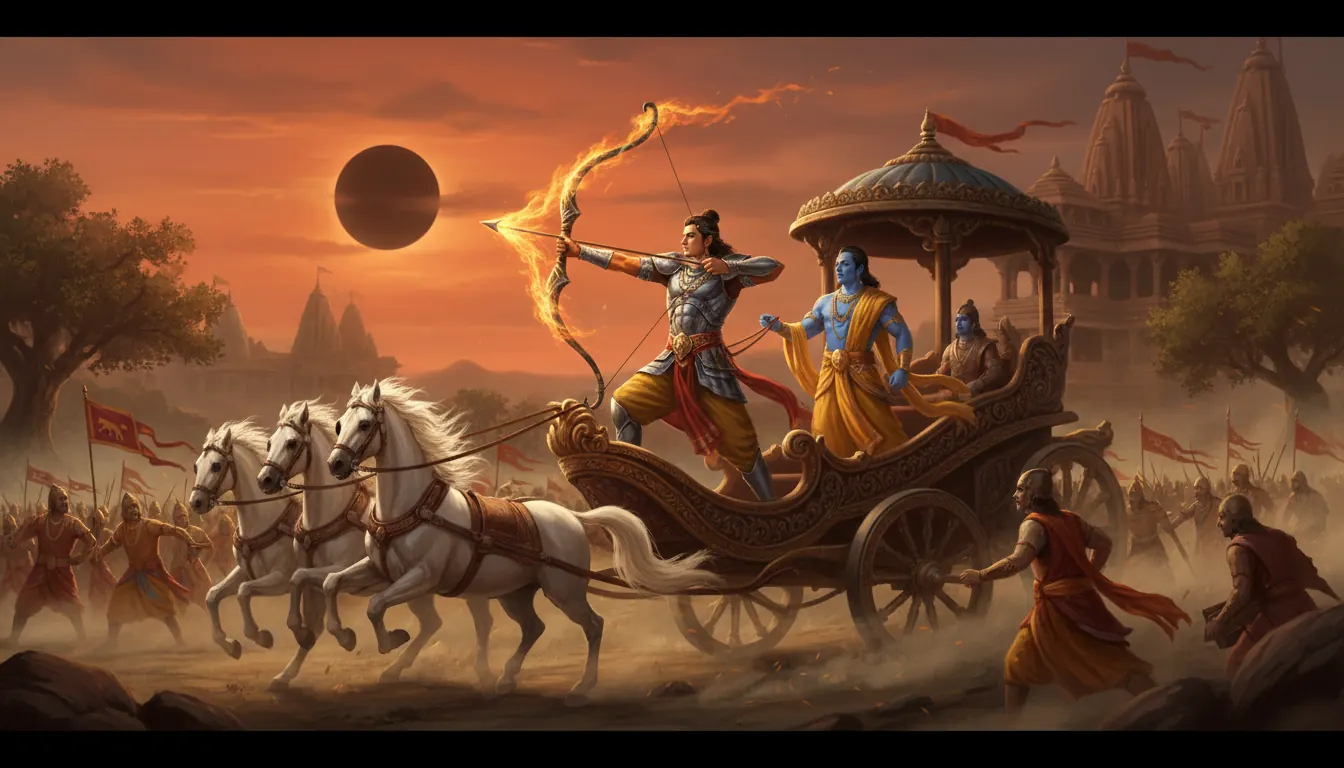
The King on Foot
Drona breaks Yudhishthira's bow, dart, mace and chariot, and the king escapes in Sahadeva's chariot
In short
On the afternoon of the fourteenth day, while Arjuna hunts Jayadratha elsewhere on the field, Drona meets Yudhishthira in single combat. The king matches him for a time, answers a Brahma weapon with a Brahma weapon and even cuts the bow from his teacher's hands, but Drona destroys his bows, his dart, his horses, his standard and his chariot in turn. Left standing on the ground weaponless with his arms raised, Yudhishthira is saved only by his youngest brother, who brings a chariot up behind him.
Told in the Drona ParvaSet in Kurukshetra and Hastinapura12 min read
The Stake They Were Playing For
"After Arjuna had got the ruler of the Sindhus within sight," Dhritarashtra said, "what did the Panchalas do, Sanjaya, when Bharadwaja's son attacked them and they met the Kurus?"
The blind king was asking about the other half of the fourteenth day. Everybody in that hall knew where Arjuna was. He was far out on the field with Krishna driving him, closing on Jayadratha, whom he had sworn to kill before the sun went down. What Dhritarashtra wanted was an account of what had been happening behind that pursuit, at the place where Drona held the line.
"In the afternoon of that day, king," said Sanjaya, "in the battle between the Panchalas and the Kurus, Drona became, as it were, the stake."
He meant it the way a gambler means it. Drona was the thing each side was playing to win or lose. The Panchalas, who had a claim on that old man older than the war itself, cheerfully roared aloud and shot dense showers of arrows, eager to kill him. That encounter was fierce, terrible and truly wonderful, and Sanjaya said it was like the battle long ago between the gods and the asuras.
All the Panchalas with the Pandavas, once they had Drona's chariot within reach, took up many mighty weapons, wanting to pierce through his array. The chariot-warriors came on with the earth shaking under them and their downpours of arrows falling ahead of them, and Sanjaya noticed the one thing about that advance which mattered. They came towards Drona's chariot without much speed.
They were not charging. They were pressing, a step and a volley and another step, because nobody who had fought the last fortnight believed that a rush at Bharadwaja's son ended well.
And at the head of his own division, from desire of victory, stood the eldest of the Pandavas, King Yudhishthira, who was the one man on that field Drona had promised not to kill.
Seven Pairs, and the Eighth
The afternoon arranged itself into pairs, the way those afternoons did.
Brihatkshatra of the Kaikeyas set out for Drona first, scattering without pause sharp arrows as forceful as thunder, and Kshemadhurti of great fame rushed against him, shooting sharp arrows by thousands. Dhrishtaketu, that bull among the Chedis, went for Drona himself, like Mahendra going against the asura Shambara. And seeing him come on with great force, like the Destroyer himself with his mouth wide open, the mighty bowman Viradhanwan went out to meet him.
That is how a line holds. Every man who starts for the commander is caught by somebody else before he arrives.
Dhritarashtra's son Vikarna, a man of great prowess, went against the rushing Nakula. Durmukha covered the advancing Sahadeva with many thousands of swift arrows. The heroic Vyaghradatta held off Satyaki, that tiger among men, making him tremble again and again with sharp-pointed arrows. The son of Somadatta angrily took on the five sons of Draupadi by himself. And the fierce son of Rishyasringa, the rakshasa Alambusha, terrible to look at, held off Bhimasena, who came on full of rage; and the encounter between that man and that rakshasa, Sanjaya said, was like the battle long ago between Rama and Ravana.
Seven pairs, and the eighth was the one the day turned on.
King Yudhishthira, staying there at the head of his division from desire of victory, was resisted by valiant Drona himself.
There was nobody left between them. The teacher had come out to stand in front of his eldest pupil, and the pupil, who had learned from him how to hold a bow at all, did not give ground.
Then Yudhishthira, that chief of the Bharatas, struck Drona with ninety straight arrows, and put every one of them into a vital part.
The King Goes Out of Sight
Enraged by the famous son of Kunti, Drona struck him back in the centre of the chest with twenty-five arrows. Then, in full sight of all the bowmen there, he struck him again with twenty more, and those twenty went into the king and his horses and his charioteer and his standard, so that there was nothing in that chariot the old man had not touched.
Pandu's virtuous son, with great lightness of hand, turned those arrows aside with showers of his own.
It is worth stopping on that, because the picture most people carry of Yudhishthira is of a man who is out of place in a battle. He was not out of place. He was the son of Dharma standing alone against the greatest master of weapons, and for a while he was answering him shot for shot.
Then that great bowman Drona, filled with rage, cut through the bow of the great-souled king Yudhishthira the just.
What followed took a moment. The son of Bharadwaja quickly covered the bowless king with many thousands of arrows, and Yudhishthira went out of sight inside them the way a man goes out of sight inside a rainstorm.
The army could not see him. That is the whole of the disaster, and it was enough. All thought that Yudhishthira was dead. Some thought that the king had fled before Drona. And many cried out, "Alas, the great-souled brahmana has killed the king."
They called him great-souled while they said it. Even the men who believed he had just killed their king could not find another word for Drona.
Inside the arrows, king Yudhishthira the just, in great distress, laid aside the broken bow and took up another, excellent and bright and tougher than the first.
The Dart With Eight Bells
Then that hero cut down all the thousands of arrows Drona had shot.
Sanjaya, who had watched every arrow of that war, said only that all this seemed truly wonderful, and went on.
When he had cut through those arrows, Yudhishthira, his eyes red with anger, took up a dart.
It was a weapon that could split even a mountain, with a golden staff, terrible to look at, and it had eight bells attached to it. As he took it up, the mighty son of Pandu gave a loud roar, and with that roar he filled all creatures with fear.
Then something happened that is easy to read past. Seeing that dart raised by king Yudhishthira the just, all creatures, as if with one voice, said, "Good fortune to Drona!"
Not good fortune to the king. The whole field, both armies, the same men who had been crying out a moment earlier that their king was dead, looked at the raised dart with the bells on it and wished well to the man it was aimed at. That is what the teacher was to the people who were trying to kill him.
Hurled from the king's arms, the dart went out like a snake just freed from its slough, lighting up the sky and all the quarters and the points between them, like a she-snake with a mouth of fire.
Drona stood and watched it come. Then that greatest master of weapons called into being the weapon called Brahma.
The Brahma weapon reduced that terrible dart to dust in the air, and it did not stop there. It came on towards the chariot of the illustrious son of Pandu.
And king Yudhishthira, in his great wisdom, checked Drona's weapon as it came at him by calling up the Brahma weapon himself.
Two Maces in the Air
Then he did the thing his brothers were never quite sure he could do.
Yudhishthira pierced Drona himself with five straight arrows, then took a sharp razor-headed arrow and cut through the large bow of Bharadwaja's son.
Drona, that crusher of kshatriyas, threw the broken bow aside. He did not take up another. He picked up a mace and hurled it with great force at the son of Dharma, and there is no mistaking what that means. The teacher had come to the end of the elegant part of his art and was throwing iron at a man he had once made stand in a courtyard with his elbow raised until it was right.
Seeing that mace hurtling towards him, Yudhishthira, filled with rage, took up a mace of his own and threw it.
The two of them met in mid-air over the ground between the chariots, struck each other, threw off sparks of fire as they collided, and fell to the earth.
Nothing was decided by it. Two maces lay in the dust, the two men stood looking at each other, and it had cost each of them a weapon he did not have a second of.
Then Drona, filled with fury, went back to the arrows.
Four excellent sharp-pointed arrows killed Yudhishthira's horses. A broad-headed arrow cut through the king's bow, which Sanjaya said had stood in that chariot like a pole raised in honour of Indra. Another arrow cut down his standard. Three more struck the Pandava himself.
It took about as long as it takes to say, and it was done by an old man who had spent the whole afternoon being pressed by an army, and it emptied the chariot of everything that made it a chariot.
Weaponless, With His Arms Upraised
Then king Yudhishthira jumped quickly down from that horseless chariot, and stood weaponless with his arms raised.
The account gives it one plain line and moves on, and it is one of the most exposed moments in the whole war. The eldest of the Pandavas, the son of Dharma, the man the entire Pandava cause existed in order to crown, was standing on the field of Kurukshetra on his own two feet with nothing in his hands and both arms lifted, in front of the greatest living master of weapons.
Seeing him without a chariot and, above all, without a weapon, Drona stunned his foes, indeed the whole army.
Not only the Pandavas. Sanjaya says the whole army, the Kaurava side with it, went numb at what it was watching. Every man there knew the vow. Drona had promised Duryodhana that he would seize Yudhishthira and bring him in alive, and had said plainly that it could be done only if Arjuna were drawn away from the king's side. Arjuna was somewhere out in the dust hunting the ruler of the Sindhus. The condition had been met at last. The old man had the king in front of him on foot with empty hands.
Holding firmly to his vow, and with great lightness of hand, Drona shot showers of sharp arrows and rushed towards the king, like a furious lion towards a deer.
That is the image the text chooses, and it does not soften it. Not a teacher walking up to a pupil. Not a captor coming for a prisoner he has undertaken to keep alive. A lion going at a deer.
Seeing Drona, that slayer of foes, rush towards him, cries of Oh and Alas suddenly rose from the Pandava army.
Sahadeva Brings the Chariot
And many cried out, saying, "The king is slain by Bharadwaja's son."
Loud wails of this kind were heard among the Pandava troops. They had said it once already that afternoon, when the arrows hid him, and they had been wrong. They were about to be wrong a second time, and on both occasions they were wrong only by a very small margin.
Because while the wailing was going on, somebody had brought a chariot up behind the king.
Meanwhile, king Yudhishthira, the son of Kunti, climbed into Sahadeva's chariot and withdrew from the field, carried away by swift horses.
That is the whole of the ending. There is no rescue by Arjuna, no counter-charge, no weapon out of the sky. The youngest of the five, who had his own duel with Durmukha going on not far away, put his chariot where his eldest brother could reach it, and the eldest brother climbed up onto another man's chariot with nothing in his hands and let the horses take him out of there.
He had lost the first bow and the second bow, the dart with the bells, the mace, the horses, the standard and the chariot. He had met a Brahma weapon with a Brahma weapon, which few men living could do, and he had cut the bow out of Drona's hands, which fewer still could do. None of it was enough. At the end of it the son of Dharma ran, in front of both armies, and lived.
Sanjaya reported all of it to a blind king in a hall at Hastinapura without a word of judgment on either man, which was his habit. He had already said the only thing that needed saying about that afternoon, before any of it happened. In the battle between the Panchalas and the Kurus, Drona became, as it were, the stake.
Dharma Lesson
Yudhishthira is not a poor warrior, and this hour proves it: he answers the Brahma weapon of the greatest living master of arms and cuts the bow out of his hands. He loses anyway, because skill measured against Drona is measured against a standard almost nobody clears. What the episode asks is what a man does at the moment his hands are empty. He does not posture, and he does not stand there to be admired for dying. He takes the chariot his brother brings and goes, and the war is still winnable in the morning because he did.