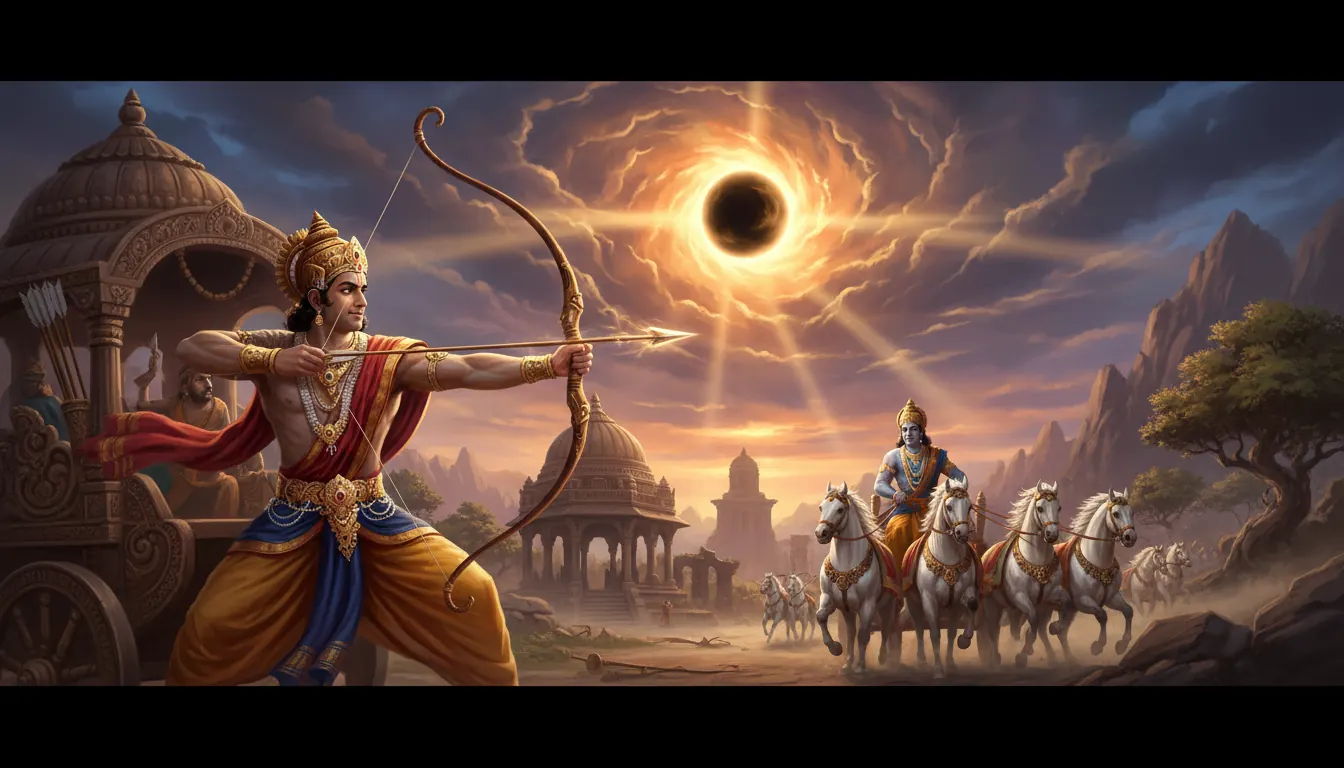
The Stake on the Table
Drona tells Duryodhana that the dice in the sabha were arrows, and that Jayadratha is what they are playing for
In short
On the afternoon of the fourteenth day, after Arjuna, Satyaki and Bhima have each broken through his array in turn, Duryodhana drives back alone to ask Drona what is left to be done. Drona answers with a picture of the whole war: the pieces Shakuni rattled in the Kuru assembly were never dice but arrows, the combatants are the players, and Jayadratha is the stake they are playing for today. He sends the king to guard the guards of the Sindhu ruler while he holds the front himself, and Duryodhana, riding out to do it, collides with the two Panchala princes who guard Arjuna's chariot wheels.
Told in the Drona ParvaSet in Kurukshetra and Sindhu Kingdom13 min read
The Single Chariot Going Back
Sanjaya said: "Once that army had been routed, and Arjuna and Bhimasena had all gone after the ruler of the Sindhus, your son went to Drona."
It was the afternoon of the fourteenth day, and the Kuru line had been opened three times.
Arjuna had gone through it first, with Krishna driving him, because he had sworn the night before that he would kill Jayadratha before the sun went down or else walk into fire. Then Satyaki had been sent after Arjuna, and had crossed the whole host on one chariot. Then Bhima had been sent after Satyaki, and had crossed it too, roaring as he went, so that Yudhishthira could hear from far off that his brothers were still alive. Three men, in succession, through an array that Drona had built forty-eight miles deep for the express purpose of keeping one man out of it.
Duryodhana turned his chariot around and went back to find his commander.
He went alone. Sanjaya says so, and says also what the king was doing on the way: turning over in his mind the many things he had to do. He had a great many of them and they were all coming due at once. That chariot of your son's, swift as the wind or as thought, raced toward Drona.
It is worth pausing on the picture, because it is not the one usually painted of Duryodhana. There is no boasting in it and no gloating. There is a man on a single chariot going back down the length of his own army, past his own dead, to ask the oldest and most honoured person on his side of the field a question he did not want to have to ask.
His eyes were red with anger when he got there. But the anger, when it came out of him, was not aimed where anyone would have expected.
What the Camp Is Saying About You
"Scourge of your enemies," Duryodhana said to his teacher, "Arjuna and Bhimasena, and Satyaki whom no one has beaten, and many mighty chariot warriors have defeated all our troops and reached the ruler of the Sindhus. Those mighty chariot warriors, who beat all our troops and were never beaten themselves, are fighting there even now."
Then the question, put to a brahmana who had been his teacher since he was a boy in the practice ground at Hastinapura.
"You who give honour to others, how did Satyaki and Bhima both get past you? Greatest of brahmanas, this defeat of yours at the hands of Satvata, Arjuna and Bhimasena is as astonishing as the ocean drying up."
Satvata is Satyaki, of the Vrishni house. Duryodhana names all three of them twice over, because the number is the whole of his complaint. Not that the line had been broken, but that it had been broken three separate times by three separate men while the greatest living master of arms stood in it.
"People are asking aloud," he said, "how Drona, that master of the science of arms, could be beaten. That is how all the warriors are talking about you."
That is a young king telling an old man what the camp is saying behind his back, and it is very close to an accusation, and both of them knew it. Then Duryodhana said the thing underneath it.
"I am doomed, luckless as I am, to be destroyed in this battle, now that three chariot warriors, tiger among men, have got past you one after another."
And then, having said it, he did something he was not always capable of. He stopped.
"But since all this has happened, tell us what you have to say about the work in front of us. What has happened is past. You who give honour to others, think now of what remains. Tell us quickly what should be done next for the ruler of the Sindhus, and let whatever you say be carried out quickly and properly."
As Much to Fear Behind As Before
"Listen, great king," Drona said, "to what I have to say about what must be done now. I have thought hard about it."
He did not defend himself. Nowhere in the answer does he explain how three men got past him, or remind Duryodhana whose idea the array had been, or point out that a line built to hold out an army is not built to hold out one chariot driven by Krishna. He took the reproach, and went straight to the arithmetic.
"So far only three great chariot warriors of the Pandavas have got past us. We have as much to fear behind those three as in front of them."
That is the position stated in one line. The Kaurava host now had enemies on both sides of it. Ahead, at the front of the array, stood Dhrishtadyumna and the Panchalas and the Srinjayas and the whole remaining Pandava force, pressing in. Behind, deep inside the formation, where the ruler of the Sindhus had been hidden with six great bowmen around him, were the three who had come through.
"But where Krishna and Dhananjaya are, our fear must be greatest. The Bharata army has been attacked both in front and from behind."
Then the priority, given plainly, with the reasoning attached.
"In this tight place, I think, our first duty is to protect the ruler of the Sindhus. Jayadratha is afraid of Dhananjaya, and he must be protected by us above everything else. The heroic Yuyudhana and Vrikodara have both gone after the ruler of the Sindhus."
Afraid of Dhananjaya. Drona says it in front of the king without softening it, because it is simply true and because it is the reason the whole day has taken the shape it has taken. Jayadratha had asked Duryodhana the night before to be allowed to go home to his own kingdom, and had been brought to Drona and told that he would be protected, and had stayed on that promise.
Everything the Kaurava army had done since sunrise had been done to keep one frightened man alive until dark.
And having got that far, the teacher stopped talking about the day in front of him, and began talking about a game of dice played thirteen years earlier in a hall in Hastinapura.
They Were Never Dice
"Everything that has come upon us," Drona said, "is the fruit of that dice match Shakuni dreamed up."
He was speaking to the man who had commissioned that match, in the hearing of the army it had produced, on the fourteenth day of the war it had caused. Shakuni himself was somewhere on that field with his Gandhara horsemen. Nobody present needed the reference explained.
"No one won or lost in the gaming hall. Now that we are playing this game, there will be victory or defeat."
This is the first turn of the thought and the sharpest one. Drona is saying that nothing was settled in the sabha. The dice fell, the kingdom changed hands, Draupadi was dragged in by the hair and asked her question and got no answer, and five men walked out toward thirteen years of exile, and none of that was a decision. It was only a wager made and not yet paid. What was going on in the dust around him was the same game still being played, and this time it would end.
Then he told the king what the dice had been.
"Those innocent things that Shakuni played with in the Kuru assembly, and that he took for dice, were really invincible arrows. Truly, sire, there where the Kauravas were gathered, they were not dice but terrible arrows that would tear your bodies apart."
Innocent things. Small pieces rattling in a cup, harmless enough to be handled by an old blind king's brother-in-law in a hall full of laughing men, and Drona tells Duryodhana that every one of them was an arrow the whole time, and that the arrows had been aimed, from the first throw, at the bodies of the people throwing them.
There is no gloating in it either. He is not saying I told you so, though he had been in the hall and had said nothing. He is a commander explaining to his king, at the point where the campaign is coming apart, exactly what kind of engagement they have been fighting since long before the armies were drawn up.
Know What the Stake Is
Having named the dice, Drona named the rest of the board.
"But now, king, know that the fighters are the players, these arrows are the dice, and the ruler of the Sindhus, beyond any doubt, monarch, is the stake in this game of battle."
Three substitutions, made in one breath, and the whole of Kurukshetra becomes a gaming table.
The men fighting are the players. The arrows going through the air by the hundred thousand are the throws. And the thing on the table, the thing that changes hands when the last throw is made, is a living man sitting on a chariot far back in the array with six great bowmen standing around him.
"Yes, Jayadratha is the great stake we are playing for against the enemy today."
It is a terrible thing to say about a member of your own side, and Drona says it to the king who is Jayadratha's brother-in-law, and neither of them disputes it. That is what the Sindhu king had been reduced to by Arjuna's vow. Not a warrior and not an ally but a counter, and both armies had spent the whole day pushing everything they had toward the square he was standing on.
"So, monarch, all of us must stop caring for our own lives and see properly to the protection of the ruler of the Sindhus in battle. In this game we are playing, it is here that we will win or lose: here, where those great bowmen are guarding the ruler of the Sindhus."
Then the order.
"So go there quickly and protect those protectors. As for me, I will stay here, to deal with others and to hold back the Panchalas, the Pandus and the Srinjayas, who have joined forces."
Protect the protectors. The guard around Jayadratha needed a guard now, and the king of the Kurus was to be it, in person, because there was nobody left of sufficient weight to send. Drona would hold the front with what remained and feed men backward into the gap for as long as the light lasted.
The whole war had come down to whether the sun could be kept in the sky over one man's head.
The Guards of the Wheels
At his teacher's command Duryodhana set off at once with his followers, steeling himself for a fierce task.
He did not get far before he ran into two young men who were on precisely the same errand as he was, from the other direction.
The two guardians of the wheels of Arjuna's chariot, the Panchala princes Yudhamanyu and Uttamaujas, were then making their way toward Savyasachin along the edge of the Kuru array. Their whole assignment in this war was to ride at Arjuna's chariot wheels, one at each side, and keep anything from getting at him where his own eyes were not. That morning Arjuna had gone into the Kaurava host without them, and they had been trying ever since to reach him.
Sanjaya reminds the blind king why. You may remember, king, that earlier, when Arjuna broke into your army eager for battle, those two princes had been stopped in their tracks by Kritavarma, who held the mouth of the array. They had been cut off at the entrance hours before, and had been working their way around the flank ever since, and now they came along the outside of the formation looking for a way back in to their man.
And there was the Kuru king, coming the other way along the same edge, going in to guard the guards of Jayadratha.
The mighty Duryodhana of Bharata's line wasted no time. Those two foremost kshatriyas, famous as mighty chariot warriors, charged him with their bows drawn, and the three of them fought there on the edge of the host while the thing each of them had been sent to protect stood waiting somewhere out of sight.
The Mace and the Buried Chariot
Yudhamanyu pierced Duryodhana with twenty arrows, and his four horses with four.
Duryodhana cut down Yudhamanyu's standard with a single arrow, cut his bow with another, knocked his charioteer out of his seat in the chariot with a broad-headed arrow, and then put four arrows into the four horses. It was, for a little while, an exhibition. Whatever else may be said of him, on the fourteenth day Duryodhana fought like a man who had finally understood what the wager was.
Then Yudhamanyu, in a rage, shot thirty arrows at the centre of your son's chest. And Uttamaujas, just as enraged, pierced Duryodhana's charioteer with gold-adorned arrows and sent him to Yama's realm.
Duryodhana killed Yudhamanyu's four horses and both his Parshni charioteers, the men who ride at the flanks of a chariot and manage its wheels. Yudhamanyu, horseless and driverless, climbed up onto his brother's chariot, and from there struck Duryodhana's horses with many shafts, and they fell down on the earth.
So the king of the Kurus was on the ground too, in the same condition as the men he was fighting. Yudhamanyu cut his bow with a mighty weapon, and then, with another arrow, cut away his leather guard, the guard strapped to the forearm that keeps the bowstring from opening a man's own skin.
That bull among men then leapt down from his horseless, driverless chariot, took up a mace, and came at the two princes of Panchala on foot.
They saw him coming, that conqueror of enemy cities, advancing in a rage with a mace, and both of them jumped down from the floor of their chariot and got clear of it.
Duryodhana, armed as he was with the mace, pressed that foremost of chariots down into the earth with it, gold and horses and driver and standard together, and left the wreck of it in the ground.
Then, having crushed the chariot, horseless and driverless as he was himself, he climbed into the chariot of Shalya, the king of the Madras, and went on toward Jayadratha.
And meanwhile those two mighty chariot warriors, the two foremost princes of Panchala, mounted two other chariots and went on toward Arjuna.
Nobody had won anything. The stake was still on the table, and the sun was still going down.
Dharma Lesson
Drona's image is not a flourish; it is a diagnosis. A wager that is made and never settled does not go away, it only waits, and everything the wager touched keeps moving toward the day it is paid. The men in the sabha thought they were risking a kingdom over harmless dice, and thirteen years later the same throw is being made with arrows, over the body of a frightened man neither side particularly loves. What makes it terrible is that Drona is right and it changes nothing: knowing exactly what game you are in is not the same as being able to leave the table.