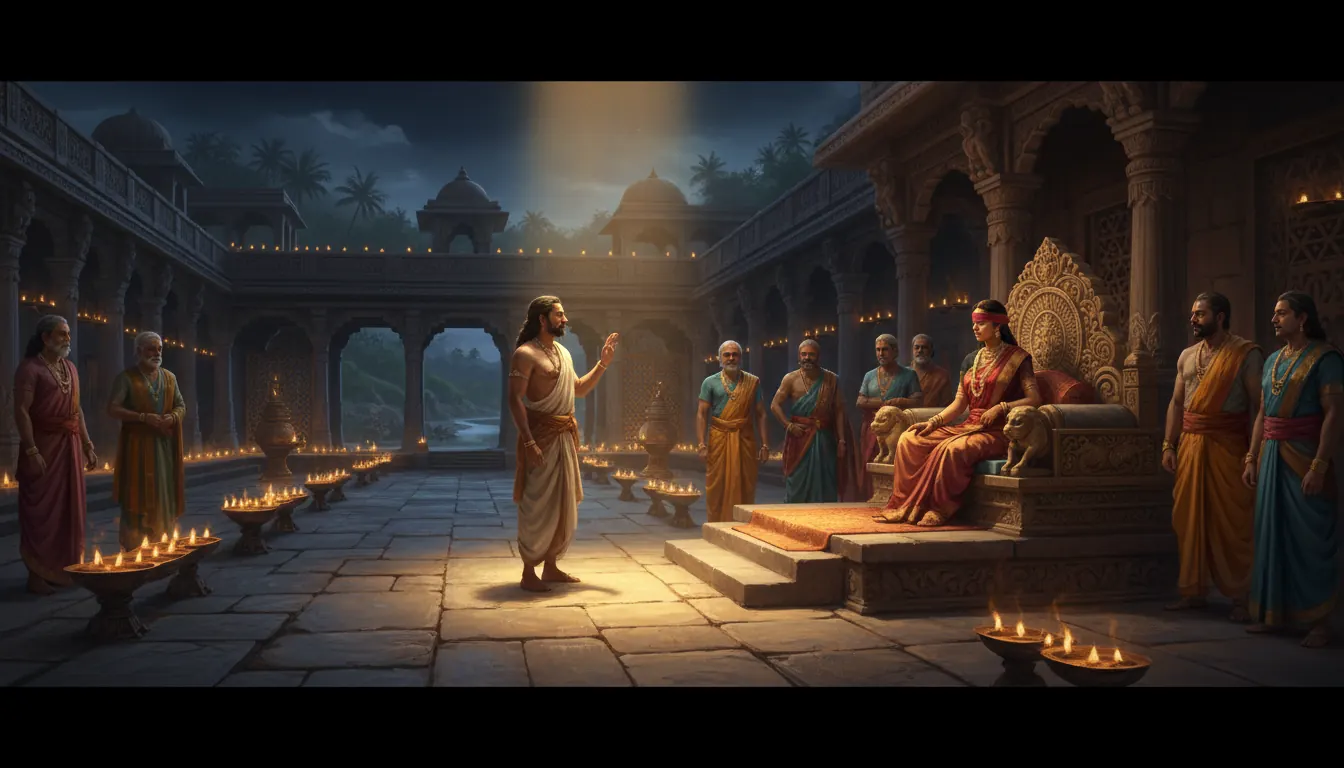
How a Charioteer Came to Know God
The blind king asks why the sight was given to a suta
In short
Back from Upaplavya, Sanjaya tells the Kuru court that Arjuna and Krishna took birth by their own will and that the universe on one scale would not outweigh Janardana. Dhritarashtra asks the question that stings him most: how does a charioteer know this when a king does not? Sanjaya answers that knowledge is earned, not inherited, and unfolds the meanings hidden inside Krishna's names while Duryodhana refuses to bow.
Told in the Udyoga ParvaSet in Hastinapura and Upaplavya16 min read
The Discus No Kuru Can See
Sanjaya had been standing on the same square of floor in the Kuru court since morning, and the blind king had asked him the same thing eleven different ways.
"Their strength," Dhritarashtra said again. "Their weakness. You have been among them. You have slept in their camp at Upaplavya and eaten what they set before you. Tell me plainly where the sons of Pandu are thin."
"Then hear it in brief, king, and hear it once," Sanjaya said. "Those two adorable bowmen, Arjuna and Vasudeva, are perfectly equal in their godlike nature, and neither of them was born the way you were born or I was. They took birth of their own will."
A murmur went along the benches. Sanjaya did not wait for it to finish.
"The discus that Vasudeva owns has boundless energy. It is a full five cubits across, and it can be hurled at a foe large or small, as the wielder wills at the instant of the throw, for it does not depend on the arm. It depends on illusion. It always blazes with light, and it is invisible to the Kurus. You keep asking me how the strength or the weakness of the Pandavas is to be measured. That discus is the best measure there is. Go and look at it. You will find that not one man in this hall can see it."
"Weapons can be answered," said a voice from among the princes.
"That son of Madhu's line," Sanjaya said, "defeated Naraka, and Shambara, and Kamsa, and Shishupala the chief of the Chedis, and he defeated all four with an effort so small that those who watched it thought he was playing. Divine, and with a soul above everything, that highest of beings can bring the earth, the sky and heaven under his control by his will alone. He does not need the discus. The discus is a convenience."
If the Universe Were Weighed
"You want a measure," Sanjaya said. "Take a measure, then. If the whole universe were placed on one scale and Janardana on the other, Janardana would outweigh the entire universe. Janardana can reduce the universe to ashes whenever he pleases; the entire universe cannot reduce Janardana to ashes. That is the arithmetic, king. There is no other."
"You speak of him as men speak of the Grandsire," Dhritarashtra said.
"I speak of him as I have learned to speak of him. Wherever there is truthfulness, wherever there is virtue, wherever there is modesty, wherever there is simplicity, there is Govinda. And where Krishna is, there success must be. He guides the earth and the sky and heaven as if in play, and he has made the Pandavas his instruments. It is not the sons of Pandu who are moving against your sons. It is he, beguiling the whole world while he does it, and he means to destroy your children because they are given over to sin."
Duryodhana laughed, once, on a single breath, and Sanjaya turned his head toward the sound and went on.
"Keshava, divine in every attribute, turns by the power of his soul the wheel of Time, and the wheel of the Universe, and the wheel of the Yuga, and he does not stop turning them. I tell you truly that that glorious Being alone is the Lord of Time, and of Death, and of this whole universe of moving and unmoving things. And yet, though he is the Lord of all of it, that great ascetic Hari still sets himself to work like a humble labourer who tills a field for hire. He drives horses. He carries messages. He sits at the feet of the old and lets himself be sent for. Keshava beguiles everyone through his illusion. Only those who have reached him are not deceived."
How Does a Charioteer Know?
The king sat forward on his seat, and the hand that was always searching the air for something to hold found the arm of his chair and gripped it.
"How have you been able to know Madhava as the Supreme Lord of the universe?" he said. "How is it, Sanjaya, that I cannot know him so? Tell me this. You drive a chariot. Your father drove a chariot. I am the head of the house of Kuru, I have listened to brahmanas all my life, I have paid for sacrifices I will never be able to count, and this thing you say you have, I do not have. Explain it to me."
There was a silence in which everybody in the hall understood what had just been asked, and understood also that it had been asked in front of two hundred people.
"Listen, king," Sanjaya said. "You have no Knowledge, whereas my Knowledge has not been diminished at all. A man without Knowledge, wrapped in the darkness of ignorance, does not know Keshava. That is the whole of the answer. It has nothing to do with your house or with mine."
"And what is it you claim to know?"
"Through my knowledge, sire, I know the slayer of Madhu to be the union of the Gross, the Subtle and the Cause. I know that he is the Creator of all and is himself uncreated. I know that he is the One from whom everything springs, and the One to whom all things return. I did not inherit this and I was not given it because of my birth. If it could be inherited, king, you would have had it from your fathers, and I would not have it at all."
The Nature of That Faith
"Then tell me what it is you have that I have not," said Dhritarashtra. "Son of Gavalgana, what is the nature of that Faith of yours in Janardana, through which you know the slayer of Madhu to be the union of the Gross, the Subtle and the Cause?"
"Blessings on you, king, for asking it," Sanjaya said. "I will tell you and you will not like the smallness of it. I have no regard for the illusion. The pleasures that men chase and call the world, I have not chased. And I never practise the useless virtues."
"There are no useless virtues."
"There are, sire. A vow undertaken without any reliance on him is a useless virtue. Work done without purity of soul is a useless virtue. A man may keep a fast for thirty years and be no nearer than when he began, because he kept it in order to be seen keeping it. I have not done that. I gained purity of soul through faith, and so I have known Janardana from the scriptures, and the scriptures were open to you before they were open to me. They lie in this house. Nobody hid them."
The old king turned his face toward the place where his eldest son was sitting.
"Duryodhana," he said, "seek the protection of Janardana, who is also called Hrishikesha. Child, Sanjaya is one of the most trusted friends we have. He has just told you what the man is. Take refuge with Keshava."
The Refusal
Duryodhana rose. He took his time about it, as a man does when he knows the room will wait for him.
"Even if the divine son of Devaki," he said, "joined in friendship with Arjuna, were to kill all mankind, I still could not give myself up to Keshava."
He said it without heat. That was the part of it that emptied the hall of sound. He was not raging at his father; he was stating a fact about himself that he had evidently settled long ago and had merely been waiting for an occasion to say aloud. All mankind, and he would still not bow. The arithmetic Sanjaya had offered a moment before, the universe in one scale and Janardana in the other, had been answered with an arithmetic of its own: put every living creature on the scale, and Duryodhana's neck outweighs them.
Dhritarashtra turned his blind face toward his wife, who sat where she always sat, with the cloth bound across her eyes.
"This evil-minded son of yours, Gandhari," he said, "is set on sinking into misery. Envious, wicked and vain, he brushes aside the words of all his elders. I have said it. Vidura has said it. The grandsire has said it. Now my own envoy has said it, and you have heard what he answers."
Gandhari's Word
Gandhari did not stand. She spoke from where she sat, and her voice went into every corner of that hall without being raised.
"You greedy wretch," she said, "who ignore the commands of your elders. You who abandon your father and me. You who throw away prosperity and life together, who add to the joy of your foes and cause me deep distress."
Nobody moved. It is one thing for a mother to scold a prince and another for her to say the next sentence, and everyone in the room could feel that there was a next sentence.
"You will remember your father's words, fool," said Gandhari, "when Bhimasena strikes you down and you bite the dust."
She did not say it as a curse. She said it the way a woman says a thing she has already seen. The blindfold had been on her eyes since the day she married into this house, worn out of love for a husband who could not see, and it had never once been lifted; and the men in the hall, who could all see perfectly well, had spent the whole morning being told what was in front of them and had not managed to look at it.
Duryodhana said nothing to his mother. He sat down.
Vyasa Tells the King to Listen
Then Vyasa, who had come into the hall without anyone marking the moment of his coming, as he always did, spoke to the king.
"Listen to me, king. You, Dhritarashtra, are dear to Krishna. That is not a small thing and you have done nothing to earn it. With Sanjaya as your envoy, he will surely lead you to your good. He knows Hrishikesha, that ancient and exalted One. If you listen to him with attention, he will certainly save you from the great danger that hangs over you now, over this roof, at this hour."
"I am listening," said Dhritarashtra.
"You are hearing," said Vyasa. "Son of Vichitravirya, men ruled by anger and joy are caught in many snares. Those who are not content with what they have, robbed of sense by greed and desire, fall again and again into the power of Death through their own acts. They go like blind men led by blind men, and they fall into pits, and the pit is always the one they were warned of. There is one path that does not end in the pit, and it is the path the wise walk. The best of men keep that path in view, and they overcome death, and they reach the goal by it."
The old king was quiet for a while.
"Tell me, Sanjaya," he said at last, "of that path without terrors, by which I may reach Hrishikesha and be saved."
The Path Without Terrors
"A man whose mind is uncontrolled," Sanjaya said, "can never know Janardana, whose soul is perfectly mastered. That is the first thing, and there is no way around it and no substitute for it. Performing sacrifices without controlling one's senses is no means to that end at all. You may pour clarified butter into fire from now until your death and it will buy you nothing."
"I have poured a great deal of it," said the king.
"I know, sire. So has your son. Turning away from the objects of the excited senses comes from spiritual light. Both spiritual light and harmlessness arise, without doubt, from true wisdom. So resolve, king, to master your senses with all your strength. Do not let your mind stray from true knowledge. Hold your heart back from the worldly temptations that surround it, and they surround you closely, for they are your own children and they are asking you for a kingdom that is not theirs."
"And this mastery. What do the learned call it?"
"Learned brahmanas say that this mastery of the senses is true wisdom, and that this wisdom is the path by which learned men travel to their goal. Men who have not mastered their senses cannot reach Keshava, king. He who has mastered them desires spiritual knowledge, and the knowledge comes to him through the scriptures and through the joy of absorption in Yoga. That is the whole road. It has no terrors in it. It has only the one difficulty, which is that a man must give up wanting what he wants."
The Meanings Inside the Names
"Tell me again of the lotus-eyed Krishna," said Dhritarashtra. "If I know the meaning of his names, son, I may yet reach that highest of beings."
"I have heard the auspicious names before," said Sanjaya, "and I will tell you as many of them as I know. Understand first that Keshava is immeasurable and beyond the power of speech to describe, so that what I give you are handles, not the thing itself.
"He is called Vasudeva because he envelops all creatures with the screen of illusion, and because of his splendour, and because he is the resting place of the gods. He is called Vishnu because his nature pervades everything. He is called Madhava because he practises, as a muni does, concentration of the mind upon truth. He is called Madhusudana because he slew the asura Madhu. He is called Krishna because in himself he unites what is meant by the two words krishi, which signifies that which exists, and na, which signifies eternal peace. He is called Pundarikaksha from pundarika, his high and eternal abode, and aksha, indestructible. He is called Janardana because he strikes fear into the hearts of all wicked beings, and if any man in this hall has felt that fear, he now knows the name for it.
"He is called Vrishabhakshana, from vrishabha, the Vedas, and ikshana, eye: the Vedas are his eyes, and the Vedas are the eyes through which he may be seen. He is called Aja, the unborn, because he has not taken birth from any being in the ordinary way. He is called Damodara because his radiance is his own and uncreated, unlike the gods, and because he has self-control. He is called Hrishikesha, from hrishika, eternal happiness, and isa, the six divine attributes. He is called Mahabahu because he upholds the earth and the sky with his two arms. He is called Adhokshaja because he never falls down nor suffers any deterioration, and Narayana because he is the refuge of all human beings. He is called Purushottama because he creates, preserves and destroys the universe. He knows all things, and so he is Sarva. Krishna is always in Truth and Truth is always in him, and Govinda is Truth's Truth, and therefore he is called Satya. He is Jishnu because of his success and Ananta because of his eternity."
Sanjaya stopped.
"With all these attributes, always devoted to righteousness, that mighty-armed one who knows no decay will come here," he said. "He is coming to this city, king, to prevent the slaughter of the Kurus. You have some time yet in which to decide what you will say to him."
I Envy Those Who Will See Him
The old king put both hands over his eyes, which he did sometimes when he was tired, though there was nothing there to shade.
"I envy those who have sight," he said, "who will see before them that Vasudeva whose body, full of beauty, shines with a light that illuminates the four quarters of the compass and the points between them. I envy those who will hear him speak words that the Bharatas will listen to with respect. They will be words auspicious to the Srinjayas, welcome to those who seek prosperity, faultless in every respect, and rejected only by those who are doomed to death.
"The assembled Kauravas will see that great-souled and adorable One, that chief of the Vrishnis, speaking words full of kindness and charming everyone of my party, and I will sit here and be told afterwards what his face did. I put myself in the hand of that Eternal one, that rishi who knows the Self, that ocean of eloquence, that Being whom ascetics reach easily and nobody else does, that bird called Arishta with beautiful wings, that refuge of the universe, that one of a thousand heads, that Creator and Destroyer of all things, that Ancient one without beginning, middle or end, that cause of the Prime seed, that unborn one, that Eternity's self, that highest of the high, that Author of gods and asuras and nagas and rakshasas, that younger brother of Indra."
He let his hands fall.
A suta's son had stood on the floor all morning and named the Lord of the universe twenty different ways, and had told a king exactly what road to walk and what it would cost him to walk it; and the king had understood every word and had asked for more of them, and had put himself into that hand in a sentence forty clauses long, and would do nothing. On the benches his eldest son sat with his arms folded, unmoved, having already said in front of everyone that the destruction of mankind would not be enough to bend him.
Outside, on the northern road, Krishna had not yet set out from Upaplavya.
Dharma Lesson
Sight of the truth is given to the disciplined and not to the highborn, and a man may sit through the whole description of the road and still refuse to walk it. Dhritarashtra hears every word, asks for more, and does nothing. Duryodhana says plainly that the destruction of all mankind would not bend him, and no one in the hall can pretend afterwards that they were not told.