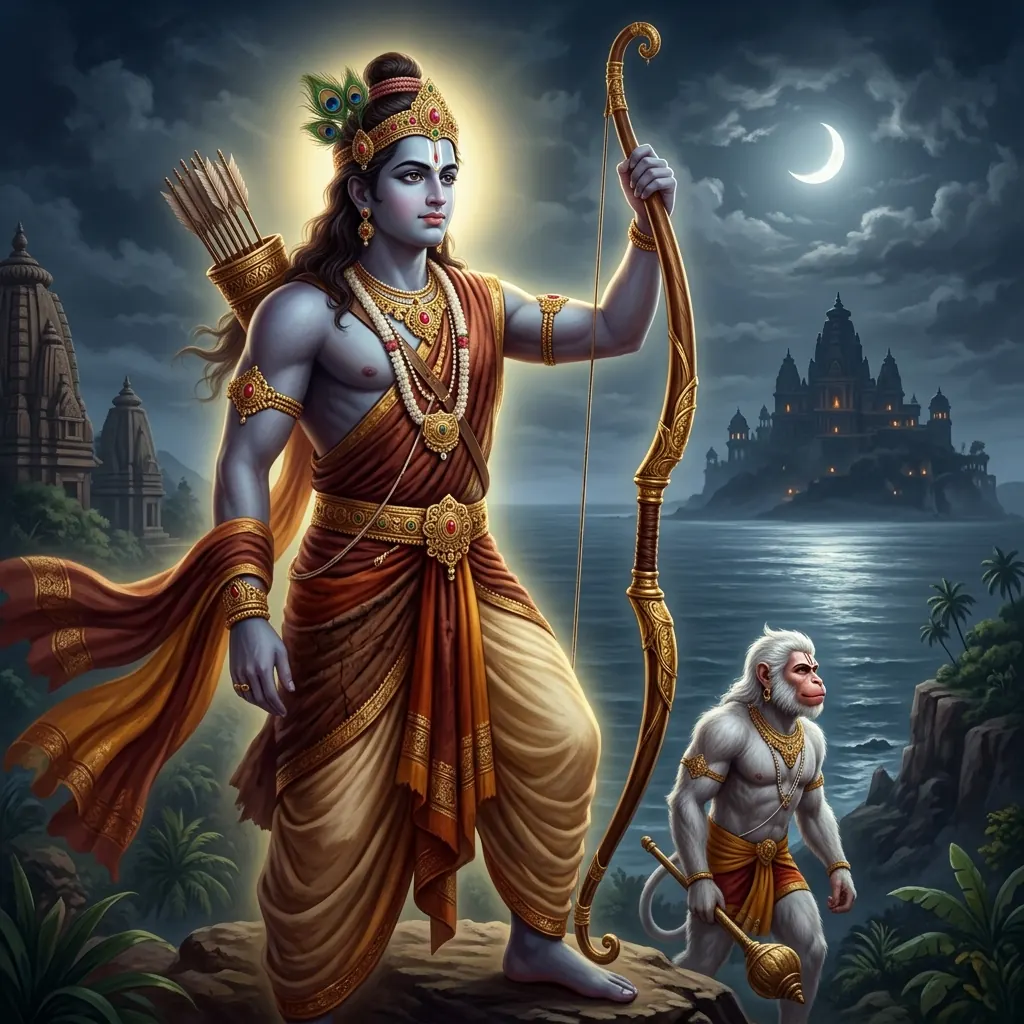
Nala's Bridge
The Ocean refuses to part and names a workman instead, and the monkey army walks to Lanka
In short
The monkey nations muster on Malyavat and march south with Rama until the land gives out at the sea, a hundred Yojanas of it, with no boats and no way over. Rama lies down fasting on the shore, and the Ocean comes to him in a vision, refuses to divide, and names a monkey already in his own army: Nala, son of the divine artificer, whatever he throws into the water will be held up. The bridge Nala builds is ten Yojanas wide and a hundred long, and the world has called it by his name ever since.
Told in the Vana ParvaSet in Kishkindha, Malaya and Lanka16 min read
The Hill Where the Monkeys Gathered
Markandeya, the sage who had outlived several destructions of the world, was sitting with the sons of Pandu in their forest and telling them, to ease the weight of thirteen years, the story of a prince who had lost more than Yudhishthira had lost and had borne it without bitterness.
He had brought that story as far as the hill called Malyavat. Rama was living on it with Lakshmana and with Sugriva, the monkey king he had put on a throne, and Hanuman had just come back over the water with a jewel in his hand and the news that Sita was alive in Ravana's city. The question was no longer where she was. The question was how a hundred thousand creatures were to reach her.
"It was on the slopes of that very hill where Rama sat," Markandeya said, "that the great monkey chiefs began to flock together at Sugriva's command."
They came by nations. Sushena, father-in-law of the dead Vali, came to Rama with a thousand crores of nimble apes behind him. Gaja and Gavaya came, each with a crore. Gavakshya, fearsome to look at and with a tail like a bull's, had gathered sixty thousand crores. Gandhamadana, who lived on the mountains that bear his name, brought a thousand crores. Panasa, wise and mighty, mustered fifty-two crores. Dadhimukha brought an army of monkeys of fearsome prowess. And Jamvuvan appeared there with a hundred thousand crores of black bears, terrible in their deeds, their faces marked as though with the Tilaka.
These and many other chiefs of chiefs came, countless in number, for Rama's cause.
Markandeya described what a hill looks like when that many arrive on it. Bodies huge as mountain peaks. Roaring like lions. Some like buffaloes to look at, some the colour of autumn clouds, some with faces red as vermilion. Some leapt high and some dropped down, some cut capers and some kicked up the dust, running restlessly from place to place, and the uproar never stopped.
Then, at Sugriva's command, that army, vast as the sea at high tide, sat down and made camp, and waited to be told where to go.
Under a Lucky Constellation
When the monkeys had gathered from every direction, the descendant of Raghu set out. He did it properly: at an auspicious moment on a very fine day, under a lucky constellation, with Sugriva at his side and the host drawn up in battle order, as if to destroy all the worlds.
Hanuman, the son of the Wind-god, went at the front, because he was the only one of them who had already been where they were going. The fearless son of Sumitra guarded the rear. The two princes of Raghu's house walked in the middle of that press of monkey chiefs with their fingers in guana-skin guards, the leather a bowman wears so the string will not cut him, and Markandeya said they shone as they went like the Sun and the Moon among the planets.
The army had no weapons to speak of. It carried stones, and Sala trees, and Tala trees, pulled up whole, and from a distance the moving mass of it looked like a far-extending field of corn under the morning sun.
Six names are given for the officers who kept that field of corn in order. Nala and Nila. Angada, the son of Vali, who had every reason to hate the man walking beside his uncle and did not. Kratha, Mainda and Dvivida. One of those six names would matter more than the other five before the month was out, and the story does not pause on it here. It simply lists him with the rest.
They marched without a single halt, camping one after another on wide and healthy tracts and in valleys full of fruits and roots and water and honey and meat, so that an army of that size fed itself as it went and nobody starved.
And then the ground ran out.
They came down to the shore of the salt sea, and that mighty host of countless colours, like a second ocean itself, halted at the edge of the first one and made its camp there. There was nothing further to march toward. The whole strength of the monkey nations stood on a beach, looking at water, a hundred Yojanas of it, with Lanka somewhere on the other side.
A Hundred Yojanas of Water
Then the illustrious son of Dasaratha, standing among all those great monkeys, spoke to Sugriva as the moment required, and his words were not the words of a man making a speech.
"This army is large," Rama said. "And the ocean is hard to cross. What way of crossing it do you think best?"
Many boastful monkeys answered at once. "We are well able to cross the sea."
They were probably telling the truth about themselves. That was exactly the trouble. The ones who could leap a hundred Yojanas could be counted on the fingers of a hand, and an army is not the sum of its best members. The answer, as Markandeya put it, was not much use, since not all of them could cross that way.
Others had more practical proposals. Some of the monkeys said they should cross in boats. Some said rafts, of different kinds.
Rama soothed them all before he turned them down, which is worth noticing in a man who was being told nonsense by people who loved him.
"That cannot be," he said. "The sea here is a full hundred Yojanas wide. Heroes, not all the monkeys will be able to cross it. So what you propose is not reasonable. Besides, we do not have enough boats to carry all our troops. And how could people like us put such obstacles in the way of the merchants?"
That last objection is the one nobody expects. Somewhere behind him a coast full of traders was using those boats to make a living, and the prince who wanted his wife back would not commandeer their season to do it.
He had a second objection, and it was military. "Our army is very large. If the enemy finds a gap in it, he will make great havoc." A crossing strung out over open water in small craft is not a crossing, it is a line of targets, and Ravana had the whole sea to watch it in.
"So crossing the sea in boats and rafts does not appeal to me. Instead I will pray to the Ocean for a way. I will go without food and lie down on the shore. He will surely show himself to me. But if he does not, I will punish him with my great weapons, which blaze hotter than fire itself and cannot be thwarted."
So the plan was to ask, and the plan if asking failed was to drink the sea.
The Bed of Kusa Grass
With these words Rama and Lakshmana touched water as the vow required, and lay down in due form on a bed of kusa grass on the seashore.
That is the whole of the ceremony. There is no fire in it, no priest, no offering. Two men who commanded the largest army in the world lay down on cut grass at the tide line with nothing in their stomachs and waited, and behind them a hundred thousand crores of monkeys and bears kept quiet.
The divine and illustrious Ocean, lord of the rivers both male and female, came to Rama in a vision.
He came surrounded by water creatures and by countless mines of gems, which is to say he brought his whole household with him, everything that lives in him and everything that is buried in him, and he spoke sweetly to the man lying on the grass.
"Son of Kausalya, bull among men, tell me what help I can give you."
He had opened by offering help, before he was asked for anything, the way an older relation establishes the terms of a conversation.
Rama answered by claiming kinship, and then did not soften what he wanted.
"I am of the race of Ikshvaku, and so I am a kinsman of yours. Lord of the rivers, male and female, I want you to give my troops a way across, so that I may go over and kill the Ten-headed, that wretch of Pulastya's line. If you do not grant me the way I ask of you, I will dry you up with my celestial arrows charged with mantras."
It is a strange sentence to say to a kinsman who has just offered help, and it is said to the sea. The man was lying hungry on a beach with his wife in another man's house, and he had reached the end of his patience with everything that stood between them, including geography.
And the spirit of Varuna's realm, who could have drowned the entire monkey army by rising the breadth of a hand, joined his hands and answered in great distress.
The Ocean Names a Monkey
"I have no wish to stand in your way," the Ocean said. "I am not your enemy. Listen to me, Rama, and when you have listened, do what is right."
Then he explained why he could not simply do what he had been asked to do, and the reason he gave was not about Rama at all.
"If I open a way for your army at your command, others will order me to do the same on the strength of their bows."
He was thinking about the men who would come after. Part the sea once for a bowman who threatens it, and the sea becomes a road that any sufficiently armed man may demand, for any purpose, for ever. He was not refusing the crossing. He was refusing the precedent, and he was asking the one person who wanted that crossing most to see why it mattered.
Then he gave him what he had instead, and it was better.
"In your army there is a monkey called Nala, who is a skilled mechanic. He is very strong, and he is the son of Tvashtri, the divine artificer of the Universe."
That is the whole introduction the epic gives him. Tvashtri, whom men also call Vishvakarma, is the maker who built the halls of the gods and forged their weapons, and one of his sons was walking about on that beach in the shape of a monkey, listed first among the officers of the line of march, and nobody had thought to ask him anything.
"Whatever he throws into my waters, wood or grass or stone, I will hold up on my surface, and so you will have a bridge."
Not a road opened by force, but a road built by hands, out of what the forest was already full of. The sea would not divide. The sea would hold up whatever the artificer's son laid on it, and the army could walk across on the work of its own labour.
With these words the spirit of the Ocean vanished, and Rama woke on the kusa grass with the answer, and it had a name in it.
Nala's Bridge
When Rama woke, he called Nala to him and said one sentence to him.
"Build a bridge over the sea. You alone, I am sure, can do it."
There is no record of Nala answering. There is no scene of him objecting that it cannot be done, or asking for time, or naming a price, or pointing out that nobody had spoken to him for the whole of the march. He is a monkey of body huge as a hill who has been carrying trees for somebody else's siege, and the son of Dasaratha turns to him and tells him what his father made him for, and he goes down to the water.
What went into the sea was what the monkeys had been carrying all along. Wood. Grass. Stone. The Sala and Tala trees they had pulled up whole and the rocks they had brought as weapons went in as material instead, and the Ocean kept his word and bore every piece of it on his surface, and the thing grew out from the shore.
Markandeya gives the measurements, because the measurements are the point. Ten Yojanas in width. A hundred Yojanas in length. It was not a footway for heroes. It was wide enough for an army with its bears and its baggage to cross in column without crowding, and it ran the entire distance that the boasting monkeys had claimed they could leap, and it was built on open water by one workman and whatever hands he could direct.
And to this day, the sage said, sitting in a forest in another age and telling it to five exiled brothers, that bridge is celebrated over all the world by the name of Nala's bridge.
Not Rama's bridge. Not the bridge of the descendant of Kakutstha, who commanded it, nor the Ocean's bridge, who held it up. The world remembered whose hands did the work, and it kept the name, and it has never given it to anybody else.
When the bridge was finished, Nala, with his body huge as a hill, came away at Rama's command.
That is the last thing the story says about him. He built the road to Lanka, he was told he could go, and he went back into the ranks.
The Brother Who Came Over the Water
While Rama was still on this side of the ocean, a Rakshasa came to the camp with four counsellors behind him and asked to be received.
It was Vibhishana, the virtuous one, the brother of the king of the Rakshasas, and there was no good reason on earth to believe him. He had come from the city they were about to besiege, on the eve of the crossing, out of a family whose head had stolen Rama's wife, and he came at exactly the moment when a spy would be most useful to the other side.
Sugriva said so. The monkey king was afraid he might be a spy, and he was not being small-minded. He had been a hunted man himself, driven out by his own brother, and he knew what a brother could be worth.
But Rama gave him a proper welcome, and then did the thing that decides such cases. He watched him. Only when the son of Raghu was fully satisfied by the sincerity of his efforts and the many signs of his good conduct did he honour him with respect.
Then he went further than anybody expected.
He installed Vibhishana in the sovereignty of all the Rakshasas.
Ravana was alive and unbeaten in a fortified city across a hundred Yojanas of water, and Rama crowned his brother king of that city and of the whole Rakshasa race before a single arrow had been shot at its walls. He was not paying for the defection. He was declaring what the war was for. He had not come south to end the Rakshasas. He had come to remove one of them, and he had just said aloud who would be sitting on the throne afterwards.
And he made him his own junior counsellor, and a friend of Lakshmana's, which is the smaller thing and perhaps the harder one. The refugee was not left at the edge of the camp with an honorary crown on him. He was put into the council, and given to the younger brother as a friend, and set to work.
It was under Vibhishana's guidance, then, that Rama took his troops across.
The Crossing, and the Envoy
The army crossed the great ocean by that bridge in the course of a month.
A month of it. That is the figure Markandeya gives, and it is worth holding beside the single leap with which Hanuman had crossed the same water. The son of the Wind-god could cross it because he was the son of the Wind-god. Everybody else crossed it because a mechanic had built a road and the Ocean had agreed to hold it up, and they went over in column, monkeys and bears and two princes of Ayodhya, for thirty days, on foot.
And when he had crossed the ocean and reached Lanka, Rama had his monkeys lay waste its many wide gardens.
He began with the pleasure grounds. Not the walls, not the gates, not the trenches. The orchards and the groves that made Ravana's island the loveliest place in the world were pulled apart first, in full view of the city, by an army that had just walked across the sea it was supposed to be unable to cross.
Two of Ravana's counsellors, Shuka and Sarana, came out to count that army. They came as spies, in the shape of monkeys, and it was Vibhishana who caught them, because a Rakshasa was the only creature in that camp who could have known them by their walk. The new king of the Rakshasas made his first arrest on his first day of office, against his brother's officers.
When those night-wanderers took back their real forms and stood there caught, Rama neither killed them nor held them. He showed them his whole army, and let them go quietly home to report.
Then he quartered his host in the woods along the edge of the city.
And when all that was done, he sent the monkey Angada, with great wisdom, as his envoy to Ravana. Vali's son walked up to the gate of Lanka alone with the last offer in his mouth, and the army that had come a hundred Yojanas over the water sat down in the trees behind him and waited to hear what the Ten-headed would say.
Dharma Lesson
Rama came to the sea ready to empty it with celestial weapons, and what he actually needed was standing in his own line of march, listed first among the officers, and had never been asked. The Ocean would not part, and the reason he gave was not fear but precedent: a road opened by threat becomes a road any armed man may demand for ever. So the crossing was made instead out of ordinary wood and grass and stone, by the one pair of hands that knew how. The world kept the name of those hands and not the name of the prince who commanded them, which is the only payment a workman is ever certain of, and here it was enough.