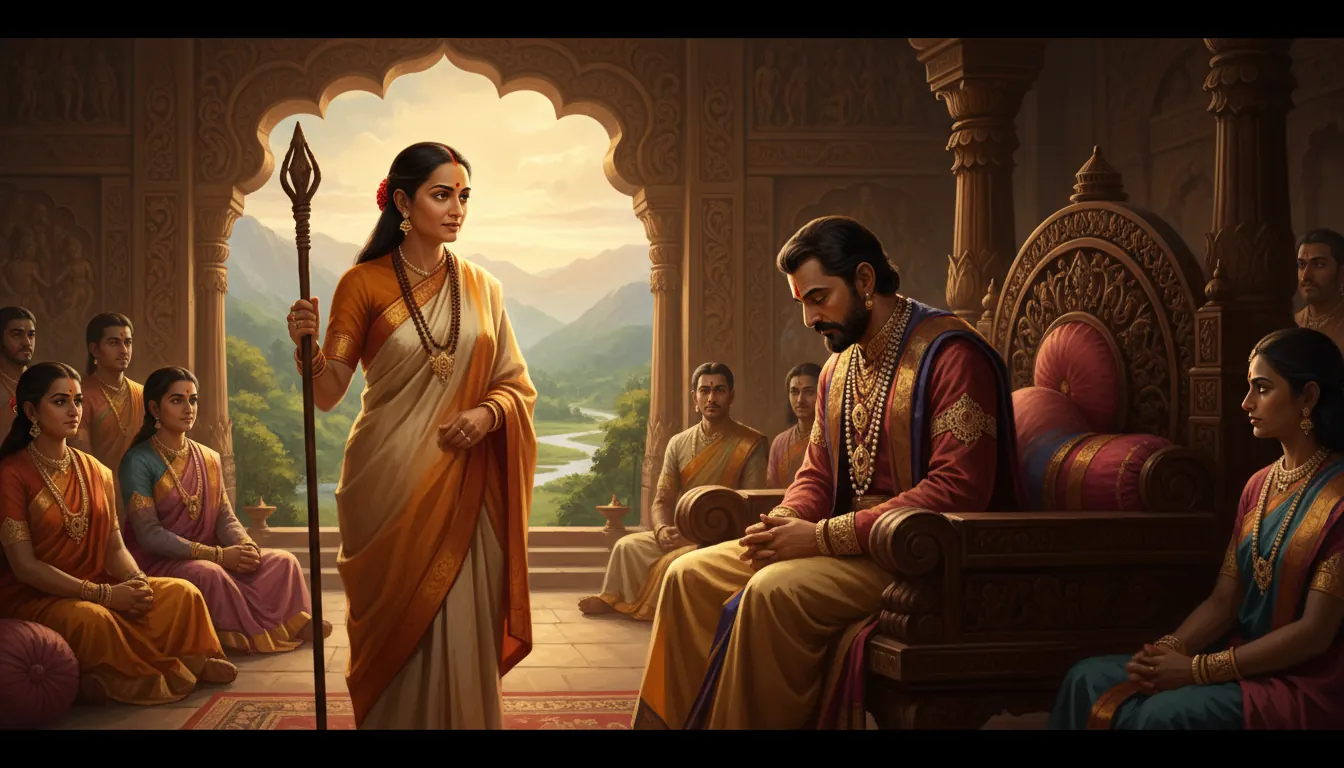
Narada Questions the Apsara
Panchachuda is made to name the faults of women, and traces them back to their maker
In short
Yudhishthira repeats to Bhishma what the men of his world say about women, and asks whether it is so. Bhishma answers with an old history: the wandering rishi Narada, having roamed the whole earth, presses the Apsara Panchachuda in the region of Brahman to describe the disposition of women. She refuses on the ground that she is a woman, and yields only when he tells her that truth can never be a fault. What follows is a long condemnation spoken in the first person plural, ending in the place none of her hearers expected.
Told in the Anushasana ParvaSet in Brahmaloka and Kurukshetra14 min read
The Question After the Gifts
Yudhishthira had spent that part of the morning on the question of gifts. Who is a fit person to receive them, the stranger who has never been seen before, the familiar man who has lived beside the giver for years, the traveller who arrives out of a great distance. Bhishma had answered that all three stand equal, and had gone on to the qualities that make any man worth honouring: absence of wrath, truthfulness of speech, abstention from injury, modesty, self-restraint.
Then the king set that subject down and asked something else.
"Best of the Bharatas," he said, "I want to hear you speak about the nature of women. Women are said to be the root of all evil. They are all thought to be exceedingly frail."
It is worth noticing how he framed it. Women are said to be. They are regarded as. He was not reporting a finding of his own. He was repeating what the men of his world said to one another about half of it, and putting it to his grandsire to be confirmed or corrected, in the same tone in which he had just asked who deserves a gift.
Bhishma lay on the bed of arrows with the field of Kurukshetra spread out beyond him and the war finished and his death still some weeks off, and he did not answer in his own voice.
"On this subject," he said, "people tell the old story of the conversation between the heavenly rishi Narada and the heavenly courtesan Panchachuda."
That was his habit through the whole of the long instruction. When a matter is settled he states it. When a matter is disputed, or when the answer is one he would rather not be the author of, he reaches back and finds two older speakers and lets them have it out where the king can hear.
The two he reached for this time were a wandering sage who had been everywhere and seen everything, and an Apsara of heaven.
So the answer Yudhishthira was about to receive concerning the nature of women would be spoken by a woman. Bhishma had arranged that before a word of it was said.
The Rishi Who Had Roamed the Whole World
Long ago the heavenly rishi Narada, after roaming all over the world, met the Apsara Panchachuda, of flawless beauty, whose home was in the world of Brahman.
Every clause of that sentence carries something. Narada is the rishi who is never in one place: he moves between the heavens and the earth and the under-worlds, he carries news and questions, he turns up in the assembly halls of kings and in the councils of gods, and what he mostly does when he arrives is ask. He had roamed over all the world before this meeting, which is the text's way of saying that whatever he was about to ask, he had already had every opportunity to observe the answer for himself.
An Apsara is a dancer of the heavens, and Panchachuda's dwelling was Brahmaloka, the region of Brahman, which is the highest of all the worlds and not a place where the frivolous are housed. She was not a stranger to the councils of the great. She lived at the top of creation.
Seeing the Apsara, every limb of whose body was beautiful, the ascetic spoke to her.
"Slender-waisted one," he said, "I have a doubt in my mind. Explain it to me."
She answered with the caution of somebody who has been asked for something before the thing itself has been named.
"If the subject is one I know," she said, "and if you think me able to speak on it, I will certainly tell you what is in my mind."
That is a careful reply. She had promised nothing except that she would not pretend to knowledge she lacked, and she had put the judgment of her competence back into his hands.
"Gracious one," said Narada, "I will certainly not set you any task that is beyond you. Lovely one, I want to hear from you about the nature of women."
He had walked over the whole world to arrive at that question, and he had not brought it to a woman in order to find out. He had brought it to a woman so that the answer would be in her voice.
I Am Unable, Being Myself a Woman
She understood the position she had been put in immediately.
"Being a woman myself, I cannot speak ill of women," she said. "You know what women are and what nature they are endowed with. You should not set me such a task, heavenly rishi."
There are three separate moves in that short refusal, and each one is worth taking on its own.
The first is the ground she stands on. Not that the charge is false, but that she cannot be the one to bring it. She is being asked to testify against the class she belongs to, in front of a sage who will carry whatever she says out into every world he visits next.
The second is that she tells him he already knows. You know what women are. She had heard the shape of the question and understood that it was not open. He had not asked her whether women have faults. He had asked her to describe them.
The third is the plainest. You should not. She asked him to withdraw it.
And there is a fourth thing in it that she did not say and did not need to, which is that she took it for granted, and he never once corrected her, that a true account of the disposition of women would be an ill one.
Narada did not argue with any of it.
"That is very true, slender-waisted one," he said. "One is at fault in speaking what is untrue. But there can be no fault in saying what is true."
That was the whole of the argument, and it worked. He granted her objection entire and then removed the ground from under it. There is only one sin available in speech, which is untruth. Say what is so and you cannot be stained by having said it. It is an answer no ascetic could refuse, and she was standing in the region of Brahman when it was handed to her.
When he said this, the sweetly smiling Apsara Panchachuda agreed to answer Narada's question.
She then began to describe the true and eternal faults of women.
Us Women
"Even when they are high-born and beautiful and have men to protect them," Panchachuda began, "women want to break through the limits set for them. That fault truly stains them, Narada. Nothing is more sinful than women. Truly, women are the root of all faults. You certainly know that, Narada."
The last sentence is hers, and it is the second time in the conversation that she has told the sage he came carrying his conclusion. She is going to deliver the indictment he asked for, and she is going to keep handing it back to him as she goes.
Then she began the particulars.
Women, even when they have husbands who are famous and wealthy, handsome and wholly obedient to them, are ready to disregard them if they get the chance. Nothing in the husband is the point. He may have everything a marriage is supposed to be arranged for, and the opportunity is still the only thing that decides.
And then she changed pronoun.
"This, mighty one, is a sinful disposition in us women, that we cast off modesty and seek the company of men of sinful habits and intentions."
Us. We. Having been told that truth cannot stain the speaker, she did not stand outside the accusation and point at other women. She put herself in the middle of it, where the ordinary rules of testimony would say a witness against herself is worth listening to.
Women show a liking for men who court them, she said, who come into their presence, and who serve them respectfully even a little. Not the great, not the handsome, not the rich. Whoever is present and attentive. The bar she sets is deliberately low, because the argument she is building is that no bar exists at all.
It is because no man asks them, or because they fear their relatives, that women, who by nature chafe at every restraint, do not break through the limits laid down for them, and stay at their husbands' side.
That is the first statement of the doctrine she will repeat before she is done. What holds a woman in her place is not virtue. It is that nobody asked, and that her family is watching.
The Fence and Its Four Posts
From there the speech goes where she had warned him it would go.
There is no man they cannot take as a lover. They never consider the age of the man they are ready to favour. Ugly or handsome, as long as he is of the opposite sex, women are ready to enjoy his company.
That women remain faithful to their lords, she said, is due not to their fear of sin, nor to compassion, nor to wealth, nor to the affection that springs up in their hearts for kinsmen and children. She names four things that might restrain a person and strikes all four off the list. Not conscience. Not pity. Not interest. Not love, not even love of her own children.
Women living in the shelter of respectable families envy women who are young and decked in jewels and gems and who lead a free life.
Then the hardest of the catalogues. Even women who are loved by their husbands and treated with great respect are seen to give their favours to men who are hunchbacked, or blind, or idiots, or dwarfs. Women may be seen to enjoy the company even of men who cannot walk, or of men who are very ugly.
"Great rishi," she said, "there is no man in this world whom women consider unfit for their company."
The list is meant to be repellent, and it is built out of the bodies that her world held in least regard, which tells a reader more about the assembly this teaching was made for than about the women in it.
And then she gave the doctrine of restraint a second time, and it had grown.
It is because they cannot find men, or fear their relatives, or fear death and imprisonment, that women keep themselves within the limits set for them.
The first time the fence had two posts, want of opportunity and fear of the family. The second time she added the other two, and named them without soft words. Death. Imprisonment.
Fire, Ocean, and the Mouth Under the Sea
"They are exceedingly restless," she went on, "for they always crave new companions. Because their nature is beyond understanding, no kindness can keep them obedient. Their disposition is such that nothing can hold them back once they are bent on transgression. Truly, women are like the words spoken by the wise."
That last comparison is the one line of her speech that nobody has ever satisfactorily explained. Something in it is about being past holding: a saying, once it is out of the mouth of a wise man, belongs to whoever heard it and goes where it likes.
Then she gave him three images, and they are the three that the epic keeps for appetites that have no floor.
Fire is never satisfied with fuel. The Ocean can never be filled with the waters the rivers bring him. The Destroyer is never satisfied even with killing all living creatures. In the same way, women are never satisfied with men.
As soon as they see a handsome and charming man, she said, the unmistakable signs of desire appear in their bodies. They never show enough regard even for husbands who fulfil their every wish, who always do what pleases them, and who protect them from want and danger. Women never value even an abundance of pleasures, or ornaments, or other pleasant possessions, as highly as they value the company of men.
And then she ended the indictment with a list of nine things.
The destroyer. The god of wind. Death. The legions of the underworld. The horse-headed mouth that roams the ocean, pouring out endless flames of fire. The sharpness of the razor. Deadly poison. The snake. And Fire.
All these, she said, exist in a state of union in women.
The strange one in that list is the fifth, and it is the one worth stopping on. The horse-headed mouth is the vadava fire, the submarine flame shaped like a horse's head that burns at the bottom of the sea and is never put out by all the water in the world. It is the same figure as the ocean that the rivers cannot fill. Hunger sitting in the middle of abundance, taking everything, and no fuller than before.
From the Same Eternal Source
Having spent the length of her speech setting women apart from the rest of creation, Panchachuda finished by putting them back into it.
"That eternal Brahman from which the five great elements came into being," she said, "from which Brahma the Creator ordained the universe, and from which, indeed, men came: truly, from that same eternal source women came into being."
Read the three things she chose to name. The five great elements, which are earth and water and fire and air and space, out of which every solid thing there is has been assembled. Brahma the Creator, who ordained the universe. And men, the ones on whose behalf the question had been asked. All four, elements and Creator and men and women, out of the one source, with nothing to choose between them at the point of origin.
And then the last sentence of the discourse.
"And at that time, Narada, when women were created, these faults I have listed were planted in them."
Planted. Not learned, not chosen, not fallen into. Put there, deliberately, at the making, by the same hand and out of the same eternal source that made the elements and the Creator and the men who complain of them.
She had been told that there is no fault in speaking what is true. She had spoken, at length, in the first person plural, everything the sage came to hear. And with her last breath she carried the whole charge past the accused and laid it at the door of whoever did the planting, and left it there without comment, in the region of Brahman, in front of the one visitor in all the worlds who was certain to repeat it.
That is where the old history stops. Bhishma did not add to it, and did not tell Yudhishthira what to make of it.
The king lay awake with it. His next question to his grandsire was not whether any of it was true. It was why, if women are stained with so many faults, men attach themselves to women at all, and whether any man who ever lived had succeeded in restraining them.
Dharma Lesson
Notice how much of this teaching is frame rather than content. Bhishma will not say it in his own voice and hands it to an old story; Narada will not say it at all, and obtains it from a reluctant woman by telling her that truth cannot stain the speaker, after making it clear what shape the true answer must take. Panchachuda then speaks the whole indictment as us and we, and closes it by tracing every fault she has listed back to the same eternal source that made the elements, the Creator, and men. A condemnation that ends by naming the maker as the one who planted the faults is not as settled as the men who repeat it would like, and the epic does not let it stand alone for long.