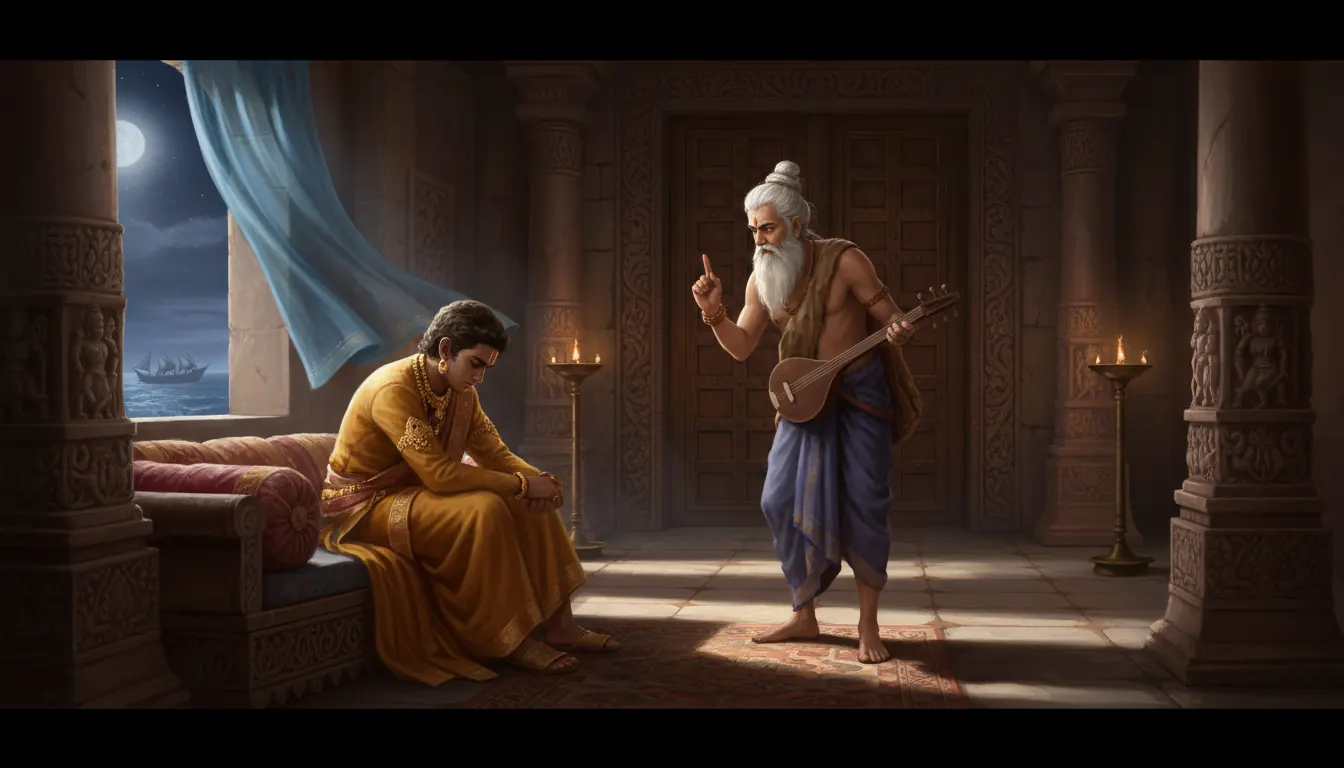
Narada as Krishna Praised Him
Ugrasena asks why everyone speaks well of one sage, and Krishna answers him item by item
In short
Yudhishthira asks Bhishma whether any man is dear to all people and yet complete in every merit. Bhishma answers by repeating a speech Krishna once made at Dwaraka, when the old Yadava king Ugrasena asked him why everybody had something good to say about Narada. Krishna went through the sage's qualities one by one, returning again and again to the same refrain: that is why he is worshipped everywhere.
Told in the Shanti ParvaSet in Dwaraka and Kurukshetra15 min read
The Question About Being Loved
Most of what Yudhishthira asked his grandsire on that field was hard and cold. He had asked about the soul and about Brahma, about the man who is neither gladdened by praise nor angered by blame, and Bhishma had answered him out of the arrows with the words of Jaigishavya, who wanted no friends and had no enemies and passed his days in happiness because of it.
The question the king asked next was a smaller one, and it came from somewhere else in him.
"What man is there," Yudhishthira said, "who is dear to all, who gladdens everyone, and who has every merit and every accomplishment?"
It is worth noticing what has changed. The sage who had just been described was admirable and unreachable. He had untied the knots of his heart and stepped out of the whole business of liking and being liked. Yudhishthira listened to that and then asked, almost immediately, whether there was anybody who had gone the whole distance and was still welcome in a room.
He had reason to want to know. He was newly a king over a country he had emptied. Half the men who had ever spoken warmly to him were dead on the plain behind him, a good many of them by his own brothers' hands, and he had spent the days since the war being told by everyone who loved him that he was not to blame, which is the particular comfort that convinces nobody. A man in that condition wants to hear that being good and being loved are not two different roads.
Bhishma did not answer with a principle. He answered with a name, and he did not even give the name himself.
"In this connection," he said, "I will tell you the words that Keshava once spoke to Ugrasena when Ugrasena asked him."
Krishna was sitting there while the old man said it. He had come every morning to that bed with the Pandavas and had said very little, and now the old man was about to quote a speech he had made years ago in another city, to another king, about a third man who was not present either.
The Chief of the Kukkuras Asks
The scene Bhishma opened was a domestic one, and it had happened long before the war.
Ugrasena was the head of the Yadava house at Dwaraka, an old king of the Kukkura line, and he was the one man in that city entitled to ask Krishna a plain question and expect a plain answer. What he asked about was gossip.
"Everyone seems very eager to speak of the merits of Narada," Ugrasena said. "I think that celestial rishi must really have every kind of merit. I ask you, Keshava, tell me about this."
Read the old king's tone. He was not doubting it. He was reporting a fact he had observed about his own city and could not account for. Everyone talked about Narada. Everyone had something good to say about him, and the something was never the same twice, and nobody ever seemed to have a grievance to add at the end of it. In a court of Yadavas, who quarrelled with each other over anything at all, that was a strange and conspicuous thing, and Ugrasena wanted it explained.
He had chosen the right man to ask. Narada was the one visitor in the three worlds who walked into any hall he pleased, at Dwaraka or Hastinapura or Indra's own assembly, and was seated at once and never questioned.
"Chief of the Kukkuras," Krishna said, "listen to me, king, as I name in brief the good qualities of Narada that I know of."
He began with the two things that most often refuse to sit together in the same man.
"Narada is as learned in the scriptures as he is good and pious in his conduct."
That is the whole first item, and it is the balance of the sentence that matters. Not learned and also somewhat decent. Learned exactly as far as he is good, the reading and the living kept level with one another, so that neither one can be used to excuse the other.
"And yet, for all his conduct, he never harbours the pride that makes a man's blood run so hot."
That is the second, and Krishna put his finger on the precise place where good men go bad. A man's conduct is the thing he is likeliest to be vain about, because he has worked at it and it is his. Narada had the conduct and did not have the heat in the blood that usually comes with it.
"That is why," said Krishna, "he is worshipped everywhere."
Four Things That Are Not in Him
Krishna went on, and he had a way of returning to that one phrase at the end of each group of merits, the way a man setting down a load keeps touching the same spot on the ground. He is worshipped everywhere. He is worshipped everywhere. It is the refrain of the whole speech, and it is also its argument: none of these qualities is being praised for its own sake. Each one is being offered as a reason why doors open.
"Discontent, anger, frivolity, and fear: these do not exist in Narada."
Four absences, and they are worth taking one at a time, because they are the four things that make a guest tiring. The discontented man brings his dissatisfaction into your house and leaves it there. The wrathful man has to be managed. The frivolous man cannot be trusted with anything you say. The frightened man will agree with you and then go and agree with the next person as well.
"He never puts things off, and he has courage. That is why he is worshipped everywhere."
Those two go together more closely than they look. Most putting off is fear wearing a calendar.
"Narada deserves the respectful worship of all. He never goes back on his word out of desire or greed. That is why he is worshipped everywhere."
Not that he never breaks his word. That he never breaks it for the two reasons men actually break it, which are wanting something and wanting more of something. Take those two away and a promise costs nothing to keep.
"He fully knows the principles that lead to knowledge of the soul; he is disposed to peace, possessed of great energy, and a master of his senses. He is free from guile, and truthful in speech. That is why he is worshipped with respect everywhere."
Disposed to peace and possessed of great energy, in the same breath. It is easy to be peaceable when there is nothing in you, and easy to be forceful when there is no quiet in you. Krishna named both of Narada at once, and he named them of a man famous throughout the epic for turning up in the middle of quarrels.
Ugrasena, who had watched that sage walk into his own council chamber more than once, would have known exactly what was being described.
Eight Distinctions, and the Small Ones After Them
Then Krishna gave the list that a herald would give, the formal one, the eight titles under which a man is announced.
"He is distinguished by energy, by fame, by intelligence, by knowledge, by humility, by birth, by penances, and by years. That is why he is worshipped everywhere with respect."
Eight, and humility is sitting in the middle of them like a stone in a ring. Energy, fame, intelligence, knowledge are what a man has. Birth, penances and years are what has happened to him. Humility is the only one on the list that is a subtraction, and it is placed there without comment, as though it belonged in a catalogue of splendours, which in this speech it does.
And then, immediately after the grandest list, the smallest.
"He is of good behaviour. He dresses and houses himself well. He eats pure food. He loves all. He is pure in body and mind. He speaks sweetly. He is free from envy and malice. That is why he is worshipped everywhere with respect."
He dresses and houses himself well. A celestial rishi, the friend of Indra, the man who carries news between the worlds, and Krishna thought it worth telling a king that Narada is clean and well kept and lives in a decent place. It is the observation of somebody who has actually had him as a guest. He is not one of those holy men whose holiness has to be smelled before it can be admired. He arrives fit to be seated next to anybody, and this is listed among his merits and not beneath them.
"He is certainly always busy doing good to all people. No sin lives in him. He never rejoices at other people's misfortunes. That is why he is worshipped everywhere with respect."
That last clause is the hardest thing on the whole list, and Krishna dropped it in among the others without pausing. There is a small warmth that rises in almost every man when a rival stumbles, and it is so quiet and so quickly hidden that most people never admit to it even privately. In Narada it does not rise.
"He always seeks to conquer all earthly desires by listening to Vedic recitations and attending to the Puranas. He is a great renouncer and he never slights anyone. That is why he is worshipped everywhere with respect."
A great renouncer who never disregards anyone. Renunciation usually comes with a certain coolness toward the people who have not renounced. His did not.
The Equal Eye
"He casts an equal eye on all," Krishna said, "and so there is no one he loves and no one he hates. He always says what is pleasing to the hearer. That is why he is worshipped everywhere with respect."
Those two sentences are not usually found next to each other, and putting them together is the whole secret of the man. A person who loves nobody in particular is generally cold, and a person who says only pleasant things is generally a flatterer, and Narada was neither, because the equal eye came first. He had no favourites to please and no enemies to wound, so there was nothing left in his mouth except what was true and what was kind, and in his case those had stopped being two separate things.
"He has great learning in the scriptures. His conversation is varied and delightful. His knowledge and wisdom are great. He is free from greed. He is free from deceit too. He is large-hearted. He has conquered anger and greed. That is why he is worshipped everywhere with respect."
His conversation is varied and delightful. Of all the merits in the speech, that is the one that explains the invitations. Learning gets a man respect and does not get him asked back. The sage was good company.
"He has never quarrelled with anyone over any matter of profit or pleasure."
Never once. Krishna said this in Dwaraka, to a Yadava, in a house where the quarrels over profit and pleasure would eventually take everybody in it down to the sea and kill them with iron clubs grown out of reeds. In that room, that sentence was not an abstraction.
"He has torn away every fault. That is why he is worshipped everywhere with respect. His devotion is firm. His soul is blameless. He is well-versed in the Srutis. He is free from cruelty. He is beyond the reach of delusion or faults. That is why he is worshipped everywhere with respect."
Torn away. Not polished off, not grown out of. It is a violent verb and Krishna chose it, and it suggests something done once with the whole strength of a man rather than something achieved by degrees over a long and comfortable life.
Attached to Nothing, and Therefore to Everything
Then came the line in the speech that is the most difficult and the most exact.
"He is unattached to all the things others are attached to. For all that, he seems to be attached to all things."
He wants nothing that other men want. And yet nobody meeting him would call him detached, because he takes an interest in everything, enters into everything, sits down with a cowherd and with a king and is entirely present at both. The freedom did not empty him out. It made room in him.
"He is never long subject to doubt. That is why he is worshipped everywhere with respect. He has no longing for things of profit and pleasure. He never praises himself. He is free from malice. He is mild in speech. That is why he is worshipped everywhere with respect."
Never long subject to doubt. Not that doubts do not come to him. That they do not lodge.
"He looks into the hearts of all men, different from one another, without blaming any of them."
This is the sentence to carry away from the whole catalogue. Narada is the great traveller of the epic, the man who has seen the inside of more courts and hermitages and heavens than anyone else alive, and what he has learned from all that looking is that hearts are not alike. Different from one another, Krishna said, and Narada watches them being different and does not hold it against them. Most men who understand other people use the understanding as a charge sheet.
"He is well-versed in all matters connected with the origin of things. He never disregards or shows hatred for any kind of science. He lives according to his own standard of morality. He never lets his time pass uselessly. His soul is under his control. That is why he is worshipped everywhere with respect."
He never disregards or shows hatred for any kind of science. There was no branch of knowledge, however small or however unfashionable, that he sneered at.
And he lives according to his own standard, which is not the same as living by nobody's. A man with an equal eye for everybody still has to decide what he himself will do, and Narada had decided, and did not put the burden of that decision on anyone else.
Who Is There That Will Not Love Him
The last of the merits are the working ones, the habits of a man who has a great deal to do.
"He has toiled at the things worth toiling at. He has earned knowledge and wisdom. He never has his fill of yoga. He is always attentive and ready for effort. He is always watchful. That is why he is worshipped everywhere with respect."
He toiled at what deserved toil. Labour is not a virtue by itself, and a man who works hard at nothing in particular has wasted an expensive thing. Narada had chosen his subjects and then spent himself on them.
"He never has to feel shame for any failing of his. He is very attentive. Others always engage him in doing what is for their good. He never reveals the secrets of others. That is why he is worshipped everywhere with respect."
There is the practical heart of it, and it is the reason the doors open. People employ him in their own business, because he is competent and because he will not repeat what he hears. A man who moves between courts as Narada does knows everything about everyone, and in a lifetime of such visits he has never once carried it out of the hall with him.
"He never gives way to bursts of joy even when he gains something valuable. He is never pained by losses. His understanding is firm and stable. His soul is unattached to all things. That is why he is worshipped everywhere with respect."
And then Krishna finished, not with a summary but with a question put back to the old king who had asked.
"Who is there that will not love him, then, a man with every merit and accomplishment, skilled in all things, pure in body and mind, wholly auspicious, who knows the course of time and the right moment for each act, and who knows all pleasing things?"
The last merit named in the list is the sense of when. Narada knew the hour at which a thing should be said, and the hour at which the same thing would do harm.
On the field, an old man on a bed of arrows stopped speaking, having given his king the answer he had gone looking for: that there was such a man, that he was still walking about the world, and that nothing on the list of what made him beloved was anything a man is born with.
Dharma Lesson
Yudhishthira asked whether goodness and being loved can belong to the same man, and the answer he received was a list of ordinary habits rather than a single great virtue. Nothing Krishna named of Narada is beyond an ordinary person: not rejoicing when a rival stumbles, keeping what you are told, not putting things off, staying clean and being good company, refusing to hold it against people that their hearts are unlike yours. The list is long because a man who is welcome everywhere is not made by one heroic act but by a thousand small refusals. What is worshipped everywhere, in the end, is not power but the absence of the things that make a person hard to be near.