The Root of All Accomplishment
Bhishma teaches that the world, the Vedas and the rank of the gods were all bought with penance
In short
Having answered Yudhishthira on self-restraint, Bhishma begins again further back and says that everything has penance for its root. The Creator made the universe with it, the rishis acquired the Vedas with it, the Grandsire made food and fruit and roots with it, medicines work by it, and the four men guilty of the great sins are cleansed by it when it is properly practised. Of all its forms he ranks abstention from food the highest, and he ends by saying that the lights in the sky and the standing of the gods themselves were won the same way.
Told in the Shanti ParvaSet in Kurukshetra12 min read
The Answer With No Question In Front Of It
Vaishampayana, telling the whole of it long afterwards, said that when Bhishma had finished speaking about self-restraint, Yudhishthira became highly gratified, as if he had quaffed nectar, and asked again. That is the shape of every one of those days.
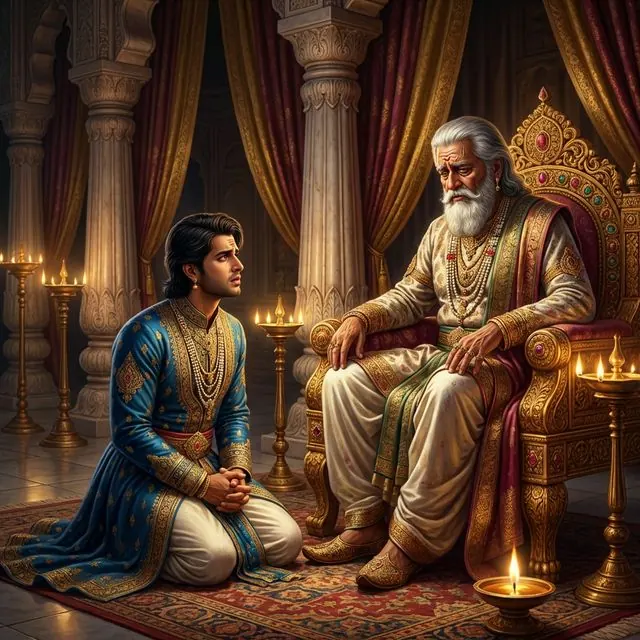
The old man was lying on the field at Kurukshetra on the bed his grandsons had made for him without meaning to, held up off the ground by the shafts in his back, waiting for the sun to turn north before he would allow himself to die. Krishna was there. The younger brothers were there. And the eldest of them, who had the kingdom now and had wanted almost anything else, came each morning with another question and sat lower than the bed and listened until the light failed.
The question just answered had been a large one. Out of all the duties in the scriptures, which few should a man prefer to the rest? Bhishma had said self-restraint, and had gone through its parts one by one, forgiveness and patience and abstention from injury and truth and the rest of them, and had ended by saying that a forest is simply wherever a self-restrained man is standing.
What comes next in the text is not introduced by a question anyone wrote down. The king asked again, but his words are not given. The old man simply starts again, further back, underneath the answer he has just given.
"Those who have knowledge say that everything has penance for its root."
Everything. Not merit only, and not the duties of brahmanas only. The world, the Vedas, food, medicine, the lights in the sky, the standing of the gods themselves. He was not adding penance to the catalogue of virtues he had been reciting for weeks. He was saying it is the thing the catalogue grows out of.
And then, before any of the grandeur, the plainest and hardest sentence in the section.
"The foolish person who has not undergone penances does not reap the rewards even of his own acts."
Not the rewards of penance. The rewards of his own acts. The undisciplined man does the work and cannot collect on it.
The Creator's Own Method
Having made the claim, Bhishma went for the largest proof available to him.
"The mighty Creator created all this universe through penances."
Not by a word, in this telling, and not by an effortless act of will. Brahma the Grandsire, who had nothing to work with because there was nothing yet, is said here to have used austerity as his instrument, the way a smith uses fire. The universe is not a thing that was spoken. It is a thing that was earned.
"In the same way, the rishis gained the Vedas through the power of penances."
In the same way. That phrase carries the argument. The rishis did not receive the Vedas as a present handed down to men who happened to be sitting in the right place. They got them the way the Creator got the world, by ascetic effort, and Bhishma sets the two acts side by side as though they were the same kind of labour done at different scales. Revelation, in this account, has a price and somebody paid it.
"It was through penances that the Grandsire created food, fruit and roots."
This is the line that turns the argument from theology into something a man can hold in his hand. Of all the things the Creator might have been credited with in a discourse on penance, the text picks out food. Not the stars. Not the orders of beings. Food, fruit and roots, which is to say precisely what the ascetic in the woods eats and nothing else. The man who has renounced everything and lives on what he digs and what falls is living on the produce of an austerity older than his own.
"It is through penances that those who have won ascetic success see the three worlds, with rapt souls."
And there is the yield in men. Not a report of the three worlds, and not a doctrine about them. Sight of them, direct, by people whose souls the text calls rapt. Bhishma has moved in four sentences from the making of the universe to what a living ascetic can see with his eyes shut, and he has used one word for the cause of both.
Medicines, and the Thing That Cannot Be Had
Then the discourse came down out of the sky altogether and into the ordinary working of the world.
"Medicines and all antidotes to harmful substances, and the many acts seen here, produce their intended results through penance."
This is a stranger claim than it looks. Bhishma is not saying that a holy man can cure a sick one. He is saying that the medicine works because of penance, and that the antidote defeats the poison because of penance, and that the diverse acts men perform in this world arrive at their intended results by the same means. The herb does what it does because somebody, once, fasted long enough to find out what it does. Behind every remedy that reliably works there stands an austerity that discovered it, and the reliability is the interest on that old labour.
"The accomplishment of all purposes depends upon penance. Whatever things are apparently unattainable are sure to be won through penance."
Apparently unattainable. The qualifier is the whole of it. Bhishma is not promising the impossible; he is saying that a great deal of what men file under impossible has only been filed there because nobody was willing to pay for it. The thing beyond reach is beyond reach at the present price. Penance is the currency in which such prices are quoted, and the man who is unwilling to spend it calls the goods unattainable and goes home.
A king lying awake over a ruined country, listening to this, is being told something quite specific about what remains open to him.
"Without doubt, the rishis gained their sixfold divine attributes through penance."
The six are not listed here, and Bhishma does not pause to gloss them. He mentions them the way a man mentions a well known wage: whatever it is that the great rishis have and other men do not, the powers that let them curse and bless and travel and see, none of it was conferred and all of it was bought. Not one of the shining figures in the epic was born shining. They sat still in one place, for a very long time, and were paid.
Four Men Who Are Not Beyond Cleansing
Then, without any warning at all, Bhishma names four men.
"A person who drinks alcohol, one who takes the possessions of others without their consent, one guilty of foeticide, one who violates his teacher's bed, are all cleansed by penance properly practised."
These four are not a random handful of offenders. In the law books they stand together as the great sins, the acts that put a man outside the ordinary machinery of atonement, and they are listed in that fixed order so often that any brahmana hearing the first of them would have been able to recite the other three. The drinker. The taker of what was not given. The destroyer of a child in the womb. The man who goes to the bed of the teacher who raised him.
The drama of the sentence is that it does not end where the audience expects. Having assembled the four worst men in the tradition, Bhishma does not condemn them. He says they can be cleansed.
And he attaches one condition, in three words that decide everything.
Properly practised.
Not penance performed. Not penance undertaken, or announced, or begun in the first flush of horror at oneself and abandoned when the horror wears off. Properly practised, which means done in the manner the discipline requires and for as long as it requires, by a man who no longer expects to be congratulated for it. That is the whole of the offer, and it is not a small one, because it means the tradition has no category of person who is finished. It has only a category of person who has not started.
The man being told this had come out of a war that killed nearly everyone he was related to, and had spent the days since it ended asking his elders in various ways whether a man in his position could be clean again. Nobody in the text says that aloud here. Bhishma lists the four, applies the remedy, and goes straight on to the next thing, and lets the king sitting at the foot of the bed do his own arithmetic.
The Highest Penance Is Not Eating
"Penances are of many kinds. They show themselves in various ways."
He grants that first, and it matters. There is no single prescribed austerity in this teaching. Silence is one. Standing in water is one. Bearing what is unbearable without complaint is one. The forms are many and they come out at many different points in a life.
Then he ranks them.
"But of all the kinds of penance one may practise after giving up pleasure and enjoyment, fasting is the highest and best. The penance of fasting is higher, king, than even compassion, truthfulness of speech, gifts, and restraining the senses."
Fasting placed above compassion. Fasting placed above truth. These are not casual comparisons in a text that has spent whole sections calling truth the foundation of righteousness, and Bhishma seems to feel the weight of it, because he immediately sets three other measures beside his own to show that he knows what he is weighing.
"There is no act more difficult to accomplish than gift. There is no mode of life that is superior to serving one's mother. There is no creature higher than those who know the three Vedas."
Three superlatives, laid down one after another like stones. Giving is the hardest thing a man does. Waiting on your mother is the highest way a man can live. The knowers of the three Vedas are the first among creatures. He is not withdrawing any of that. He is showing that his scale has other things on it and that he has handled them.
"In the same way, Renunciation is the highest penance. People keep their senses under control to guard their virtue and their heaven. In such control over the senses, and in gaining virtue, there is no penance higher than fasting."
The reason lies in that last sentence, and it is a practical one rather than a pious one. Every other discipline governs a desire a man can, at need, walk away from. Hunger is the one appetite that cannot be avoided, postponed indefinitely, or argued with. A man who can sit quietly with an empty stomach has taken hold of the senses at the one place where they cannot slip out from under him.
How the Gods Became Gods
The last movement of the section widens until it takes in every living thing, and it does so in one breath.
"The rishis, the gods, human beings, beasts, birds, and whatever other creatures there are, moving or unmoving, are all devoted to penances, and whatever success they win is won through penance."
Read the order of that list. Rishis first, then gods, then men, then beasts and birds, and then everything else that moves, and then everything that does not move at all. Trees are in that sentence. Stones are in it. Bhishma is not saying that all creatures ought to perform austerities. He is saying they do, that the endurance of a bird through a cold night and the standing of a tree through a drought belong to the same order of effort as a sage's hundred years on one foot, and that nothing anywhere in the world gets anything except by paying for it in that coin.
Then the claim he has been walking toward from the beginning.
"Thus it was through penance that the gods acquired their superiority."
They were not born superior. There is no rank in this account that came free with the birth. The gods hold what they hold because at some point they earned it, which means the difference between a god and a man is a difference of expenditure and not of kind.
"These lights in the sky, each with its share of felicity, are all the fruit of penance."
He was lying on his back. He had been lying on his back for weeks and would go on lying there until the sun turned, and there was very little for a man in that position to look at except the sky. The lights up there, he says, each with its allotted share of felicity, are not ornaments and not accidents. Every one of them is somebody's austerity, finished and hung up where it can be seen.
"Without doubt, through penance the very status of godhead may be acquired."
And that is where he stopped. Not with a rule, and not with a warning. With the flat statement that the highest thing there is remains, in principle, purchasable, by anyone willing to go without.
The man who said it had held to one vow for a lifetime and was at that moment holding his own death off by the strength of it, and did not mention himself once.
Dharma Lesson
The claim in this section is not that austerity is admirable but that it is the currency everything is priced in, so that a man without it cannot collect even on the work he has already done. What makes it bearable rather than crushing is the sentence about the four great sinners: nobody in this teaching is finished, only unstarted, and the condition attached is not talent or birth but the words properly practised. And the ranking of fasting above compassion and truth is less a demotion of those virtues than a statement about where the senses can actually be gripped, since hunger is the one appetite a man cannot walk away from or argue with.