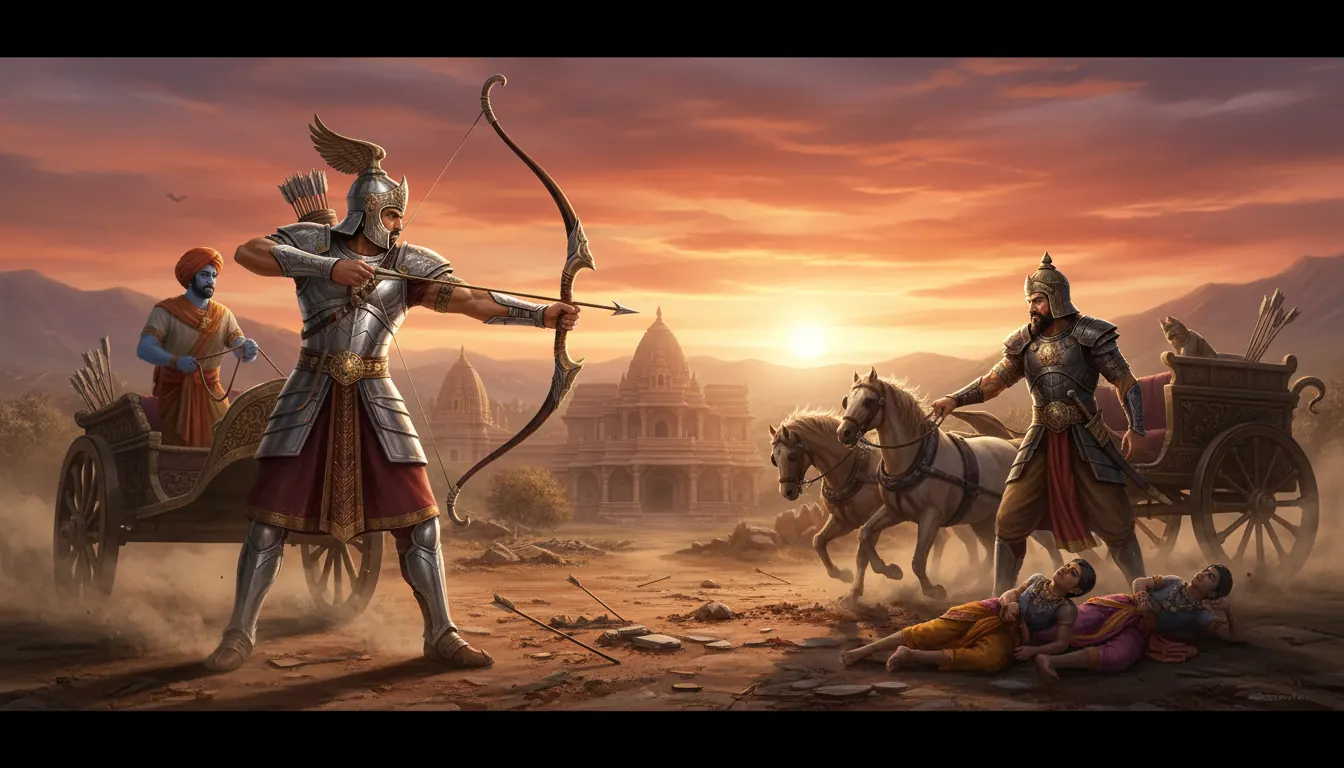
The Oath Comes Due
Susharma, his forty-three sons, and the last of the sworn men
In short
On the eighteenth afternoon Arjuna counts what is left of the Kaurava army, and among the names is the ruler of the Trigartas, whose samsaptaka oath had opened the gap Abhimanyu died in. Arjuna destroys the cavalry, kills Satyakarman and Satyeshu before their brother, shoots his horses, and drives a shaft like the rod of Yama through his heart, then kills his forty-three sons.
Told in the Shalya ParvaSet in Kurukshetra, Trigarta and Hastinapura15 min read
The Umbrella in the Middle of the Cavalry
It was the afternoon of the eighteenth day, and there were two sons of Dhritarashtra left alive on the earth. Duryodhana was one of them. Sudarshana was the other. Both of them were in the middle of what was left of the Kaurava horse.
Krishna held the reins and looked across the field and told Arjuna what he was seeing, the way a man reads out a page.
"A great many of our enemies, kinsmen who had our protection, have been killed. There, that bull of Shini's race is coming back, and he has taken Sanjaya alive. Nakula and Sahadeva are both tired, having fought the wretched sons of Dhritarashtra and their followers. Those three, Kripa and Kritavarma and the mighty chariot-warrior Ashwatthama, have left Duryodhana's side and taken up a position somewhere else. The Panchala prince is over there among the Prabhadrakas, very beautiful to look at, having killed Duryodhana's troops.
"And there, Partha, is Duryodhana himself, in the middle of his cavalry, with the umbrella held over his head, flinging his glances all around. He has re-arrayed the remnant of his army and he is standing in the middle of it. Kill this one with your keen shafts and you have everything you came for.
"Do it while those troops are still there. As long as they do not flee at the sight of you among them and of their elephant force destroyed, try to kill Duryodhana. Send someone to the Panchala prince and tell him to come here. The Kaurava troops are all tired, sire. The sinful Duryodhana will never manage to escape. He has killed a great many of your men today and he is wearing a proud face, as though he believes the Pandavas have been beaten. When he sees his own troops stricken and slaughtered, the Kuru king will certainly come out and fight, for his own destruction."
Arjuna Counts What Is Left
Arjuna answered him, and what came out was not a plan. It was an inventory. He had been keeping it in his head.
"Almost all the sons of Dhritarashtra have been killed by Bhima, giver of honours. Only these two are still alive, and they will meet their destruction today as well. Bhishma has been killed. Drona has been killed. Karna, who is also called Vaikartana, has been killed. Shalya the king of the Madras has been killed, and Jayadratha, Krishna, has been killed.
"Of the troops of Shakuni the son of Subala there remain five hundred horse. Of chariots, only two hundred. Of elephants there remain a hundred that are formidable, and of foot, three thousand. There remain also Ashwatthama, and Kripa, and the ruler of the Trigartas, and Uluka, and Kritavarma of the Satvata race. That is the whole of Duryodhana's force, Madhava.
"Truly, there is no escape from death for anybody on earth. Such a slaughter as this has taken place, and look, Duryodhana is still alive.
"Today king Yudhishthira will be free of all his enemies. Not one of them gets past me, I think. Even if they are more than men, Krishna, I will kill all of those warriors today, however furious they are, if only they do not run away from the field. By killing the prince of Gandhara with my keen shafts today I will dispel that sleeplessness which the king has suffered from for so long. I will win back every one of those valuable possessions that Subala's son, of wicked conduct, took from us at the gambling match in the assembly. Today all the ladies of the city called after the elephant will hear of the slaughter of their husbands and their sons and will wail aloud.
"Today, Krishna, our task is ended. Take the foolish son of Dhritarashtra for a dead man, if he does not flee today from the battle I am going to make. Those horses of theirs cannot endure the twang of my bow and the slap of my palms. Drive, Krishna. I will kill them."
And the hero of Dasharha's line urged the horses toward the division in which Duryodhana was standing.
The Ruler of the Trigartas
One name in that inventory had been sitting in Arjuna for a very long time, and it was not Duryodhana's.
The ruler of the Trigartas was Susharma, king of Prashthala, and he and Arjuna had a history that went back well before the war. It was Susharma who had driven the cattle of the Matsyas in the year the Pandavas were hiding in Virata's household, and who had been taken alive that day and let go. That is where the account gets its phrase about what Arjuna carried against him: wrath cherished for many long years.
But the debt that mattered was newer and much larger.
Susharma was the man who had invented the samsaptakas. He and his brothers had gone out in front of both armies, kindled a fire, put on their mail, tied on their quivers, and sworn a public oath in the hearing of everyone: they would kill Arjuna, or Arjuna would kill them, and they would not come back off the field alive with the thing undone. Men who swear that are the sworn ones, and the swearing is a weapon. It does not have to be kept in order to work. It only has to be issued, because a kshatriya who is called out by name and refuses to answer is finished, and Arjuna could not refuse.
So on day after day of that war, Susharma challenged him, and Arjuna went, and the two of them fought at the far end of the field while the battle was decided somewhere else. On the thirteenth day of the war he answered the challenge as usual and rode to the south, and behind him Drona closed a wheel formation that nobody left in the camp knew how to open, and a boy of sixteen went into it because he knew the way in and had never been taught the way out.
The oath had been sworn against Arjuna's life. What it actually cost was Abhimanyu's. And on the eighteenth afternoon Susharma was still on that field, in the remnant, and Arjuna had just read his title out loud in his own count.
Three Chariots Go at the Cavalry
Three mighty chariot-warriors made ready to go into that force together, and they went with lion-like roars, wanting Duryodhana: Bhimasena, and Arjuna, and Sahadeva.
Subala's son saw them coming and moved to that spot to meet them, and the matches sorted themselves out in the way such things do, each man taking the enemy in front of him.
Sudarshana went at Bhimasena.
Susharma and Shakuni together went at Kiritin.
And Duryodhana, on horseback, went at Sahadeva.
That is worth stopping on for a moment. The king of the Kurus, who had ninety-nine brothers when the war began and had one left alive now, who had been carried to and from that field in a chariot under a white umbrella for seventeen days, was up on a horse at the end of it, in the middle of five hundred surviving riders, going in personally against the youngest of the sons of Madri. His chariots were gone. That is what the two hundred remaining chariots in Arjuna's count actually meant, spread across a whole army: the king rides.
He came at Sahadeva with great speed and great care, and he struck him on the head with a lance, forcibly.
Sahadeva went down onto the floor of his chariot with all his limbs bathed in blood, and he lay there sighing like a snake.
For a moment on that field there were the makings of a completely different ending, in which the last living son of Dhritarashtra killed the last son of Madri from horseback in front of Arjuna.
Then Sahadeva regained his senses, and got up, and covered Duryodhana with keen arrows.
The Cavalry Division Comes Apart
Kunti's son Dhananjaya put out his strength and went to work on the horse.
He cut off the heads of many brave combatants on horseback. That is a particular kind of shooting: a rider is a small target moving fast and low, in a body of other riders moving fast, and the head is the smallest part of him, and Arjuna took them in numbers, with many arrows, until that entire division was destroyed. Five hundred horse had been the whole of Shakuni's remaining strength and the whole of the screen standing between the Pandavas and Duryodhana's umbrella.
When he had felled all the horses, he went on toward the chariots of the Trigartas.
The great chariot-warriors of the Trigartas did the only sensible thing, which was to unite. They came together in a body and covered Arjuna and Vasudeva with showers of shafts from every direction at once, both men in the same chariot, the driver as much a target as the archer.
Two of them were Susharma's brothers, and they went in front of him.
Their names were Satyakarman and Satyeshu. Both names are built on the word for truth, and both men had stood at the fire beside him and sworn the same oath against this archer. His sons were there too, forty-three of them, every one a great chariot-warrior, and on the eighteenth afternoon of the war they were all still there behind him.
Satyakarman and Satyeshu
Arjuna took Satyakarman first, with a razor-headed arrow that cut off his chariot-poles, so that the horses ran on with the traces and the young man stood still in the middle of the field in the wreck of his own vehicle.
Then a second razor-headed arrow, whetted on stone. The account puts in a detail here that most readers pass over and should not: he was smiling the while. And with that arrow, that celebrated hero cut off his adversary's head, which was adorned with bright gold.
He went at Satyeshu next, in the sight of all the warriors, and the man who wrote it down reached for a lion and a deer: like a hungry lion in the forest attacking a deer. Not like a duel between equals. Like feeding.
Having killed him, Partha pierced Susharma himself with three arrows.
Three. Not a killing volley, and he was well within range to make it one. It was a touch, the way you set a hand on a door you are coming back to. Then he turned away from Susharma and killed all those chariot-warriors adorned with ornaments of gold, the whole company that had come in around them, and cleared the ground between the two of them completely.
The old man had watched two of his brothers killed in front of him, one with the shafts cut from under him and one run down like an animal, and had felt three arrows go into his own body from a bow that could have finished him with either of them, and had then been made to stand and wait while the archer worked his way through everything else that was standing.
There was a long debt on this. Arjuna was not going to settle it in one shot from a distance.
The Rod of Yama
Then he proceeded against Susharma the ruler of Prashthala, with great speed, vomiting the virulent poison of a wrath cherished for many long years.
That is the sentence in the book, and there is nothing like it anywhere else in the account of that day. Arjuna kills a great many men in the shalya parva and the text almost never tells you what is in him while he does it. Here it stops and says exactly what he was carrying and how long he had been carrying it.
He covered him first with a hundred arrows. Then he killed all that bowman's horses, so that the Trigarta king was standing in a chariot that could not move, in the open, at the far end of Gandiva.
Then Partha fixed on his bowstring a mighty arrow that resembled the rod of Yama.
The rod of Yama is not a figure of speech about a big arrow. It is the staff of the judge of the dead, the instrument by which a sentence already passed is carried out, and the man who chose that comparison chose it because nothing was being decided at that moment. The oath had decided it. Susharma had stood up in front of two armies and announced, on his own initiative, that either he would kill this man or this man would kill him, and there was no third clause in it, and it had been running ever since.
Smiling the while, he sped it at him, aiming it at him.
Sped by that bowman blazing with wrath, the arrow reached Susharma and pierced through his heart.
Deprived of life, the king of the Trigartas fell down on the earth, gladdening all the Pandavas and paining all the warriors of the Kauravas.
Forty-Three
When he had killed Susharma in that battle, Partha sent the forty-three sons of that king, all of them great chariot-warriors, to the abode of Yama.
The account gives them one line. It is a line worth sitting with, because forty-three is not a number of men who fall in a moment; it is a number that has to be gone through, one after another, and the archer has to still be there at the end of it.
They could have gone. Their father was on the ground and the war was decided and there was nothing left to hold and no one left to hold it for, and men were running off that field in every direction all afternoon and nobody afterwards was in a position to blame them for it. Not one of these forty-three went. They came at him in the order in which they could reach him, and Arjuna killed the forty-three of them, and then he killed all the followers of Susharma with his keen arrows as well, the last remnant of the sworn men, the tail end of the vow.
That is what the oath finally cost. It was sworn to take one life. It took Abhimanyu's, which it had not been aimed at. It took Susharma's, which it had promised as the alternative. It took forty-three sons, who had never sworn anything at all except by being born into the house of a man who had. And then it took everyone who had ridden behind them.
When it was done, the mighty chariot-warrior Arjuna turned and went against the remnant of the Bharata host, and did not, so far as the record shows, say anything about it to anybody.
What Was Left By Evening
Elsewhere on the same ground, Bhima had been working through the other match.
Filled with rage, he made your son Sudarshana invisible with his arrows, and then, smiling the while, cut his head off his trunk with a razor-headed arrow of great sharpness, and the prince fell down on the earth deprived of life. His followers closed around Bhima, shooting whetted arrows from every side, and Bhima covered that force with keen shafts whose touch was like the touch of Indra's thunder, and within a very short time he had killed all of them.
There was one son of Dhritarashtra left in the world after that, and he was sitting on a horse under an umbrella.
Many Kaurava leaders of great might came up to Bhima and began to fight with him, and the son of Pandu covered all of them with his arrows, and your warriors covered the great chariot-warriors of the Pandavas with dense showers of arrows from every side, and both armies were thrown into turmoil. Struck by one another, the combatants of both sides began to fall down, wailing aloud for their dead kinsmen.
The thing the samsaptaka oath had been designed to do was to take the best archer in the world out of the place where he was needed and hold him somewhere else. Day after day it worked, and Abhimanyu died inside the gap it made, and Jayadratha stood in the mouth of that gap and held it open, and the whole shape of the war bent around it.
It was answered inside a quarter of an hour on the eighteenth afternoon, and it was not a duel and it was not glorious and nobody made a speech. A man who had promised to kill Arjuna was pinned in a chariot with no horses and shot through the heart, and then his sons were shot, and then his followers, and the archer moved on to the next division without stopping.
An oath sworn against another man's life is a note drawn on your own. What the house of Prashthala found out on that field is that everybody in the house has signed it.
Dharma Lesson
An oath sworn against another man's life is a note drawn on your own, and the whole house signs it. Susharma promised in public to kill Arjuna or be killed, and the debt was collected from two brothers who had sworn beside him, from himself, from forty-three sons who had sworn nothing, and from every rider behind them. It was answered in a quarter of an hour, without a duel and without a speech.