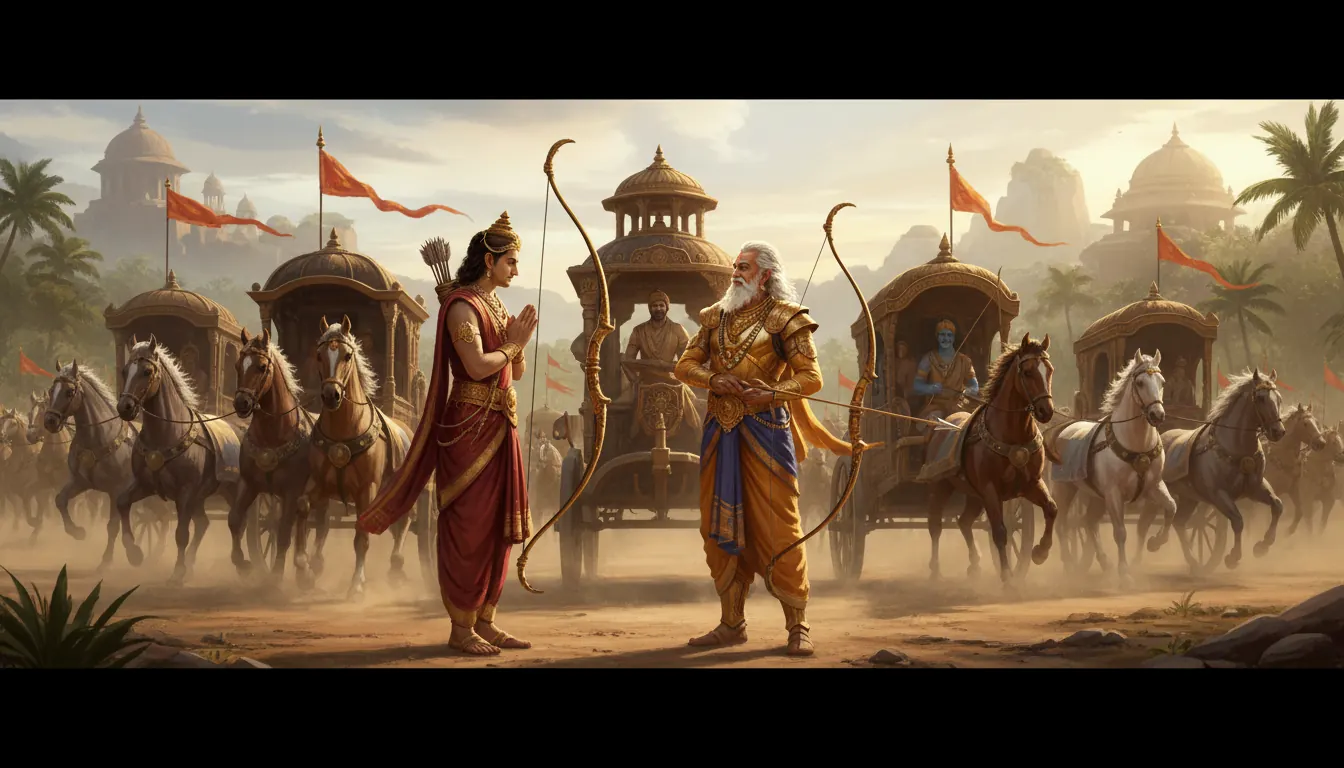
The Blessing at the Gate
Arjuna asks his teacher's leave to break his teacher's line
In short
At the mouth of Drona's six-deep array, with a sunset deadline and a vow to enter the fire if he fails, Arjuna lays Gandiva down and salutes the man blocking his road. He asks to be protected as Ashwatthama is protected. Drona smiles, answers that Jayadratha cannot be reached without defeating him first, and covers him with arrows.
Told in the Drona ParvaSet in Kurukshetra15 min read
The Mouth of the Array
He had already broken Dushasana's division to get this far, and the horses were wet through when they came out of it.
The night before, standing over what was left of a sixteen-year-old boy, he had sworn in front of his brothers and the assembled kings that he would kill Jayadratha the next day; that if any man stood between them, be it Drona or Kripa, he would cover that man with arrows; and that if tomorrow's sun set with the ruler of the Sindhus still breathing, he would walk into a blazing fire himself where he stood.
So there was a clock on the day, and everybody on both sides knew what time it was.
Ahead of him the ground had been cleared and dressed and stood waiting, and at the entrance of the array, precisely in the gap a man would have to pass through, was a chariot with red horses and a golden altar on the standard, and an old brahmana standing in it with his bow strung.
Arjuna had been driving since morning toward one man he had sworn to kill before the sun went down, and here at the very first gate was the one man on the field he had never in his life wanted to shoot at. Drona had spent the night arranging it that way. Six divisions deep, with Jayadratha at the far end of them, and at the near end the teacher, because the Kauravas had understood something about their enemy that he would have preferred nobody understood.
He slowed the chariot without being asked to. Krishna, at the reins, did not turn round, but he said something quietly, and afterwards nobody could say for certain what it was, only that Partha did what it suggested.
He laid Gandiva across the rail. Then, standing in the chariot, in front of both armies, with the day burning away behind him and Jayadratha somewhere at the far end of that array under six ranks of guards, the greatest archer alive joined his hands and bowed to the man who was blocking his road.
The Kaurava line saw it and did not know what to make of it. Some of them thought he was surrendering. Some of them thought it was a trick. The old man in the chariot ahead knew exactly what it was, because he had taught the boy who was doing it how to hold a bow, and had never once in all those years been saluted carelessly by him.
"Wish me well, brahmana," Arjuna said.
What He Asked For
"Wish me well, and bless me, and say Swasti to me," he said. "By your grace I wish to break into this array that cannot be broken into. You are to me what my own father was. You are to me what king Yudhishthira the just is. You are to me what Krishna is. I tell you this truly, sinless one."
He was not flattering. Everyone within hearing knew the history of it: the boy who had come to the ashrama and eaten in the dark to learn to shoot without seeing his hands, the boy who had been promised he would have no equal on earth, the teacher who had made that promise and had kept it, and who was now paid for it by being made to stand in a gateway.
Then Arjuna said the sentence that went furthest.
"Just as Ashwatthama deserves your protection, best of the twice-born, so do I."
He had put himself beside the son. Not above him, not in place of him, beside him, on the same shelf, with the same claim. Nobody else alive would have dared to say it to Drona's face, and nobody else alive had the right.
"By your grace," he finished, "I want to kill the ruler of the Sindhus in battle today. My lord, see that my vow is fulfilled."
There was a silence of the kind that happens in the middle of a battle only two or three times in a war, when eighty thousand men all stop to hear an answer.
The Smile and the Answer
The teacher smiled.
That is the word Sanjaya used for it afterwards, and it is worth pausing on, because a great deal of the war is contained in it. He was not angry. He was not moved to tears. He was pleased, in the exact way an old teacher is pleased when a pupil says something clever and correct, and he answered like a man setting a final examination.
"Bibhatsu," said Drona, "unless you defeat me, you will not be able to defeat Jayadratha."
That was the whole of the blessing. Not a refusal of affection. A statement of the arithmetic. The road to the Sindhu king ran through the gateway, and the gateway was a man, and there was no version of the day in which that man simply stepped aside because he loved the person asking.
And having said that much and no more, Drona covered him with showers of sharp arrows, and the chariot with him, and the four white horses, and the ape on the standard, and the driver holding their reins.
There was no cruelty in it and no relish. He was doing his work. He had eaten the Kauravas' food for many years and had said so publicly more than once, and a man who has said that does not get to stand aside on the afternoon when it becomes expensive. If Arjuna wanted the gate, the gate had a price, and the price was posted.
And there was a second thing folded into the answer that nobody much enjoyed hearing. Drona had trained this archer. He had made him, deliberately, the finest bowman on the earth, and had promised him once that there would be nobody living to equal him. If that promise was true, the pupil could break the teacher, and the teacher was inviting him to come and try.
So the sun went a little further down the sky, and the man who had exactly one afternoon to reach the far end of a six-deep array found himself fighting his own teacher at the front of it.
True to a Kshatriya's Duty
Arjuna checked that shower of arrows with arrows of his own, and then, true to the duties of his order, because a kshatriya who is shot at shoots back and it is not open to him to stand and be a son, he pierced Drona with nine arrows.
Drona cut those nine shafts out of the air with his own and pierced both Krishna and Arjuna with many more that resembled poison or fire.
Then, while Arjuna was still thinking about cutting his teacher's bow, which is a thing that takes a fraction of a moment to decide and about which he had evidently hesitated, Drona, without any hesitation at all, cut the bowstring of Gandiva through.
And he pierced the horses, and the standard, and the charioteer, and covered Arjuna himself with arrows, smiling while he did it.
That, king, is what a lifetime of teaching buys. The teacher knew exactly where his pupil would look and when he would flinch, and he was ahead of him on both counts. Krishna, with arrows in his arms and his chest, kept the horses steady and said nothing.
Arjuna, with a cut string, stood in the chariot and strung his great bow again, and the day changed.
Six Hundred as If One
Getting the better of his teacher at last, that greatest of all masters of arms shot six hundred arrows as though he had taken up and shot only one.
Then he shot seven hundred more. Then a thousand that could not be resisted. Then ten thousand.
They did not all go at Drona. Most of them went past him and into the array behind him, and they killed a great many warriors of Drona's own division. Men and horses and elephants went down together, lifeless. Chariot-warriors, struck by those shafts, fell out of their fine chariots with their horses gone, their standards gone, their weapons gone. Elephants came down like the summits of hills, or like great houses loosened and burnt by lightning and wind. Thousands of horses fell as swans fall on the breast of Himavat when the force of a current strikes them down.
He was like the sun that rises at the end of the yuga and dries up whole waters with his rays, and what he was drying up was the front rank of his teacher's command.
This is worth being exact about, king, because men afterwards told it as though Arjuna spent that hour worshipping. He did not. He went through the division standing behind the gate the way fire goes through a stand of dry cane, and the men in it died in their thousands with their standards and their weapons and their lives all leaving them in the same moment. Deeply pierced by Partha, who knew every way of warfare, they fell out of their fine chariots and did not get up again.
And then the cloud came over the sun. Drona, with his showers of arrows, covered the Pandava as clouds cover the sun at evening, and the scorching stopped.
A Hill in an Earthquake
Then the teacher struck Dhananjaya on the breast with a long shaft, shot with great force, of the kind that is made to drink the life-blood of whoever it reaches.
Arjuna's strength went out of him. He shook in all his limbs, standing in the chariot, like a hill during an earthquake, and for a moment the whole Kaurava line began to shout.
He got his fortitude back and pierced Drona with many winged arrows. Drona struck Vasudeva with five, and Arjuna with seventy-three, and the ape standard with three.
And then, within the twinkling of an eye, the old man made his pupil disappear.
We saw the shafts of Bharadwaja's son falling in continuous lines, so that they seemed to be one object rather than many, and his bow was seen to be incessantly drawn into a full circle, and it never at any moment appeared to be in any other shape. Countless arrows winged with kanka feathers fell without a gap on Dhananjaya and on Vasudeva, and the chariot with the two of them in it could no longer be picked out of the dust.
Dhritarashtra, your teacher was getting the better of the man who had sworn to enter a fire at sunset if he failed. On merit, at that hour, in that gateway, Drona was winning.
Krishna Does the Arithmetic
Inside that shower, at the reins, Vasudeva of great intelligence stopped watching the duel and began to reflect on the accomplishment of the task.
The task was not Drona. The task was a man in a blue turban somewhere behind six divisions, and a sun that was going to set whether or not this argument was finished, and a fire Arjuna had promised in front of witnesses to enter if Jayadratha lived through the day.
"Partha, you of mighty arms," Krishna said, "we should not waste time. We must go on, avoiding Drona. A more important task awaits us."
And Arjuna, who could not have said it first and could not have proposed it himself and had perhaps been waiting all afternoon for somebody else to say it, answered in four words.
"Keshava, as you please."
That is the whole of his reply. Not an argument, not a protest, not a request for one more exchange. Four words, and the fight of his life was over because the man holding his horses had told him it was costing too much.
Then the white horses came round, and keeping the mighty-armed Drona on their right hand, the way a man keeps a temple or an elder on his right when he passes, Arjuna went by the gate instead of through it. He turned his face round as he went and shot backward as he drove, covering himself, giving nothing away, but he went past.
He did not defeat his teacher. He declined to.
Where Are You Going
Drona let him pass, and then called after him. It was the voice he had used on the practice ground at Hastinapura, and it carried.
"Where are you going, son of Pandu? Is it not said of you that you never stop fighting until you have defeated your foe?"
It was the taunt of a teacher, and it was also a genuine question, because the boy he had raised had never once in twenty years walked away from an unfinished contest, and the man he had become was doing it in front of two armies.
Arjuna answered without stopping the chariot.
"You are my teacher and not my foe," he said. "I am your disciple, and therefore like your son. Nor is there any man in the whole world who can defeat you in battle."
Three sentences, and each of them settles something. The first refuses the frame: whatever the array says, whatever Duryodhana pays him, this is not an enemy. The second claims the relation that the salutation had claimed, out loud, where Ashwatthama's people could hear it. And the third is not modesty, and was not offered as modesty. He had just spent an hour finding out whether it was true, and had been made invisible in his own chariot, and was reporting the result.
Then he was gone into the army, and Drona did not stop him, and everyone who had heard the exchange had to make of it what they could.
The Teacher Comes From Behind
The Panchala princes Yudhamanyu and Uttamaujas came up behind him to protect his wheels, as they had been charged to do that day, and they went into the array with him.
What was waiting was Jaya, and Kritavarma of the Satvata race, and the ruler of the Kambojas, and Shrutayush, with ten thousand chariots behind them; and the Abhishahas, the Surasenas, the Sivis, the Vasatis, the Mavellakas, the Lalithyas, the Kaikeyas, the Madrakas, the Narayana cowherds and the various tribes of the Kambojas, all of them regardless of their lives, and all of them placing Bharadwaja's son at their head.
They had most of them been beaten before, a good many by Karna, and they had all come back, and they placed themselves in front of a man who was burning with grief on account of the death of his son, who was clad in mail and conversant with every mode of warfare and prepared to throw away his life in the thick of the fighting, who resembled all-destroying Death itself and looked ready to devour the whole hostile army. They opposed him the way medicines oppose a raging disease, which is to say slowly, at some cost, and without any certainty at all.
And the ground opened in front of him as he came. Horses were pierced and chariots broken and mangled with their riders still in them; elephants were overthrown; umbrellas were cut down and displaced and vehicles ran on without their wheels. Nothing could be distinguished. With his straight shafts he made that army tremble and did not stop making it tremble.
Because Drona had not stayed in the gateway. He had turned his chariot and come after his pupil from behind, and pursued him into the middle of that press.
And there, for a little while, Arjuna turned and fought him again. Firmly devoted to truth and eager to fulfil his vow, he rushed at Drona of the red horses, and Drona struck him with twenty-five straight shafts capable of reaching the vitals. Arjuna invoked the Brahma weapon and checked everything that came at him with it, and the skill we saw in the teacher then was truly wonderful, because Arjuna, though young and struggling vigorously, could not pierce Drona with a single shaft.
So he stopped trying a second time.
Avoiding the invincible Drona, who stood immovable as the Mainaka mountain, the diadem-decked son of Kunti took his chariot round between Kritavarma and Sudakshina of the Kambojas, and went on into the day with the sun already leaning westward, and the thing he had come for still six divisions away.
Dharma Lesson
Refusing to win an argument you could win is sometimes the whole of respect. Arjuna spends an hour finding out whether his teacher can be beaten, is beaten instead, and then declines the second attempt rather than finish it, saying only that a teacher is not a foe. Reverence that costs nothing is not reverence; his cost him the daylight he could not spare.