In short
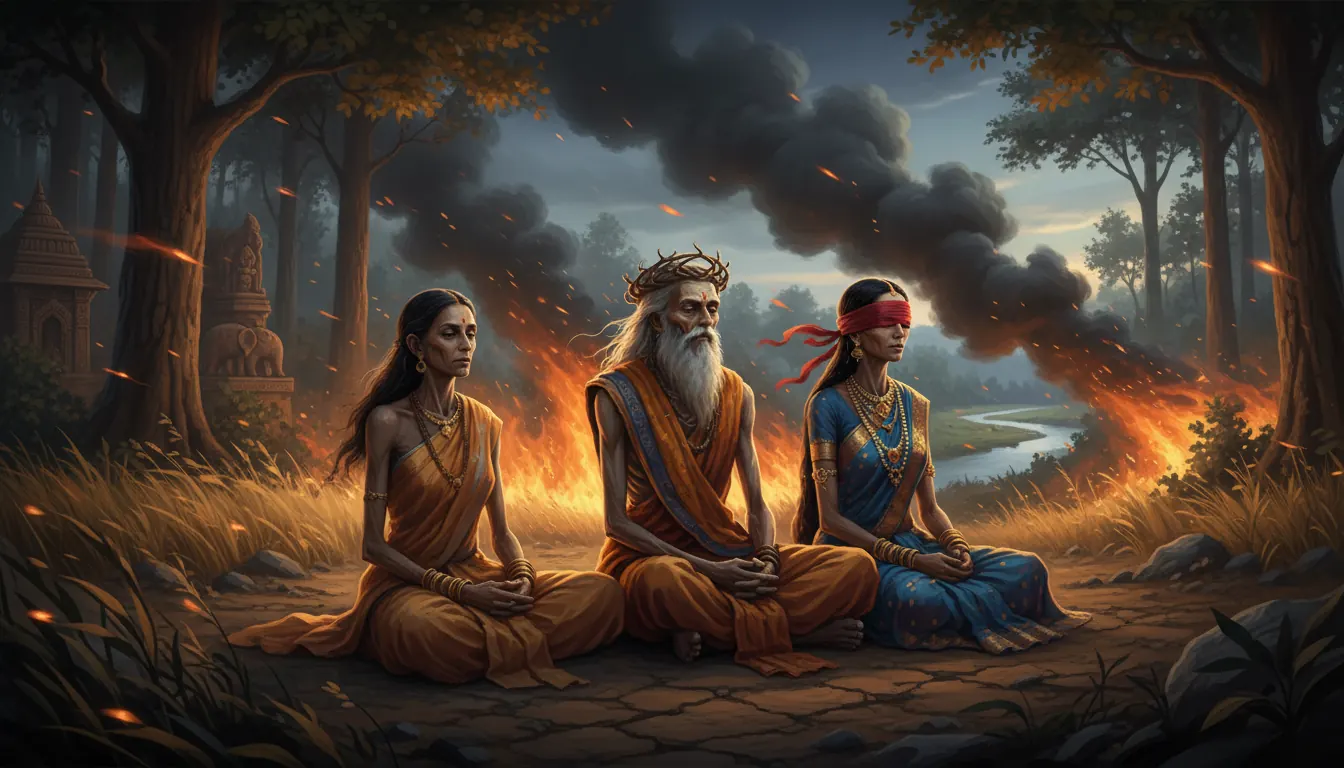
Narada brings word from the Ganga: the old king starved to a skeleton, Sanjaya guiding him over rough ground and Kunti serving as Gandhari's eyes, until a wind-driven forest fire closed on them and all three sat down facing east. Yudhishthira's grief turns to rage against Agni, and then to a worse fear, that the fire was unsanctified. Narada answers both charges.
Told in the Ashramavasika ParvaSet in Hastinapura, Ganga and Khandava Forest16 min read
Narada Comes to Court
Two years after the Pandavas came back from their father's retreat, the celestial rishi Narada came to Yudhishthira.
The king worshipped him with the due rites and gave him a seat, and let him rest a while before he asked anything. Then he said what a host says.
"It has been a long time since I last saw you, holy one, come to my court. Are you at peace and happy, learned brahmana? What countries have you passed through? What can I do for you? Tell me. You are the greatest of the twice-born, and you are our highest refuge."
"I have not seen you for a long while," said Narada. "That is why I have come to you from my retreat. I have seen many sacred waters. I have seen the sacred river Ganga too, king."
And at the word Ganga, Yudhishthira stopped being a host.
"People who live on the banks of the Ganga report that the high-souled Dhritarashtra is practising the austerest of penances," he said. "Have you seen him there? Is that upholder of Kuru's race at peace? Are Gandhari and Pritha, and the Suta's son Sanjaya, at peace? How is it going with my royal father? I want to hear it, holy one, if you have seen the king and know his condition."
"Listen, king," said Narada, "with calmness, while I tell you what I have heard and seen in that retreat."
He had given the warning. Yudhishthira did not hear it, because nobody ever hears it.
Pebbles in the Mouth
"After your own return from Kurukshetra," Narada said, "your father went on to Gangadvara. He took his sacred fire with him, and Gandhari, and Kunti, his younger brother Pandu's widow and the daughter-in-law of his house, and Sanjaya of the Suta caste, and all his Yajakas.
"There he set himself to the practice of severe austerities. He held pebbles of stone in his mouth. He had air alone for his food. He gave up speech altogether. All the ascetics in those woods worshipped him for it. In six months the king was reduced to a skeleton.
"Gandhari lived on water alone. Kunti took a little food every sixth day.
"The sacred fire of the Kuru king was worshipped properly by the sacrificing assistants who were with him, with libations of clarified butter poured on it, and they did this whether the king was there to see the rite or not."
That detail is dropped in the middle of the account as though it were nothing. Remember it. Everything that follows turns on it.
"The king had no fixed habitation," Narada went on. "He had become a wanderer through those woods. The two queens went with him, and Sanjaya. Sanjaya acted as his guide over even and uneven ground. And the faultless Pritha became the eye of Gandhari."
So they moved, the four of them, through the forest at Gangadvara: a charioteer feeling out the ground for a blind man who would not speak because his mouth was full of stones, and, behind them, one starving woman describing the world to another who had chosen never to see it. That is how they lived for two years.
The Wind Rose High
"One day," said Narada, "that best of kings went down to a spot on the bank of the Ganga. He bathed in the sacred river, and when he had finished bathing he turned back toward the retreat.
"The wind rose high. A fierce forest fire broke out, and it began to burn that forest all around."
The herds of animals were burning on every side, and the snakes that lived in that country were burning, and the wild boars were running for the nearest marshes and standing water. The whole wood was in distress at once and every living creature in it was in flight.
And the king, who had taken no food, was not capable of moving or of exerting himself at all.
That is the whole of the trap. He was not caught by surprise and he was not too slow. He was a man who had spent six months reducing his own body to bones on purpose, and a body like that will not run. His two mothers, Narada said, exceedingly emaciated, were unable to move either.
They stood in a burning forest with the smoke coming towards them and three of the four of them physically incapable of leaving.
Go, Sanjaya
The king, feeling the fire come at him from every side, spoke to Sanjaya, that most skilful of charioteers.
"Go, Sanjaya, somewhere the fire cannot burn you. As for us, we will let this fire destroy our bodies and reach the highest goal."
And Sanjaya, who was the finest of speakers as well as of drivers, made the one objection that a man of that household would think to make.
"King, this death, brought on by a fire that is not sacred, will be a calamity for you. Yet I see no way for you to escape this fire. You must tell me what is to be done next."
He was not arguing about the burning. He was arguing about the fire's status. A death is not merely a death to men who have spent their lives inside the rites; a wildfire is an accident of the weather, an unclean thing, and to be taken by one is to be taken by nothing, in the middle of no ceremony, with no merit accruing.
"This death cannot be a calamity for us," the old king said, "for we left our home of our own accord. Water, fire, wind, and fasting are all worthy ends for ascetics. Leave us, Sanjaya, without any delay."
Then he concentrated his mind. He turned his face to the east and sat down, and Gandhari sat with him, and Kunti sat with them.
Sanjaya, seeing them settle, walked round the three of them in the reverent circle a man makes before a departure.
"Gather your soul, mighty one," he said.
The king, who was the son of a rishi and possessed of great wisdom himself, did exactly as he was told. He restrained all his senses and stayed there like a post of wood, and the highly blessed Gandhari held the same attitude, and Pritha held it too.
Then the fire came over them.
What Narada Saw Afterwards
"Sanjaya, his minister, succeeded in getting out of that conflagration," Narada said. "I saw him myself on the banks of the Ganga, in the middle of a group of ascetics. He said farewell to them and set out for the mountains of Himavat.
"That is how the high-souled Kuru king met his death, and that is how Gandhari and Kunti, your two mothers, met theirs.
"In the course of my wandering I saw the bodies of that king and those two queens myself. Many ascetics came to the retreat when they heard that Dhritarashtra was dead, and not one of them grieved for that end of his. There I heard all the details of how the king and the two queens had been burnt.
"King of kings, you should not grieve for him. The king met that fire of his own will, and so did Gandhari, and so did your mother."
It was the correct thing to say and it was said by the correct person, and it made no difference whatever.
The Palace Hears
The Pandavas gave way to great grief.
The wailing started in the inner apartments and came out through the walls. The citizens heard what had happened to the old king and set up their own lamentation in the streets. Yudhishthira threw his arms in the air and cried out, and then, thinking of his mother, he wept like a small child, and Bhimasena and the others wept with him. The women of the royal household, hearing what had become of Pritha, uttered loud lamentations of grief.
Everybody in that city grieved: that the old king, who had already been made childless, had been burnt to death, and that the helpless Gandhari had shared his end.
When the noise died down a little, Yudhishthira the just stopped his tears by summoning all the patience he had, and began to speak. What came out of him was not patience.
Fanned by Vultures
"When such a fate has overtaken that high-souled monarch," he said, "who was engaged in austere penances, and with kinsmen like ourselves all alive, it seems to me, twice-born one, that the end of human beings is impossible to guess.
"Who would have thought that the son of Vichitravirya would be burnt to death? He had a hundred sons, every one of them mighty-armed and prosperous. The king himself had the strength of ten thousand elephants. And even he has been burnt to death in a forest fire.
"He who used to be fanned with palm leaves by the fair hands of beautiful women was fanned by the wings of vultures after he had been burnt. He who used to be woken every morning by bands of Sutas and Magadhas had to sleep on the bare ground, and it was the act of my sinful self that put him there.
"I do not grieve for the famous Gandhari, who had lost all her children. She observed the same vows as her husband and she has reached the same regions he has reached. I grieve for Pritha, who left the blazing prosperity of her sons behind her because she wanted to live in the woods.
"Shame on this sovereignty of ours. Shame on our prowess. Shame on the ways of kshatriyas. We are alive and yet we are really dead.
"The course of Time is very subtle and hard to understand, holy one, since Kunti gave up a kingdom in order to live in a forest. How is it that she who was the mother of Yudhishthira, and of Bhima, and of Vijaya, was burnt to death like some helpless creature? I am stupefied when I think of it."
The Charge Against Agni
And then his grief turned and found a defendant.
"It was for nothing that Arjuna satisfied the god of fire at Khandava," the king said. "Ungrateful as he is, he has forgotten that service and burnt to death the mother of his benefactor. How could that god burn Arjuna's mother? He once disguised himself as a brahmana and came to Arjuna himself to ask a favour.
"Shame on the god of fire. Shame on the famous success of Partha's arrows."
The debt he was calling in was a real one and every man in that hall knew the story. Agni had come to the two of them at the Yamuna in the shape of a brahmana begging for food, sick with too much butter poured into him at a king's long sacrifice, and asked to be allowed to eat the Khandava wood. Arjuna and Krishna had held the ring for him while he did it. They had shot down Indra's rain and shot down the creatures that tried to escape, and the god had eaten the whole forest for six days and got his health back, and before it began had fetched from Varuna the Gandiva bow and the two inexhaustible quivers and the ape-bannered chariot for Arjuna to do it with.
That is the transaction Yudhishthira was reading back to the god now. We fed you a forest. You have eaten our mother in one.
It is not a legal argument. It is what a man says when the person he wants to blame is dead and the only other party to the affair is an element.
A Fire That Nobody Had Sanctified
But there was a second thing under the first, and the king said it was worse.
"There is another matter, holy one, and it seems to me to cause even greater misery. That lord of the earth met his death in a fire that was not sacred.
"How could such a death overtake a royal sage of Kuru's race, who ruled the whole earth and then took up the practice of penances? In that great forest there were fires that had been sanctified with mantras. And my father has left the world in a fire that was never sanctified."
This is the real wound, and it is a technical one. A death in a consecrated fire is an offering. A death in a wildfire is a mishap. If the flame that took Dhritarashtra was nobody's ritual fire, then two years of pebbles and air and silence had ended in an accident of the weather, and all of it counted for nothing at the last step.
And having got that far, the king's mind went where it should not have gone.
"I suppose Pritha, wasted away until every one of her nerves showed, must have trembled in fear and cried aloud. 'Yudhishthira, my son,' she must have said, waiting for that terrible fire to reach her. She must have said, 'Bhima, save me from this danger,' when she was surrounded on every side by it.
"Sahadeva was her darling among all her sons. And that heroic son of Madravati did not rescue her."
At that everyone in the hall began to weep, holding one another, and the five sons of Pandu were so stricken that they looked like living creatures at the dissolution of the universe. The sound filled the chambers of the palace, and got out of them, and went up into the sky.
It Was His Own Fire
"The king has not been burnt to death by an unsanctified fire," said Narada. "I heard this there. I tell you, Bharata, that this was not the fate of the son of Vichitravirya.
"We have heard that when the old king, living on air alone, went into those woods after his return from Gangadvara, he had his sacrificial fires duly kindled. He performed his sacred rites with them, and then he abandoned them all. And the Yajaka brahmanas he had brought with him cast off those fires in a solitary part of the woods and went away on their own errands, wherever they liked.
"The fire that was cast off grew in the woods. It was that fire which produced the general conflagration in the forest. This is what I have heard from the ascetics dwelling on the banks of the Ganga, whom I saw with my own eyes on the banks of the sacred Bhagirathi.
"So king Dhritarashtra met his own sacred fire, and left this world, and reached the high goal that is now his. And your mother, by the service she gave her elders, has won very great success. There is not the slightest doubt of it.
"It is now for you, king of kings, with all your brothers, to perform the water rites in their honour. Let the necessary steps be taken."
So the whole verdict turned on a detail nobody at the fire had known: some priests, tidying up after a rite, had put a live fire down in a lonely part of the wood and walked away. It was not an unholy fire. It was the king's own fire, gone wandering in the forest exactly as the king had, and it came back and found him.
Then the lord of the earth went out with all his brothers and the ladies of his household, and the people of the city and the provinces went out too, out of loyalty, every one of them dressed in a single piece of cloth. They came down to the banks of the Ganga and went into the stream, and they put Yuyutsu at their head, and offered the oblations of water to the high-souled king, and to Gandhari, and to Pritha, naming each of them separately and reciting their families.
When those rites that cleanse the living were finished they came back, but they did not enter the capital; they took up their residence outside it. Trusted men who knew the ordinances for the cremation of the dead were paid in advance and sent to Gangadvara, where three bodies were still lying and still awaiting their fire.
On the twelfth day the king, properly purified, performed the shraddhas. For Dhritarashtra he gave gold and silver, and cattle, and costly beds. Naming Gandhari and Pritha, he gave chariots and conveyances, robes and coverlets, food of every kind, and female slaves adorned with ornaments. Every man there received the thing he wished for and as much of it as he wished.
Then he entered the city named after the elephant. The men came back from the Ganga and reported that they had honoured the remains with garlands and scents and disposed of them properly, and Narada, having comforted Yudhishthira, went away wherever he liked.
Dhritarashtra had lived three years in the forest and fifteen in the city after the war. And Yudhishthira, after the death of his uncle, was very cheerless, and, stripped now of his kinsmen and his relatives, somehow carried the burden of sovereignty.
Dharma Lesson
Whether a death was holy or squalid can turn on one fact that nobody present knew. That is a reason to withhold the verdict rather than to curse a god, and grief that goes looking for a defendant will always find the wrong one.