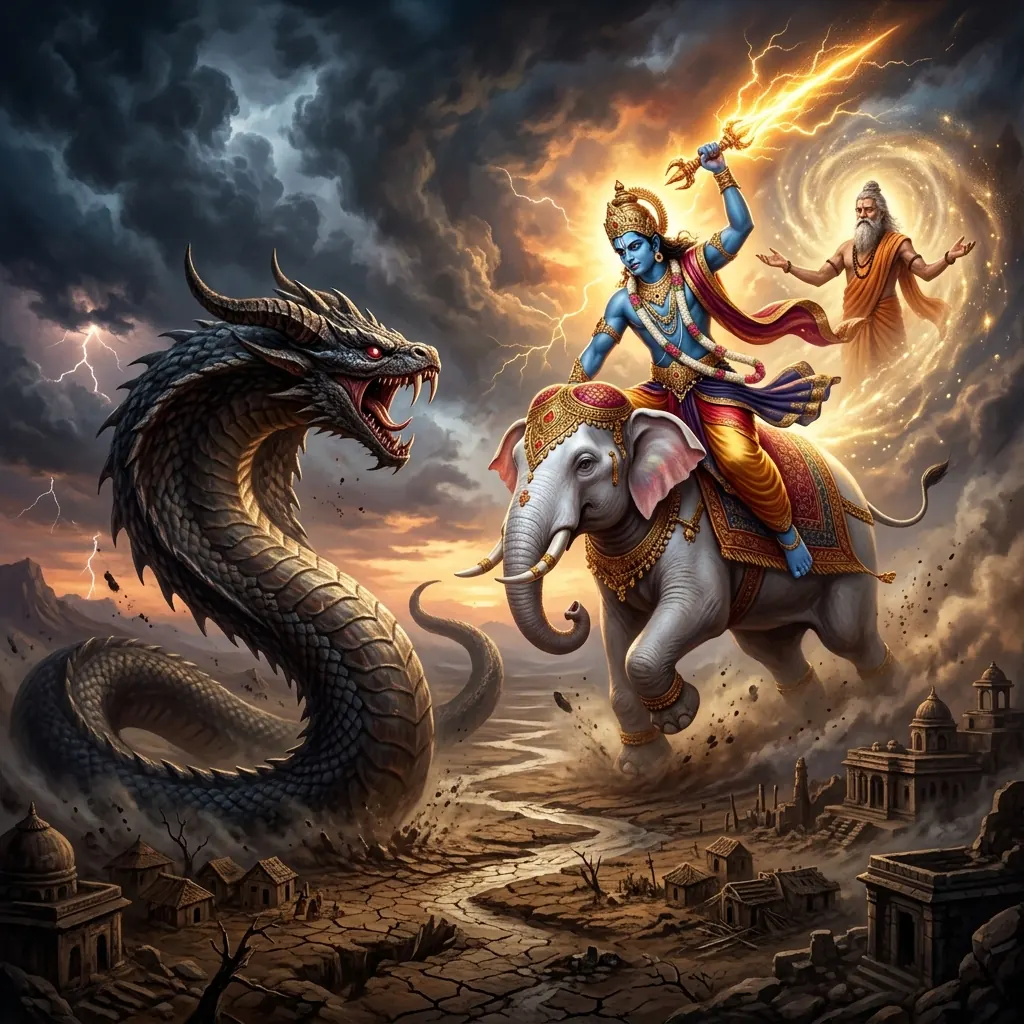
The Fourth Portion of Vishnu
Sanatkumara tells the defeated Vritra what holds up the universe, and Bhishma tells Yudhishthira who Krishna is
In short
Bhishma recites the discourse that the sage Sanatkumara gave to the Danava Vritra after he had lost the three worlds: that the universe rests on Vishnu, who is reached not by learning or penance or sacrifice but by restraint of the senses, and who wears the earth for feet and heaven for a head. The sage measures a creation by the drying of lakes with the tip of a hair, sets out the six colours a soul may take and the fourteen hundred thousand stages it must pass, and names the road out. Vritra, freed of grief, gives up his breath. Then Yudhishthira asks whether Krishna is that same Lord, and Bhishma answers that Keshava creates the three worlds from a fourth portion of that Lord's richness, and that the Pandavas have nothing to fear.
Told in the Shanti ParvaSet in Kurukshetra23 min read
The Sage Who Came While They Were Talking
Yudhishthira had asked, that morning, when he would be allowed to put the kingdom down. He had been given it a few days before and he already found it heavy, and he wanted to know when a man born into sorrow could go out into the woods and be finished with sorrow altogether. Bhishma, lying on the arrows with the whole of his answer still ahead of him, had told him that everything has an end, that even rebirth has an end, and that the fear he was expressing had been felt before by someone in a far worse position than a newly crowned king.
That someone was Vritra, chief of the Danavas, who had ruled the three worlds and lost them, and who sat among his enemies without sovereignty and without grief. His teacher Ushanas, whom the world calls Shukracharya, teacher of the asuras, had asked him whether the defeat did not gnaw at him, and Vritra had answered with the whole round of birth and death, and had ended by asking the questions that a man asks only when he has nothing left to lose.
From whom do creatures spring and live? Through whom do they act? What is that high fruit by reaching which a creature succeeds in living eternally as Brahma? By what act, by what knowledge, is it reached?
"Listen with undivided attention," Bhishma said, "to what the sage Ushanas said when that prince of the Danavas had put this to him."
Ushanas began with a bow.
"I bow to that divine, illustrious and mighty Being who holds this earth and the sky in his arms. I will speak to you of the supreme greatness of that Vishnu whose head, best of the Danavas, is that Infinite place."
He meant the place called Emancipation, and he did not get past the sentence.
For while the two of them were talking, the great sage Sanatkumara, righteous of soul, came to them to clear away their doubts. He was worshipped by the prince of the asuras and by Ushanas both, and he sat down on a costly seat, and when he was comfortable Ushanas gave away his own discourse without a word of complaint.
"Speak to this chief of the Danavas," he said, "about the supreme greatness of Vishnu."
The teacher of the asuras sat down beside his pupil and became a listener.
The Goldsmith and the Sesame Grains
"Listen, Daitya, to everything about the greatness of Vishnu," Sanatkumara said. "Understand, scorcher of foes, that the entire universe rests on Vishnu."
He laid out the shape of the thing first. It is He who creates all creatures mobile and immobile. In course of Time it is He who withdraws all things, and in Time it is He who once more casts them forth from Himself. Into Hari all things merge at the universal destruction, and from Him all things again come forth. There is no other warehouse. What goes away goes into Him and what arrives arrives out of Him, and the interval between the two is what creatures call the world.
Then he answered the question about the means, and the answer was a series of refusals.
Men learned in the scriptures cannot reach Him by that learning. Nor can He be reached by penances. Nor by sacrifices. The only way to reach Him is by restraining the senses.
Sanatkumara did not leave the sacrifices lying there insulted. Not that they are entirely useless towards such an end, he said. A man relying upon both external and internal acts, and upon his own mind, can purify them by his own understanding, and by such means he succeeds in enjoying infinity in the world. The rite is not the payment. The rite is one of the tools with which a man cleans himself, and the cleaning is slow.
He gave three pictures of how slow.
As a goldsmith purifies the dross of his metal by casting it into the fire again and again, with very persistent efforts of his own, so Jiva succeeds in cleaning himself by his course through hundreds of births. Some one may be seen to purify himself in only one life by mighty efforts, but that is the exception, and it is named as an exception.
As one should wipe stains from off one's person before they become thick, so one should with vigorous efforts wash off one's faults, and the time to do it is early.
And the third. By mixing only a few flowers with them, grains of sesame cannot be made to cast off their own odour. But when those grains are perfumed repeatedly with the aid of a large quantity of flowers, then they give up what they smell of and take the smell of the flowers instead.
"In this way," he said, "faults, in the form of attachments to everything around us, are driven out by the understanding over the course of many lives, with the help of a large measure of the quality of Sattwa, and through efforts born of practice."
The Body That Is the World
"The Supreme Lord creates all creatures mobile and immobile," Sanatkumara said. "He is without beginning and without end."
Without attributes of any kind, He takes on attributes when He chooses to create. He is the universal Destroyer, the Refuge of all things, the Supreme Ordainer, and pure Chit. In all creatures it is He who dwells as the mutable and the immutable. With eleven modifications as His essence, He drinks this universe with His rays.
And then, because a Danava asked to be told what holds up the world will not be satisfied by abstractions, the sage gave him the body.
Know that the Earth is His feet. His head is constituted by Heaven. His arms are the several points of the compass. The intermediate space is His ears. The light of His eye is the Sun, and His mind is in the Moon. His understanding dwells always in Knowledge, and His tongue is in Water. The Planets are in the midst of His brows. The stars and the constellations are from the light of His eyes. The Chandas, the metres in which the hymns are sung, are the hair on His body, and Akshara, which is Pranava, the syllable Om, is His word. The diverse orders of men and the modes of life are His refuge. His mouths are many. Duty is planted in His heart.
Rajas, Tamas and Sattwa are of Him. He is the fruit of all the modes of life. He is the reward of every pious act, of japa and of sacrifice, and He is also, being the Highest and the Immutable, the fruit of abstention from all work whatsoever. The man who acts and the man who has stopped acting arrive at the same door.
Then the names, which Sanatkumara did not soften.
He is Brahma. He is the highest Righteousness. He is Sat and He is Asat. He is Sruti. He is the scriptures. He is the sacrificial vessel. He is the sixteen Ritwijes who conduct the rite. He is all the sacrifices. He is the Grandsire. He is Vishnu. He is the twin Ashvins. He is Purandara, who is Indra. He is Mitra. He is Varuna. He is Yama. He is Kubera, the lord of treasures.
"Although the Ritwijes seem to see Him as separate," the sage said, "they know Him as one and the same. Understand that this entire universe is under the control of One divine Being."
The Veda that is in the soul, he added, sees the unity of all creatures. When a living creature realises that unity through true knowledge, he is said to reach Brahma.
The Lakes and the Tip of a Hair
Vritra had ruled for a long time, by any measure a Danava would use, and it had ended. So the sage gave him a measure that was not a Danava's.
The period of time for which one creation exists, or for which it ceases to exist, is called a Kalpa. Living creatures exist for a thousand millions of such Kalpas. Immobile creatures also exist for an equal period. Those numbers are said plainly and are not meant to be imagined, because they cannot be, and Sanatkumara knew it, and so he put the same quantity into a shape that a mind can hold.
"Conceive a lake," he said, "that is one Yojana in width, one Krosa in depth, and five hundred Yojanas in length."
That is a body of water long enough to take a marching army many days to walk beside.
"Imagine many thousands of such lakes."
Not one. Thousands, filled, standing side by side.
"Seek then to dry up those lakes by taking from them, only once a day, as much water as may be taken up with the end of a single hair."
Once a day. One hair's tip of water. Not a cup, not a drop, but the wet that clings to the end of one hair when it is dipped and lifted out, and then nothing more until tomorrow.
The number of days that would pass in drying up those lakes completely by that process is the period occupied by the life of one creation, from its first start to the time of its destruction.
And a thousand millions of those are the term of a creature's wandering.
It is worth noticing what the sage was doing to his listener, who had come to this conversation as a defeated king. He was not consoling him. He was not telling him that his loss was small. He was showing him a clock beside which sovereignty over the three worlds is not even an event, and he was about to explain that the wandering is not aimless, that it has a scale of hues from the bottom to the top, and that a creature can be somewhere on it deliberately rather than by accident.
Six Colours
"The highest Evidence for all things," Sanatkumara said, "says that creatures have six colours."
Dark, Tawny, Blue, Red, Yellow and White. These are not the colours of skin or of cloth. They are the colours a life takes on, and they proceed from mixtures, in various proportions, of the three attributes, Rajas and Tamas and Sattwa. The sage gave the proportions one by one, and the arithmetic of it is worth following, because it is the whole map.
Where Tamas predominates, Sattwa falls below the mark, and Rajas keeps to the mark, the result is the colour called Dark.
When Tamas predominates as before, but the relations between Sattwa and Rajas are reversed, the result is the colour called Tawny.
When Rajas predominates, Sattwa falls below the mark, and Tamas keeps to the mark, the result is the colour called Blue.
When Rajas predominates as before, and the proportion between Sattwa and Tamas is reversed, the result is the intermediate colour called Red. That colour is more agreeable than the one before it.
When Sattwa predominates, Rajas falls below the mark, and Tamas keeps to the mark, the result is the colour called Yellow. It is productive of happiness.
And when Sattwa predominates and the proportion is reversed between Rajas and Tamas, the result is the colour called White. It is productive of great happiness.
Three ingredients, six recipes, and every creature that has ever lived standing somewhere in that list.
"The White is the foremost colour," the sage said. "It is sinless because it is free from attachment and aversion. It is without grief, and free from the toil that Pravritti brings. That is why White, prince of the Danavas, leads to success."
Jiva, after passing through thousands of births from the womb, at last reaches that success. It is the very end that the divine Indra declared after studying many auspicious spiritual treatises, and its essence is the realisation of the Soul.
Then one line that put the whole scheme back into motion, and that a listener who was about to die would not have missed.
The end that creatures obtain is dependent on their colour, and colour, in its turn, depends upon the character of the Time that sets in.
Fourteen Hundred Thousand Stages
"The stages of existence through which Jiva must pass are not unlimited," Sanatkumara said. "There are fourteen hundred thousand of them."
Through them Jiva rises, stays, or falls, as the case may be. The sage then walked the ladder from the bottom, and there was no hurry in it anywhere.
The end reached by a Jiva of the Dark hue is very low, for he becomes given to acts that lead to hell, and then he has to rot in hell. The learned say that, because of his wickedness, a Jiva's stay in such a form is measured in many thousands of Kalpas.
After passing many hundred thousand years in that condition, Jiva then reaches the colour called Tawny, and is born as an intermediate creature, an animal, and there he dwells for many long years in perfect helplessness.
At last, when his sins are exhausted and he has endured all the misery they can bring, his mind casts off its attachments and holds to Renunciation. When Jiva gains the quality of Sattwa, he drives out everything connected with Tamas with the help of his intelligence and strives for what is good, and as a result he reaches the colour called Red. If he does not gain the quality of Sattwa, he travels instead in a round of rebirths in the world of the inert, having reached the colour called Blue.
Having reached humanity, and having been held for one whole creation in the bonds born of his own acts, Jiva reaches the colour called Yellow, which is to say that he becomes a deity. He exists in that condition for the space of a hundred creations, then leaves it to be a human being, then returns to it. He takes his pleasure for thousands of Kalpas as a deva. Since he is still not liberated, even then he has to stay in hell, enjoying or enduring the fruits of his acts of past Kalpas, and wandering through nineteen thousand courses.
Falling from the world of the gods he gains the status of humanity once more, and stays in it for a hundred and eight Kalpas, and then attains once more to the status of a deva.
And here the sage put in the trapdoor.
If, while in the status of humanity for the second time, he falls through the evil acts represented by Kala in the form of Kali, he sinks into the Dark colour and occupies the very lowest of all the stages of existence.
Godhood, twice held, is not a safe place to stand.
The Road Out
"Now I will tell you, foremost of the asuras, how Jiva succeeds in winning his Emancipation."
Seeking Emancipation, Jiva relies on seven hundred kinds of acts, every one of them marked by a predominance of the quality of Sattwa, and through them he gradually passes through Red and Yellow and at last reaches White. Once there, he travels through several most worshipful regions, which have the eight well-known regions of happiness beneath them, and all the while he pursues that stainless and radiant form of existence which is Emancipation's self.
Then he qualified it. The Eight already mentioned, he said, which are the same as the Sixty subdivided into hundreds, are, to those of great radiance, only creations of the mind. The highest object of acquisition with one who is White of hue is that condition called Turiya, the fourth, which transcends the three other states of consciousness, wakefulness and dream and dreamless slumber.
Then he described the two men who stop short.
There is the Yogin who cannot give up the delights that the power of Yoga brings. He has to dwell in one and the same body for a hundred Kalpas in auspiciousness, and after that in four other regions, called Mahar and Jana and Tapas and Satya. That is the highest end of one who belongs to the sixth colour, and who is unsuccessful though crowned with success, and who has transcended all attachments and passions.
And there is the Yogin who falls off from his practices after attaining that eminence. He lives in heaven for a hundred Kalpas with the unexhausted remnant of his past acts, and with the seven, which are the five senses of knowledge and the mind and the understanding, purged of all stains by their leaning towards Sattwa. When that period ends he comes to the world of men, where he rises to great eminence. Turning back from the world of men he goes on to new forms of existence that rise higher and higher, passing through seven regions seven times, his power always increased by his Samadhi and his reawakening from it.
The one who wants the end itself does something harder. He suppresses those same seven by Yoga-knowledge, and continues to dwell in the world of life freed from attachments, and taking the seven for certain means of grief he casts them off, and attains afterwards to that which is Indestructible and Infinite.
"Some say that that is the region of Mahadeva," the sage said. "Some, of Vishnu. Some, of Brahman. Some, of Shesha. Some, of Nara. Some, of the radiant Chit. And some, of the All-pervading."
What Happens When the Worlds Are Put Away
There remained the question of what a universal destruction does to those who are caught in it, and Sanatkumara sorted the caught into three kinds.
When universal destruction comes, those persons who have succeeded in completely consuming by Knowledge their gross and subtle and karana bodies always enter into Brahma. All their senses too, which have action for their essence and which are not identical with Brahma, merge into the same. These are the ones for whom the ending of the worlds is simply the ending of the worlds, and no more.
Those Jivas who have risen to the position of devas, and who still have an unexhausted remnant of the fruits of acts to enjoy or endure, revert in the subsequent Kalpa to the stages of life that had been theirs in the previous one. This is due to the similarity of every successive Kalpa to every previous one. The universe is dismantled and rebuilt to the same plan, and a creature wakes up on the same rung he was standing on when the lights went out.
And those whose acts have been exhausted by enjoyment or endurance in respect of their fruits fall down from heaven and take birth among men in the subsequent Kalpa, for without Knowledge one cannot destroy one's acts in even a hundred Kalpas. All superior Beings, with similar powers and similar forms, return to their own destinies at a new creation, ascending and descending precisely in the same manner as during the creation that was dissolved.
Then the sage turned from the machinery to the man who is done with it.
As regards the person who is conversant with Brahma, so long as he continues to enjoy and endure the unexhausted remnant of his acts of previous Kalpas, it is said that all creatures and the two stainless sciences live in his body. When his Chitta becomes cleansed by Yoga, and when he practises Samyama, this perceptible universe appears to him as only his own fivefold senses. The world does not vanish for such a man. It shrinks to what it always was, five doors and what comes in at them.
Enquiring with a purified mind, Jiva reaches a high and stainless end. From there he reaches a place that knows no decay, and from there eternal Brahma, which is so hard to attain.
"So, mighty one," Sanatkumara said, "I have told you of the greatness of Narayana."
Vritra Puts Down His Breath
Vritra had asked his questions and had been answered at a length that would have exhausted a patient man, and what he said at the end of it was not an argument.
"I see that these words of yours are wholly in keeping with the truth. And since this is so, I have no cause for grief. Now that I have listened to your words, you of great mind, I am freed from sorrow and from every kind of sin."
Then he said what he was looking at.
"Illustrious rishi, holy one, I see that this wheel of Time, full of mighty energy, belonging to the most radiant and Infinite Vishnu, has been set in motion. Eternal is that station from which every kind of creation springs. That Vishnu is the Supreme Soul. He is the foremost of Beings. In Him this entire universe rests."
He had begun the conversation as a king who had lost a kingdom and had refused to weep about it, which his own teacher had called foolish rhapsody. He ended it having been told the size of a Kalpa and the price of a colour and the fourteen hundred thousand stages, and having found in all of that not a rebuke but a place to stand.
Ushanas, who had opened the discourse and then handed it away, said nothing at all.
"When he had said this, son of Kunti," Bhishma said, "Vritra gave up his life-breaths, uniting his soul in Yoga with the Supreme Soul, and reached the highest station."
That is the whole of the death. There was no battle in it, no weapon, no last defiance. A defeated Danava sat in front of two brahmanas, listened until he understood, and then let go of his breath the way a man puts down a load he has been told he may put down, and went where the discourse said he would go.
On the field at Kurukshetra the old man stopped there, and the king who had been listening asked the one question that such a story leaves behind.
"Tell me, grandfather," Yudhishthira said, "whether this Janardana is that illustrious and mighty Lord of whom Sanatkumara spoke to Vritra long ago."
The Fourth Portion
Janardana was the man who had driven his brother's chariot and gone to Hastinapura as their envoy and come back refused. Bhishma answered with an arrangement.
"The Highest Deity, who has the six attributes, is at the Root. Staying there, the Supreme Soul, by his own energy, creates all these many existing things. Understand that this Keshava never moves from that fourth portion of His. Possessed of the highest Intelligence, it is this Keshava who creates the three worlds from that fourth portion of His richness."
A quarter of Him, then, is what the three worlds cost, and the rest stands untouched beyond them.
Coming immediately after Him who lies at the Root, Bhishma said, this Keshava, who is eternal compared with all other existent things, changes at the end of each Kalpa. But He who lies at the Root, of supreme might and power, lies in the waters when universal destruction comes, in the form of the potential Seed of all things. Keshava is that Creator of pure Soul who courses through all the eternal worlds, filling all space with emanations from Himself and coursing through the universe in the form of everything that constitutes it. Freed from limitations of every kind, He suffers Himself to be invested with Avidya and awakened to Consciousness, and creates all things.
"In Him," the old man said, "rests this wondrous universe in its entirety."
Yudhishthira went back to the colours.
Vritra, he said, must have foreseen the excellent end that awaited him, and that was why he did not give way to grief. One who is White of hue, who has been born in a stainless race, and who has risen to the rank of a Sadhya, does not come back. But he who has attained to either the Yellow or the Red hue is seen sometimes to be overwhelmed by Tamas and to fall among the order of intermediate creatures.
"As for ourselves, we are deeply troubled, and attached to things that bring sorrow or indifference or joy. Alas, what end will we come to? Will it be the Blue, or the Dark, which is the lowest of all hues?"
"You are Pandavas," Bhishma said. "You were born in a stainless race. You are strict in your vows. After taking your pleasure in joy in the worlds of the gods, you will come back to the world of men. Living happily as long as the creation lasts, all of you will be admitted among the gods at the next creation, and after enjoying every kind of happiness you will at last be counted among the Siddhas. Have no fear. Be cheerful."
Dharma Lesson
Vritra asks his questions from the worst position a king can occupy, having held the three worlds and lost them, and the answer he receives offers him no compensation at all. It gives him a clock beside which his empire was not even an event, a ladder with a trapdoor near the top where godhood is held twice and then forfeited, and a road out that is walked over hundreds of births by a soul cleaning itself the way a goldsmith burns dross out of metal. What steadies him is not consolation but scale. And when Yudhishthira, newly crowned and already sick of it, asks where his own life stands on that ladder, the old man does not lecture him. He tells him whose son he is, and tells him to cheer up.