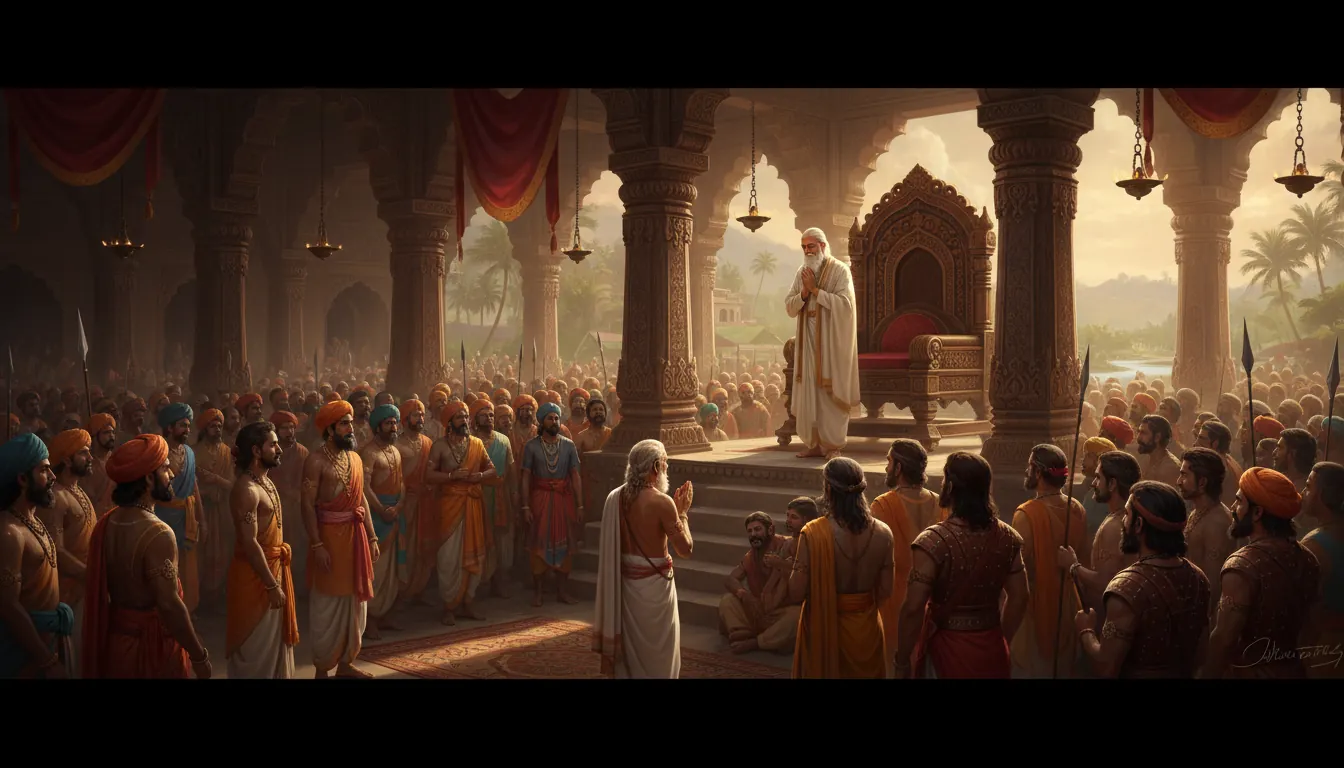
The King Asks Leave of His People
An Assembly Absolves the Man Who Ruined It
In short
His last lesson in kingcraft finished, Dhritarashtra calls every order of Kuru-jangala into his hall and asks their permission to retire, joining his hands and blaming the carnage on his own impolicy. The crowd is struck dumb, then weeps, then chooses one brahmana to answer. Samba tells him Duryodhana never wronged them and that destiny alone destroyed eighteen armies.
Told in the Ashramavasika ParvaSet in Hastinapura and Kurukshetra17 min read
Enough, Son, My Labour Has Been Great
Vaishampayana said to Janamejaya: the old king had been teaching for days. He had gone through the circles of kings, the friends and the neutrals and the enemies at one remove; the twelve concerns and the six measures; when to march and when to sit still; what land to give a stronger enemy and what gold, and how a king who must lose should lose. He had told Yudhishthira how to gratify an army before hurling it, and how to keep the blind and the deaf and the diseased among his people fed. He spoke without seeing anything, his hands resting on his knees, and Yudhishthira sat at his feet and did not interrupt him once.
When the last of it was said, Yudhishthira answered.
"Lord of the Earth, I will do as you tell me. But I need further teaching from you. Bhishma has gone to heaven. The slayer of Madhu has gone away to Dwaraka. Vidura and Sanjaya will go with you into the forest. Who but you is left to teach me? What you have taught me today, out of care for my good, I will certainly follow. Be sure of that."
It was said as a promise. Dhritarashtra heard in it what was actually there, which was a question about who would be left in the house afterward, and he did not answer it. He had been waiting through all of the instruction for the moment when he could ask for something in return, and this was the moment, and he found that what came out of him was not a request at all.
"Enough, son," he said. "My labour has been great."
Then he rose, and felt for the doorway with his hand, and went into the inner apartments where Gandhari was.
Gandhari Knows the Hour
He sat down on a seat, and Gandhari came and stood by him. She had worn the cloth over her eyes for as long as she had been his wife, and she had a way of knowing the shape of a silence, and she had known since the morning what he was going to do.
"You have the permission of the great rishi," she said. "Vyasa himself has given it. When, then, will you go to the forest, with Yudhishthira's leave?"
"I have the permission of my great-souled father," Dhritarashtra said. "When I have Yudhishthira's, I will soon withdraw into the woods. But there is a thing I want to do first, and I cannot do it in the forest."
"Say it."
"I want to give away wealth," he said. "Wealth of the kind that follows a man into the state of a Preta and reaches him there. For all those sons of mine who were given over to ruinous dice. All of them. I want to make those gifts openly, and I want to invite the whole people into my mansion to see them made, and not do it in a corner as a man does a thing he is ashamed of."
Gandhari said nothing for a moment. A hundred sons had gone out of that house and none had come back, and there was no woman in the world who had less reason than she to consent to a public accounting of how they had lived. She had never pretended, to anyone, that her sons had been other than what they were.
"Invite them," she said. "And I will sit where they can see me. If you are going to ask a whole kingdom for its pardon, it should not have to ask where your wife is standing."
The Four Orders Come to the Mansion
He sent for Yudhishthira, and Yudhishthira came, and was told what was wanted, and did not argue. At his uncle's command he brought all the articles necessary. Whatever the old king asked for was in the hall before the old king had finished naming it.
Then the people came. Brahmanas who lived in Kuru-jangala, many of them, and many who had travelled in from other realms; kshatriyas whose fathers and sons had not come back from Kurukshetra; vaishyas who kept the grain and the cattle and the shops of the city; shudras who served in the houses of all of them. They came with glad hearts, because a summons from the palace had not meant anything good for a long time and this one, whatever it was, was not a levy.
They filled the hall and then the courtyard beyond it. Old men were given room at the front. Men stood who had not stood in the same room as one another since the war, and stood quietly.
Dhritarashtra came out of the inner apartments, led by the hand, and was set in his place, and turned his blind face toward the noise of them and waited until the noise stopped. He could not see how many there were. He asked, and was told, and it was more than he had expected, and for a moment he could not begin.
They were his well-wishers. That was the strange thing, and the thing that made it hard. They had come because he had sent for them, and they were standing there patiently in the heat, waiting to hear what their king wanted, fifteen years after their king had emptied the country of its men.
What He Asked Them For
"You and the Kurus have lived together for many long years," Dhritarashtra said, "wishing each other well, each busy doing good to the other. What I am going to say now, because of the occasion that has come, I ask you to do for me as disciples do what their teachers ask."
They listened. Nobody yet knew what was coming.
"I have set my heart on retiring into the woods, with Gandhari as my companion. Vyasa has approved it. The son of Kunti has approved it. Let me have your permission also. Do not hesitate in this."
There was a sound in the hall then, not words, a single indrawn breath from several hundred people at once.
"The goodwill that has always existed between you and us," he went on, "is not to be seen, I believe, between rulers and ruled in any other realm. I am worn out with this load of years on my head. I have no children left. I am wasted with fasting, and so is she. The kingdom has passed to Yudhishthira and I have enjoyed great happiness under him, and I will tell you the truth, sinless ones, since I am telling you everything else: that happiness has been greater than what I could have expected from Duryodhana's rule."
He stopped, as though he had surprised himself, and then said the rest of it.
"What other refuge can I have, old as I am and with no children left, but the woods? Blessed ones, you should grant me the permission I seek."
The residents of Kuru-jangala answered him with lamentations, loud, in voices choked with tears, and not one of them said yes and not one of them said no. Dhritarashtra stood in the middle of that sound and understood that he had not yet said the thing he had actually come out of his apartments to say, and that he would have to say it now.
Through My Own Bad Policy
"Shantanu ruled this Earth rightly," he said. "So did Vichitravirya, protected by Bhishma. All this you know. You know too how Pandu my brother was dear to me and dear to you, and how he ruled you rightly. And I have served you. Whether that service came up to the mark or fell short of it, you should forgive me, for I attended to my duties without carelessness."
He raised his hands and put them together in front of him, a king joining his palms to his own subjects, and the men nearest the front saw it and went still.
"Duryodhana also enjoyed this kingdom without a thorn in his side. He was foolish, and his understanding was wicked, but he did you no wrong. Through the fault of that wicked-minded prince, and through his pride, and through my own bad policy, a great carnage of men of the royal order has taken place. Whether I acted rightly or wrongly in that matter, I beg you with joined hands to put all memory of it out of your hearts."
Then he gave them the reasons they might use, laying them out one by one like a beggar laying out what he has.
"This man is old. This man has lost all his children. This man is stricken with grief. This man was our king. This man is a descendant of former kings. Thoughts like these should move you to forgive me. This Gandhari too is cheerless and old, and has lost her children, and is helpless, and stricken with grief for the loss of her sons, she begs you along with me."
And he set down beside them the last thing he had.
"This Kuru king, Yudhishthira, the son of Kunti, should be looked after by you in prosperity and in adversity. He will never fall into distress, with four such brothers for counsellors. I hand this Yudhishthira over to you as a trust. And I place you as a trust in the hands of this hero. You should forget and forgive whatever injury has been done to you by those sons of mine who are no longer alive, or by anyone else belonging to me. You never bore any anger against me before. I join my hands before you. Here, I bow to you all."
And the old king bowed.
The Assembly Cannot Answer
Nobody answered him.
The citizens and the inhabitants of the provinces stood there filled with tears, and said nothing at all, and only looked at one another. They stood, Vaishampayana said, like men deprived of consciousness. What had been asked of them had no form they recognised. A king had asked them to release him, and to pardon him, and to pardon his dead sons, and there was no custom for it and no elder who had ever done it before them, and every man in the hall was waiting for some other man to know what to do.
Dhritarashtra, finding them silent, with their throats choked by grief, spoke a third time, and more simply than before.
"Best of men, old as I am, sonless, pouring out many laments in the sadness of my heart along with my wedded wife here, I have obtained permission to retire from my father, the Island-born Krishna himself, and from king Yudhishthira, who knows every duty. Righteous people of this kingdom, sinless ones, I beg you again and again with bowed head, and Gandhari with me. Grant us permission, all of you."
At those pitiable words from the Kuru king, the assembled denizens of Kuru-jangala all began to weep. They covered their faces with their hands and with their upper garments and wept where they stood, burning with grief, the way fathers and mothers weep at the prospect of a dear son leaving them forever. Every other thought had been driven out of them by the one fact that he was going.
Then, slowly, they got hold of themselves. They began to speak to one another, saying what they wished, and settling their words in brief. And when they had settled them, they charged one man with the task of replying to the old king.
The Man They Chose
The man they chose was a brahmana named Samba: of good behaviour, conversant with all topics, master of all the Richs, taken by unanimous consent and not by rank. He was nobody's minister. He took the permission of the whole assembly, and with its full approbation, conscious of his own abilities, he stepped forward where the blind king could hear him.
"King, the answer of this assembly has been put in my care. I will give voice to it. Receive it, king."
"Speak," said Dhritarashtra.
"What you say is all true, king of kings. There is nothing in it that is even slightly untrue. You wish us well, as indeed we wish you. In this line of kings there was never a king who, coming to rule his subjects, became unpopular with them. You have ruled us like fathers or brothers."
Then he said the sentence that the whole hall had been unable to say and had chosen him to say for them.
"King Duryodhana never did us any wrong."
No one contradicted him. He went on.
"We were well protected and ruled by king Duryodhana just as we had been ruled by king Shantanu, or by Chitrangada, or by your father, who was protected by the prowess of Bhishma, or by Pandu, that ruler of the Earth. Your son never did us the slightest wrong. We lived relying on that king as trustfully as on our own father. You know how we lived under him. And in the same way we have enjoyed great happiness under Kunti's wise son, who performs sacrifices and gives lavish gifts and follows the conduct of the royal sages of old. There is nothing in the least to blame in this Yudhishthira's rule. Not the slightest fault can be laid at your door or at your son's."
He let that stand a moment, because he knew what he had just done. Duryodhana had gambled a cousin's wife into a hall and stripped the country of its men, and to the citizens of Kuru-jangala he had been a good landlord, and both of those things were true, and the assembly had chosen to say the one that would let the old man walk into the forest.
"As for what you have said about Duryodhana in the matter of this carnage of kinsmen," said Samba, "I beg you, delight of the Kurus, to listen to me."
Eighteen Armies in Eighteen Days
"The destruction that has overtaken the Kurus was not brought about by Duryodhana," the brahmana said. "It was not brought about by you. Nor was it brought about by Karna and Subala's son. We know that it was brought about by destiny, and that nothing could have prevented it. Destiny cannot be resisted by human effort."
He put the arithmetic of it in front of them, since the assembly was full of men who had counted their own dead.
"Eighteen akshauhinis of troops were brought together, king. In eighteen days that host was destroyed. It was destroyed by the greatest of Kuru warriors, by Bhishma and Drona and Kripa and the others, and by the great-souled Karna, and by the heroic Yuyudhana, and by Dhrishtadyumna, and by four sons of Pandu, that is, by Bhima and Arjuna and the twins. Consider what that means. Such a carnage could not happen without the influence of destiny. And it is kshatriyas above all who must kill their foes and meet death in battle. By those greatest of men, with their skill and their might of arms, the Earth has been laid waste with her horses and chariots and elephants. Your son was not the cause of that carnage of great-souled kings. You were not the cause, nor your servants, nor Karna, nor Subala's son. The destruction of those leading men of Kuru's race, and of kings by thousands, was brought about by destiny. Who can say otherwise?"
And then, standing in front of several hundred citizens who had lost sons in that eighteen days, the brahmana did the thing the assembly had sent him to do.
"You are regarded as the Guru and the master of the whole world. So we, in your presence, absolve your righteous son. Let that king, with all his companions, reach the regions kept for heroes. With the leave of the best of brahmanas, let him take his joy in heaven. And you too will gain great merit, and unwavering steadiness in virtue. You of excellent vows, follow fully the duties the Vedas lay down."
Dhritarashtra did not speak. He had asked to be forgiven for his own impolicy and had been told, by the only people entitled to tell him, that there had been no impolicy to forgive. It is not clear from anything he said afterward whether he believed it.
Excellent, Excellent
"There is no need for you or for us to look after the Pandavas," Samba said, finishing. "They could rule the heavens themselves; what need is there to speak of the Earth? In prosperity as in adversity the subjects of this kingdom will be obedient to the Pandavas, who are adorned by their own good conduct. The son of Pandu is mild and self-restrained and spends as if he were a second Vaishravana. He is compassionate even to his foes. He rules and protects us like a father protecting his children. Through their closeness to him who is the son of Dharma, Bhima and Arjuna and the others will never do us the least wrong. They are mild to those who are mild, and fierce like snakes of deadly poison to those who are fierce. Neither Kunti, nor your daughter-in-law of Panchala, nor Ulupi, nor the princess of the Satvata race, will do the least wrong to these people. The affection you have shown us, which in Yudhishthira is seen in still greater measure, can never be forgotten by the people of the city and the provinces. Put all anxiety about Yudhishthira out of your heart, king, and set yourself to doing every meritorious act."
He stepped back. And every person in that assembly, hearing words so full of righteousness and merit, said "Excellent, Excellent," and accepted them as his own, so that the answer became not one brahmana's but the whole hall's.
Dhritarashtra applauded the words again and again, and then, slowly, dismissed the assembly of his subjects. They looked at him with auspicious glances as they went. And the old king, honoured by them, joined his hands once more and honoured them all in return, standing there returning the salute of every order of his people while they filed out past a man who could not see them.
Then he took Gandhari's hand and entered his own mansion, having been given leave to go, and having been told that there was nothing to give him leave for.
What he did after that night had passed, Vaishampayana said, you will hear next.
Dharma Lesson
The people a ruler failed may forgive him more readily than he can forgive himself, and their pardon is not the same thing as the truth. A public absolution can close a grievance without ever settling the question of guilt, and the man absolved is left to carry the difference into the forest with him.