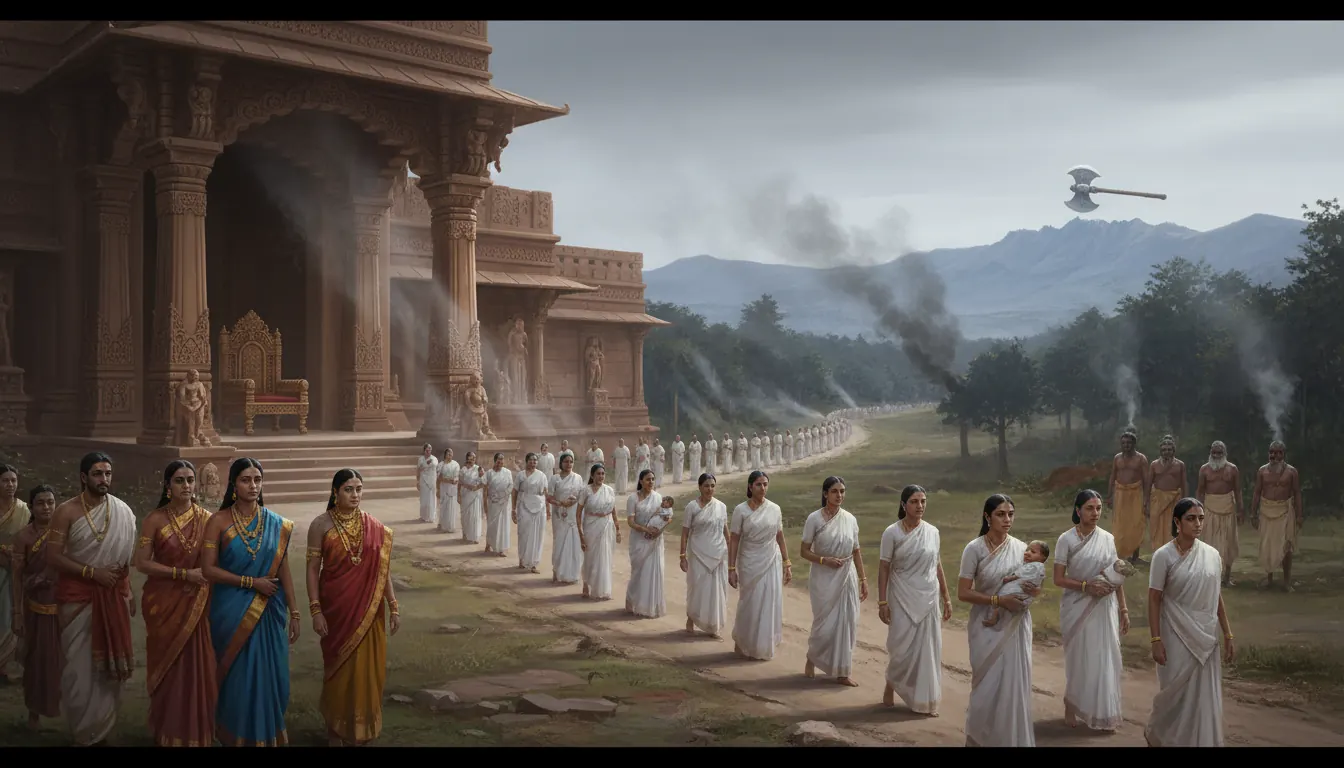
The Age After the Axe
How the warrior caste came back, and how it was spoiled again
In short
With Parashurama withdrawn to Mahendra after twenty one exterminations, the widowed kshatriya women go to the brahmanas for children, and the warrior order is rebuilt out of ascetics. A Krita age follows in which no child dies untimely, no merchant weighs falsely and no brahmana teaches for money. Then the beaten Daityas begin taking birth in royal houses, and the earth, unable to carry them, goes to Brahma.
Told in the Adi ParvaSet in Mahendra Parvata, Brahmaloka and Takshashila15 min read
A Mystery Even to the Gods
"Brahmana," said Janamejaya, "I wish to hear in detail of those you have named and those you have not named, and of thousands of other kings besides. And, fortunate one, I ask you to tell me in full the purpose for which those Maharathas, equal to the gods themselves, were born on earth."
It was not an idle question and Vaishampayana did not treat it as one. The king had been given the genealogies, the names of the great chariot-warriors on both sides of the field where his own great-grandfathers had destroyed one another, and he had noticed the thing that everybody notices sooner or later: that there were too many of them, and that they were too large. Men of that size do not occur by accident in one generation of one family.
"We have heard, king," the sage said, "that what you ask is a mystery even to the gods. I will speak of it to you all the same, after bowing down to the Self-born."
He bowed. Then he began, not with a birth, but with a man who had stopped killing.
For the answer to Janamejaya's question does not start in any palace of the Kurus. It starts in an empty country, at the moment when the loudest sound on earth had just ceased.
The Axe Laid Down at Mahendra
The son of Jamadagni, after emptying the earth of kshatriyas twenty-one times, went to Mahendra, the best of mountains, and there began his ascetic penances.
Read the sentence slowly, because a whole age is folded into the first half of it. Twenty-one times he had gone through the warrior order of the world, and each time it had grown back, and each time he had come again with the axe. When he stopped at last, it was not because anyone had beaten him. He stopped because he was finished, and he walked east to a mountain on the sea and sat down to do penance, and the noise went out of the world.
What he left behind him was not a defeated caste. It was an absence. The thrones were empty and the armouries were full and there was no one to open them. In the houses of the kshatriyas there were widows and no husbands, and in most of those houses there were no sons either, and no brothers, and no cousins, and no boy of nine being taught to hold a bow, because Parashurama had been thorough and he had come back twenty-one times to be sure of it.
Consider what that means for a country. A caste is not only its men; it is a store of knowledge held in living hands, and the hands were gone. Nobody was left who could teach the drawing of a bow, or the ordering of a line, or the sitting of a court.
The world still needed protecting. Cattle still needed guarding and roads still needed keeping and the borders of villages still needed somebody who would ride out. And the order whose work that was had been taken off the earth.
The Women Go to the Ascetics
So the kshatriya women, longing for children, went to the brahmanas.
That is how the epic says it, in one clause, without argument or apology, and it is one of the strangest sentences in the whole book. The warrior caste of the world was rebuilt, deliberately and openly, by the caste that does not fight. The women went out of the empty houses and asked the men in the hermitages for children, and the men in the hermitages gave them.
And the manner of it was fixed as strictly as a rite, because it was one. Brahmanas of strict vows lay with them only in their fertile season, and never, king, out of lust, and never out of season. Not one of these unions was a romance. Nobody married. There was no household set up and no property joined and no bride led round a fire. It was done in the appointed days and not otherwise, by men under vows who understood exactly what they were being asked for and gave that and nothing else.
Thousands of kshatriya women conceived from such unions with brahmanas. And there were born, in that generation, many kshatriyas of greater energy than before, boys and girls both, so that the kshatriya race might thrive.
There was no other way to do it, and there was no pretending otherwise, and nobody in the story pretends. A caste is not a bloodline kept in a jar. It is a body of work that somebody has to be raised to do, and the raising takes a generation, and the world did not have one to spare. So the thing was done in the open, with vows and seasons and no shame attached to any party to it, and the sons of hermits grew up in reoccupied palaces learning to ride.
Which means that every king who comes later in this history, every one of the Maharathas whose names Janamejaya had just asked for, every man who stood on the field at Kurukshetra with a standard over his chariot, descends from an ascetic who gave up an afternoon of his penance because the world had run out of soldiers.
The Four Orders Set Up Again
The new generation was blessed with long life, and it began to thrive in virtue, and out of it the four orders, with the brahmanas at their head, were re-established one by one.
The discipline under which those children had been conceived did not stop with their conception. It became the ordinary practice of the world. Every man at that time went to his wife in her season, and never out of lust or out of season, and, bull of the Bharatas, in the same way the other creatures too, even the birds, went to their mates in the season alone. The restraint that had been forced on the world by an emergency was kept up afterwards by choice, from the ascetics down through the householders and out into the nests in the trees.
Hundreds of thousands of creatures were born, and all of them were virtuous, and they multiplied in virtue, and they were free from sorrow and from disease.
And this wide earth, with the ocean for her boundary, with her mountains and her woods and her towns, was once more governed by the kshatriyas. When the earth began again to be governed virtuously, the other orders with the brahmanas at their head were filled with great joy, and it is worth pausing on the reason. They were not glad because kings had returned. They were glad because the work each of them did was possible again. A merchant cannot trade on an unpoliced road, and a farmer cannot sow what an army will trample, and a sage cannot meditate in a hermitage that anybody may walk into with a spear.
Rain at the Proper Time
The kings who came out of that rebuilding gave up all the vices born of lust and of anger, and handed down punishments justly, to those and only those who deserved them, and so protected the earth.
And he of the hundred sacrifices, who has a thousand eyes, looked down and saw that the kshatriya kings were ruling virtuously, and poured down life-giving showers at the proper times and in the proper places, and blessed all creatures.
That is the oldest bargain in the book and it is set out here as plainly as it is ever set out. Indra does not send the rain to the strongest king or the most generous one. He sends it where punishment is awarded justly. Heaven watches the courts, and the crops are the verdict. A king in that age who wanted a good harvest could not buy it with a sacrifice; he had to earn it in the plainest and least glorious of his duties, which is deciding, correctly, which of two men before him is lying.
And notice the direction the gift runs. The kings did not petition for weather. They gave up lust and anger first, and judged rightly first, and the showers came afterwards as the consequence and not as the payment. Between a virtuous court below and a thousand eyes above there was no negotiation at all, only observation.
So the rain came when it was wanted and stopped when it was not, and the ground held, and the season did what the almanac said it would do, and men who had been born into the ruin left by the axe grew old in a world that was working.
The Krita Age
Then, king, no one died young, and no one knew a woman before coming of age, and so the earth, to the very coasts of the ocean, was filled with men who all lived long.
It is worth listing what that age actually consisted of, because the epic does not describe it in adjectives. It describes it in trades.
The kshatriyas performed great sacrifices and bestowed much wealth at them. The brahmanas studied the Vedas with their branches and the Upanishads, and no brahmana in those days ever sold the Vedas, which is to say taught them for money, or ever read them aloud in the presence of a shudra. The vaishyas had the earth tilled with the help of bullocks, and they never yoked the cattle themselves, and they fed all lean cattle with care. Men never milked cows while the calves were still drinking only their mothers' milk and had not yet taken to grass. And no merchant in those days ever sold his goods by false scales.
A golden age, in the telling of this book, is not a time of miracles. It is a time when nobody underfeeds a thin ox, nobody takes the milk a calf still needs, nobody teaches sacred knowledge for a fee, and nobody keeps a rigged balance under the counter. All persons held to the ways of virtue and did everything with their eyes set upon virtue, and every order was mindful of its own duties, and virtue in those days never grew less.
Both cows and women gave birth at the proper time, and the trees bore flowers and fruit as the seasons required. Once the Krita age had set in like this, the whole earth was filled with creatures.
Born in Kingly Lines
And when the earthly world was in this blessed state, the asuras began to be born in kingly lines.
They did not invade. There was no war in heaven that spilled downward, no gate broken open. The sons of Diti had been beaten in battle by the sons of Aditi again and again, and had been stripped of sovereignty and of heaven, and with nowhere else to go they simply took birth on the earth, in the ordinary way, in ordinary wombs.
They came in everywhere at once. Mighty and hungry for sovereignty, they began to be born among all kinds of creatures: among cows and horses, among asses and camels and buffaloes, among rakshasas and their kind, among elephants and deer. And some of the sons of Diti and of Danu, cast out of heaven, were born on earth as kings of great pride and insolence.
That is the part that matters. The palaces of the age just described, the courts where punishment had been awarded justly and the rain had come for it, began quietly filling with children who had lost a war in heaven and remembered it.
Full of great energy and able to crush any foe, they covered the earth in many shapes and filled it to its ocean boundary. By their strength they began to oppress brahmanas and kshatriyas and vaishyas and shudras and every other creature also. Terrifying and killing, they traversed the earth in bands of hundreds and thousands. Devoid of truth and of virtue, proud of their strength, intoxicated with the wine of their own insolence, they even insulted the great rishis in their hermitages.
And the punishments of the courts could hardly reach them, because these were kings, and a king is the one man in the settlement whom the settlement has no machinery for stopping. Every safeguard the age possessed was aimed downward from the throne. Nothing in it was aimed at the throne.
Everything the widows and the ascetics had rebuilt was still standing. It had simply been occupied, and the occupiers had come in through the nursery.
The Weight the Earth Could Not Hold
And the earth, oppressed like this by mighty asuras of great strength and great energy and abundant means, began to think of going to Brahman.
It would have taken the united strength of Shesha and the Tortoise and the huge Elephant, and of many Sheshas besides, to support her with her mountains under the weight of the danavas she was carrying. She was not complaining of cruelty only. She was being crushed. There is a difference between a bad king and a burden, and what had come to birth in those royal houses was a burden, a mass of beings who did not belong in the world in the numbers in which they now stood upon it.
So the earth, crushed by the weight and stricken with fear, sought the protection of the Grandsire of all creatures.
She found him surrounded, as he always is, by the gods and the brahmanas and the greatly fortunate rishis, and worshipped by delighted gandharvas and by apsaras always busy in the service of the gods, and she went in among all of them and stood before the Regents of the worlds and laid everything before him: what was being born, where, and how much of it she could hold.
She need not have troubled. The Omniscient, the Self-created, the Supreme Lord, had known the earth's purpose beforehand. Since he is the Creator of the universe, why should he not know fully what is in the minds of his creatures, the gods and the asuras included? He heard her out to the end regardless, which is a courtesy worth noticing in a deity who already had his answer prepared.
Be Incarnate
"Holder of wealth," said Brahman, "to accomplish the purpose for which you have come to me, I will appoint all the dwellers in the heavens."
When he had said that much to the Earth, he said farewell to her, and turned to the assembly, and gave the order that set this entire history in motion.
"To ease the Earth of her burden, go and be born in her, each according to his part, and seek out the asuras already born there and fight them."
Then he summoned all the tribes of the gandharvas and the apsaras as well, and spoke to them these words of deep meaning: "Go and be born among men, each according to your part, in whatever forms you like."
All the gods with Indra at their head heard those words, which were true, and right for the moment, and full of benefit, and accepted them. And once they had resolved to come down to the earth in their several parts, they went first to Narayana, the slayer of all foes, at Vaikuntha: he who has the discus and the mace in his hands, who is clad in yellow, who is of great splendour, who has the lotus upon his navel, whose eyes look down upon his own wide chest in the attitude of yoga, who bears upon his breast the mark of the auspicious whirl, who is the mover of every creature's faculties and is adored by all the gods.
Indra, most exalted of persons, addressed him with two words.
"Be incarnate."
And Hari replied, "Let it be."
"That, king," said Vaishampayana, "is the object for which the Maharathas were born, and the answer to what you asked me. But mark where it began. The earth was emptied of her warriors by one man with an axe, and she was refilled by women who went to hermitages and by ascetics who kept the season and asked nothing, and what they built was so sound that for a while nobody died young and no scale in any market was false. It did not fall because the brahmanas failed at their books or the vaishyas at their fields. It fell because a new sort of king was born into it, who would not keep to the work of a king. A world can be rebuilt after a slaughter. It stands only as long as each order in it does its own work and no other, and it can be spoiled again in a single generation by men who are born wanting something else."
Dharma Lesson
A world can be rebuilt after a slaughter, and it can be rebuilt by the people least expected to do it, but the rebuilding lasts only as long as each order keeps to its own work. The age after the axe did not fall because its priests or its farmers failed. It fell because a new kind of king was born into it who wanted something other than the work of a king.