In short
The Pandavas have barely left Hastinapura with the wealth Dhritarashtra returned to them when Dushasana runs weeping to Duryodhana and the three conspirators talk the blind king round again. Gandhari begs him to remember what Vidura said the day Duryodhana was born, and is told that if the destruction of the race has come, let it come. Shakuni names a single stake and wins on one cast.
Told in the Sabha ParvaSet in Hastinapura20 min read
The Carts Went Out the Eastern Gate
Janamejaya said, "How did the sons of Dhritarashtra feel, when they came to know that the Pandavas had left Hastinapura with the old king's leave, and with all their wealth and their jewels?"
Vaishampayana said: They felt it very bitterly, king, and Dushasana felt it first.
He stood at the eastern gate and watched it go. Everything that had been won in that long day in the assembly hall was moving out along the Khandava road in the dust: the gold in its jars, the elephants, the horses, the herds, the serving men and women, the five brothers' weapons laid back into the five brothers' own chariots. Draupadi's ornaments had been packed again into Draupadi's own boxes and set on a cart with a driver of her own choosing. Dhritarashtra had given the whole of it back with his own mouth, and had put blessings on top of it, and had told Yudhishthira to go home and rule and to bear his cousins no malice, for the old are foolish and the young are hot.
Dushasana did not wait for the last cart to clear the gate. He went straight to his brother with his counsellor at his heels, and by the time he arrived he was weeping with rage.
"You mighty warriors," he said, "what we won with so much trouble, the old man has thrown away. Do you hear what I am telling you? He has handed the whole of it over to the enemy. Every jar of it. He gave them their bows back with his own hands."
Duryodhana said nothing for a long moment. Then he sent for Karna, and he sent for Shakuni son of Subala, and when the three of them stood together in one room there was no need for any of them to explain anything to the others. They went in haste to the wing of the palace where the blind king sat, and they asked to see him privately, and they were let in.
Snakes Around the Neck
Duryodhana began pleasantly, the way a man begins who has come to ask for something enormous.
"Have you not heard, king, what the learned Brihaspati said when he was advising Shakra about mortals and about politics? These were his words. 'Enemies who always do you wrong, whether by trickery or by force, should be killed by every means.' Every means, father. He did not say by fair means."
"I have heard it," said Dhritarashtra.
"Then hear this also. When a man has taken angry, venomous snakes and laid them with his own hands around his neck and across his back, can he ever take them off again? That is what you did this morning. You gave them back their mail and their quivers and you sent them east with your blessing."
He leaned closer, and he began to describe the road, because his father could not see it and he could.
"Arjuna is on the road at this moment in his armour, with his pair of quivers full, taking up the Gandiva again and again in his hands and putting it down and taking it up, breathing hard, casting angry glances all around him. It has been reported to us that Vrikodara had his chariot made ready in haste and rode out in it whirling that heavy mace of his. Nakula is on the road, sword in hand and the half-moon shield on his arm. And Sahadeva and the king have shown plainly enough what is in their minds. They have mounted chariots loaded with every kind of arms, they are whipping their horses toward Khandava, and they are assembling their forces."
"They gave me no hard word," said Dhritarashtra. "Yudhishthira touched my feet."
"Yudhishthira touched your feet," Duryodhana agreed. "After the way we have persecuted them, they cannot forgive us those injuries. Who is there among them, father, who will forgive that insult to Draupadi? Name him to me. Name one."
The old king did not name one.
The Terms of the One Stake
Having brought his father to the edge, Duryodhana laid the plan down in front of him, complete, with its arithmetic already done.
"Blessings on you. We will gamble with the son of Pandu once more, and this time for exile. That way we can bring them under our power. Whichever of us loses at dice must go, dressed in skins, to the great forest for twelve years. The thirteenth year is to be spent in some inhabited country, unrecognised, and if we are recognised in that year, another twelve years of exile follow. Either we will live like that, or they will. That is the whole of the wager, and it is a fair one, for we take the same risk they take."
"And who casts the dice?" said Dhritarashtra.
"This Shakuni knows the entire science of dice," said Duryodhana, and did not elaborate, because nothing in that room needed elaborating. "Bull of the Bharatas, this is our highest duty. And think about the thirteen years themselves. Even if they manage to keep such a vow to its last day, we will in the meantime be firmly rooted in the kingdom, making alliances, gathering a vast and invincible army, and keeping every ally content. So if they reappear at the end of it, we will defeat them anyway. Give this plan your approval, slayer of foes."
Dhritarashtra sat with his hands on his knees. Then he said the sentence that ended the peace of the world.
"Bring back the Pandavas. Even if they have gone a great way, bring them back. Let them come at once again to cast dice."
The word went out of that room and through the palace, and the palace rose against it. Drona said it. Somadatta said it, and Bahlika, and Gautama the son of Sharadvan, and Bhurishravas, and Ashwatthama, and Yuyutsu the king's son by his vaishya wife, and Vikarna who was Duryodhana's own brother, and Vidura, and last of all Bhishma, who was older than any grief in that house.
Do not let the game begin. Let there be peace.
Dhritarashtra, partial to his sons, disregarded the counsel of all his wise friends and relatives, and summoned the sons of Pandu.
What Vidura Said the Day the Child Was Born
Then Gandhari came, who loved her sons and knew exactly what they were, and stood before her husband with her eyes bound as they had been bound since the day she was married.
"When Duryodhana was born," she said, "the wise Vidura said this to you, and I was in the room, and you have never once repeated it aloud since. He said, 'It would be well to send this disgrace of our race to the other world.' The child cried again and again, harshly, like a jackal. Vidura said he would surely be the destruction of our race. Take that to heart now, king of the Kurus."
"That was long ago," said Dhritarashtra.
"Bharata, do not sink through your own fault into an ocean of calamity. Do not approve the counsel of wicked, immature young men. Who would break down an embankment that is finished and holding? Who would go and rekindle a fire that has been put out? The Pandavas have gone home peaceful. Who provokes the peaceful sons of Pritha?"
She went on, and her voice did not rise, which made it worse.
"You remember everything, Ajamida, and still I will remind you of this. The scriptures can never turn a wicked mind to good or hold it back from evil, and a person of immature understanding will never act as a mature one does. Let your sons follow you as their leader. Do not let them be separated from you for ever. So, at my word, king, cast off this one wretch of our race. You could not do it before, out of a father's affection. The time has come for the destruction of the race through him. Prosperity gained by wicked acts is soon destroyed. Prosperity won by gentle means takes root, and passes down from generation to generation."
Dhritarashtra listened to the whole of it. Then he said:
"If the destruction of our race has come, let it come freely. I am not able to prevent it. Let it be as they desire. Let the Pandavas return. And let my sons gamble again with the sons of Pandu."
The Messenger on the Khandava Road
The royal messenger rode hard, because the Pandavas had by that time gone a great way, and he came up with them out on the open road with the dust of their own column hanging behind them.
He gave the message exactly as it had been given to him.
"These are the words your uncle, who is a father to you, has spoken to you, Bharata. 'The assembly is ready. Son of Pandu, King Yudhishthira, come and cast the dice.'"
The brothers had stopped. Nobody said anything. Yudhishthira looked back along the road at the city he had left that morning, and then at the messenger, who was a young man and frightened, and who had done nothing wrong.
"Creatures reap their fruits, good and ill, as the Ordainer of creation decrees," Yudhishthira said. "Those fruits cannot be escaped, whether I play or not. This is a summons to dice, and it is also the command of the old king. Though I know it will destroy me, I cannot refuse."
A living animal made of gold is an impossibility, and yet Rama suffered himself to be tempted by a golden deer. The minds of men over whom a calamity hangs become deranged and go out of order, and they walk toward the thing that is waiting for them as if they had an appointment with it.
Yudhishthira turned his chariot. His brothers turned theirs, because he was the eldest and the king, and Draupadi's cart turned with them, and the whole column that had been going east went back west toward Hastinapura with the sun in its face. He knew the deception that Shakuni practised. He had watched it work on him for an entire day already. He came back to sit at dice with the man anyway.
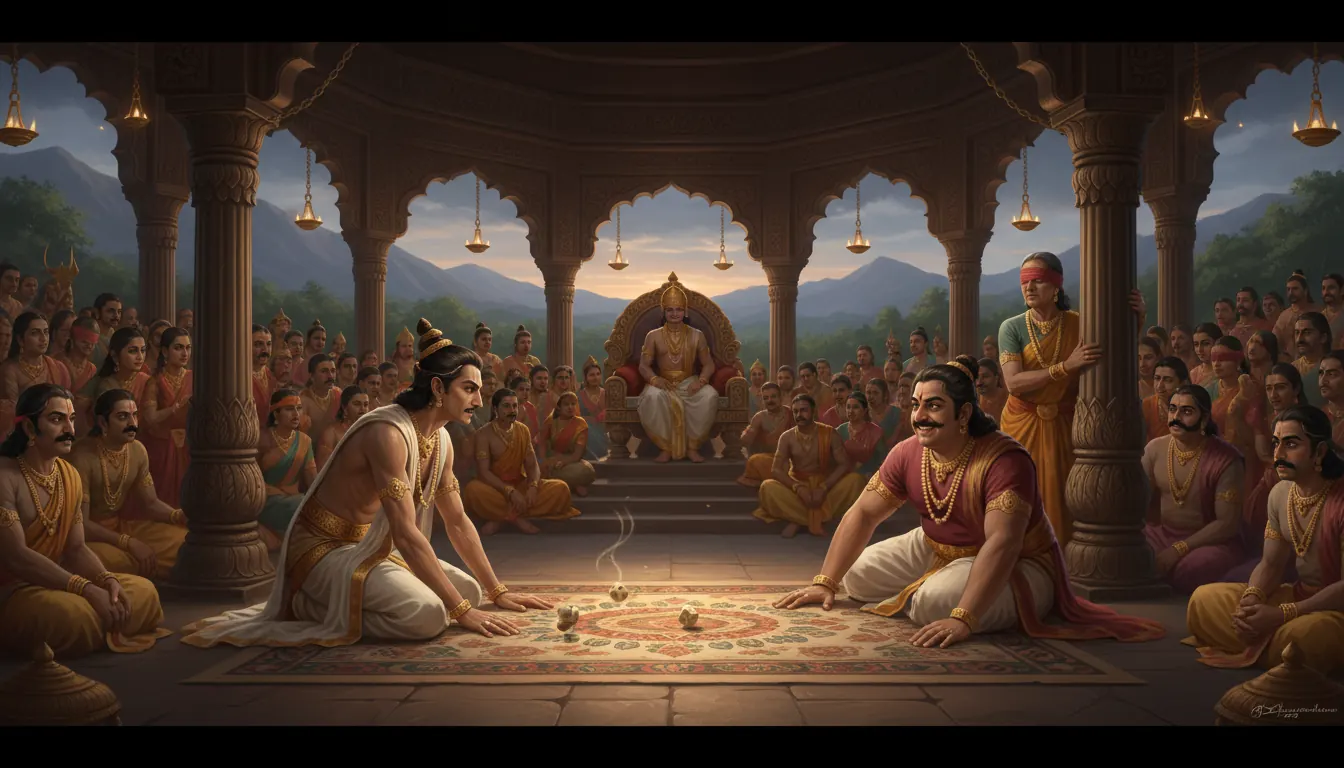
They entered the assembly hall a second time, and the sight of them coming in afflicted the hearts of every friend they had in the room. Compelled by Fate, they sat down again at their ease to gamble for their own destruction.
One Cast
Shakuni was courteous, as he always was.
"The old king has given you back all your wealth," he said. "That is well. That is as it should be. But listen to me, bull of the Bharatas, for there is one stake of great value left. Either you defeat us at dice, and then we will dress in deer skins and go into the great forest and live there twelve years, spending the whole of the thirteenth unrecognised in some inhabited region, and if we are recognised, going back to another twelve years of exile. Or we defeat you, and then you will dress in deer skins and go with Krishna of Panchala and live twelve years in the woods and spend the thirteenth unrecognised in some inhabited region, and if recognised, another twelve. And when the thirteenth year is over, each side is to have its kingdom handed back by the other. On these terms, Yudhishthira, play with us. Cast the dice."
A sound went through the hall. Men who had sat silent through the whole of the first day raised up their arms where they sat, and out of the sheer strength of their feeling they said aloud to one another what none of them would say to the throne.
"Alas. Shame on Duryodhana's friends, that they do not warn him of his great danger. Whether the king sees this for himself or not, it is our duty to tell him plainly."
And not one of them stood up.
Yudhishthira heard all of it. Out of shame, and out of a sense of what his order required of him, he sat down at the dice again, knowing perfectly well what would follow.
"How can a king like me, Shakuni, who always keeps the customs of his own order, refuse when he is summoned to dice? So I will play with you."
"We have many cattle," said Shakuni, "and horses, and milch cows, and goats and sheep beyond counting, and elephants, and treasuries, and gold, and slaves both male and female. All of these were staked by us before. But now let this be our one stake: exile into the woods. Whichever of us is defeated, you or we, will live twelve years in the woods and the thirteenth unrecognised in some inhabited place. You bulls among men, on these terms we will play."
The proposal about the stay in the woods was uttered once. Only once. The son of Pritha accepted it, and Shakuni took up the dice, and cast them, and said:
"See. I have won."
Deer Skins
The vanquished sons of Pritha prepared for their exile into the woods. They did it there, in the hall, in front of everyone, one after another in due order of age, casting off their royal robes and dressing themselves in deer skins.
Dushasana watched them do it and could not contain himself.
"The absolute sovereignty of the illustrious King Duryodhana has begun," he announced to the hall. "The sons of Pandu have been defeated and plunged into great misery. Now we have reached our goal, by broad paths or by narrow ones, it does not matter which. Today we have risen above our enemies in prosperity and in length of rule, and men will praise us for it. We have plunged the sons of Pritha into everlasting hell. They who were so proud of their wealth, who laughed in derision at the son of Dhritarashtra, will now go into the woods, defeated and deprived by us of everything."
He walked along the line of them as they changed.
"Take off those many-coloured coats of mail. Take off those shining robes of celestial make. Dress yourselves in deer skins, according to the stake you accepted from the son of Subala. They who always used to boast that they had no equals in all the world will now know themselves for what they are: grains of sesame without the kernel. Look at them. In that dress they seem like wise and powerful persons installed in a sacrifice, and yet they look like persons who have no right to perform sacrifices at all, going about in such a guise."
Then he turned toward Draupadi, who had come back into that hall a second time and was standing at the side of it, and he raised his voice so that she could not pretend not to hear.
"The wise Yajnasena of the Somaka race, when he bestowed his daughter, the princess of Panchala, upon the sons of Pandu, acted most unfortunately for her. These sons of Pritha are eunuchs. And Yajnaseni, what joy will you have, seeing these husbands of yours in the woods, dressed in skins and threadbare rags, stripped of their wealth and their possessions? Choose a husband. Anyone you like, from among all those present here. The Kurus gathered here are patient and self-controlled and very rich. Choose one of them as your lord, so that this great calamity may not drag you down into wretchedness. The sons of Pandu now are like grains of sesame without the kernel, or like show-animals encased in skins, or like husks of rice with nothing inside them. Why should you go on serving the fallen sons of Pandu? It is wasted labour to press a sesame grain that has no kernel in it."
O Cow
Bhima came at him the way a Himalayan lion comes at a jackal, and stopped, because he could not deviate from the path of virtue, and had to make do with words.
"Wicked-minded villain. Do you rave in language that only the sinful use? Do you boast like this in the middle of kings, you who have risen by the skill of the king of Gandhara and by nothing of your own? As you pierce our hearts here with these arrow-sharp words of yours, so I will pierce your heart in battle, and I will remind you of every word of this while I am doing it. And those who walk behind you as your protectors, out of anger or greed, I will send them too to the abode of Yama, with their descendants and their relatives."
Dushasana looked at him. Bhima was standing in a deer skin with his royal clothes at his feet, and he had not lifted a hand, and everyone in the hall had seen that he had not lifted a hand.
So Dushasana abandoned all sense of shame, and began to dance around the Kurus, in and out among the seated kings, calling out as he went:
"O cow. O cow."
Bhima said, "Wretch. Do you dare to use words like these? Who has the right to boast of wealth won by foul means? I tell you this. If Vrikodara, the son of Pritha, does not tear open your breast in battle and drink your life-blood, let him never reach the worlds of the blessed. And I tell you truly, by killing the sons of Dhritarashtra in battle, before the eyes of all the warriors, I will quench this wrath of mine soon enough."
He said it in a room that contained Bhishma, and Drona, and Vidura, and the blind king on his seat, and not one of them contradicted him, because every man there had just watched what had been done and knew that it was a debt now, and that debts of that kind are collected.
The Four Vows
As the Pandavas were going out of the assembly, Duryodhana, from an excess of joy, got up and mimicked with his own steps the rolling lion-walk of Bhima, so that the hall could laugh at it.
Bhima half turned in the doorway.
"Do not think, you fool, that this gives you any power over me. I will kill you soon, with all your followers, and I will answer you then, reminding you of all of this."
And then, suppressing his rage and following in the steps of Yudhishthira, he spoke the thing out fully as he walked from the Kaurava court, so that the whole room heard it, and the whole room afterwards remembered where it had been standing when it was said.
"I will slay Duryodhana. Dhananjaya will slay Karna. And Sahadeva will slay Shakuni, that gambler with dice. I repeat these proud words in this assembly, and the gods will surely make them good if we ever meet the Kurus in battle. I will slay this wretched Duryodhana in battle with my mace, and when I have thrown him to the ground I will set my foot on his head. And as for this other wicked man, Dushasana, who is so audacious in his speech, I will drink his blood like a lion."
"Bhima," said Arjuna, "the resolves of great men are not known by words alone. In the fourteenth year from today, they will see what happens."
"The earth will drink the blood of Duryodhana," Arjuna went on, "and of Karna, and of the wicked Shakuni, and of Dushasana who makes the fourth."
"Bhima, I will do as you say. I will slay this Karna in battle, malicious, jealous, harsh-tongued and vain as he is. To do what pleases Bhima, Arjuna vows that he will slay this Karna in battle with his arrows, and all his followers with him. And I will send to the worlds of Yama all those other kings who are foolish enough to fight against me. The mountains of Himavat might be moved from where they stand, the maker of the day might lose his brightness, the moon might lose her coldness, but this vow of mine will be kept for ever. And all of this will surely happen, if in the fourteenth year from now Duryodhana does not return our kingdom to us with proper respect."
Then Sahadeva, the handsome son of Madri, waving his mighty arms and sighing like a snake, with his eyes red, said, "You disgrace to the Gandhara kings. Those you think defeated are not really defeated. Those are sharp-pointed arrows, and you have invited their wounds in battle. I will certainly do everything that Bhima has said concerning you and all your followers. So if you have anything to do, do it before that day comes. I will slay you in battle soon enough, if you stand your ground in the light, as a kshatriya should."
And Nakula, the handsomest of men, said last, "I will certainly send to the abode of Yama all those wicked sons of Dhritarashtra who, longing for death, driven by Fate and wanting to please Duryodhana, spoke harsh and insulting words to this daughter of Yajnasena at the gambling match. Soon enough, at Yudhishthira's command and remembering the wrongs done to Draupadi, I will empty the earth of the sons of Dhritarashtra."
When they had pledged themselves so, those tigers among men, all of them long-armed, walked back across the hall and went to king Dhritarashtra to take their leave of him before going into the woods.
Dharma Lesson
A man who could not refuse the first summons cannot refuse the second, because the reason he gave himself the first time is still there. The vows sworn by the wronged in that hour became debts, and the world paid them out over eighteen days on a field far from that hall.