What the Blind King Was Told
Duryodhana's inventory of the rajasuya, and the quarrel it started
In short
Dhritarashtra takes his son aside and pleads with him privately to drop the idea of dice. Duryodhana answers by describing, item by item, everything at Indraprastha his father could not see: Kamboja blankets shot with gold, parrot-nosed horses, Bhagadatta turned away at the gate, gold that ants raise out of the earth. Then father and son argue openly, and Shakuni closes the argument with an offer.
Told in the Sabha ParvaSet in Hastinapura, Indraprastha and Kamboja20 min read
Have Nothing To Do With Dice
Janamejaya said, "How did that game of dice come about, which brought such evil on the cousins and plunged my grandfathers into such sorrow? Which of the kings present approved of it, and who forbade it?"
Vaishampayana said: Listen, best of the Bharatas, and I will tell it again from the beginning.
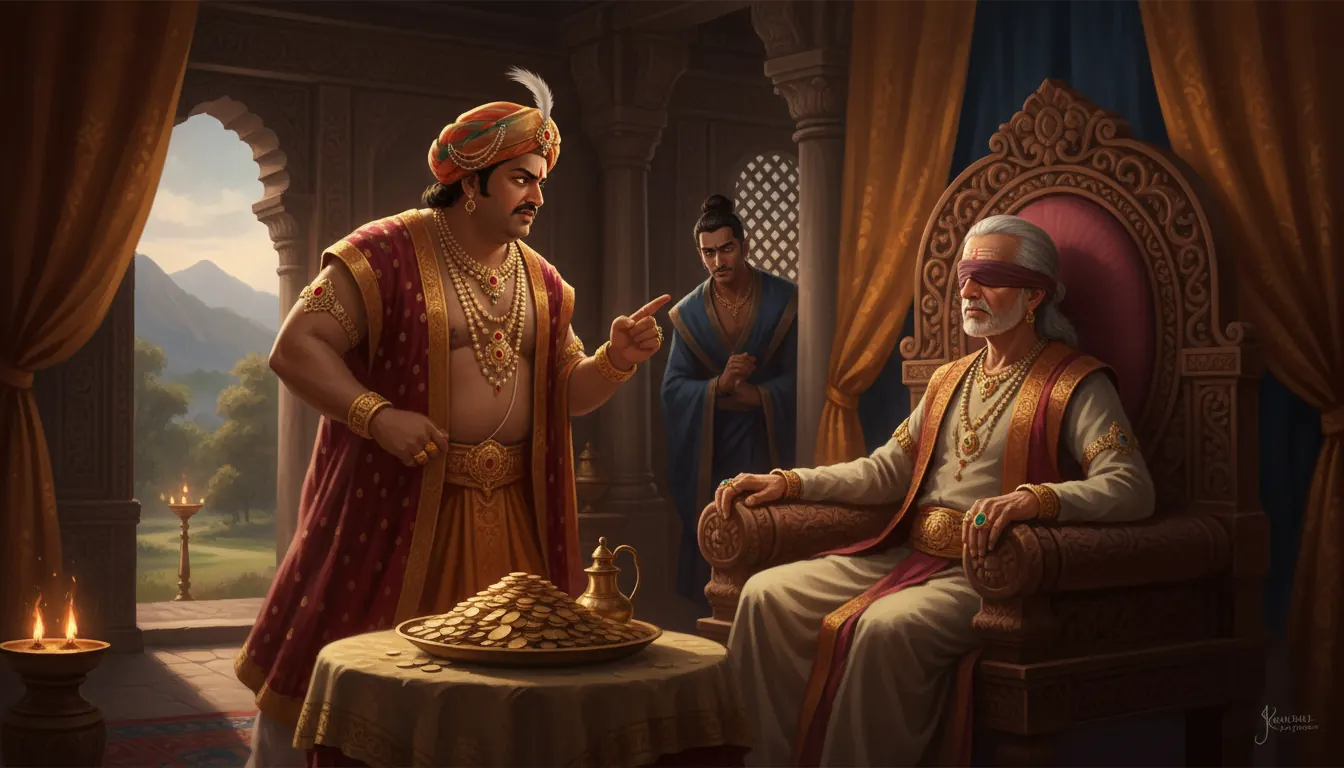
Dhritarashtra had asked Vidura what he thought and received an answer he did not like. So he called Duryodhana to him privately, in a room with no counsellors in it, and tried the only thing a father in that position can try.
"Son of Gandhari, have nothing to do with dice. Vidura does not speak well of it. He is a man of great wisdom, and he will never give me advice that is not for my good. He knows, with all its mysteries, the science of statecraft that Brihaspati taught long ago to the chief of the immortals. As Uddhava is regarded among the Vrishnis, so Vidura is esteemed among the Kurus. Dice sows quarrels, and quarrels ruin a kingdom."
Duryodhana said nothing, so his father tried the other approach.
"You have had from us what a father and a mother are meant to give a son: the rank and possessions of your ancestors. You are educated and clever in every branch of knowledge. You were born the eldest of all your brothers, and you live in your own kingdom. Why do you think yourself unhappy? You have food and clothing of the very best kind, such as ordinary men can never have. Ruling a great ancestral kingdom full of people and wealth, you shine as splendidly as the chief of the gods shines in heaven. Tell me, what can be the root of this grief that has made you so gloomy?"
That was the invitation. Duryodhana took it, and the answer went on for the better part of an evening.
The Water That Was Not There
"I am a sinful wretch, king," said Duryodhana, "because I eat and dress while I look on the prosperity of my enemies. It has been said that a man is a wretch if he is not filled with jealousy at the sight of his enemy's prosperity. This prosperity of mine does not satisfy me. When I see that blazing prosperity of the son of Kunti, it pains me deeply. My hold on life must be strong, since I am still alive after seeing the whole earth under the rule of Yudhishthira."
"The whole earth is a large phrase," said Dhritarashtra.
"The Nipas, the Chitrakas, the Kukkuras, the Karaskaras, the Lauha-janghas: they live in his palace like bondsmen. The Himavat, the ocean, and the countless other regions that yield jewels have all bowed to the greatness of his palace. And because he regards me as the eldest and owed respect, Yudhishthira made me the one to receive the tribute. My hands grew tired from receiving all that wealth. When I was tired, those who had carried it from distant lands waited until I could go on."
He had come to the part he had been circling.
"The Asura architect Maya brought jewels from the lake Vindu and made them a crystal floor that looked like a lake. When I saw the lotuses that filled it, I took it for water. And when Vrikodara saw me draw up my clothes to cross it, he laughed at me, taking me for a man with no jewels of his own who had lost his head at the sight of his enemy's wealth. If I could have, I would have killed Bhima for it. But if we try to kill him now, the fate of Shishupala will be ours. That insult burns me.
"Then I saw a surface just like it that really was full of water, and I took it for crystal, walked out onto it, and fell in. Bhima laughed, and Arjuna laughed with him, and Draupadi, with the other women, joined in the laughter. My clothes were wet, and at the king's command the servants brought me other clothes. That too is my great sorrow.
"And hear of one more mistake. When I tried to pass through something shaped exactly like a door, where there was really no way through, I struck my forehead on the stone and hurt myself. The twins Nakula and Sahadeva saw from a distance that I had hit my head, and came and held me up in their arms and showed great concern for me. And Sahadeva told me again and again, as if with a smile, 'This is the door, king. Go this way.' And Bhimasena, laughing aloud, said, 'Son of Dhritarashtra, this is the door.' I had never even heard the names of the gems I saw in that palace. That is why my heart aches so."
The Queue at the Gate
"Now listen," said Duryodhana, "to the costly things I saw that belong to the sons of Pandu, brought one after another by the kings of the earth. When I saw that wealth of my enemy, I lost my reason."
And then, in a small room, to a man who had never seen anything at all, he began the catalogue.
"The king of Kamboja gave innumerable skins of the best kind, and blankets made of wool, of the soft fur of burrowing animals, and of the hair of cats, all of them inlaid with threads of gold. He gave three hundred horses of the Titteti and Kalmasha breeds, with noses like parrots, and three hundred camels and as many she-asses, fattened on olives and the Pilusha.
"Brahmanas without number waited at the gate with three hundred million in tribute and were not let in. Hundreds more came with their golden Kamandalus filled with clarified butter, and they too were turned away. The shudra kings of the sea coast brought a hundred thousand serving girls of the Karpasika country, decked in golden ornaments, and skins of the Ranku deer fit even for brahmanas. The Vairamas and Paradas and Tungas waited at the gate and were refused entry, with goats and cattle and camels and honey and blankets and gems of every kind on the ground beside them."
He let that sit a moment, because the next name was one his father knew.
"And king Bhagadatta, the brave ruler of Pragjyotisha, lord of the mlechchhas, at the head of a body of Yavanas, waited at the gate and could not get in, with horses of the best breed, as swift as the wind. When he saw the crowd, Bhagadatta went away from that gate. He left behind him a number of swords with hilts of the purest ivory, set with diamonds and every kind of gem, and went home.
"Tribes came from every region. Some have two eyes, some three, some have their eyes on their foreheads. There were the Aushmikas and the Nishadas and the Romakas, and some who eat men, and many who have only one leg. Those with one leg gave wild horses, some as red as cochineal, some white, some like evening clouds, all as swift as the mind. The people of Bahlika gave ten thousand black-necked asses that run two hundred miles in a day, and blankets made in Chin, and cloth woven from threads spun by insects, and battle-axes made in the western countries. The Sakas and Tukharas and the men with horns brought elephants and ten thousand horses and hundreds of millions in gold, and waited at the gate, refused entry."
Gold Raised Out of the Earth by Ants
"Those who live by the river Sailoda, which flows between the mountains Meru and Mandara, in the shade of the groves of Kichaka bamboo, brought heaps of gold measured out in jars. That gold is raised from under the earth by ants, and so it is named after them.
"The mountain tribes brought long brushes of chamara hair, some soft and black, others white as a moonbeam, and honey from the flowers of the Himavat and the Mishali champaka, and garlands from the region of the northern Kurus, and plants out of the north, even from Kailasa. They waited at the gate with their heads bowed, refused entry. The Kiratas came, armed with cruel weapons, dressed in skins, with load after load of sandal and aloe and black aloe, and ten thousand serving girls of their own race, and beautiful animals and birds of remote countries. They also were refused.
"The Vangas and Kalingas and Magadhas and Tamraliptas came, and the gatekeepers told them, at the king's command, that if they would wait and bring good tribute they would be let in. So each of those kings gave a thousand elephants with tusks like the poles of ploughs, decked with girdles of gold, dark as rocks and always in rut, brought from the shores of the Kamyaka lake. Once they had made those gifts, they were allowed in.
"Chitraratha, king of the Gandharvas, gave four hundred horses as swift as the wind. Tumvuru gave a hundred horses of the colour of mango leaf. Virata of Matsya gave two thousand elephants decked in gold. Yajnasena presented fourteen thousand serving girls and ten thousand serving men with their wives, and his whole kingdom besides. And Vasudeva of the Vrishni race, only to add to Arjuna's dignity, gave fourteen thousand elephants.
"The kings of Chola and Pandya brought jars of gold filled with fragrant sandal juice from the hills of Malaya, and loads of aloe wood from the Dardura hills, and fine cloths inlaid with gold, and were not let in. The king of the Singhalas gave the finest of sea-born gems, called lapis lazuli, and heaps of pearls, and hundreds of coverlets for elephants.
"Only two peoples on this earth pay him no tribute, father. The Panchalas, by marriage. The Andhakas and Vrishnis, by friendship."
What It Costs To Feed That House
"And now I will tell you of the servants of the Pandavas," said Duryodhana, "the people for whom Yudhishthira supplies food, both cooked and uncooked.
"There are elephants and cavalry beyond any count I can give you, and chariots by the hundred million, and foot soldiers without number. In one place raw provisions are being measured out, in another cooked food, in another it is being handed round. The sounds of festivity are heard everywhere there, at every hour. And among men of every order I did not see one person in that palace who lacked food and drink and ornaments.
"He supports eighty-eight thousand Snataka brahmanas living as householders, with thirty serving girls given to each, and, contented by the king, they pray with glad hearts for the destruction of his enemies. Ten thousand other ascetics, who keep their vital seed drawn up, eat every day off golden plates in his palace.
"And Yajnaseni, without having eaten herself, goes through that house every day and sees whether everybody has eaten. Everybody. Including the deformed. Including the dwarfs. She does not sit down to her own food until she has seen it."
He stopped there, and what he said next he said differently from all the rest of it.
"When I saw the kings of the earth bringing such gifts to my enemies, I wished I were dead, out of grief."
It is worth noticing what the inventory had done to him. He had stood at that gate for days receiving the wealth of the world into his hands, and the thing his mind had kept was not the gold. It was the woman who would not eat until the dwarfs had eaten. It was the twins picking him off the floor and asking whether he was hurt. Every kindness done to him in that house had gone in and turned, and lay in him now beside the mockery, and he could not tell one from the other.
The Conch Out of the Northern Sea
"For Yudhishthira's bath at the end of the sacrifice," said Duryodhana, "the kings themselves brought the jars, in a state of purity, as eagerly as they could. King Bahlika brought a chariot decked with pure gold. King Sudakshina himself yoked to it four white horses of the Kamboja breed. Sunitha fitted the lower pole with his own hands, and the ruler of Chedi set the flagstaff. Magadha held the garlands and the head-gear. Vasudana brought an elephant sixty years old. Matsya brought the side-fittings of the chariot, cased in gold. King Eklavya brought the shoes. Avanti brought the waters for the final bath. Chekitana carried the quiver, Kashi the bow, and Shalya a sword whose hilt and straps were adorned with gold.
"Then Dhaumya and Vyasa, with Narada and Devala the son of Asita, performed the sprinkling of the sacred water. Satyaki held the umbrella over his head. Dhananjaya and Bhima fanned him, and the twins stood with chamaras in their hands.
"And the Ocean himself brought, in a sling, that great conch of Varuna which the celestial craftsman Vishvakarma had made out of a thousand nishkas of gold, and which Prajapati had given to Indra in an earlier age. It was with that conch that Krishna bathed Yudhishthira. And when I saw it, father, I fainted.
"Men go to the eastern sea and to the western, and to the southern too. But only birds can ever go to the northern sea. The Pandavas have spread their rule even there. I heard hundreds of conches brought from that sea blown together in the hall of sacrifice, and while they blew my hair stood on end, and the weaker kings fell down where they stood. And Dhrishtadyumna and Satyaki and the sons of Pandu and Keshava, seeing the kings senseless and seeing me in that state, laughed outright.
"Yudhishthira has won a prosperity such as neither Rantideva won, nor Nabhaga, nor Manu, nor king Prithu the son of Vena, nor Bhagiratha, nor Yayati, nor Nahusha. Seeing it, I do not see the least good in going on living. Ruler of men, a yoke tied to the bullock's shoulders by a blind man works loose. That is how it is with us. The younger ones are growing while the elder ones decline. And seeing all this I cannot find peace, however much I reflect. That is why I am sunk in grief, and growing pale and thin."
The Sons of Pandu Are Like Your Arms
Dhritarashtra had heard all of it, every gate and every jar and every tribe with one leg, and when his son finally stopped speaking he answered him gently, which was the only way he ever answered him.
"You are my eldest son, and born of my eldest wife too. So, my son, do not be jealous of the Pandavas. A jealous man is always unhappy, and suffers the pangs of death. Yudhishthira knows no deceit. He has wealth equal to yours, and he is not jealous of you. Why then should you be jealous of him? Why should you foolishly covet your brother's property? Stop being jealous. Do not grieve.
"If you long for the dignity that comes with performing a sacrifice, let the priests arrange the great sacrifice called the Saptatantu for you. Then the kings of the earth will gladly, and with great respect, bring wealth and gems and ornaments for you too."
He was offering him the thing itself: the same rite, the same gate, the same queue of kings, in his own city, at his own door. Both of them knew he did not want it, because it had never been the tribute that he wanted.
"Child, coveting what belongs to others is very mean. The man who is content with his own, and keeps to the duties of his own order, is happy. Never striving for the wealth of others, working hard at one's own affairs, and protecting what one has earned: these are the marks of true greatness. "The sons of Pandu are like your own arms. Do not cut off those arms of yours. Do not plunge into quarrels at home for the sake of your brothers' wealth. There is great sin in quarrelling with friends. Your grandfathers are theirs too. Give in charity at times of sacrifice, enjoy everything your heart holds dear, take your pleasure freely in the company of women, and be at peace."
Discontent Is the Root of Prosperity
"A man without intelligence who has merely heard of many things," said Duryodhana, "can hardly understand the real meaning of the scriptures, just as the spoon has no sense of the taste of the soup it touches. You know everything, and yet you confuse me. Like a boat tied to another boat, you and I are bound together. Do you not care about your own interests? Or do you bear me ill will?
"These sons of yours are doomed, since they have you for their ruler, for you put off to the future what must be done now. A man often stumbles when his guide takes his instructions from others.
"Brihaspati has said that the ways of kings are different from those of common people. Success is the only measure that should guide a kshatriya's conduct. Whether the means are virtuous or sinful, what scruples can there be in the duties of one's own order?
"Those used to handling weapons say that a weapon is not simply an instrument that cuts. It is any means, hidden or open, by which an enemy can be defeated. Who is an enemy and who a friend does not depend on a man's shape or size. Whoever causes another pain is to be counted an enemy by the one he pains.
"Discontent is the root of prosperity. So, king, I choose to be discontented. The man who strives to gain prosperity is truly wise in policy. No one should cling to wealth, for hoarded wealth may be plundered. It was in a time of peace that Shakra cut off Namuchi's head, after pledging not to, and he did it because he approved of this eternal way of treating an enemy. Like a snake that swallows frogs and the other creatures that live in holes, the earth swallows up a king who is peaceful and a brahmana who never leaves his home.
"One's enemy is the man who pursues the same ends as oneself, and nobody else. A man who foolishly neglects a growing enemy has his vitals cut away, as by a disease he has left untreated. An enemy, however small, if allowed to grow in prowess, swallows a man up, like the white ants at the root of a tree eating away the tree itself.
"I covet the prosperity of the Pandavas, but I have not yet made it my own. Right now I am full of doubts about my own ability, and I am determined to settle them. I will either win that prosperity of theirs, or I will lie dead on the battlefield. With my mind in this state, what do I care for life, when the Pandavas grow every day while our possessions never increase?"
Betting Is My Bow
Shakuni had been waiting for that, and he spoke into the silence after it.
"Greatest of victors, I will snatch for you this prosperity of Yudhishthira that grieves you so to see. Let the son of Kunti be summoned. By throwing dice, a skilled man can defeat one who has no skill, without coming to any harm himself. Know this, Bharata: betting is my bow, the dice are my arrows, the marks on them my bowstring, and the dice-board my chariot."
"This Shakuni is skilled at dice," said Duryodhana, "and is ready to snatch the prosperity of the son of Pandu with dice. You should give him permission."
"I follow the counsel of my brother Vidura," said Dhritarashtra. "When I have consulted him, I will tell you what should be done."
"Vidura is always busy doing good to the sons of Pandu," said Duryodhana at once. "He will certainly turn your heart against this plan. No man should take up any task relying on another's counsel, for two minds seldom agree. The fool who lives avoiding everything that might frighten him wastes away like an insect in the rainy season. Neither sickness nor Yama waits until a man is prosperous. As long as there is life and health, a man should carry out his purpose."
"Hostility toward the strong never appeals to me," said Dhritarashtra. "Hostility changes men's feelings, and that is itself a weapon, though not one made of steel. You think a great blessing, prince, what will bring the terrible consequences of war in its train. Once it begins, it will bring forth sharp swords and pointed arrows."
"Men of the most ancient times invented dice," said Duryodhana. "There is no destruction in it, and no striking with weapons. Give the command for the assembly house to be built quickly. Gambling will open the door of heaven to us, and the Pandavas will become your equals instead of, as now, your superiors."
"Your words do not appeal to me," said Dhritarashtra. "Do as you please, ruler of men. But you will be sorry for acting on these words, for words so full of wrong can never bring prosperity in the future. The learned Vidura foresaw just this. Even the great calamity that will destroy the lives of the kshatriyas comes as fate decrees."
When he had said this, the weak-minded king, holding fate to be supreme and unavoidable, robbed of his reason by Fate and obedient to his son's counsel, gave his men their orders in a loud voice.
"Build an assembly house of the greatest beauty, with care and without losing any time. Let it be called the crystal-arched palace. A thousand columns, decked with gold and with lapis lazuli, furnished with a hundred gates, two miles in length and the same in breadth."
Thousands of craftsmen built it with the greatest speed, covered it with many-coloured carpets inlaid with gold, and came cheerfully to report that it was finished. Then Dhritarashtra summoned Vidura, the chief of his ministers, and gave him the errand he had spent all this while refusing to give.
"Go to Khandavaprastha and bring prince Yudhishthira here without delay. Let him come with his brothers and see this handsome assembly house of mine. And let a friendly game of dice begin here."
Dharma Lesson
Envy described in detail is envy rehearsed. A father who asks his son to be content while listening greedily to the whole inventory has already agreed with him, and the sacrifice he offers as a substitute is refused because the tribute was never the thing wanted.