The Rain Agastya Did Not Need
Twelve years of drought against one sage's seeds
In short
Janamejaya asks why a mongoose valued gleaned barley above a horse sacrifice, and hears of Agastya's twelve-year initiation, fed on food lawfully got until Indra shut off the rain. Agastya offers to sacrifice in the mind, then by touch, then to become Indra himself, and calls the wealth of the northern Kurus to his ground. The rishis beg him not to.
Told in the Ashvamedhika ParvaSet in Forest Hermitage, Hastinapura and Amaravati15 min read
The Question the Mongoose Left Behind
The mongoose with the golden head had vanished out of the sacrificial enclosure, and the brahmanas had gone home, and Janamejaya was still not satisfied.
"Kings are devoted to sacrifices," he said to Vaishampayana. "The great rishis are devoted to penances. Learned brahmanas cultivate a calm mind, peaceful conduct and self-restraint. So it seems that nothing in this world can compare with the fruits of sacrifice. That is my conviction, and it seems to me beyond doubt correct.
"Indra of the thousand eyes won sovereignty over the gods through the many sacrifices he performed with lavish gifts, and every one of his wishes was fulfilled. King Yudhishthira, with Bhima and Arjuna beside him, was like the chief of the gods himself in prosperity and prowess. Why, then, did that mongoose belittle his great Horse-sacrifice?"
"Once," said Vaishampayana, "Shakra himself performed a certain sacrifice. All the parts of the sacrifice were laid out. The Ritwijas were busy with the many rites. The gods were invoked one by one by contented brahmanas of great learning chanting the Mantras in sweet voices, and the finest of the Adhwaryus, never tiring at their work, recited the Yajurveda in soft tones.
"Then the time came to slaughter the animals. And when the animals chosen for the sacrifice were seized, the great rishis felt pity for them."
They went to Indra where he stood in his own sacrifice and told him he did not understand it.
"This way of sacrificing is not auspicious. You want to win great merit, and this only shows that you do not understand sacrifice. Purandara, animals were never meant to be slaughtered in sacrifices. These preparations of yours destroy merit. Killing creatures can never be called righteous. Perform the sacrifice with seeds of grain that have been kept for three years. That, Shakra, would be truly righteous and would bear fruit of great power."
"But the god of a hundred sacrifices, swayed by pride and blinded by folly, would not accept these words."
The King Who Answered Too Quickly
"A great dispute then broke out among the ascetics at that sacrifice of Shakra," Vaishampayana said, "over how sacrifices should be performed: with living, moving creatures or with things that do not move. They all wore themselves out arguing.
"Then the rishis, those seers of truth, agreed with Shakra to put the matter to arbitration, and they asked King Vasu: Blessed one, what do the Vedas say about sacrifices? Is it better to sacrifice with animals, or with seeds and juices?
"When King Vasu heard the question, he weighed the strength and weakness of each side, and then answered: Sacrifices may be performed with whichever of the two is to hand.
"Having answered the question thus, he had to enter the nether regions. Indeed, the ruler of the Chedis had to undergo that misery for having answered falsely."
He had not lied about anything he cared about. He had been asked a hard question, and after all his weighing he had produced a convenient answer, and the ground opened.
"So when a doubt arises, no one, however wise, should decide the matter alone, unless he is the self-born Lord of creatures himself.
"Gifts made by a sinner with an impure mind are lost, however large they are. Such gifts count for nothing. The foolish man who wants merit and performs sacrifices with wealth gained by unrighteous means never earns merit. But men rich in penances who give away, as far as they are able, grains of corn gleaned from the fields, or roots, or fruits, or pot-herbs, or water, or leaves, earn great merit and go to Heaven. We hear of Vishvamitra, and Asita, and King Janaka, and Kakshasena, and Arshtishena, and King Sindhudwipa. These and many other kings, rich in penances, gave away things they had come by lawfully, and attained high success."
Janamejaya heard that out and put the obvious question, which was about the word lawfully.
"If Heaven is the fruit of wealth gained by lawful means, tell me all about it. You know the subject well. You have told me what a great reward came to that brahmana who lived by the Unccha way of gleaning, through his gift of powdered barley, and no doubt everything you have said is true. But how is the highest goal made certain in every sacrifice?"
Twelve Years and the Men Who Came
"On this subject an old story is told," said Vaishampayana, "of what happened long ago at the great sacrifice of Agastya.
"Long ago, king, Agastya of great energy, devoted to the good of all creatures, undertook a Diksha that was to last twelve years."
Twelve years is the length of the thing. It should be said plainly at the outset, because everything that follows turns on the arithmetic: a rite consecrated for twelve years, provisioned for twelve years, and fed daily to whoever came.
And they came. Many Hotris served at that great-souled rishi's sacrifice, their bodies shining like blazing fires. Among them were men who lived on roots or on fruits. There were men who used nothing but two stones to husk their corn, and men who lived on nothing but the rays of the moon. There were also men who never ate unless someone else, eager to feed them, set the food before them, and men who never ate anything until they had first served the gods, the Pitris and their guests, and men who never washed the food they ate. There were Yatis among them, and Bikshus.
All of them, the account says, were men who had seen the god of Righteousness in bodily form. They had conquered anger and gained complete mastery over their senses. They lived in self-restraint, free from pride and from any wish to harm others, and their senses never stood in the way of what they set out to do.
Those great rishis attended that sacrifice and carried out its many rites. Many other ascetics were performing great sacrifices of their own elsewhere at the same time.
And of the food gathered for that sacrifice, all that the rite required, every grain had been got by the illustrious rishi by lawful means, as far as he was able.
That is the sentence the whole story hangs from, and nobody at the time thought it remarkable. It is the same standard by which the brahmana of the Unccha mode was measured, the man who lived on grains of corn picked up one by one from the fields after the reapers had gone, and who gave away a prastha of powdered barley to a guest and turned half a mongoose to gold with it. Lawful means is not a phrase about honesty only. It is a phrase about the width of the channel: roots, fruits, pot-herbs, water, leaves, gleanings, and nothing whatever taken by force, by flattery, by office, or by the exercise of a power that other men do not have.
The Rain Stops
As Agastya was engaged in that sacrifice of his, the thousand-eyed Indra ceased to pour rain on the Earth.
No message came with it. There was no herald and no curse pronounced in an assembly and no envoy sent down with terms, and there is nothing in the account to say that Indra ever explained himself to anybody. The sky simply held what it had.
The rishis noticed first, as men who live on what grows will. In the pauses between the rites, when there was nothing to do but sit in the shade of the enclosure and wait for the next hour of the ritual, they began to talk, and they were careful to speak of Agastya as men speak of someone they are worried for and do not wish to shame.
"This Agastya is busy with his sacrifice, giving away food with a heart free of pride and vanity. But the god of the clouds has stopped sending rain. How will food grow?
"This rishi's sacrifice is a great one, brahmanas, and it lasts twelve years. The god will not send rain for those twelve years. Bearing this in mind, you ought to do something to help this rishi of great intelligence, Agastya of the hard penances."
They were not asking him to submit. They were proposing, among themselves, to help him out of a difficulty that was plainly going to break him, since a man who has undertaken to feed several hundred ascetics daily for twelve years out of grain lawfully got cannot do it out of a country where nothing is growing.
Agastya heard them. He did not argue with them and he did not raise his voice. He pleased those ascetics by bowing his head to them, as a host acknowledges the kindness of his guests, and then he answered.
The Mental Sacrifice and the Sacrifice by Touch
"If Vasava does not send rain for those twelve years," Agastya said, "then I will perform the mental sacrifice. That is the eternal ordinance.
"If Vasava does not send rain for these twelve years, then I will perform the Touch-sacrifice. That is the eternal sacrifice.
"If Vasava does not send rain for these twelve years, then I will put all my strength into arranging other sacrifices, bound by the hardest and strictest vows."
He had three answers ready before he was asked for one, and each of them was smaller than the last. If there is no grain there will be a rite performed in the mind. If the mind is not permitted, there will be a rite performed by the laying on of a hand. He was not proposing to abandon the sacrifice. He was proposing to keep shrinking it until it fitted inside whatever the world would still allow him.
"This sacrifice of mine, with seeds, I prepared with many years of labour," he said. "With seeds I will do much good. Nothing will stand in the way. This sacrifice of mine cannot be thwarted. It matters little whether the god sends rain or not."
The rishis in the enclosure sat and listened to a man tell them that the weather was not a party to his vow. He had provisioned the rite years before it began, and the provision was seed, and seed does not care whether the year is wet. Whatever else the lord of the clouds could withhold, he could not withhold what was already in the store.
And then, having exhausted the humble answers, Agastya said the other thing.
Then I Shall Be Indra
"In fact, if Indra will not of his own accord show me any regard, I will make myself Indra and keep all creatures alive.
"Every creature, on whatever food he has been nourished, will continue to be nourished on it as before. I can even repeatedly create a different order of things."
It was said in the same tone as the arrangements about seeds. The office of the king of the gods was described as a vacancy that could be filled if its present holder declined the work, and the duty attached to it, which is that every creature goes on being fed, was described as a duty Agastya was prepared to assume.
Then he began to call, and the calling was itself the demonstration.
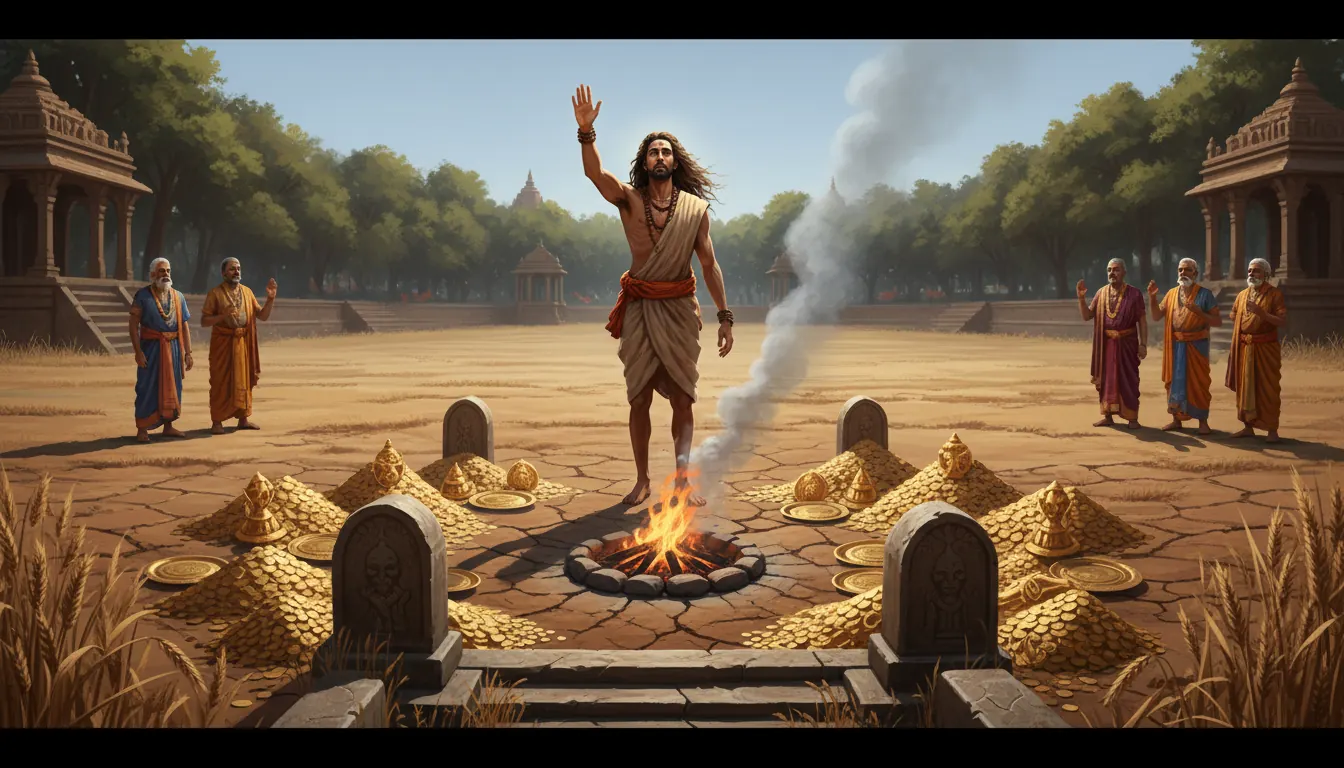
"Let gold, and every other kind of wealth there is, come to this place today. Let all the wealth in the three worlds come here today of its own accord. Let all the hosts of heavenly Apsaras, and all the Gandharvas with the Kinnaras, and Viswavasu, and the rest of their kind, come to this sacrifice of mine. Let all the wealth of the Northern Kurus come of its own accord to these sacrifices. Let Heaven, and all who live in Heaven, and Dharma himself, come here."
After the ascetic had uttered these words, everything happened as he wished.
It happened because of his penances, for Agastya's mind was like a blazing fire and his energy was extraordinary. The wealth of the Northern Kurus came down into a sacrificial ground in a country where it had not rained. The singers of heaven came, and the dancers, and Dharma in his own person, and the thing that had been withheld was shown to be a thing the sacrifice had never actually required.
The rishis who were there saw the power of penances with joyful hearts, and were filled with wonder, and then they said something that no one at that ground expected.
The Rishis Ask Him Not To
"We are delighted with what you have said," the rishis said. "But we do not want your penances to be diminished."
That was the whole of the objection, and it was not made out of timidity. The men saying it had spent their lives on penances and knew to the last grain what such a display costs the man who makes it, and they had watched a twelve-year store of merit spent in an afternoon to solve a difficulty about rainfall.
"The sacrifices we approve of are those performed by lawful means. Truly, the sacrifices we want are those that rest on lawful means.
"Earning our food lawfully and keeping to our own duties, we will go through the initiations of the sacrifice, the pouring of offerings on the sacred fire and the other religious rites. We should worship the gods by lawful means, keeping Brahmacharya. We completed our Brahmacharya and came out of our homes keeping to lawful ways.
"We approve of the mind that is free of any wish to harm others. Mighty one, you should always order such harmlessness in every sacrifice. Then we will be truly pleased, best of the twice-born. When your sacrifice is complete and you have given us leave, we will go away from this place."
They had been offered a miracle that would have kept them all fed for the rest of the twelve years, and they asked instead to go on eating what they could lawfully get, and to be dismissed in the ordinary way when the twelve years were done.
It is the same argument the rishis had made to Indra in his own sacrifice, when they told him to use seeds three years old rather than the animals at the stake. It is the argument the mongoose made about a prastha of powdered barley. The size of the offering is not the measure of the offering. How it was got is the measure of it, and a rite funded by a display of power is no better placed than a rite funded by plunder.
Purandara Pours
As they were saying this, Purandara, the chief of the gods, a god of great energy, saw the power of Agastya's penances, and sent rain.
Nothing was negotiated. No envoy went up and no terms came down, and Indra did not require the sage to unsay anything he had said about becoming Indra. He had seen the wealth of the Northern Kurus arrive of its own accord in a dry country and had drawn the correct conclusion, which was that the drought was no longer a weapon and had only ever been an argument, and that he had lost it.
And indeed, Janamejaya, until the sacrifice of that rishi of boundless power was complete, the god of rain sent rain just as men wished it, in the right amount and at the right time. Not merely enough. The right amount, at the right hour, for every year that remained.
Then the chief of the gods came there with Brihaspati at his head, royal sage, and pleased the rishi Agastya. He brought the priest of heaven with him and put him in front, which is what a king does when he intends the visit to be read as an honour rather than a submission, and Agastya let it be read that way.
When the sacrifice was complete, Agastya, filled with joy, worshipped those great rishis with due rites, and then gave them all leave to go, exactly as they had asked him at the beginning.
"You should not think highly of sacrifice, king," Vaishampayana had said to Janamejaya when he finished the tale of the mongoose, and the account of Agastya bore him out. "Millions of rishis have risen to Heaven by their penances alone. Harmlessness toward all creatures, contentment, good conduct, sincerity, penances, self-restraint, truthfulness and gifts are each equal in merit to sacrifice."
Dharma Lesson
The measure of a sacrifice is not the size of what is offered but the lawfulness of how it was got, so that a prastha of gleaned barley can outweigh a horse sacrifice. And a power great enough to replace God is a power the wise will ask you not to use, because a rite funded by a display of force stands no better than a rite funded by plunder.