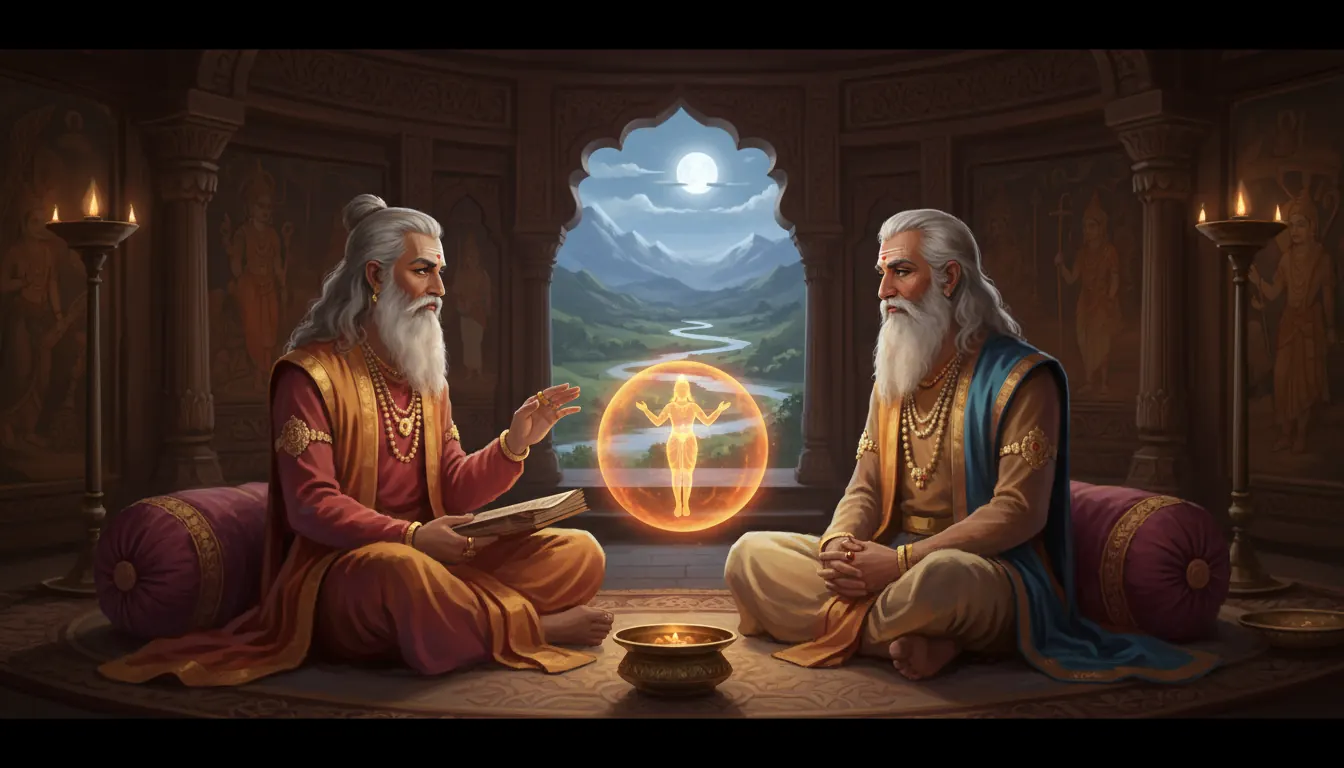
The Adhwaryu and the Yati
A wandering ascetic stops at a sacrifice and asks the priest who gave the goat his consent
In short
Asked to repeat the Gita and unable to, Krishna gives Arjuna an older discourse instead, in which a brahmana recites the quarrel between a sacrificing priest and a wandering yati. The priest explains that the goat is not destroyed but returned to the elements, his eye to the sun and his breath to the sky. The yati answers that if the gain is the goat's then the rite is the goat's, and sends the priest to fetch the consent of the animal's mother and brother. The argument that follows runs through the elements, the taking of life by everything that moves, and the self that stands above both.
Told in the Ashvamedhika ParvaSet in Indraprastha13 min read
The Song He Could Not Sing Twice
Vaishampayana was telling Janamejaya about the days after the war, when the fires of the dead had burned out and Krishna, before going home to Dwaraka, spent an afternoon in the palace at Indraprastha with Arjuna.
Arjuna asked him for the teaching again. What was said to him between the two armies had gone out of his head, he admitted, and he wanted it once more.
Krishna was not pleased to be asked. He said that he had spoken those words in a condition of yoga he could not enter again by wishing, and that to say them over exactly was beyond him now. What he could give instead was an old discourse he had once heard, held between a brahmana who had mastered his senses and the wife who questioned him.
The brahmana had begun by describing what he no longer did.
"I do not smell scents. I do not perceive tastes. I do not see colours. I do not touch. Nor do I hear the many sounds that arise. Nor do I form purposes of any kind."
It was not that his nose and tongue had stopped. It was that he had stopped claiming them. It is Nature, he said, that desires the objects it likes, and Nature that hates the objects it dislikes, and desire and aversion rise in a living body the way the upward and the downward life-winds rise in it, without being invited and without being owned. Separate from these there is another thing, and the yogis look for it in the body and find it.
"Living in that," he said, "I am never bound to anything through desire or anger, or through old age and death. No taint clings to my nature, just as no drop of water clings to a lotus leaf."
Actions are still performed. The enjoyments simply do not fasten on to them, he said, any more than the gathered rays of the sun fasten on to the sky they cross.
His wife had been asking him plain questions all through this, the way one asks about a country never seen. Where is that forest. What are its trees. How far. Instead of another description, he offered her a story.
"There is an old story on this," the brahmana said, "about a discussion between an Adhwaryu and a Yati. Listen to it, glorious lady."
An adhwaryu is the priest of the working hands. He measures the ground, sets the posts, handles the vessels, and it is his office to deal with the victim. A yati has no fire of his own to tend, no house, and nothing to sacrifice with.
The Goat Sprinkled With Water
The animal had been sprinkled with water.
That is the moment the story chooses, and it is chosen with care. The sprinkling is not the killing. It is the consecration, the point at which a goat that was an animal a minute ago becomes a victim, and everything after it is only procedure. The adhwaryu was seated at his work. The rite was moving.
And a yati, passing through, stopped and looked at it and said a few words in censure.
"This is the destruction of life."
He did not argue. He named the thing. Whatever else was going on in that enclosure, an animal that was alive was about to not be, and the man arranging it was sitting right there.
The adhwaryu answered him without heat, and his answer is the oldest defence there is.
"This goat will not be destroyed. If what the Vedas declare on this subject is true, the animal is meeting with great good."
Then he laid out how the goat would be dispersed rather than ended, part by part, each part going home.
"The part of this animal that is earth will go to earth. The part of him born of water will enter the water. His eye will enter the sun. His ear will enter the different quarters of the sky. His life-winds will enter the sky."
It is a beautiful account and it is not a dodge. The priest believed it. A body is a loan made out of the five elements, and at a properly conducted sacrifice the loan is called in cleanly, with mantras spoken over it, and the creature that walked in is not extinguished but returned, and returned better placed than it was. Under that reading the sprinkling of water was a kindness and the knife was a door.
And then he added the sentence that gave away where he was standing.
"I follow the scriptures, and so I incur no fault."
Not: the goat is unharmed, therefore nobody is harmed. But: I am covered. The text says so, I am doing what the text says, and whatever is happening on that grass in front of us, it is not being charged to me.
The yati had been listening for exactly that.
Go and Ask His Mother
"If you see so much good for the goat in his parting from his life-winds," the yati said, "then this sacrifice is for the goat. What do you need it for?"
There is the whole of it in two sentences, and every later argument about sacrifice is a footnote to them.
The priest had just finished explaining that the animal was the winner here. His eye goes to the sun. His ear goes to the quarters of the sky. He is dissolved into the elements with the proper words said, which is a better end than any goat comes to in a field. Very well, said the yati. Then the goat is the one being enriched, and the merit of the rite belongs to him, and there is nothing in it for you. Take your hands off it.
The priest could not say yes to that, because the sacrifice was being performed for the sacrificer and everyone present knew it. The goat's excellent destination was an argument produced to answer an objection, not a reason anybody had brought the goat.
Then the yati did something sharper than argument. He proposed a procedure.
"Let this goat's brother, father, mother and friend give you their approval. Take him to them and ask them. This goat is especially dependent on others. You should go to those who can give consent for him. Once you have heard their consent, the matter will be worth considering."
Go and ask his family.
If this is a gift, then somebody is giving it, and the one thing certain about the goat is that he is not the one. He is especially dependent, the yati said, which is the exact and unsentimental word. He is owned. He was led here on a rope by a man who bought him. He has no standing to refuse and no voice to refuse with, and a benefit that is conferred on a creature who cannot decline it is not a benefit, it is a disposal.
So take him back to the herd, said the yati, and put the proposal to his mother, and see what she says, and when you have her word we will sit down again and discuss whether this is fit to consider.
He knew there was no such consent to be had anywhere in the world. That was the point of sending him to look for it.
The Fuel Is the Animal Himself
Then the yati turned to what was actually lying on the grass.
"This goat's life-winds have been sent back to their sources. Only the lifeless body is left behind. That is what I think."
He was granting the priest his own doctrine and following it to its end. Suppose it is all true. Suppose the eye has gone into the sun and the earthy part into the earth and the breath into the sky. Then what is left in front of you is not a gift and not a guest. It is a carcass. Everything that made it worth having has already been dispatched to the addresses you named.
"If people hope to find happiness through the lifeless body of an animal, which is no better than fuel," he said, "then the fuel of their sacrifice is, after all, the animal himself."
Say it plainly, then. You are burning him. You have wood on that fire and you have a goat on that fire and you are treating the second the way you treat the first, and no amount of the sun and the horizon changes what the ladle is doing.
Then he gave the rule he was standing on, and he gave it as inheritance rather than as invention.
"Refraining from cruelty is the foremost of all the deities. That is what the elders teach. We know the principle: no killing of living creatures."
The foremost of all deities. Not a virtue that the gods approve of. Placed above them, ahead of every name to which an offering could be poured, so that a rite which injures in order to worship has already passed by the greatest of the powers it thinks it is serving.
He stopped short of saying the rest, and he said that he was stopping.
"If I said anything more, it would look as though I were laying many kinds of wrongdoing to your charge."
He would not stand there and start counting the priest's sins. He had come to state a proposition, not to convict a man.
"What we approve of is never being cruel to any creature. We prove this from what we can see directly. We do not rely on what lies beyond direct perception."
That last line is the yati's whole method. The goat's eye entering the sun is something nobody in that enclosure had ever seen. The goat struggling on the rope was in front of them.
There Can Be No Movement Without Slaughter
The adhwaryu had been given his answer and he did not accept it, and the counter he made is the reason this argument was worth preserving.
"You enjoy smells, which belong to the earth. You drink tastes, which belong to water. You see colours, which belong to bodies of light. You touch the qualities that come from the wind. You hear sounds, which come from space. You think thoughts with the mind."
He was walking the yati back through the same five elements the yati had just used against him, and turning them around.
You say the goat is earth and water and light and wind and ether. Agreed. So is everything. So is the fruit you eat and the water you drink and the air you take in and the ground you set your foot on, and if the elements are living things when they are arranged in a goat, they are living things when they are arranged in anything else.
"All these things, you hold, have life. So you do not abstain from taking life either. In truth, you are engaged in killing."
The wandering man who owns nothing and kills nothing had been shown a bill. He breathes and something dies. He drinks and something dies. He walks and something dies under his heel, and his vow of harmlessness is a piece of bookkeeping in which the small deaths have simply not been entered.
"There can be no movement without slaughter."
That is the sentence the priest had been building toward, and it is not a debater's trick. It is true. To be alive in a body is to be consuming the world at every moment, and the man on the road is doing it as certainly as the man at the altar. The difference the yati was insisting on, between what he does and what the priest does, would have to be defended on some ground other than a clean record, because nobody has a clean record.
"Or what do you think, twice-born one?"
He asked it as a real question. He had stopped defending the goat and started asking the stranger who he was.
Alike to All Creatures
The yati did not deny the charge. He answered from underneath it.
"The Indestructible and the Destructible are the two forms in which the soul shows itself," he said. "Of these, the Indestructible is what truly exists. The Destructible is said to be utterly unreal."
Everything the priest had listed was real, and he said so: the life-wind, the tongue, the mind, the quality of goodness and the quality of passion, all of these exist and all of them act. His eating and his walking belonged to that side of the account. But the Atman stands above these forms, without a second and without expectation, and it is not the thing that eats or walks, and a man who has actually taken up residence there is not the party to the transaction that the priest supposed he was.
"But for one who is free of these existing things, who is beyond all pairs of opposites, who expects nothing, who is alike to all creatures, who has let go of the idea of 'mine', who has mastered himself and is released from everything around him, there is no fear from any quarter."
Alike to all creatures. That is the clause that answers the goat. The man who wants nothing from any creature is the one creature at that sacrifice with no use for the animal on the grass, and abstention from cruelty in such a man is not a ledger he keeps but simply what is left when there is nothing he needs to take.
The adhwaryu heard it and gave way, and he did it without a scrap of resentment.
"Wisest of men, one should live in the company of the good. Hearing what you think, my understanding is lit up. Illustrious one, I come to you believing you to be a god, and I tell you, twice-born one, that I am at no fault in performing these rites with mantras."
The yati remained silent after that. He had said what he came to say, he had been heard, and he did not press for a surrender.
And the adhwaryu, said the brahmana, freed from delusion, went on with the great sacrifice.
That is how the old story ends, with the fire still burning and the priest still at his post and neither man walking away from the other. The brahmanas understand Emancipation, which is very subtle, to be of this kind, and having understood it they live by it, guided by the Kshetrajna, the knower of the field, who sees all things.
Krishna gave it to Arjuna exactly so, with nothing settled and nothing softened, in place of the song he could not sing twice.
Dharma Lesson
The priest's defence is the one every institution reaches for: the text permits it, I followed the text, therefore the fault is not mine. The yati does not attack the text. He asks who was consulted, and the answer is nobody, because the only party with everything at stake was owned and could not speak. His harder task is the priest's reply, that no creature moves without killing, and he does not escape it by claiming a clean record. He answers that a man who wants nothing from any creature has nothing to take from one. Non-injury, on this showing, is not an achievement to be audited but the shape a life takes when the wanting has gone out of it.