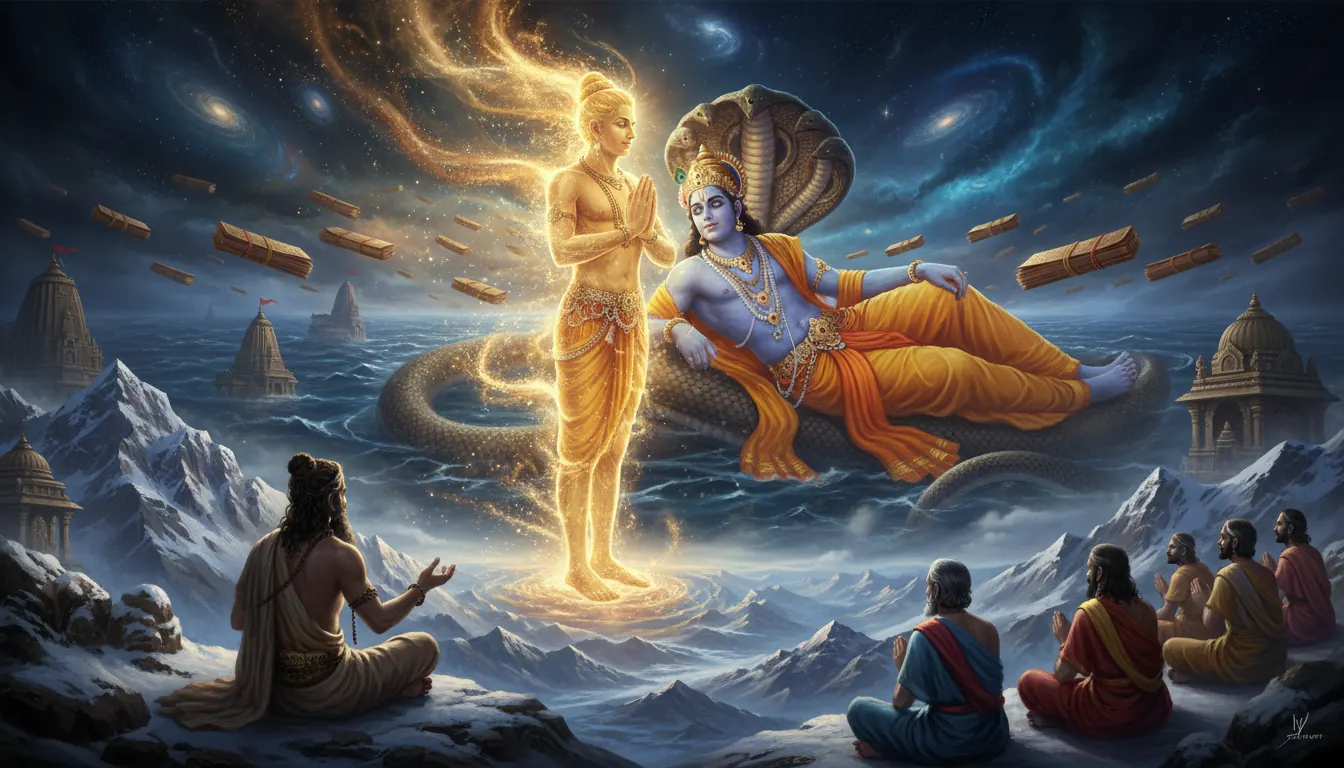
The Rishi Born From a Word
Vyasa tells his disciples who he was before he was Vyasa
In short
Janamejaya asks how Vyasa can be son of both Parashara and Narayana. Vyasa answered it once, resting on the Himavat after composing the epic: the Lord uttered the syllable Bho, and from that speech rose the rishi Apantaratamas, given the Vedas to divide in every age. He was then told that last birth in advance, its dark complexion, its warring princes, and its one son who lets go of everything.
Told in the Shanti ParvaSet in Himavat, Takshashila and Vyasashrama15 min read
A King Asks About the Systems
"Twice-born rishi," said Janamejaya, "the Sankhya system, the Pancharatra scriptures, the Aranyaka Vedas: these different bodies of knowledge are all current in the world. Do they all teach the same course of duties, or do the courses of duty they teach differ from one another? I have asked you. Speak to me now about Pravritti, in due order."
Vaishampayana did not begin with the systems. He began where he always began.
"I bow," he said, "to that great rishi who drives away darkness, whom Satyavati bore to Parashara in the middle of an island. The learned say of him that he is the origin of the Grandsire Brahma; that he is the sixth form of Narayana; that he is the greatest of rishis and possessed of the power of Yoga; that, as the only son of his parents, he is an incarnate portion of Narayana; and that, born in extraordinary circumstances on an island, he is the inexhaustible storehouse of the Vedas. In the Krita age, Narayana of great power and mighty energy created him as his son. Truly the high-souled Vyasa is unborn and ancient, and the inexhaustible storehouse of the Vedas."
The king had been listening to this man for a long time and had learned to catch the places where the account did not sit flat.
Two Fathers for One Man
"Best of the twice-born," said Janamejaya, "it was you who told me before that the rishi Vasishtha had a son named Saktri, and that Saktri had a son named Parashara, and that Parashara fathered a son called the Island-born Krishna, a man of great ascetic merit. Now you tell me that Vyasa is the son of Narayana. I ask you: was it in some former birth that Vyasa of immeasurable energy sprang from Narayana? You are a man of great intelligence. Tell me about that birth of Vyasa which came from Narayana."
It is a fair question, and the answer is not a genealogy. A man has one father in the world and may have another behind the world, and the second one is harder to speak of, because the only person who can testify to it is the man himself.
Vaishampayana had that testimony. He had not got it out of a book and he had not reasoned it out from the Srutis. He had been sitting on a mountain with four others when the man in question opened his mouth and told them what he had been before he was anybody, and he had never forgotten a word of it, partly because of what was in it and partly because of the flat and unhurried way it was said.
So he did not answer the king's objection with an argument. He told him where they had been sitting, and who was sitting there, and in what condition their teacher had been when he began.
The Tired Man on the Himavat
"Wishing to understand the meaning of the Srutis," said Vaishampayana, "my teacher, that ocean of penances, wholly devoted to all the duties of scripture and to the pursuit of knowledge, lived for a time in a certain part of the Himavat mountains. Great as his intelligence was, he had grown tired from his penances, because composing the Mahabharata had put a great strain on his energies.
"At that time Sumanta and Jaimini and Paila of firm vows, and I as the fourth, and Shuka his own son, were attending on him. Seeing how tired our teacher was, all of us waited on him dutifully and did whatever was needed to relieve his weariness. Surrounded by these disciples, Vyasa shone in beauty on the breast of the Himavat like Mahadeva, the lord of all the ghostly beings, in the midst of those attendants of his.
"We had recapitulated the Vedas with all their branches, and the meanings of all the verses in the Mahabharata besides. One day, with rapt attention, all of us approached our teacher, who had mastered his senses and was then wrapped in thought. Taking advantage of a pause in the conversation, we asked that greatest of the twice-born to explain to us the meanings of the Srutis and of the verses in the Mahabharata, and to tell us the story of his own birth from Narayana.
"Since he knew every subject of enquiry, he first spoke to us about the interpretation of the Srutis and of the Mahabharata. Then he began to tell us the following."
The Task Brahma Could Not Take
"Listen, my disciples," said Vyasa, "to this finest of narratives, this best of histories, which tells in its turn of the birth of a rishi. It belongs to the Krita age, and I have come to know it through my penances.
"On the occasion of the seventh creation, that which was due to the primeval Lotus, Narayana, rich in the austerest penances, beyond both good and ill, of unrivalled splendour, first created Brahma from his navel. When Brahma had sprung into being, Narayana said to him: 'You have sprung from my navel. You have the power to create, so set yourself to creating every kind of creature, rational and irrational.'
"When the author of his being spoke to him like this, Brahma felt how hard the task was, his mind filled with anxiety, and he became unwilling to do what he had been commanded. Bowing his head to the boon-giving Hari, the Lord of the universe, he said, 'I bow to you, Lord of the gods. But I ask you, what power do I have to create all these creatures? I have no wisdom. Ordain what should be done about this.'
"At these words of Brahma, the Lord of the universe vanished there and then from Brahma's sight, and began to think. Then the Goddess of Intelligence appeared before him. Narayana, who is himself beyond all Yoga, used Yoga to direct her rightly, and said to that goddess, who was full of activity and goodness and all the power of Yoga, 'To accomplish the task of creating all the worlds, enter into Brahma.'
"At this command, Intelligence at once entered Brahma. And when Hari saw that Brahma had become united with Intelligence, he spoke to him again, saying, 'Now create every kind of creature.' Answering Narayana with the word 'Yes,' Brahma reverently accepted the command of his creator. Then Narayana vanished from his presence and in a moment went to his own place, which is called Deva, and returning to his own unmanifest state, remained there in oneness."
The Weight the Earth Was Given
"When Brahma had finished the task of creation, however, another thought arose in Narayana's mind, and he reflected like this.
"'Brahma, otherwise called Parameshthi, has created all these creatures, Daityas and Danavas and gandharvas and rakshasas. The helpless Earth has become burdened with their weight. Many of the Daityas and the Danavas and the rakshasas will become very strong. Through their penances they will win many excellent boons at different times, and swelling with pride and might because of those boons, they will oppress and torment the gods and the rishis. So it is right that I should lighten the Earth's burden from time to time, taking one form after another as the occasion requires. I will do this by punishing the wicked and upholding the righteous. Cared for by me in this way, the Earth, which is the embodiment of Truth, will be able to bear her load of creatures. In the form of a mighty snake I myself must hold up the Earth in empty space, and held up by me, she will hold up the whole of creation, moving and unmoving. Born on the Earth in different forms, I will have to rescue her from peril at such times.'
"When he had reflected in this way, the slayer of Madhu created in his mind the various forms in which he would appear from time to time to accomplish his purpose. 'Taking the form of a Boar, of a Man-lion, of a Dwarf, and of human beings, I will subdue or slay those enemies of the gods who become wicked and ungovernable.'"
The disciples heard this sitting on a mountain in the same age in which the last of those forms had walked the plains below them and driven a chariot for a friend. Not one of them interrupted to say so. Their teacher was describing a decision taken before there was anybody to see it taken, and describing it in the manner of a man who had been standing in the room at the time.
The Rishi Born From a Syllable
"After this," said Vyasa, "the original Creator of the universe uttered the syllable Bho, causing the atmosphere to resound with it. And from that syllable of speech there arose a rishi named Saraswat. This son, born of the Speech of Narayana, also came to be called Apantaratamas. He was a being of great power, and he knew fully the past, the present, and the future. Firm in the observance of his vows, he was truthful in speech.
"As soon as he was born, that rishi bowed his head to Narayana, and Narayana, the original Creator of all the gods, whose nature never changes, said to him: 'You must give your attention to dividing the Vedas, greatest of all the wise. Do what I command you, ascetic.'
"Obeying the command of the Supreme Lord from whose Speech he had sprung into being, Apantaratamas, in the Kalpa named after the Self-born Manu, distributed and arranged the Vedas. And for that act of his, and for his well performed penances, and his vows and observances, and his restraint of the senses, the illustrious Hari was pleased with him and said, 'At each Manwantara, my son, you will do the same with the Vedas. Because of this act of yours you will be unchanging, and no one will surpass you.'"
That was the whole of the reward: to be told that he would do the same work again at the beginning of every world-age, for as long as there were world-ages, and that nobody would ever get past him. There is no release in that and no rest in it. The Vedas come apart in the mouths of men as an age wears out, and somebody has to gather them and set them in order again, and the one who did it first was told at his birth that he would still be doing it when the Sun had been put out and lit again a hundred times over. Vyasa reported all of this without any complaint in his voice, in the manner of a man stating the terms of his employment. Then he told them the rest of what the Lord had said, which was longer, and which was about a life he had not yet begun to live.
The Life He Was Told in Advance
"'When the Kali age begins,' said Narayana, 'certain princes of Bharata's line, who will be called the Kauravas, will be born of you. They will be famous over the Earth as high-souled princes ruling powerful kingdoms. Though they are born of you, quarrels will break out among them, ending in their destruction at one another's hands, with you alone excepted.
"'In that age too, rich in austere penances, you will divide the Vedas into their different classes. In that dark age your complexion will become dark. You will set many kinds of duties flowing, and many kinds of knowledge too. And although you will be rich in austere penances, you will never be able to free yourself from desire and from attachment to the world. Your son, however, will be freed from every attachment, like the Supreme Soul, through the grace of Maheshvara. It will not be otherwise.'"
Shuka was sitting with the others while his father repeated that sentence, and neither of them said anything about it.
"'Vasishtha of great intelligence, whom learned brahmanas call the mind-born son of the Grandsire, an ocean of penances whose splendour outshines the Sun's, will found a line in which a great rishi named Parashara, of mighty energy and prowess, will be born. That greatest of men, that ocean of the Vedas, that home of penances, will be your father when you are born in the Kali age. You will be born the son of a maiden living in her father's house, through her union with the great rishi Parashara.'"
You Will Have No Doubts
"'You will have no doubts,' said Narayana, 'about the meaning of things past, present, and future. Rich in penances and taught by me, you will see the events of thousands upon thousands of ages long gone, and you will see through thousands upon thousands of ages to come as well. In that birth, ascetic, you will see me, who am without birth and without death, born on Earth and armed with the discus. All this will come to you through the merit you will earn by your ceaseless devotion to me. These words of mine will never be otherwise.
"'You will be one of the foremost of creatures, and your fame will be great. Surya's son Sani will, in a future Kalpa, be born as the great Manu of that period, and during that Manwantara, my son, you will surpass even the seven rishis in merit. You will be so through my grace, without doubt. Whatever exists in the world is the result of my effort. The thoughts of others may not match their acts, but I always ordain what I think, without the least hindrance.'
"When he had said these words to the rishi Apantaratamas, also called Saraswat, the Supreme Lord dismissed him, saying, 'Go.'
"I am the one who was born as Apantaratamas at the command of Hari. I have been born once more as the celebrated Krishna-Dvaipayana, a joy to the race of Vasishtha. So I have told you, my dear disciples, about my own former birth, which came from the grace of Narayana, since I was a very portion of Narayana himself. Long ago I underwent the austerest penances, with the help of the highest absorption of the mind. Moved by my great affection for you who are devoted to me with reverence, I have told you everything relating to what you wished to know: my first birth in remote antiquity, and that other birth which came after it."
The Man Who Walked Into It
"So I have told you, king," said Vaishampayana, "about the former birth of our revered teacher, Vyasa of unstained mind, as you asked. Listen to me once again.
"There are diverse kinds of cults that go by diverse names: Sankhya, Yoga, the Pancharatra, the Vedas, and Pashupati. The founder of the Sankhya cult is said to be the great rishi Kapila. The primeval Hiranyagarbha, and no one else, is the founder of the Yoga system. The rishi Apantaratamas is said to be the teacher of the Vedas, and some call that rishi Prachina-garbha. The cult known as Pashupata was founded by the Lord of Uma, the master of all creatures, the cheerful Shiva. The illustrious Narayana himself is the founder of the whole of the cult contained in the Pancharatra scriptures. In all these cults, foremost of kings, it is seen that Narayana is the one sole object of exposition. The Sankhya and the Yoga systems are eternal, and all the Vedas are eternal. The rishis of all these systems have declared that this universe, existing from ancient times, is Narayana's self."
That was the answer to what Janamejaya had asked at the beginning, and it had taken the whole of a life to give it.
For consider what was in that life. A rishi comes out of a spoken syllable, bows, and is set to sort the Vedas, and is told he will do it again in every age. Then he is told, before he has done anything at all, that in the dark age his skin will be dark, that his father will be Parashara and his mother a girl still living in her father's house, that princes will be born of him who will destroy one another to the last, that he will not be able to let go of the world however much he burns himself, and that his one son will let go of it entirely and be gone.
He was given the list and he said nothing against it. He was born as Krishna-Dvaipayana, and he made the divisions of the Veda, and he fathered those princes, and he came afterwards among the grieving women of the Kurus, and he watched Shuka go north like the wind and not come back. A man may be told the whole of his life in advance, including its griefs, and still have to get up and walk into it, one day at a time, exactly as if he had not been told.
Dharma Lesson
A man may be told the whole of his life in advance, its work, its griefs and its losses, and still have to get up and walk into it one day at a time. Apantaratamas was promised the same labour of dividing the Vedas in every world-age and no release from it, and said nothing against the terms. Knowing the end changes nothing about having to go there.