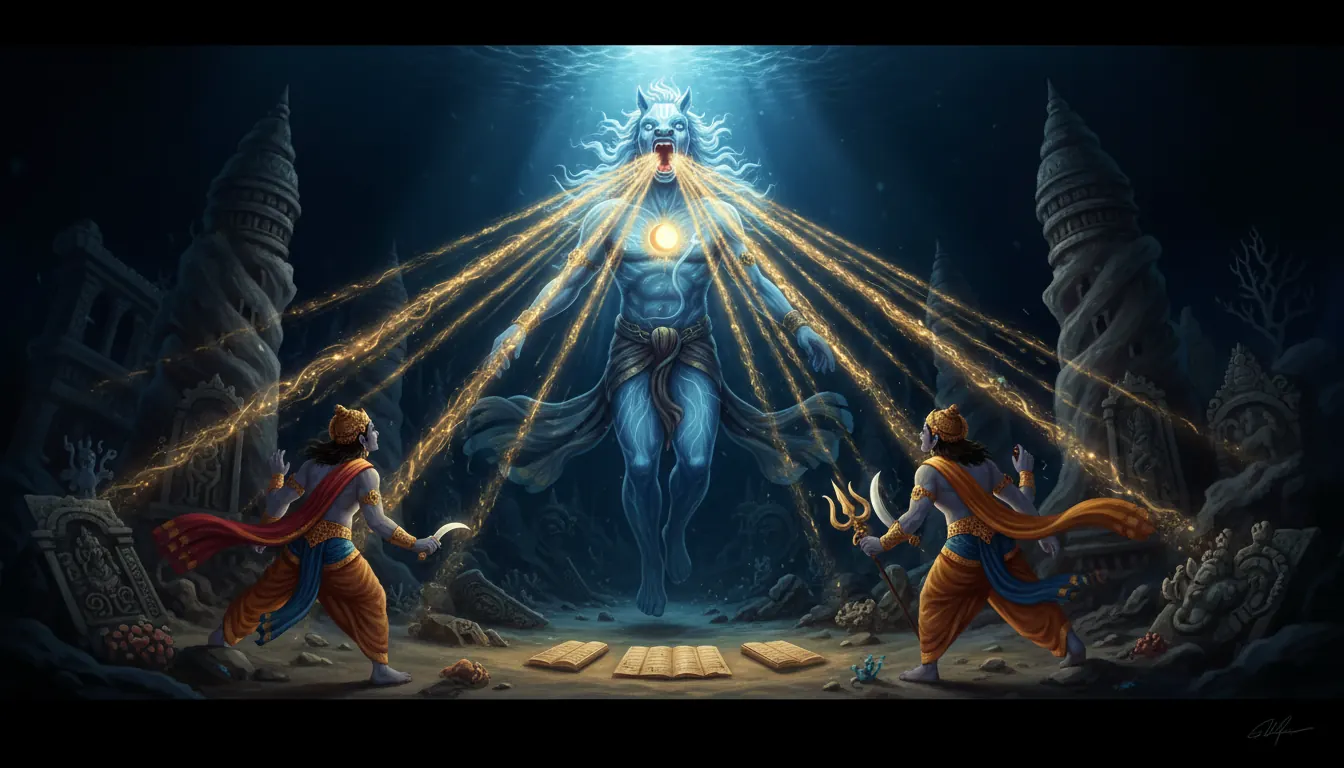
The Horse-Headed Voice in the Deep
How the Vedas were sung back out of the hands of thieves
In short
Two asuras born from drops of water in the primeval lotus snatch the four Vedas from under Brahma's hands and carry them to the floor of the ocean, leaving the creator blind and his worlds standing in the dark. Roused by Brahma's hymn, the sleeper on the waters takes a second form with the head of a horse and a body made of stars, rivers, sun and moon, goes down to the nether region, and begins to chant in perfect Siksha. The thieves put the Vedas down and run toward the sound.
Told in the Shanti ParvaSet in Kshira Sagara, The Ocean and Hastinapura17 min read
A Doubt About a Horse's Head
The fires of the snake sacrifice had been burning for a long while, and the king had heard a great deal.
"I have heard from you the glory of the divine and Supreme Soul," Janamejaya said. "I have heard of the birth of the Supreme Deity in the house of Dharma, in the form of Nara and Narayana. I have heard the origin of the Pinda from the mighty Boar that lifted the sunken Earth. You have told us which gods and rishis were appointed for the religion of Pravritti and which for the religion of Nivritti, and much else besides, and I am grateful for all of it.
"But there is one thing you said in passing, twice-born one, and then went on, and it has stuck in me like a splinter. You spoke of a vast form of Vishnu with the head of a horse. You said it appeared in the great ocean, in the North-East, and that the illustrious Brahman, who is also called Parameshthi, saw it there."
"I did say that," Vaishampayana agreed.
"Then tell me the rest. What exactly did that form look like? What was its energy, the like of which had never appeared before among all great things? What did the Grandsire do when he had seen that greatest of gods, whose likeness had never been seen, him of boundless energy, him with the horse's head, him who was Sacredness itself? Why did the supreme Deity take that shape and show himself in it to Brahman? This doubt about an ancient matter has arisen in our minds, and you have blessed us with so many holy subjects that I am bold enough to ask for one more."
Vaishampayana was quiet for a moment. "It is an old story," he said, "and perfectly consistent with the Vedas, which is fortunate, since the Vedas are in it. Sit, king. It begins with the world being put away."
The Sleeper on the Water
"Everything that exists," said Vaishampayana, "is a combination of the five primal elements, and the combining is done by the intelligence of the Supreme Lord. Narayana is that Lord, infinite, the inner Soul of all things and the giver of boons; without attributes, and then again with them. Hear now how the Destruction of all things comes about, for you cannot understand the theft unless you know what the world is made of and what it comes back to.
"First the element of Earth becomes merged in Water, and then nothing is seen anywhere but one vast expanse of water. Water merges into Heat. Heat merges into Wind. Wind merges into Space, and Space in its turn into Mind. Mind merges into the Manifest, which is also called Consciousness. The Manifest merges into the Unmanifest, which is Prakriti. Prakriti merges into Purusha, and Purusha merges into the Supreme Soul.
"Then Darkness spreads over the face of the universe, and nothing at all can be perceived. And out of that primal Darkness, which is primeval and full of immortality, arises Brahma, who holds the principle of Creation."
He developed, by his own potency, into the idea of the universe, and took the form of Purusha, and that Purusha is called Aniruddha. Divested of sex, he is called Pradhana. He exists with Knowledge alone for his companion, and he is otherwise called Viswaksena, and Hari.
Yielding to Yoga-sleep, he laid himself down upon the waters.
And while he slept he thought about making a universe of many different things, and as he thought about it he remembered his own high attributes, and from that memory sprang the four-faced Brahma, who is the Consciousness of Aniruddha. With eyes like lotus petals, the illustrious Hiranyagarbha, Grandsire of all the worlds, was born within the Lotus that springs from the sleeper's navel.
Seated on that Lotus, wonderful of aspect, he looked around him and saw that the waters were on all sides. So he adopted the attribute of Sattwa and commenced to create.
Two Drops in the Primeval Lotus
In that primeval Lotus, which shone like the sun, Narayana had cast two drops of water, and they were full of great merit. The illustrious Narayana, who is without beginning and without end and beyond destruction, turned his eyes on those two drops of water.
One of them was of very beautiful and bright form, and looked like a drop of honey. From that drop, at the command of Narayana, there sprang a daitya of the name of Madhu, and he was made up of the attribute of Tamas, which is dullness.
The other drop within the Lotus was very hard. From it sprang the daitya Kaitabha, and he was made up of the attribute of Rajas, which is passion.
"Consider what they were," Vaishampayana said. "They were not intruders from outside the creation. They were made of two drops of water that the Lord himself had put into his own flower and then looked at. Everything that happened afterwards, the theft and the darkness and the horse and the long descent into the deep, happened inside a lotus, among the family."
Made in this way of dullness and passion, the two daityas had great might, and each of them was armed with a mace, and as soon as they were born they began to roam about inside that vast primeval Lotus, going up and down its petals as men go about a country, looking for something to do.
And in the middle of it they came upon Brahma of immeasurable splendour, sitting at his work.
Taken in the Sight of Their Maker
He was busy creating the four Vedas, and each of them had the most delightful form.
That is what the two asuras saw: not four books, but four beings, newly made and beautiful, standing beside the Creator on the petal while he finished them. They were the first things anyone had ever made, and they had come out well, and Brahma was looking at them the way a maker looks at work that has gone right.
Those two mightiest of asuras, in their bodies and armed with maces, saw the four Vedas, and suddenly seized them.
They did it in the very sight of their Creator. Not by stealth, not at night, not while he was turned away; they took hold of the four Vedas while the eyes of Brahma were upon them, which is a thing worth noticing about a certain kind of thief, that the being seen is part of what he is after.
Then the two mighty danavas, having seized the eternal Vedas, went at once to the edge of the Lotus and dived into the ocean of waters that they saw below, and swam down and down to its very bottom, and there they stopped, in a place where no light had ever gone, holding all the knowledge there was.
And Brahma sat on his flower above the water and could not follow them.
The Creator Goes Blind
Seeing the Vedas forcibly taken away from him, Brahma was filled with grief, and the grief in him was not of the ordinary kind, because a great deal more than his feelings had gone down into the water.
"The Vedas are my great eyes," he said aloud, to the Lord sleeping on the water below him. "The Vedas are my great strength. The Vedas are my great refuge. The Vedas are my high Brahman. And two danavas have taken all of them from me by force.
"Without the Vedas, the worlds I have created are wrapped in darkness. Without the Vedas beside me, how can I bring my excellent Creation into being? Alas, great is the grief I suffer for the loss of them, and at such hands. My heart is in great pain. It has become the home of a great sorrow.
"Who will rescue me from this ocean of grief in which I am sunk? Who will bring me the Vedas I have lost? Who will take pity on me?"
"He was not being poetical," Vaishampayana said. "When he says the Vedas are his eyes, he means that he cannot see. Creation had gone as far as four books and stopped, and everything he had already made was standing in the dark waiting to be told what it was, and he had no way to tell it. A creator without the Vedas is a blind man in a house he built himself and can no longer find his way about."
And while Brahma was uttering these words, best of kings, a resolution suddenly arose in his mind: to praise. He joined his hands in reverence, and took hold of the feet of his progenitor, who lay asleep upon the water below him, and sang the highest of hymns.
Give Me Back My Eyes
"I bow to you, heart of Brahman," sang Brahma. "I bow to you who were born before me. You are the origin of the universe and the highest of all dwelling places. You are the ocean of Yoga with all its branches. You are the Creator of what is Manifest and of what is Unmanifest. You walk a path whose auspiciousness is beyond imagining. You are the consumer of the universe. You are the Inner Soul of all creatures. You have no origin, and for origin you have none that is not yourself.
"As for me, I have sprung from your grace, and from you I took my birth. My first birth from you, which all the twice-born hold sacred, was by a decree of your Mind. My second birth, long ago, was from your eyes. Through your grace my third birth was from your speech. My fourth birth, mighty Lord, was from your ears. My fifth, excellent in every way, was from your nose. My sixth birth was, through you, from an egg.
"This is my seventh. It has taken place within this Lotus, and it is meant to stir the intellect and the desires of all beings. At each Creation I am born from you as your son, and as your eldest son, made of Sattwa, the highest of the three attributes.
"The Vedas are my eyes. Through them I transcend Time itself. Those Vedas that are my eyes have been taken from me, and so I have become blind.
"Wake from this Yoga-sleep. Give me back my eyes. I am dear to you, and you are dear to me."
"It is not a bargain and it is not a complaint," Vaishampayana said. "He counts up seven births to establish who is speaking, and then he asks for the one thing, twice, in the plainest words in the hymn. Give me back my eyes."
And thus praised by Brahma, the illustrious Purusha, with his face turned toward every side, shook off his slumber.
The Form With the Horse's Head
He resolved to recover the Vedas from the daityas who had snatched them, and he did not go down in the body he was lying in. Using the power of his Yoga, he took a second form.
That body, with a fine nose, became as bright as the Moon. On it he set a horse's head of great radiance, and that head was the home of the Vedas.
And then, said Vaishampayana, he was made out of the world. The firmament with all its luminaries and constellations became the crown of his head. His locks of hair were long and flowing and had the splendour of the rays of the sun. The regions above and the regions below became his two ears. The Earth became his forehead. The two great rivers Ganga and Saraswati became his two eyebrows. The Sun and the Moon became his two eyes. The twilight became his nose. The syllable Om became his memory and his intelligence. The lightning became his tongue. The Pitris who drink the Soma became, it is said, his teeth. The two regions of felicity, Goloka and Brahmaloka, became his upper and his lower lip. And the terrible night that succeeds universal destruction, which transcends the three attributes, became his neck.
"You asked me what its features were," Vaishampayana said to the king. "There they are. He did not put on a disguise to go and fetch the Vedas. He put on the universe, and he put a horse's head on top of it, because the head was to be the house of the Vedas and the mouth was to be the instrument."
Having taken that form, with all those different things for its different limbs, the Lord of the universe vanished from that place and went down to the nether regions.
The Chanting at the Bottom of the World
When he reached those regions, he did not hunt for the thieves. He set himself to high Yoga, and in a voice governed by the rules of the science called Siksha, he began to chant the sacred syllable Om aloud.
His pronunciation was distinct. Every syllable stood where it belonged, with its proper measure and its proper pitch, as Siksha lays down; and the sound echoed through the air and was sweet in every way. It filled the nether region from one end to the other. Since it held the properties of all the elements, it did great good wherever it went, though there was nobody down there to do good to but two demons and four stolen books.
Madhu and Kaitabha, lying on the floor of the ocean with the Vedas beside them, lifted their heads.
"Consider what they did next," said Vaishampayana, "because in it is the whole of their nature and the whole of the Lord's stratagem. They did not abandon their loot. They were careful. The two asuras made an appointment with the Vedas about the time when they would come back and take them up again, and having settled that, they laid them down there in the nether region.
"And then they ran. They ran toward the place the sound seemed to come from, with their maces in their hands and their prize left lying behind them, because a beautiful noise was being made somewhere in the dark and they could not bear not to know what it was."
"They were made of dullness and passion," Janamejaya said.
"They were," said Vaishampayana. "And neither dullness nor passion has ever been able to sit still while somebody sings."
The Books Go Home
Meanwhile the Supreme Lord with the equine head, who was himself in the nether region, went to the place where they had been and took up all the Vedas.
He carried them up out of the water and returned to where Brahma was staying and gave them into his hands, and the eyes of the Creator were restored to him, and the worlds standing in the dark were given their names at last.
Having restored the Vedas, the Supreme Lord returned once more to his own nature. But he did not simply put the horse-headed body away, as a man takes off a garment he has finished with. He set that form in the North-Eastern region of the great ocean, and left it standing there; and having in this way set up the one who was the home of the Vedas, he became once more the horse-headed form that he was.
"That is the answer to the first half of your question," Vaishampayana said. "You asked why the Grandsire saw a vast form with a horse's head in the north-east of the ocean, and why it was there to be seen at all. It is there because it was never taken down. The shape that was made for one errand was left standing where the errand ended, at the corner of the world, with the sound of correct recitation still in its mouth."
Janamejaya said, "And the thieves came back for their appointment."
"They came back," said Vaishampayana.
Whose Is He? Who Is He?
Not finding the one who had made those sounds, the two danavas quickly came back to the spot where they had left their prize. They looked around, and saw that the place where they had thrown down the Vedas was empty.
Those two mightiest of Beings then moved with great speed and rose out of the nether region, and returned to where the primeval Lotus was that had given them birth. And there they saw the mighty Being, the original Creator, in the form of Aniruddha, fair in colour, with a splendour like the Moon's. He was in Yoga-sleep, his body stretched on the waters and taking up a space as vast as itself, lying on the splendid hood of a snake that seemed to give off flames of fire.
Seeing him lying there, the two mightiest of danavas let out a loud laugh.
"This is that Being of white complexion," they said. "He is lying asleep now. Without doubt he is the one who has brought the Vedas away from the nether region. Whose is he? Whose is he? Who is he? Why is he asleep like this on the hood of a snake?"
With these words, they woke Hari from his Yoga-slumber; and the greatest of Beings, woken in this way, understood that they wanted to fight him, and made up his mind to satisfy that wish of theirs. So the battle came, one against two, and Narayana killed Madhu and Kaitabha to please Brahma, and from that day he has been called Madhusudana.
Then, with Hari's help and with the Vedas beside him, Brahma created all the worlds with their moving and unmoving creatures; and Hari, having given the Grandsire the highest understanding of Creation, vanished, and went to the place he had come from.
"That is the old story of Hayasiras," Vaishampayana said, "consistent with the Vedas, which you asked me about. Of all his mighty forms, this one is known as the most ancient. The man who often listens to it, or recites it in his mind, will never forget his Vedic or his other learning. It was by worshipping the god with the horse's head with the most austere penances that the rishi Panchala, whom men also call Galava, acquired the science of Siksha."
The king sat looking at the fire.
"They put the Vedas down of their own accord," he said, "and ran toward a voice."
"They did," said Vaishampayana. "What was taken by force was not taken back by force. It was sung out of their hands."
Dharma Lesson
What is stolen by force can be recovered by beauty; the thief will always leave his loot to go and listen. The Lord did not hunt Madhu and Kaitabha through the dark water. He recited correctly, and dullness and passion, which can seize anything but cannot sit still while somebody sings, put down what they had taken and went to find the voice.