In short
A voice from the sky forbids Yudhishthira the direct road to Kubera's city and names a route instead. Past Vrishaparva's hermitage, where the Pandavas leave every hard thing they still own, they reach Gandhamadana and the royal sage Arshtishena, who questions the king only about his ordinary duties and then tells him it is impossible to proceed beyond this. Bhima goes up anyway.
Told in the Vana ParvaSet in Badarikashrama, Himavat and Gandhamadana21 min read
The Voice That Named the Road
They had run out of holy places.
Standing by the unearthly lake above Badari, Yudhishthira counted them off for Bhima the way a man counts what he has spent. "Everywhere we have gone we have pleased the pitris. With the great-souled ones we have bathed at all the sacred mountains and lakes and in the ocean itself. With the brahmanas we have bathed in the Ila, and in the Saraswati, and in the Sindhu, and in the Yamuna, and in the Narmada, and in various other lovely tirthas. We have passed the source of the Ganga. We have seen the Himalaya and the jujube called Visala, where the hermitage of Nara and Narayana stands. And now this lake, which the Siddhas and the gods and the sages revere.
"One by one, with care, in the company of the great-souled Lomasa, we have seen every famous and sacred spot there is."
Then he asked the question he had been working toward.
"Now, Bhima. How are we to reach the sacred home of Vaishravana, where the Siddhas live? Think of a way to get in."
Bhima, who had never in his life been asked how to get into somewhere and answered that it could not be done, was opening his mouth when something else spoke.
It came out of the air above the lake and it addressed the king.
"You will not be able to go to that inaccessible spot."
Nobody moved.
"Go back from this region of Kubera by the way you came, to the hermitage of Nara and Narayana called Badari. From there, Kaunteya, you will go to the hermitage of Vrishaparva, rich in flowers and fruit, where the Siddhas and the Charanas live. Beyond that, Partha, you will come to the hermitage of Arshtishena. And from there you will see the abode of Kubera."
At that very moment the breeze turned fresh and joyful and cool, full of an unearthly fragrance, and it showered blossoms over all of them.
The rishis of earth and the brahmanas were more amazed than anyone. It was Dhaumya who found his voice first, and what he said was the whole of his profession in six words.
"This must not be disputed. Let it be so."
And king Yudhishthira obeyed him. He noticed, as they turned back, that the voice had given him a road with three stops on it and had not said what was at the end of the third, except that from there he would see. Not enter. See.
Seventeen Days North
They went back to the hermitage of Nara and Narayana and lived there, and it was there, one evening, remembering his brother Jaya, that Yudhishthira called them all together with Draupadi and told them why they were going to move again.
"We have spent these four years roaming the woods in peace. Bibhatsu arranged that around the fifth year he would come to that king of mountains, the splendid cliff Shveta." He described it the way a man describes a place he has never seen and has thought about every day: graced with blooming plants and maddened kokilas and black bees and peacocks and chatakas, roamed by tigers and boars and buffaloes and deer, lovely with blown lotuses of a hundred and a thousand petals, visited by the celestials and the Asuras alike.
"Partha arranged it with me. 'I will stay away five years,' he said, 'to learn the science of war.' In a place like the region of the gods we will see the bearer of Gandiva, come back with his weapons."
He summoned the brahmanas and told them. They went round the ascetics of rigid austerities and pleased them and told them also. And the brahmanas gave their assent in the form such men use, which is never quite a blessing and never quite a prediction.
"This will bring prosperity and well-being. First of the Bharatas, these troubles will end in happiness. Pious one, you will win the earth by kshatriya virtue and rule it."
So Yudhishthira set out with his brothers and those brahmanas, followed by the Rakshasa and protected by Lomasa. At some places they went on foot. At others the Rakshasas carried them, which is not a thing anyone enjoys and nobody complained about.
They went north, into country abounding in lions and tigers and elephants. They passed the mountain Mainaka and the base of the Gandhamadana and the rocky mass of Shveta, and higher and higher up they crossed one crystal rivulet after another, and on the seventeenth day they came out onto the sacred slopes of the Himalayas.
What They Left With Vrishaparva
Not far from the Gandhamadana, on those slopes, under trees and creepers and beside cascades that came down in white ropes, stood the holy hermitage of the royal sage Vrishaparva.
He received them as his own sons. There is no better way to say it and the account does not try. A king who had put off being a king met five men who had had it taken from them, and he took them in, and asked no questions about dice.
They stayed seven nights and were duly honoured. On the eighth day they took his permission to go, and then came the part of the visit that mattered.
They brought the brahmanas to him one by one and introduced them, and left them there in his charge as friends, because what lay ahead was not a road for men whose work is recitation. They gave him their remaining robes to keep. And then, in a heap on the floor of a hermitage on the side of a mountain, the sons of Pandu left their sacrificial vessels, and their ornaments, and their jewels.
Every hard thing they still owned. Exile had already stripped them of a kingdom and they had carried these last objects up the Himalaya, and here they set them down, and went on with nothing but weapons and what was on their backs.
Vrishaparva was wise and pious and versed in every duty, and he had knowledge of the past and of the future, and knowing both he still gave them instructions as he would to his own children, and did not tell them what he saw. He followed them a certain distance up the path. Then he placed them in the care of the brahmanas who went with them, blessed them, told them the route, and turned and went back down.
The Forest at the Top of the World
Then Kunti's son and his brothers went on foot along a mountain path where every kind of beast lived, and on the fourth day they reached the Shveta mountain, which stood up like a mighty mass of cloud and was made, as far as anyone could tell, of gold and gems.
They went the way Vrishaparva had directed and came to the intended places one by one. Over and over they passed inaccessible rocks and caves that should have been impassable, and passed them with ease, which none of them could afterwards account for. Dhaumya and Draupadi and the sons of Pritha and the mighty Lomasa went on in a body, and none grew tired.
And then, with the hair standing on end on their arms, they saw the Gandhamadana.
It is the abode of the Kimpurushas. Siddhas and Charanas visit it and Vidyadharis and Kinnaris roam it and there are herds of elephants in it and lions and tigers, and the roar of the sarabha comes off it. They went in as men go into the Nandana gardens. There were mangoes and hog-plums and pomegranates and citrons and jacks and plantains, champakas and asokas and ketakas and bakulas and punnagas and karnikaras, kadambas and salas and tamalas and devadarus, every one of them bearing flower and fruit in the same hour.
Yudhishthira walked through it talking, which he rarely did.
"Ah, Bhima. How beautiful this forest of the Gandhamadana is. There is not a tree here that does not flower. Look at the lotus lakes, humming with black bees, stirred up by elephants and their mates. Look at the karnikaras on the summits with their golden blossoms, like finely made ear-rings. Look at the tilakas, like beauty-spots painted on the forehead of the forest.
"On this mountain there is collyrium in the rock, and gold, and yellow orpiment, and vermilion, and caves of red arsenic like the evening clouds. And listen to the peacocks crying with their hens. By coming here, brother, we have reached a state beyond the human. Look at the celestial river Mahaganga with her swans, where sages and Kinnaras come."
Bhima looked at the summits, where the Gandharvas and the Kimpurushas were visible in company with their loves, and did not say what he was thinking.
The Man With His Muscles Bare
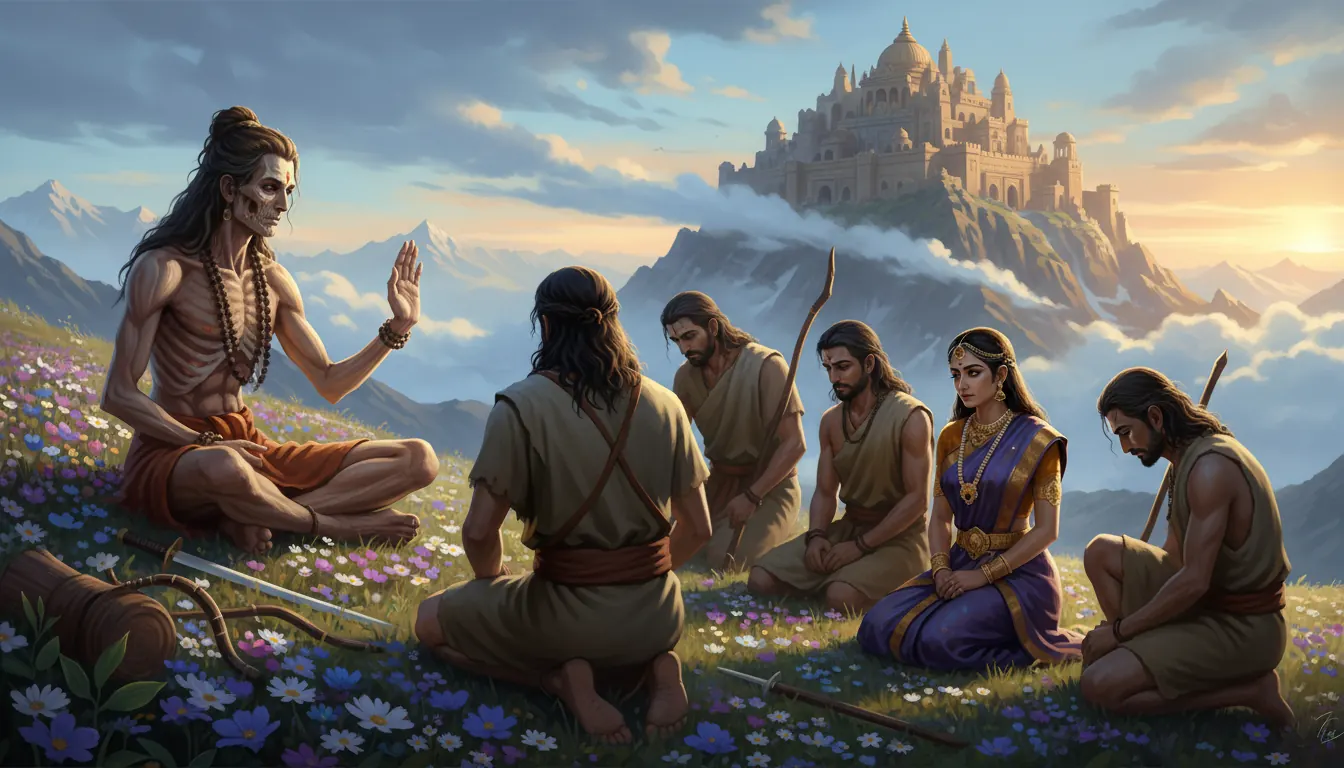
After that they saw a hermitage full of flowers and trees bearing fruit, and in it they found the royal sage Arshtishena.
The account gives him three words. Versed in all duties, of rigid austerities, skeleton-like, having his muscles bare. That is what was sitting there. A man whose sins had been consumed by asceticism and whose body had gone the same way as the sins, so that what remained was a frame with the cords standing out on it, holding still.
Yudhishthira went up to him, gave his name, and greeted him gladly with his head bowed. Then Draupadi and Bhima and the devout twins bowed their heads to the royal sage and stood around him, and Dhaumya, the Pandavas' own priest, came up and paid his respects in the proper form.
By his prophetic eye the muni had known who they were before any of them opened their mouths. He had known since they were three ridges away. He let Yudhishthira say his name anyway, because it is good for a man to say his name aloud to somebody who already knows it.
"Sit down," he said.
They sat. And here was a king who had lost a throne at dice, and his queen who had been dragged into an assembly by the hair, and a brother who had sworn to drink a man's blood, and two young men who had grown up in the woods, and a chaplain who had held the whole household together through the years of exile, all of them come up to the roof of the world after seventeen days of walking, sitting on the ground in front of a skeleton, waiting to hear what the holy man would ask them about.
The Examination
He asked them about home.
"You do not lean toward untruth? You are intent on virtue? And, Partha, your care for your father and your mother has not grown less?"
Not one word about the dice. Not one about Duryodhana, or the thirteenth year, or the war that every ascetic on that mountain knew was coming.
"Do you honour all your superiors, and the old, and those versed in the Vedas? You do not lean toward sinful acts? Do you truly know how to do meritorious deeds and avoid wicked ones?"
Then the one that went in deepest, put quietly, in the middle of the list where a man might miss it.
"Do you not exalt yourself?"
"And are pious men pleased with the honour you show them? Even living in the woods, do you follow virtue alone? And, Partha, Dhaumya does not grieve at your conduct?"
Dhaumya, sitting to one side, kept his face entirely still.
"Do you follow the customs of your ancestors, by charity, and religious observances, and asceticism, and purity, and candour, and forgiveness? And do you go along the way taken by the royal sages?"
Then Arshtishena told him why he was asking.
"When a son is born into their line, the pitris in their own regions both laugh and grieve, thinking: will this son's sins harm us, or will his good deeds bring us welfare? The man who honours his father, his mother, his teacher, Agni, and fifth, the soul, wins both worlds."
Yudhishthira answered him without any ornament at all.
"Worshipful one, you have named those duties as excellent. To the best of my power I carry them out duly and properly."
And that was the examination. A man had come to the last habitable place on the road to the city of the lord of treasures, and had been questioned on whether he was good to his mother.
It Is Impossible to Proceed Beyond This
Then the sage told them where they were.
"At the Parvas, sages who live on air and water come through the sky to this best of mountains. On the summits you can see amorous Kimpurushas with their lovers, devoted to one another. Many Gandharvas, and Apsaras dressed in white silk, and lovely Vidyadharas wearing garlands, and mighty Nagas, and Suparnas, and Uragas.
"And at the Parvas the sound of kettle-drums and tabors, conchs and mridangas is heard on the summits. Even from here you will hear it."
He let that sit a moment before he finished the sentence.
"On no account think of going there."
And then, flatly, the thing they had come all this way to be told.
"And best of the Bharata race, it is impossible to go beyond this point. That place is where the gods take their pleasure. Mortals have no way in. Here every creature bears ill-will toward the man who commits the least aggression, and the Rakshasas punish him.
"Beyond the summit of this Kailasa cliff lies the path of the celestial sages. If anyone is impudent enough to go beyond this, the Rakshasas kill him with iron darts and other weapons."
He told them what they would see from where they sat, which was a great deal. During the Parvas the lord of treasures himself, who goes about on the shoulders of men, is seen there in pomp and grandeur surrounded by the Apsaras, and when that lord of all the Rakshasas is seated on the summit, all creatures see him like a risen sun. Tumburu entertains him, and the sweet notes of his singing are heard all over the Gandhamadana.
"Here, at the Parvas, every creature sees and hears marvels like these. Pandavas, stay here until you meet Arjuna, and eat luscious fruits and the food of the munis."
And last, to Yudhishthira, in the tone a man uses for the one instruction he expects to be disobeyed.
"Child, now that you have come here, do not be impertinent in any way. Live here as you wish and enjoy yourself as you like, and in the end you will conquer the earth by the strength of your arms and rule it."
Flowers of Five Colours
So they behaved accordingly, and it was, for a while, the best time any of them had had since the dice.
They lived on the Himavan and ate what the munis ate, and luscious fruit, and the flesh of deer killed with unpoisoned shafts, and various kinds of pure honey. They passed the fifth year that way, listening to the stories Lomasa told, and there were a great many of them. Ghatotkacha had already gone, taking all the Rakshasas with him. "I will be there when the need arises," he had said to his father, which was the closest that particular son ever came to a farewell.
Months went by in the hermitage of Arshtishena and they witnessed many marvels. Contented munis and Charanas of pure soul came to see them, and the foremost of the Bharata race sat and talked with them about earthly matters, which is what men do at the roof of the world.
Then one day Suparna came down on the great lake and took a mighty Naga out of it.
The whole mountain trembled. Gigantic trees came apart. Every creature there saw it, and the wind that the wings raised came off the brow of the mountain and brought a fall of blossoms down over the Pandavas where they sat, flowers of five hues, fragrant and unearthly, more than anyone could gather.
Bhimasena was sitting at his ease on the rock. Draupadi turned to him.
"Best of the Bharata race, before the eyes of every creature, these flowers of five colours, carried on the wind that Suparna has raised, are falling thick and fast on the river Aswaratha." She was looking up at the summit while she said it. "In Khandava your great-souled brother, true to his word, held off the Gandharvas and the Nagas and Vasava himself, slew fierce Rakshasas, and won the bow Gandiva.
"You too have great prowess, and the might of your arms is great and unbearable, like Shakra's. Bhimasena, let all the Rakshasas, terrified by the strength of your arms, leave the mountain and flee to the ten quarters. Then your friends will be free of fear and distress and can see the auspicious summit of this splendid mountain, bright with flowers of many colours.
"Bhima, I have long cherished this wish: that under the protection of your arms I may see that summit."
The Path Wide Enough for One
Like a high-spirited bull that has been struck, Bhimasena considered himself rebuked by Draupadi, and could not bear it.
He took up his bow, plaited at the back with gold, and his sword, and his mace, and he went. Every creature on that slope saw him go, equipped with bow and arrows, coming on like a lion or a maddened elephant, and free from fear and from affliction, and nobody put out a hand to stop him, and Arshtishena was in his hermitage and did not know.
He found the rugged path that allowed passage to one person only, and went up it, and came out on the terrible summit that stands as high as several palmyra palms set one upon another. His arrival gladdened Kinnaras and great Nagas and munis and Gandharvas and Rakshasas alike, which is to say that all of them saw him and understood at once what was going to happen.
And there in front of him was the abode of Vaishravana.
Golden crystal palaces, surrounded on all sides by golden walls with the splendour of every gem in them. Gardens all round it. Ramparts and towers, doorways and gates, and rows of pennons waved by the breeze. Playful damsels dancing in the courts. Heaps of gems, and many-coloured garlands. A breeze carrying every perfume there is, and trees of many hues sounding with sweet notes.
Bhima stood with his arms bent, supporting himself on the end of his bow, and looked at it with eagerness, and gave up all care for his life.
Then he blew his conch.
He twanged his bowstring, and struck his arms with his hands, and the three sounds together unnerved every creature on the mountain, and the Yakshas and Rakshasas came, with their hair standing on end, rushing toward the noise with flaming maces and clubs and swords and spears and javelins and axes in their hands.
He cut the darts and javelins and axes out of the air with arrows and pierced the roaring bodies behind them, those in the sky and those on the ground both, until he stood drenched in a rain of blood that came from all sides at once, like the sun with clouds around him.
Either Through Rashness or Through Ignorance
The Yakshas broke and ran toward the southern quarter, leaving their maces and spears and swords and clubs and axes on the ground.
One did not run. Maniman, the friend of Vaishravana, broad-chested and mighty-armed, stood holding darts and maces, and he called after the ones who were fleeing with a smile on his face.
"When you go to Vaishravana's house, how will you tell that lord of wealth that so many of you were beaten in battle by a single mortal?"
Then he came on like a maddened elephant. Bhima pierced his sides with three choice arrows. Maniman took up a tremendous mace and flourished it and hurled it, and Bhima met it with shafts sharpened on stone and they were turned aside and fell away and could not stop it, and he broke its flight with his own mace instead, being the better man at that particular trade. Then the Rakshasa hurled a terrible iron club with a golden shaft, belching flame and roaring, and it came through everything and pierced Bhima's right arm and fell to the ground.
Bhima's eyes rolled in anger. He took up his own mace, inlaid with plates of gold, and sprang into the sky, and hurled it with a shout, and it went down like the thunderbolt of Indra and destroyed the Rakshasa, and every creature there saw Maniman lying slain like a bull killed by a lion. The survivors went east, crying out.
Down below, Yudhishthira and the twins and Dhaumya and Draupadi and the brahmanas had been hearing sounds resounding in the caves of the mountain and could not find Bhima, and were filled with anxiety. They put Draupadi in the charge of Arshtishena, took their arms, and climbed.
What they found on the summit was the abode of Kubera, and the Rakshasas of mighty strength lying struck down in every direction, and their brother standing among them with his mace and sword and bow, looking like Maghavan after the slaughter of the danava hosts.
They embraced him. They sat down. And then the king said what he had been assembling on the way up.
"Either through rashness or through ignorance, Bhima, you have committed a sinful act. Hero, you are living the life of an anchorite, and this needless slaughter is not like you. Those versed in duty say that acts likely to displease a king ought not to be done. But you, Bhimasena, have done a deed that will offend even the gods.
"A man who turns his mind to sin, careless of profit and duty, must reap the fruit of his sinful acts. If you want my good, never do such a thing again."
When he had said this to his brother, Yudhishthira fell silent and began to think the matter over, sitting on the forbidden summit with the dead lying around him and the golden walls of the city of treasures shining a little way off, exactly where the skeleton on the lower slope had told them it would be, and exactly as far out of reach.
Dharma Lesson
A man is examined on the ordinary duties he left at home long before he is trusted with the road ahead: Arshtishena asked the king about his mother and his teachers and whether he exalted himself, and said nothing of dice or war. And a limit given in plain words is still a limit when the one who crosses it wins, which is why Yudhishthira called his brother's victory a sin.