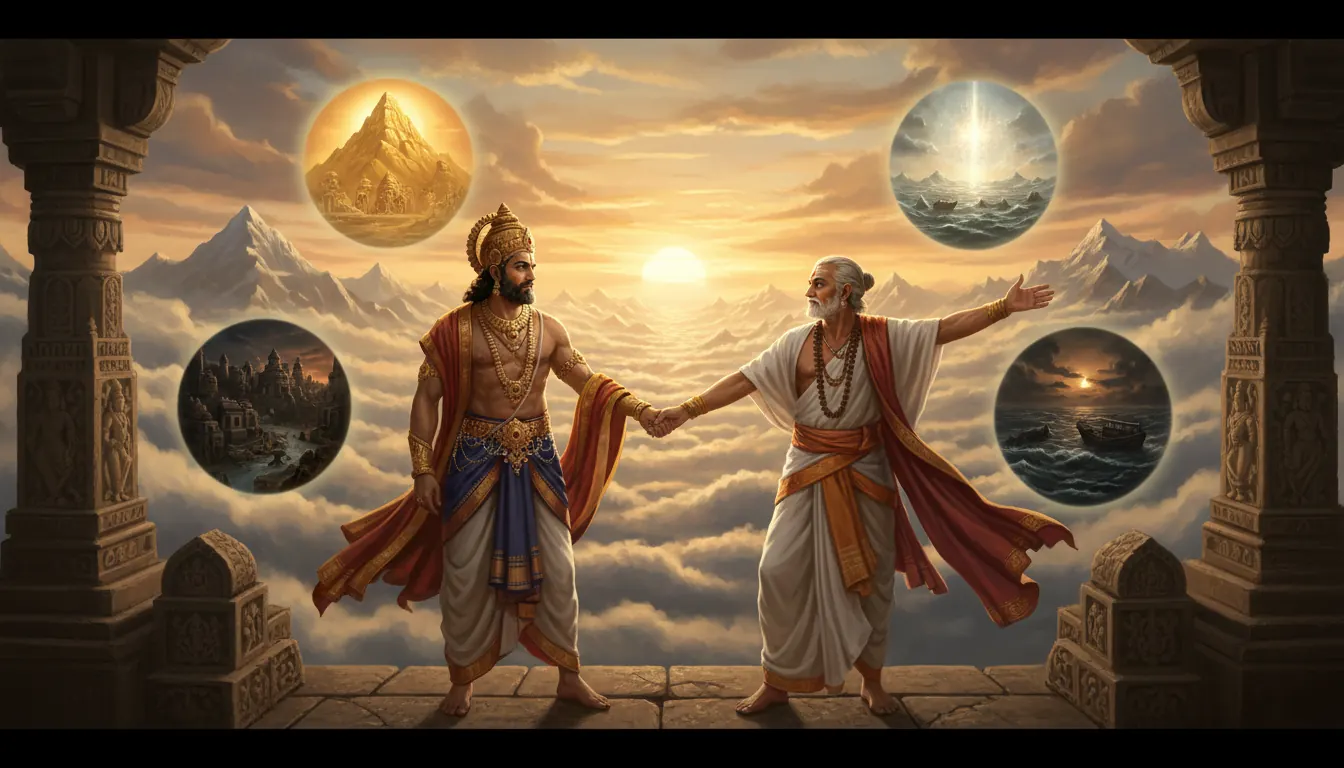
The Map of the Worlds
A priest naming the four quarters of the cosmos from a mountain shoulder
In short
At sunrise on Gandhamadana, Dhaumya takes Yudhishthira by the right hand and turns him to face each quarter in turn, naming what rules there: Mandara with Indra and Kubera, Yama's city Sanyamana and the setting mountain Asta, Varuna in the west and the deep, and northward Mahameru with Brahma's court and the region of Narayana no god can look at.
Told in the Vana ParvaSet in Gandhamadana, Mount Mandara and Mount Meru17 min read
Sunrise on Gandhamadana
The bodies of the rakshasas had been carried off the summit at Kubera's word, and the Pandavas had slept for several nights in the habitations the yakshas had kept, which were better lodging than they had known since Indraprastha.
At sunrise, having finished his daily devotions, Dhaumya came up to them with Arshtishena. The brothers bowed at the feet of both men and paid homage with joined hands to all the brahmanas who had followed them out of the kingdom and had not gone home.
Yudhishthira was the last to straighten. He had the look he had worn for months now, which was the look of a man doing sums in his head while other people talked. Five years of the twelve were gone. Arjuna had been away in Indra's house for all of them, and this mountain was the agreed place of meeting, and the meeting had not happened.
Kubera had left him with a list, some days earlier, standing on this same rock: patience, ability, time, place and prowess, and these five, the lord of treasures said, lead to success in human affairs. He had also said that a kshatriya who understands the propriety of place and time may govern the world a long while, and that the man who from anger cannot see his own fall, and the man who does not know what is proper to the act, are destroyed in this world and the next. It was excellent counsel and Yudhishthira had been turning it over ever since like a coin he could not spend.
Dhaumya, who had been the family priest long enough to read that face, did not offer him consolation.
Instead he took the king's right hand in his own, the way one leads a man who is going to be shown something, and turned him bodily to face the east, where the sun was just then coming off the rim of the world.
"Look there, mighty king," he said. "Before you speak of Hastinapura, look there, and I will tell you what you are looking at."
Bhima came and stood at his brother's shoulder. Draupadi came. The twins came. And the priest of a landless king began, at sunrise, on a mountain shoulder in the Himavat, to name the four quarters of the created world in order, as a steward names the rooms of a house.
The East, and Who Keeps It
"This king of mountains, Mandara, lies vast before you," Dhaumya said, "covering the earth as far as the ocean. Indra presides over this quarter, and Vaishravana with him, and it is graced with woods and forests and mountains. The wise sages, who know every duty, say that this region is the abode of Indra and of king Vaishravana."
"Kubera," said Bhima, "whose rakshasas I killed a few days ago."
"Kubera," Dhaumya agreed, "who came here in a chariot the colour of dark clouds and forgave you, and told your brother to check you. Do not interrupt."
He kept his hold on Yudhishthira's hand and did not let him turn away from the light.
"Now see what happens here every morning of the world. The twice-born, and the sages who know the duties, and the Siddhas, and the Sadhyas, and the gods, all of them worship the Sun as he rises from here. Not from Hastinapura. Not from Indraprastha. From here. That worship is going forward at this moment in every quarter of the earth and in the regions above it, and it does not pause to ask which of Vichitravirya's grandsons is sitting on a throne."
Yudhishthira looked at the light on Mandara a long while.
"You are telling me the east does not care," he said.
"I am telling you the east is occupied," said Dhaumya. "Indra keeps it. The lord of treasures keeps it. It is administered, king, and not by you, and the sun comes up over it in good order whether your seal is on anything or not. There is comfort in that, if you will take it. Now turn."
And he moved the king's hand and turned him to his right, to the south.
The Southern Quarter and the Setting Mountain
"The lord of all living beings, king Yama, who is conversant with duty, presides over the southern region," said Dhaumya. "The spirits of the departed come there. And this is Sanyamana, the city of the lord of departed spirits, sacred, wonderful to see, and crowned with prime prosperity."
Nobody said anything for a moment. Sanyamana means the place of restraint, the house of holding, and every person on that summit had someone in it.
"It is beautiful?" Draupadi asked.
"It is crowned with prime prosperity," Dhaumya said. "I am telling you what the sages tell. It is not a pit. It is a court, and the judge in it is conversant with duty. He does not hate the dead. He receives them."
"And the mountain beyond it?"
"The wise call that king of mountains Asta," he said. "The setting mountain. Every evening the Sun arrives at Asta, and once he has arrived there, king, the Sun always abides by the truth."
He let that stand, because it was the sentence he had brought the king out at sunrise to hear.
"Consider it," he said at last. "The Sun is the greatest of the visible powers. He crosses the whole sky in a day, and men in every country stand up when he appears. And when he comes to the end of his course, at the mountain where all courses end, what is required of him is not brilliance and not victory. It is that he abides by the truth. That is the whole of what is asked at Asta, of him and of everyone else who arrives there. You lost a kingdom at dice, Yudhishthira. You did not lose that, and it is the only property that is assessed in the south."
"Duryodhana will arrive at Asta also," said Yudhishthira, after a while.
"Every creature that has come into being arrives at Asta," said Dhaumya. "The spirits of the departed come to that quarter, and there is no other road out of the world. I did not turn you south to promise you your cousin's death. I turned you south to show you that the case is already listed, that the judge is conversant with duty, and that you are not required to sit on that bench yourself."
The West, and the Deep
He turned the king again, another quarter to the right, and now they were looking away from the sun at a sky still holding the last of the night.
"King Varuna protects all creatures," said Dhaumya, "abiding in this king of mountains, and in the vast deep as well."
"That is all?" said Yudhishthira. "The east had Indra and Vaishravana and the whole assembly of the twice-born at their morning worship. The south had a city and a judge and a setting mountain. The west has one sentence."
"The west has water," said Dhaumya, "and one god in it, and there is not much to say about water except how much of it there is. Varuna does not preside over the west as a king presides over a court. He abides in it. He is in the mountain and he is in the deep at the same time, and what he does there is protect all creatures. Not the good creatures. Not the creatures of the four orders. All of them, the fish under the ships and the makaras that eat the fish, without an assembly, without heralds, without anyone at all watching him do it."
Nakula, who was young and still liked to catch out his elders, said, "Then how do we know he is doing it?"
"We do not," said Dhaumya. "That is the instruction. There is a whole quarter of the world where the work of protection goes on out of sight, unreported, unpraised, with nobody keeping count. A king who has been driven into the woods should be told that such a quarter exists. It is where most of the world's protecting is actually done."
The wind came up off the snowfields, and Draupadi drew her cloth about her shoulders, and Dhaumya turned the king once more, north.
Mahameru and the Court of Brahma
"There, lighting up the northern regions, lies mighty Mahameru," said Dhaumya, "auspicious, and the refuge of those who know Brahma. There is the court of Brahma. Staying there, Prajapati, the soul of all creatures, created everything that moves and everything that does not move."
"Everything," said Yudhishthira.
"Everything, most fortunate one. Your enemies included, and the dice, and the man who threw them."
He went on before the king could answer that.
"Mahameru is the auspicious and healthy abode of the seven mind-born sons of Brahma, of whom Daksha was the seventh. And it is here, child, that the seven heavenly rishis, with Vasishtha at their head, rise and set. Look at that excellent, bright summit of the Meru. There the great sire sits with the gods, and the gods there are happy in self-knowledge."
Bhima, squinting north where there was nothing to see but cloud on cloud and a whiteness beyond them, said, "Happy in what?"
"In self-knowledge," said Dhaumya. "You may take it as a jest at your expense, Vrikodara, or you may take it as the fact. Those are gods. They have the drink of immortality, they have the gardens of Nandana, they have the Apsaras and the wealth of the three worlds. And what the account gives as the ground of their happiness is not any of that. It is that they know what they are."
"And the rishis rise and set there," said Yudhishthira, "like stars."
"Like stars, because that is what they are, and they go round that mountain in their order, and they were doing it before Kuru was born and will do it after the last of his line is ash. The seven of them, with your own family's ancestor at their head."
Draupadi said, "You have named the makers, and the court, and the seven who go round. Where in all of it is the part that belongs to us?"
"Under our feet," said Dhaumya. "Mandara covers the earth as far as the ocean, and the whole quarrel over the Kuru country would go into one fold of its skirt. That is not said to make you small, daughter of Drupada. It is said because a grief the size of a kingdom looks different when you are shown the frame it hangs in."
The Region Not Even the Gods Can Look At
"And next to the abode of Brahma," said Dhaumya, and here his voice changed, "is visible the region of the one who is called the true first Cause, the origin of all creatures, the first lord, the god Narayana, who has neither beginning nor end."
"Visible," Yudhishthira repeated.
"Visible, and not to be looked upon. That auspicious place is made of all energies, and the gods cannot look at it. By its own native splendour the region of great-souled Vishnu outshines the sun and fire together, and neither the gods nor the Danavas can look upon it. It lies shining to the east of the Meru, where the lord of all creatures, the self-created first Cause of the universe, having brought all beings into being, shines in his own excellent grace.
"Not only the Maharshis, best of the Kurus: even the Brahmarshis cannot enter that place. Only the Yatis can reach it. There the lights of heaven cannot shine, son of Pandu. There that lord whose soul is beyond conception shines alone, beyond all things. By reverence and by severe austerities the Yatis, lifted by their pious practices, reach Narayana Hari. And great souls who have won success in Yoga and are free from ignorance and pride go there and reach that universal Soul, the self-created and eternal God of gods, and do not have to return to this world."
He stopped. The sun had cleared the eastern ridge behind them and the whole snowfield to the north had gone from grey to a white that hurt.
"This region," Dhaumya finished, "is without beginning, or deterioration, or end, for it is the very essence of that God."
Yudhishthira stood holding his priest's hand like a child and looked at a place he had been told he could not see, and did not ask a single question about Hastinapura.
The Sun and the Moon Go Round
"Now pay attention to the machinery," said Dhaumya, "because a king should know how the year is made.
"Every day, son of the Kurus, the Sun and the Moon go round this Meru, travelling in opposite directions. The other lights of heaven also go round this king of mountains in the same way. So the worshipful Sun, who drives away darkness, goes round this mountain, dimming the other lights as he passes. Then, when he has set and the evening is over, the Maker of day turns north. Then, nearing the Meru again, the divine Sun, always intent on the good of all beings, travels once more facing the east.
"And in the same way the divine Moon, together with the stars, goes round the mountain, dividing the month into its sections as he reaches each Parva. When he has travelled without fail round mighty Meru and nourished all creatures, the Moon goes back to the Mandar. In the same way the destroyer of darkness, the divine Sun, moves on this unobstructed path, bringing the universe to life."
Sahadeva, who kept the reckoning of days for the family and had done since the first month of the exile, said quietly, "Then the Parvas are not a thing we invented for the sacrifices."
"They are the joints of the moon's road," said Dhaumya. "We put our sacrifices at the joints because they are there, and not the other way about. The full moon does not arrive because a brahmana wants to light a fire. You count the nights on your fingers, Sahadeva, and I have watched you doing it, and every night you have counted has been the moon coming round a mountain that neither of us has ever seen."
Winter, Sweat, Sleep and Rain
"And now the year itself," said Dhaumya. "When the Sun goes to the south to bring the dew, winter comes to all creatures. Then, turning back from the south, he draws up with his rays the energy of all creatures, moving and unmoving. Then men fall prey to sweat, and fatigue, and drowsiness, and weariness, and living beings always feel ready to sleep. From there, returning through unknown regions, that divine and radiant one brings the rain, and with it revives all beings. And when he has cherished the moving and the unmoving with the comfort of rain and wind and warmth, the powerful Sun takes up his former course."
"Unknown regions," said Yudhishthira.
"Unknown," said Dhaumya. "The account says so plainly and does not pretend otherwise. Part of his road is not shown to us. He goes out of sight, and the shower comes, and that is as much as anyone on this mountain is going to be told."
He let go of the king's hand at last.
"Partha, travelling like this, the Sun turns without fail on the wheel of Time, shaping created things. His course never ceases. He never rests, Pandava. He draws in the energy of all beings and gives it back again. Dividing time into day and night, and into Kala and Kashtha, that lord gives life and motion to all created things.
"You have been given twelve years and a thirteenth. You did not choose the number and you cannot spend it faster. But it is measured off the same wheel that makes the sweat on a labourer's back in the hot months and the water in the tank afterwards, and it is turned by one who never rests and takes nothing for it. If you want a model for a king, you have been standing in his light since we began."
The Month That Was a Year
That was the whole of it. The priest bowed and went to his fire, and Arshtishena went to his, and the Pandavas were left on a summit with the quarters of the world named around them and nothing to do.
They stayed. Gandharvas and maharshis came gladly to visit them there, and the mountain was worth the visiting: slopes and summits filled with flowers, loud with peacocks and cranes, lakes covered with lotuses and edged with trees, swans and karandavas on the water. Because of the mountain's own splendour and the brightness of the annual plants there was hardly any difference on that summit between night and day. Living where the Sun himself cherishes all that moves and does not move, they watched him rise and set, and they saw the rising mountain and the setting mountain, and all the cardinal points, exactly as they had been shown.
And it did them no good at all, because they were waiting for their brother.
They recited the Vedas and performed the daily rituals and kept their vows and abided by the truth, and said to one another, "Let us take our pleasure here by joining Arjuna, who is accomplished in arms, and let it be soon." Looking at the lovely woods and thinking of Kiritin, they found that every day and every night seemed to them a year. Joy had left them at the moment when the high-souled Jishnu, with Dhaumya's permission, matted his hair and walked off into the woods from Kamyaka at his brother's command, and no summit in the Himavat could give it back.
So, Bharata, those descendants of Bharata passed one hard month on that mountain.
And Arjuna, after living five years in the abode of the thousand-eyed god, and obtaining from the lord of the gods the weapons of Agni and Varuna and Soma and Vayu and Vishnu and Indra and Pashupati and Brahma and Parameshthi and Prajapati and Yama and Dhata and Savita and Tvashta and Vaishravana, bowed to the god of a hundred sacrifices, walked around him, took his leave, and came joyfully to the Gandhamadana.
Dharma Lesson
A man who has lost a kingdom is helped less by being promised it back than by being shown how small the quarrel is inside the frame of the whole world. The quarters are already governed, the sun keeps his course without resting or being thanked, and at the setting mountain what is asked of the greatest of the visible powers is only that he abide by the truth. That much no dice game can take.