The Bow Tip and the Boast
Karna keeps his word to Kunti and pays for it in insults
In short
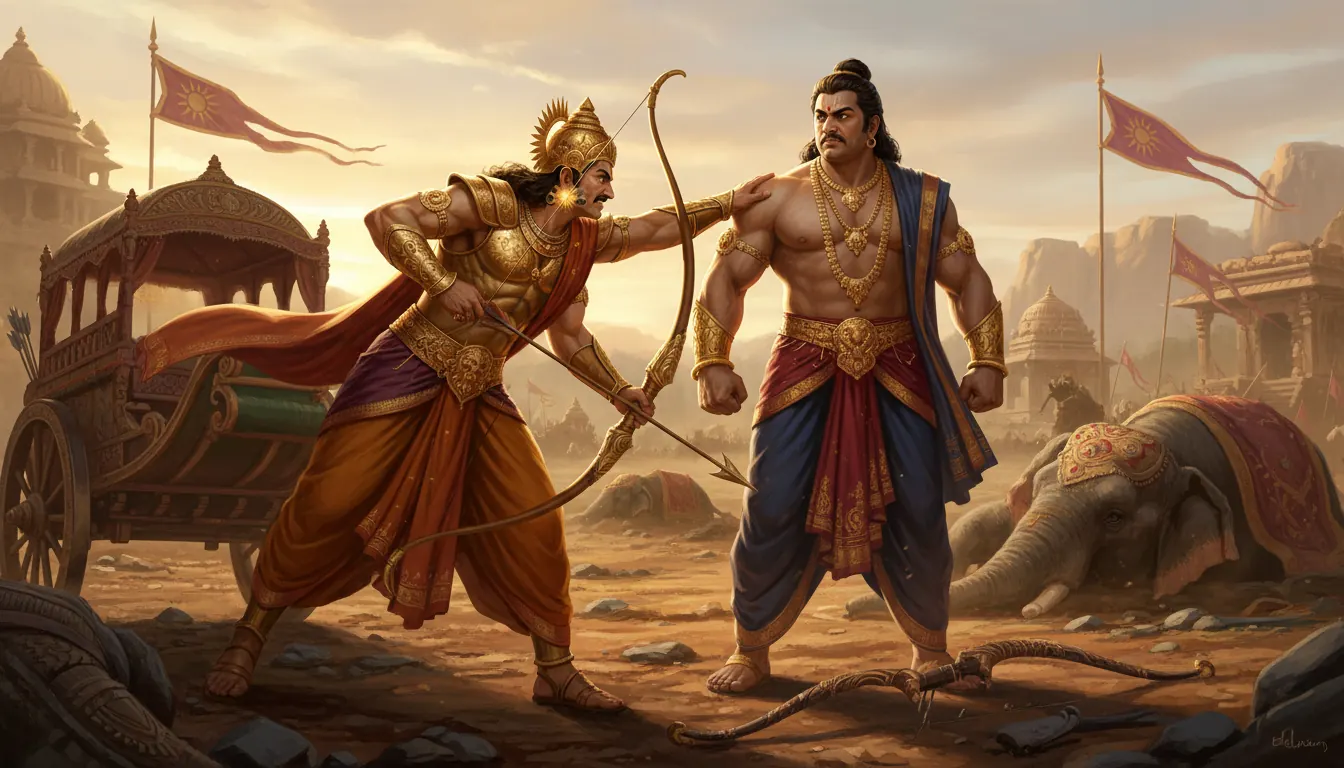
Again and again in one afternoon Bhima leaves Karna without bow, horses or chariot, killing twenty sons of Dhritarashtra in his sight. When at last Karna has the disarmed Bhima at his mercy, he refuses the killing shot because of the promise he made to Kunti by the river, and instead touches him with the horn of his bow and calls him a beardless glutton fit only for a kitchen.
Told in the Drona ParvaSet in Kurukshetra20 min read
The Question the Blind King Asked
"How did that battle rage," Dhritarashtra said, "near Arjuna's chariot, between those two? Karna had been beaten by Bhimasena once already. How could he go against him again? And how could Bhima go against the son of a Suta, who is counted the greatest chariot warrior on earth?
"Yudhishthira, having got the better of Bhishma and of Drona, fears nobody the way he fears the bowman Karna. Thinking about Karna he passes his nights without sleeping. So how could Bhima meet that man?
"And there is the other thing, Sanjaya. Karna has been told of his brotherhood with the Pandavas. He is compassionate. Remembering his words to Kunti, how could he fight with Bhima at all? And Bhima, remembering every wrong that man ever did him, how could he fight with Karna and stop?"
Sanjaya said: "They met eight times, king, in one afternoon. Let me tell it in order."
It was the fourteenth day. Arjuna was somewhere ahead in the dust with Krishna driving him and the whole Kaurava host between him and the man he had sworn to kill before sunset, and Bhima was trying to get to him.
That was all Bhima wanted, that afternoon. To reach his brother. He was leaving Radha's son behind him and going toward the place where the two of them were, and Karna would not let him go.
The arrows came over him like a cloud pouring rain on a mountain. Then Karna's face, beautiful as a full-blown lotus, lit up with a smile, and Karna called after him.
"Bhima, I never dreamt that you knew how to fight. Why then are you showing me your back because you want to meet Arjuna? This is hardly fit for a son of Kunti. Stay where you are and cover me with your arrows."
Bhima wheeled his chariot a little, and stayed.
First Blood, and the First Chariot
Karna fought that first bout the way a teacher fights a promising student. He swallowed Bhima's showers of arrows with the power of his own weapons and careered about the field like a master of military science giving a demonstration, and he smiled the whole time.
Bhima could not bear the smile. Not with brave men on every side watching them.
He pierced Karna in the centre of the chest with calf-toothed arrows, the way a driver strikes an elephant with the hook. Then seventy-three well-shot arrows with beautiful wings and gold on their shafts, five at a time. Karna answered with a net of arrows that in the twinkling of an eye hid Bhima's chariot and standard and driver from view, and put sixty-four arrows through Bhima's impenetrable armour.
Sanjaya said that the difference in the two men was visible from a great distance. Karna fought mildly. Bhima fought remembering.
He took the shafts and did not feel them. He shot thirty-two broad-headed arrows of keen point and fierce energy, and Karna covered him again with the greatest indifference, as though the whole thing were happening to somebody else. Then Bhima's arrows began to fall on every limb of the man like cooing birds settling, like a flight of insects covering a blazing fire, and Bhima stood in the middle of it all bathed in his own blood, looking, said Sanjaya, like an asoka tree in spring loaded with flowers.
He cut the bow. He killed the four horses. He killed the driver. He put a number of long shafts through Karna's chest, and they went out the other side and into the ground like sunlight coming through cloud.
And Karna, proud of his manliness, felt great pain, and went to another chariot.
What Bhima Was Remembering
He came back at once in a fresh chariot, with the fury of an ocean tossed by a tempest, and Duryodhana's men looked at Bhima and considered him a libation already poured on the fire.
But Bhima had thirteen years stacked behind his eyes.
The match at dice. The exile in the woods. The year in Virata's city. The kingdom taken away, swollen as it was with prosperity and gems. The house of lac and the plan to burn an innocent woman and her sons in it. The assembly hall, and Dushasana with a fistful of Draupadi's hair, and Karna's voice saying to her in front of everyone: "Take another husband, for all your husbands are dead. The sons of Pritha have sunk into hell. They are like sesame seeds without kernel." The offer to have her serve as a slave. The words Karna threw after five men in deer-skins walking out toward fourteen years of forest.
He stretched the bow whose staff was decked with gold and became entirely reckless of his own life.
Karna blew his conch, whose blast was like a hundred trumpets, and shook the troops that stood behind Bhima. Then he brought his own horses, white as swans, in among Bhima's horses, which were the colour of bears, and men on the Kaurava side cried out at the sight, because the two teams mingled in the dust looked like white cloud and black cloud running together in one sky.
The great chariot warriors of the Kaurava army stopped to watch, the way men watch a contest in an arena, and could not see that either had the advantage of the other.
The Dart and the First Brother
Bhima cut off Karna's bow with three sharp shafts and felled Karna's charioteer out of his niche with a broad-headed arrow. Then Karna took up a dart whose shaft was adorned with gold and stones of lapis lazuli, a thing like a second dart of death, and lifted it and aimed it and hurled it with force enough to take Bhima's life, and roared as it left his hand, and Dhritarashtra's sons were filled with delight at the sound.
Bhima cut it in the air with seven swift arrows.
Then he cut Karna's next bow at the handle, sent the conch-white horses to Yama's realm, and brought down the driver, and Karna stood on a chariot with no horses and no driver in the middle of a battle, stupefied, not knowing what to do.
Duryodhana, trembling, called his brother Durjaya.
"Go. There, the son of Pandu is about to devour the son of Radha. Kill that beardless Bhima and put strength into Karna."
"So be it," said Durjaya, and went, and covered Bhima with arrows, nine into the man, eight into the horses, six into the driver, three into the standard, seven more into Bhima again.
Bhima pierced his vitals and his horses and his driver and sent all of them to Yama's house in one motion, without turning his head.
And Karna came down off his useless chariot and walked round the body of that son of yours, who lay on the earth in his ornaments writhing like a snake, and he was weeping while he did it.
The Mace, and the Second Brother
The next time, Karna went at him with a shaft capable of piercing anybody, hurled the way Indra hurls the thunderbolt, and it went through Bhima and sank into the earth behind him.
Bhima did not reflect for a moment. He picked up a heavy six-sided mace, four cubits long and adorned with gold, and threw it, and it killed the well-trained horses of the finest breed that Adhiratha's son was driving. Then two razor-headed arrows took down the standard, and a number of arrows took the charioteer, and Karna stepped off the wreck onto the ground and stood there drawing his bow on foot.
Sanjaya said that the prowess they saw then was truly wonderful: that the greatest of chariot warriors, with no chariot under him, went on holding off his enemy.
"Durmukha," said Duryodhana. "Bhimasena has robbed Radha's son of his chariot. Give that greatest of men a chariot."
Durmukha went, and covered Bhima with shafts, and Bhima, seeing him come, was filled with delight and licked the corners of his mouth. Holding Karna off with one hand, so to speak, he drove at Durmukha and put nine straight arrows of keen point through him and sent him to Yama's abode.
Karna mounted the dead man's chariot and looked, said Sanjaya, as splendid as the blazing sun.
Then he looked down and saw Durmukha lying on the field with his vitals pierced and his body bathed in blood, and he stopped fighting. He went round the fallen prince, and left him there, and began to breathe long and hot breaths, and did not know what to do.
Bhima used the moment. Fourteen long shafts with vulturine feathers on them, gold-winged, went through the armour of the Suta's son and drank his blood and passed out of his body into the ground behind, where they stood up like angry snakes with half their length in the earth.
Five, and Then Six
Karna could not go on standing there. He fled, forsaking the battle, carried away by his fleet horses, and Bhima stayed on the field with his gold-decked bow, looking like a fire.
Five of Dhritarashtra's sons could not bear it: Durmarshana and Duhsaha and Durmada and Durdhara and Jaya, uterine brothers, all great bowmen, clad in beautiful mail. They surrounded Bhima and shrouded every point of the compass with shafts like flights of locusts.
Bhima received those princes of celestial beauty smiling. Karna, seeing them go in, came back and rushed at Bhima with gold-winged arrows to support them. Bhima went for Karna anyway, straight through the middle of them, and as he went he loosed twenty-five arrows and sent all five of those bulls among men to Yama's realm with their horses and their charioteers. They fell out of their chariots like great trees heavy with many-coloured flowers uprooted by a storm.
Karna, resisted by Bhima on every side, only looked at him. Bhima, with eyes red in wrath, looked back, stretching the formidable bow.
And Karna, seeing the sons of the man whose bread he ate lying on the earth in front of him, thought himself guilty, and became hopeless about his life.
He fought on. He cut Bhima's armour off him with arrows and put twenty-five small shafts into him in the sight of all the troops. Bhima answered with nine straight shafts that went through Karna's coat of mail and his right arm and entered the earth like snakes into an ant-hill, and once more Karna turned his back and went away on foot, covered all over with the arrows of Kunti's son.
"Go quickly, all of you, to the chariot of Radha's son," Duryodhana said.
Six more came: Chitra, Upachitra, Charuchitra, Sarasan, Chitrayudha, Chitravarman, every one of them well versed in every mode of warfare.
Bhima felled each of them with a single arrow.
And Karna, with his face wet, recollected the words of Vidura.
Vikarna
There was an arrow Bhima had been saving.
It was barbed, rubbed with oil, of great keenness and excellent temper, and he put it into Karna's ear, and the large and beautiful earring came off and fell to the earth like a blazing luminary dropping out of the sky.
Then ten long arrows into the forehead, and they stood there in a row, and Sanjaya, who had no reason to be kind, said that with those shafts sticking in him the Suta's son looked as beautiful as he had looked when his brow was encircled with a chaplet of blue lotuses. Karna leaned on the pole of his chariot and shut his eyes.
When he opened them he was mad with rage, and the seventh bout was the worst of the eight.
Before that, when Bhima had shrouded Karna in arrows and warriors of both sides were cheering him, Duryodhana had sent seven more of his brothers in to save Karna, and Bhima drew his beautiful bow with great force and a firm grasp, knowing that his enemies were only men, and aimed seven shafts.
They went through the seven bodies and out and up, gold-winged, wet, still climbing, and looked from below like birds of excellent plumage going into the sky.
Satrunjaya. Satrusaha. Chitra. Chitrayudha. Dridha. Chitrasena.
And Vikarna.
Bhima looked at that one, and of all the dead in that hour it was for Vikarna that he grieved bitterly, and he said so aloud where men could hear him.
"This was my vow: that I would kill all of you in battle. That is why, Vikarna, you have been killed. My vow is fulfilled. You came to battle with the duties of a kshatriya in mind. You always worked for our good, and above all for the good of the king my eldest brother. So it is hardly right for me to grieve for one as illustrious as you."
He grieved anyway, and then he gave the great shout he and Yudhishthira had agreed on beforehand, so that far off across the field the eldest brother would know the count was climbing and that the day was going their way. Yudhishthira heard it and was filled with joy in the middle of a battle and had the drums answer it.
Thirty-one sons of Dhritarashtra were down by then, twenty of them in Karna's sight, and Duryodhana stood among them recollecting the words of Vidura, unable to do what he should.
The Eighth Bout
The last of the eight went against Bhima and went badly.
Karna cut both his quivers and his bowstring and the traces of his horses. He killed the horses. He put five arrows into the charioteer, who ran off and took shelter in Yudhamanyu's chariot. He cut the flagstaff and felled the banner.
Bhima seized a dart and whirled it and threw it at Karna's chariot, and Karna cut it into ten pieces in the air with ten arrows. Bhima took up a gold-decked shield and a sword, wanting either death or victory, and Karna smiled and cut the shield to fragments. Bhima hurled the sword; it sheared the string of Karna's bow and fell on the earth like an angry snake out of the sky, and Karna took up a tougher bow and began shooting arrows by the thousand.
Bhima leaped into the sky to get away from that downpour, which filled Karna's heart with anguish, and Karna fooled him by dropping out of sight on the platform of his own chariot, and Bhima came down catching hold of Karna's flagstaff and stood on the ground holding it. Every Kuru and every Charana on that field applauded the attempt, a man snatching another man off a chariot like Garuda taking up a snake.
With no bow and no chariot, Bhima kept the wreck of his chariot behind him and stood ready, because that is what the duties of his order required.
His weapons were gone. He backed away among the elephants Arjuna had killed earlier in the day, huge as hills, and got into the middle of them where no chariot could follow, and lifted one of the dead beasts and held it up over his head like Hanuman lifting a peak of Gandhamadana. Karna cut the elephant apart with arrows while Bhima was holding it. So Bhima threw the pieces at him, and chariot wheels, and dead horses, and everything else on the ground that his hands could reach, and Karna cut each thing out of the air as it came.
Then Bhima raised his two fists, which had the force of the thunder in them, and could have finished it there, and did not.
Because Arjuna had sworn to kill Karna, and Bhima would not make his brother's vow a lie.
And Karna, who had the disarmed man in front of him and every reason in the world, did not kill him either.
Because of a promise made on a riverbank to a woman who had come to him alone.
The Horn of the Bow
What Karna did instead was walk up to him and touch him with the horn of his bow.
Bhima, sighing like a snake, snatched the bow out of his hands and hit him on the head with it, and Karna, with his eyes red, smiling, said the words that decided the rest of the war.
"Beardless eunuch. Ignorant fool. Glutton."
He stood over the unarmed man and went on.
"You have no skill in weapons. Do not fight with me. You are a child, a laggard in battle. Where there is a profusion of eatables and drink, wretch, that is where you should be, and never in a battle. Live on roots and flowers. Keep vows and austerities. Pass your days in the woods, Bhima, since you are unskilled in fighting. There is a great difference between battle and the austere life of a muni, so go back to the forest. You have an aptitude for it. Urging cooks and servants and slaves in the house to hurry, and reproving them in anger for the sake of your own dinner, that is what you are fit for, Vrikodara. Take up a muni's mode of life and gather fruits. Go to the woods, son of Kunti, for you are not skilled in battle. Cutting fruits and roots, or waiting on guests, is your work. I do not think you are fit to take a part in any passage of arms."
And he went through all the wrongs of Bhima's younger years, one after another, in harsh words, and then, as Bhima stood there in his weakness, touched him with the bow a second time and laughed out loud.
"You should fight with others, sir, but never with someone like me. Men who fight with people like us have to undergo this and worse. Go where the two Krishnas are, they will protect you in battle. Or go home, child. What business have you with a war?"
Bhima laughed too. Everyone within hearing heard him do it.
"Wicked wretch, I have beaten you over and over today. How can you go on boasting idly? In this world the ancients saw both the victory and the defeat of the great Indra himself. You low-born man, come down and take me on with bare arms, and I will kill you in the sight of all these kings as I killed Kichaka of the gigantic frame."
Karna, who was the cleverest of men, understood exactly what was being offered and declined it, in the sight of all the bowmen there.
Then Arjuna, urged by Keshava, put arrows out of Gandiva into Karna's body until he left Bhima's vicinity, and Karna fled from that place in his great chariot.
The Vow Bhima Made Him Say
Bhima climbed into Satyaki's chariot, because he no longer had one of his own, and went after his brother through the wreckage, and when he got to him he did not talk about the thirty-one dead princes or the elephants or the eight broken chariots.
"In your very sight, Dhananjaya," he said, "Karna has said to me again and again: eunuch, fool, glutton, unskilled in weapons, do not fight, child, unfit to bear the burden of a battle. Any man who says that to me is to be killed by me. He said it. You know the vow I made jointly with you. Remember the words that I spoke then. Act, best of men, so that neither my vow nor your own is made false. Do that, Dhananjaya, by which my vow may be made true."
So Arjuna went and found Karna and said it publicly, which is what Bhima had wanted.
"Karna, you fight falsely and you applaud yourself. Listen to what I tell you. Heroes meet with one of two things in battle, victory or defeat, and both are uncertain, even when Indra himself is the one fighting. When Yuyudhana took your chariot from you and your senses had left you, you were close to death, and that hero let you go without your life because he remembered that I had vowed to kill you. It is true that you robbed Bhimasena of his chariot. Your abuse of that hero, however, was sinful. Men who are truly righteous and brave do not boast when they have beaten someone, and do not speak ill of anybody. Your knowledge is small; that is why you talk like this. And the abusive epithets you applied to Bhimasena, a man of great prowess devoted to the ways of the righteous, were not true. In the sight of all these troops, and of Keshava, and of me, you were left without a chariot by Bhimasena many times over, and that son of Pandu never once called you a harsh word.
"Since you have spoken to Vrikodara in many harsh speeches, and since you, with others, killed the son of Subhadra out of my sight, take today the fruit of those offences. It was for your own destruction that you cut off Abhimanyu's bow. I will kill Vrishasena in your very sight. I say this truly, with my hand laid on my weapon."
The uproar the chariot warriors made at that was tremendous, and while it was still going on the thousand-rayed sun dimmed his rays and entered the hill of the west, and the sun of the fourteenth day went down with Jayadratha dead.
Karna could have killed Bhima that afternoon and did not, because he kept his word to his mother, and he made the mercy sound like contempt, as though contempt were the only voice he had left. The insult cost him more, in the end, than eleven armies.
Dharma Lesson
A promise kept against one's own interest is still only half a virtue if the keeper takes his payment in cruelty. Karna could have killed Bhima that afternoon and did not, and what men remembered of him was not the mercy but the abuse he used to hide it. The insult cost him more than the killing would have.