In short
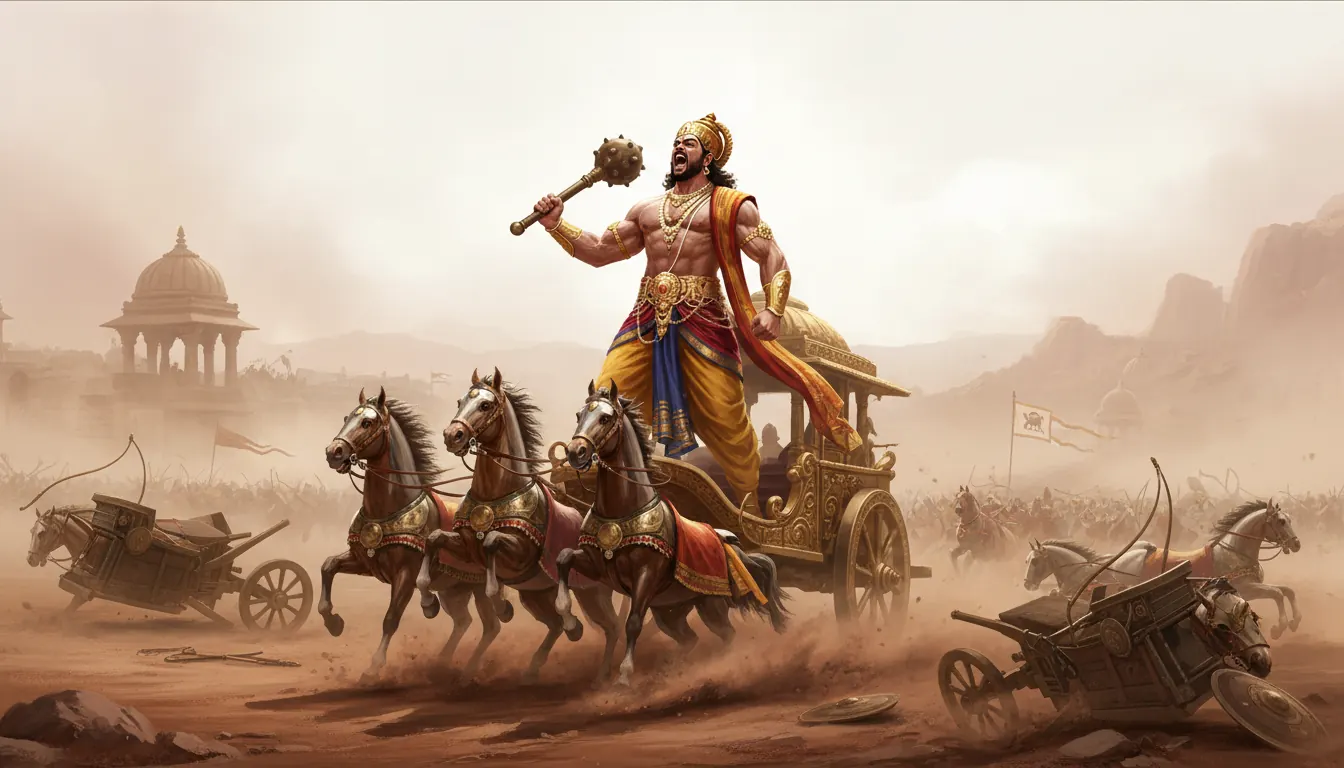
Unable to see Arjuna's standard or hear Gandiva, and having already sent Satyaki after Arjuna, Yudhishthira sends Bhima after Satyaki. Because the field is too loud and too wide for any runner to survive, the brothers agree that Bhima will shout when he reaches them. He tears through Drona's line, wrecks the teacher's chariot twice, and lets out a roar that carries the whole way back.
Told in the Drona ParvaSet in Kurukshetra18 min read
The King Could Not See the Standard
Yudhishthira had lost sight of two men and it was ruining him.
The Pandava army had been agitated on every side that afternoon and the Parthas and the Panchalas and the Somakas had been pushed back a great distance. Drona was uttering lion-like shouts somewhere in the middle of it and the carnage looked like the end of a Yuga. The king, finding no refuge anywhere in that distress, began to think about how the day would end.
He cast his eyes around, expecting to see Savyasachin. He did not see him. He did not see Madhava either. He could not find the ape-bannered standard anywhere on that plain, and, worse, he could not hear Gandiva, which is a thing a man can hear from a long way off if he has spent his life listening for it.
Then he looked for the other one, and could not find him either, and there was nobody left to look for after that.
"Satyaki of true prowess, that dispeller of the fears of friends, was sent by me on the track of Phalguna," he said to himself. "I had one source of anxiety before. Now I have two.
"I have sent Satyaki after Arjuna; whom shall I send now after Satyaki? And if I go to every length to find out about my brother and do not ask after Yuyudhana, the world will reproach me. They will say: Yudhishthira, the son of Dharma, asked after his brother and left Satyaki of the Vrishnis to his fate.
"The love I bear that invincible warrior of the Satvata race is not less than the love I bear Arjuna. And I have set him a very heavy task. He went into the Bharata army for the sake of a friend's request and for the sake of honour, like a makara going into the ocean, and I can hear the noise of unretreating heroes fighting together against him. There are too many of them for him."
He worked it through to the only answer, which was the one he had been avoiding.
"There is nothing on earth that Bhima cannot bear. Relying on the strength of his arms we came back out of the woods, and we have never been beaten in battle. Take me to Bhima."
Rise, King of Kings
The charioteer, who knew the lore of horses, took that chariot decked with gold to where Bhima was.
And when the king arrived in his brother's presence, remembering the occasion, he became unmanned by grief, and could not begin.
Bhima looked at him.
"I have never before seen or heard your words so full of despair," he said. "When we were stricken with grief it was always you who comforted us. Rise. Rise, king of kings. Say what I am to do for you. There is nothing I cannot do. Tell me what your commands are, and do not set your heart on grief."
Then Yudhishthira, with a sorrowful face and his eyes bathed in tears, sighing like a black cobra, told him.
"I can hear the blasts of the conch Panchajanya, blown in wrath by Vasudeva. It seems from this that your brother Dhananjaya is lying dead on the field today. Without doubt Arjuna has been slain and Janardana is fighting alone.
"Dark in complexion, youthful in years, curly-haired, exceedingly handsome, broad-chested, long-armed, with the tread of a maddened elephant and eyes the colour of burnished copper. That brother of yours strikes fear into his foes. I do not see his standard. That is the cause of my grief.
"And know also that the tiger among men, Satvata, is slain. Satyaki followed in the wake of that other mighty chariot-warrior and your brother, and I cannot see him either, and I am bewildered.
"So go there, son of Kunti, where Dhananjaya is and Satyaki is, if you think it your duty to obey my words. Remember that I am your eldest brother. And you should think Satyaki dearer to you than Arjuna himself, for he went, from a desire to do me good, on a track that men of vile souls cannot walk."
Then he said the practical thing, which was the reason the whole errand was worth making.
"When you have seen the two Krishnas and the Satvata safe and whole, send me word, son of Pandu, with a lion's roar."
A Sound Instead of a Runner
It is worth stopping on that, because it is the most sensible arrangement anybody made on the fourteenth day and it cost nothing.
The field was vast and the light was going. Between the king's chariot and the place where Arjuna was there stood most of Drona's army, and Drona in the middle of it, who had never given up his wish to take Yudhishthira alive. Any messenger sent back through that would be killed inside the first mile, and if he were not killed he would arrive an hour later with news that was an hour old.
So the brothers agreed on a noise.
One roar, in Bhima's voice, which every man in both armies could pick out of any amount of shouting, meaning: I am there, and they are alive, and there is nothing more to say. It required no runner, could not be intercepted, could not be misremembered or garbled or bought, and would cross the whole battlefield in the time it takes sound to travel.
Between people who trust each other one agreed sound can carry more than any message a man could survive to deliver. The king asked for it. The brother understood it. Nobody wrote anything down.
"The two Krishnas have gone in the chariot that once carried Brahma and Isana and Indra and Varuna to battle," Bhima answered. "They need fear no danger. But I take your command on my head, and I am going. Do not grieve. When I have met those tigers among men I will send you word."
The King Handed Over
Then, before he moved, Bhima made king Yudhishthira over to Dhrishtadyumna, repeatedly, and to the other friends of the Pandava cause, and he did it in a way that made the responsibility unmistakable.
"You know, mighty-armed one, how the chariot-warrior Drona is always watching for a chance to seize King Yudhishthira the Just by every means in his power. I would never put my going above my duty of protecting the king. But the king has commanded me to go, and I dare not contradict him. I will go where the ruler of the Sindhus stands at the point of death, and I should act, in complete truthfulness, according to the words of my brother and of Satyaki.
"So you, resolved to fight, must protect the son of Pritha today. Of all tasks in this battle, that is your highest duty."
"I will do what you wish," said Dhrishtadyumna. "Go, son of Pritha, without any anxiety of that kind. Without slaying me in battle first, Drona will never be able to humiliate king Yudhishthira in this fight."
It was a promise that would be kept.
Before dismissing him the king embraced Bhimasena and smelt his head and pronounced blessings on him.
Kairataka Honey
He went through the preparations properly, and there were more of them than a man in a hurry usually allows for.
He walked around a number of brahmanas who had been gratified with worship and with presents. He touched the eight kinds of auspicious articles. Then he drank Kairataka honey, and the corners of his eyes went red with it, and he felt his own might double in him.
The brahmanas performed the propitiatory ceremonies. Omens appeared, all of them good, and he saw them and felt the pleasure of a victory that has not happened yet. The wind turned favourable, which men on that field noticed and remarked on.
Then he put on his mail: a costly coat of black steel decked with gold, which looked, when he moved, like a cloud with lightning inside it. He wore earrings and angadas, and leather guards on both hands, and robes of yellow and red and black and white, and a coloured cuirass that came up to protect his neck, so that when he climbed into his own fine chariot he looked like a cloud with a rainbow across it.
Vishoka took the reins. Swift, well-broken horses of the finest breed, neighing furiously, as fast as the wind or thought, stood in the harness.
And while he was on the point of setting out, the fierce blasts of Panchajanya were heard again from somewhere out in the dust, loud and terrible enough to fill three worlds with fear.
"There," the son of Dharma said. "The Vrishni hero is blowing his conch. That prince of conches is filling the earth and the sky with its sound. Without doubt Savyasachin has fallen into great distress and the bearer of the discus is battling all the Kurus alone. Without doubt Kunti and Draupadi and Subhadra are looking at inauspicious omens today. Go, Bhima. Go quickly where Dhananjaya is. All the points of the compass seem empty to my eyes."
So Bhima caused the drums to be beaten, and blew his conch, and twanged his bowstring, and uttered lion-like roars that damped the hearts of the men opposite, and rushed at them wearing a dreadful form, with the Panchalas and the Somakas coming along behind him like the celestials behind Maghavat.
The Brothers in the Way
Dhritarashtra's sons came around him in a body to stop it: Dushasana and Chitrasena, Kundabhedin and Vivinsati, Durmukha and Duhsaha and Sala, Vinda and Anuvinda, Sumukha, Dirghavahu, Sudarshana, Suhasta, Sushena, Dirghalochana, Abhaya, Raudrakarman, Suvarman, Durvimochana. All great chariot-warriors, all resplendent, all with their troops and followers behind them, all firmly resolved.
Bhimasena looked at them the way a lion looks at smaller animals, and went in.
They covered him with shafts like clouds shrouding the risen sun and he went through them without stopping and hit the elephant division in front of Drona's own line, and dispersed it in all directions in almost no time, so that the elephants ran off into the dark screaming like animals that have heard a Sarabha in the forest.
Drona met him at his line then, and what passed between them is told below; and when the teacher had gone to another chariot, the brothers closed on Bhima again. Dushasana threw a keen dart made entirely of iron at him, wanting to end it there, and Bhima cut the dart in two while it was still coming, which the men watching thought was the most wonderful thing they had seen that hour.
Then he began to answer, one arrow to a brother. Kundabhedin. Sushena. Dirghanetra. Then Vrindaraka, that enhancer of the fame of the Kurus. Then, with three more shafts, Abhaya and Raudrakarman and Durvimochana. They shot at him in return like a summer cloud pouring rain on a mountain, and he took it like the mountain, and felt nothing.
Then, smiling, he sent Vinda and Anuvinda and Suvarman to the abode of Yama, and pierced Sudarsan, who fell down and expired.
Within a very short time that chariot-force was fleeing in every direction, like a herd of deer frightened by the noise of wheels, and Bhima went after them piercing the Kauravas from every side, and they urged their horses to their best speed to get away from him.
Then he stopped, and roared, and slapped his armpits, and clapped his palms together with a noise that frightened what was left of them, and went on toward Drona's array.
The Teacher Expects Reverence
This is how it had gone at Drona's line. Drona checked his course the way a coastline resists a rising sea, and struck him in the forehead with one shaft, smiling, so that Bhima stood in his chariot looking like the sun with rays going up off it.
The teacher expected to be shown reverence. Arjuna had done it that morning at this same spot: had come to the gate of the array, saluted, and asked for his blessing, and Drona had found the courtesy agreeable.
"Bhimasena," he said, "you cannot enter the enemy host without first defeating me, your foe, in battle. Krishna and your younger brother went into it with my permission. You, however, will never succeed in doing so."
Bhima's eyes went red as blood.
"Wretch of a brahmana," he said, "it cannot be that Arjuna entered this host with your permission. He is invincible. He would break into a host commanded by Shakra himself. If he offered you reverent worship it was only to honour you.
"But know this, Drona. I am not compassionate like Arjuna. I am Bhimasena, and I am your foe. We have regarded you as our father, our teacher and our friend, and we have looked on ourselves as your sons, and thinking so we have always humbled ourselves to you. When you use words like these to us today, it seems all that is altered. If you regard yourself as our foe, let it be as you think. Since I am none other than Bhima, I will now act toward you as I would toward a foe."
And he whirled a mace like the Destroyer whirling his fatal rod, and hurled it.
Drona jumped down from his chariot, which proved to be his safety. The mace came in and pressed that chariot into the earth with its horses and its driver and its standard, all together, flat.
Drona mounted another and went to the gate of the array and stood there. Bhima crushed the warriors around him like a tempest crushing trees, and a little later, when the teacher came at him again with those showers of arrows, the son of Pandu jumped down off his own chariot, and shut his eyes, and ran at Drona on foot through the arrows, and took hold of the chariot by the pole and threw the whole thing over.
Drona got up again and mounted a third, and his driver took him away at speed, and even the men on the Pandava side thought that feat exceedingly wonderful.
The Roar
After that there was only distance left.
He came upon the Bhoja troops, who were protected by the son of Hridika, and ground them and passed through. He frightened the soldiers ahead of him with the sound of his palms alone and beat them like a tiger going through a herd of bulls. He passed the Bhoja division and then the Kambojas and then countless tribes of Mlecchas, all of them accomplished fighters, and did not stop for any of them.
And then he saw Satyaki, alive, fighting.
He did not stop for that either, because the message was to be sent only when he had seen both, so he went on with great speed, resolutely, wanting the sight of Dhananjaya. He got past every warrior in that part of the field. And then, through the dust, he saw the ape-bannered chariot and the man in it putting out his whole prowess for the slaughter of the ruler of the Sindhus.
Then the son of Kunti opened his mouth and shouted.
It went out over that battlefield like clouds roaring in the season of rains. Arjuna heard it in the middle of what he was doing and so did Vasudeva, both at the same moment, and both of them shouted back, wanting to be found, and the three noises careered about in that battle like bulls answering each other across a field.
And a long way behind them, where the king was, Yudhishthira the son of Dharma heard it: the roar of Bhimasena, and under it, unmistakable, the answering roar of the wielder of Gandiva.
His grief was dispelled. He began, standing there, to wish his brother success in battle, over and over.
By Good Luck
The king smiled and reflected a while, and then said aloud what was in his heart, which was mostly a list.
"Bhima, you have truly sent me the message. You have truly obeyed the commands of your superior. They can never have victory who have you for their foe.
"By good luck, Dhananjaya, who can shoot the bow even with his left hand, still lives. By good luck the heroic Satyaki is safe and sound. By good luck I hear both Vasudeva and Dhananjaya uttering these roars. He who vanquished Shakra himself in battle and gratified the bearer of sacrificial libations, by good luck he lives. He on the might of whose arms all of us depend, by good luck he lives. He who beat the Nivatakavachas with a single bow, whom the very gods could not defeat, by good luck he lives. He who beat all the Kauravas together in Matsya's city when they came for Virata's cattle, by good luck he lives. He who killed fourteen thousand Kalakeyas, by good luck he lives. He who for Duryodhana's sake defeated the mighty king of the gandharvas, by good luck he lives.
"Decked with diadem and garlands, with white horses and Krishna himself for a charioteer, that Phalguna, always dear to me, by good luck lives still."
And then, being who he was, he began to ask the questions that had no answers. Would Arjuna kill the ruler of the Sindhus before the sun set? Would Duryodhana, seeing his brother-in-law dead, make peace with us? Would he give way to remorse, seeing all those great warriors lying on the earth? Should our hostilities not have ceased with the single sacrifice of Bhishma?
Out on the field, meanwhile, Karna had heard the roaring and could not bear it, and came at Bhima with his bow stretched to check him like a tall tree standing against a tempest. They fought until the men around them were trembling at the sound of their palms, and bows dropped out of the hands of warriors watching, and horses and elephants voided where they stood. Bhima cut Karna's bowstring, and killed his driver with a broad-headed arrow, and killed the four horses, and Karna jumped down from a chariot that could no longer move and climbed into his son Vrishasena's.
And Bhima roared again, and Yudhishthira, hearing it, was highly gratified, because he knew what that particular noise meant too.
Duryodhana went to Drona then and asked him, with red eyes, how it was that three chariot-warriors had now gone through him one after another, and what should be done. And Drona, who had spent the day being crossed by men he had taught, gave him the answer that stands as the epitaph of that entire afternoon.
"All this is the fruit of that match at dice conceived by Shakuni's intellect. Neither victory nor defeat took place in the gaming assembly. Now that we are engaged in this sport there will be victory or defeat. Those innocent things that Shakuni played with in the Kuru assembly, and that he took for dice, were really invincible arrows. Know now that the warriors are the players, these arrows the dice, and the ruler of the Sindhus, without doubt, the stake."
Dharma Lesson
Between people who trust each other a single agreed sound can carry more than any message a runner could survive to deliver. Yudhishthira asks for a roar and gets one, and his grief goes at once, because the signal was arranged by people who knew exactly what it would mean. Trust is what makes a short message sufficient.