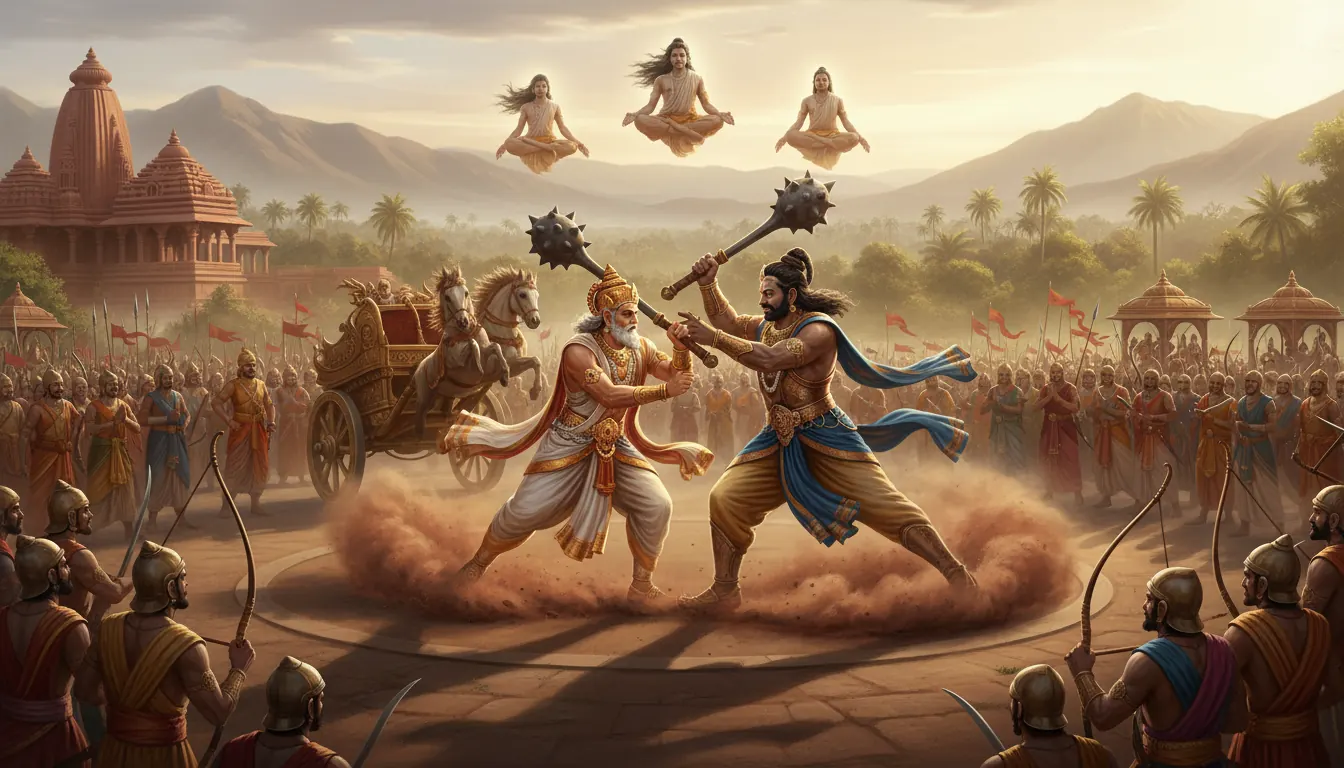
The Two Maces
Bhima sends Abhimanyu aside and meets the king of Madra blow for blow until both men fall
In short
On the eleventh day of the war, Abhimanyu catches Shalya's dart in the air and throws it back, killing the king's charioteer, and Shalya comes down from his chariot with an iron mace. The boy lifts a mace to meet him, but Bhima persuades him with much ado to stand aside and takes the duel himself. The two greatest mace-fighters alive strike each other blow for blow until they fall at the same instant, and Kritavarma carries the senseless Shalya from the field while Bhima gets up.
Told in the Drona ParvaSet in Kurukshetra and Madra14 min read
The King Who Envied Those With Eyes
It was the eleventh day of the war, and the first day on which Drona held the command. All evening in the hall at Hastinapura, Sanjaya had been giving the blind king the single combats of that afternoon one after another, the way a man counts out coins: Shakuni against Sahadeva, both of them ending on foot with maces in their hands, Nakula cutting down the horses and the umbrella and the standard of his own uncle Shalya and then blowing his conch over the wreck, Satyaki and Kritavarma trading arrows by the seventy without either of them giving ground.
And Dhritarashtra, who had heard all of it and seen none of it, interrupted him.
"You have described to me many excellent single combats, Sanjaya," he said. "Hearing about them, I envy those who have eyes. All men will speak of this battle between the Kurus and the Pandavas, which is like the old battle between the gods and the Asuras, as exceedingly wonderful. Listening to your account of this stirring battle, I can hardly have enough of it."
Then he named what he wanted.
"So tell me about this combat between Artayani and Subhadra's son."
Artayani was Shalya, king of the Madras, uncle to Nakula and Sahadeva by their mother Madri, a man the Pandavas had counted as their own until Duryodhana bought his marching army out from under him with pavilions and food and honours the whole length of the road. Subhadra's son was Abhimanyu, Arjuna's boy, sixteen years old, who had spent that afternoon lifting one king out of his own chariot by the hair and breaking another king's sword against his shield.
Shalya had thrown a dart at him. It was made wholly of iron, decked with gold, and it came through the air like a blazing flame of fire. Abhimanyu jumped up and caught it, the way Garuda catches a mighty snake falling from above, and unsheathed his sword, and then thought better of the sword and threw the dart back with the strength of his arms. It reached Shalya's chariot and killed the driver and pitched him out of his niche onto the ground.
That is where Sanjaya began.
Come, Come
"Seeing his driver slain," Sanjaya said, "Shalya raised a mace made wholly of iron and jumped down in rage from his excellent chariot."
He did not call for another charioteer and he did not reach for another bow. He came down onto the churned ground of the field with a bar of iron in his hands, and there was nothing in front of him but a boy.
Bhima saw it from where he was.
He took up his own huge mace and went for Shalya at speed, and Sanjaya, describing the man he was going toward, reaches for the two largest things he can find: Shalya standing there in that moment resembled the blazing Yuga-fire, the conflagration that burns up an age at its ending, or else the Destroyer himself armed with his bludgeon.
Abhimanyu had already taken up a mace of his own. It was a prodigious weapon, and Sanjaya says it resembled the bolt of heaven, and the boy who had caught a flying dart barehanded a moment earlier lifted it and called out to the king of the Madras.
"Come, Come!"
He was not asking for help, and he was not going to be talked out of it easily. Sanjaya is exact about the difficulty, and the phrase he uses is one of the very few in the whole account that concerns persuasion rather than iron: Bhima, however, with much ado, persuaded him to stand aside.
Whatever passed between the uncle and the nephew in the middle of that noise is not recorded. Only that it took some doing, and that it worked, and that Abhimanyu lowered the mace and stepped back out of it.
There was a reason for the trouble Bhima took, and Sanjaya gives it a few lines further on, when he tells the blind king that in the whole world there was exactly one man who could stand in front of the mace of the ruler of the Madras and live. Bhima knew that count. He was in it. The boy, for all his day's work, was not, and the difference between those two facts was about to be settled by a full-grown man swinging a bar of iron.
The valiant Bhimasena, then, having persuaded Subhadra's son to stand aside, approached Shalya in battle and stood immovable as a hill.
The Only Two Men Who Could
The mighty ruler of the Madras saw Bhima standing there, and went toward him like a tiger toward an elephant.
Both armies understood at once what they were about to be shown. Then came the loud blare of trumpets and conchs by thousands, and lion-like shouts, and the sound of drums, and loud cries of "Bravo, Bravo" arose among hundreds of Pandava and Kaurava warriors rushing toward each other to get a place from which to see it.
Sanjaya, who had been reciting duels all evening without comment, stopped to explain to the blind king why this one was different.
There is no one else among all the kings, he said, except the ruler of the Madras, who can dare to bear the might of Bhimasena in battle. And in the same way, who else in the world except Vrikodara can dare to bear the force of the illustrious Shalya's mace in battle?
That is a narrow claim and it is meant to be. Not that these were the two best men on the field, which they were not, with Drona and Karna and Arjuna all inside the sound of those drums. Only that in this one art there were exactly two names anywhere, and both of them were now standing inside the same ring of shouting soldiers, and the thing everyone had come to watch was whether either could survive the other's arm.
They were also, in the ordinary reckoning of families, uncle and nephew. Shalya's sister Madri was the mother of Nakula and Sahadeva, and Nakula had cut this same king's horses out from under him not an hour before while the king laughed and pierced him as if in dalliance, for the pleasure of angering a boy he had known since birth.
That was how the Madra king had fought all afternoon: fondly, and on the wrong side, and without any intention of losing.
Bhima had not come to argue with him about it.
The two of them raised their maces, and began to circle.
A Couple of Horned Bulls
The maces themselves get a full description, because in a duel of this kind the weapon is half the man.
Bhima's was bound about with hempen strings mixed with wires of gold. Sanjaya says its beauty could delight every onlooker, and that when he gripped it, it shone brilliantly, which is a strange thing to say of a club whose only purpose is to break bone, and is said anyway. And in the same way the mace of Shalya, who moved with it in beautiful circles, looked like a blazing flash of lightning going round and round in one place.
Both of them roared like bulls. Both moved in circles. And both Shalya and Vrikodara, standing as they did with their maces slightly bent, looked like a couple of horned bulls set head to head in a field.
Whether in moving in circles, or in whirling and striking with their maces, the combat that took place between those two lions among men was in every way equal.
That sentence is the whole duel, given in advance. Everything after it is a demonstration. There is no passage in the account where one of them is winning and the other is not, no moment where the older man tires or the younger one finds an opening. Every blow is answered by a blow of the same weight, and every image Sanjaya reaches for has to be handed out twice, once to each man, because anything true of one of them was true of the other in the same instant.
Struck by Bhimasena's mace, Shalya's prodigious mace threw out fierce sparks of fire and soon broke into fragments.
And in the same way Bhimasena's mace, struck by the foe, looked as beautiful as a tree covered with fireflies on an evening in the rainy season.
The blind king in the hall could see none of it. He could only hear that whatever was done out there was done twice.
Sighing She-Snakes
They fought on with maces, and they fought by throwing them.
The mace the ruler of the Madras hurled in that battle lit up the sky as it went, and kept throwing off sparks of fire around it in the air. In the same way, the mace Bhimasena hurled at the foe scorched his enemy's forces like a fierce meteor falling out of the sky, so that men who had crowded in to watch a duel found the duel arriving among them.
And both those best of maces, striking against each other, resembled sighing she-snakes, and caused flashes of fire.
Then the two men closed again.
Like two large tigers attacking each other with their claws, or like two mighty elephants with their tusks, those mighty warriors moved in circles, meeting each other with those two finest of maces. Soon they were covered with blood, both of them, from the scalp down, and those two illustrious warriors looked like a pair of flowering Kinsukas, trees that come into red blossom all at once and all over, without a leaf on them anywhere.
And the blows, loud as Indra's thunder, of the maces wielded by those two lions among men, were heard on all sides. Not seen. Heard, by men too far back in the press to see anything at all, who could tell from the sound alone that it was still going on.
Struck by the ruler of the Madras with his mace on both the left and the right side, Bhima did not move in the least, like a hill riven by the thunder.
In the same way the mighty ruler of the Madras, struck by Bhima's mace, stood patiently still like a hill struck by the thunder.
It is worth stopping on what that means in practice. Each man was taking, on the ribs, blows from the only other arm on earth capable of delivering them, and each was refusing to give the other the satisfaction of a single step backward. They had stopped defending. They were standing in front of each other being hit, and going on hitting, and waiting to see which of the two would stop first.
Neither did.
Eight Steps
Both of them, with maces raised and with all their great force, fell on each other, moving now in shorter circles.
That is the detail that ends it. A mace duel is fought in circles, and the width of the circle is the measure of how much caution is left in the men fighting it. Wide rings are for looking, for feinting, for waiting on a mistake. These two had run out of anything to wait for. The rings they were treading grew tighter and tighter until there was no room left in them for skill, and then no room left in them for anything.
Then, closing on each other quickly by eight steps, and falling upon each other like two elephants, they suddenly struck each other with those maces of theirs made entirely of iron.
Sanjaya counts the steps. Eight. Then both arms came round at the same time, and neither man made the smallest attempt to be anywhere else.
And each of those heroes, struck by the other's mace with all the other's force and violence, fell down at the same instant, like a pair of Indra's poles.
The poles of Indra are the great festival standards raised in a city for the god's yearly rite and then, when the days of it are over, cut loose and let down flat along the ground. Two of them. Coming down together. It is not an image of defeat for either man. It is an image of something enormous and honoured that had been standing upright, and is now lying full length in the dust with the ceremony finished.
The shouting stopped.
Out of all the thousands who had left off their own fighting to crowd round and watch, and who had been calling Bravo, Bravo the whole time, not one could have said who had won. Nothing whatever had happened to either of those two that had not happened to the other in the same instant.
The dust came down over both of them.
The Bhoja Chief's Chariot
It was Kritavarma who got there first.
Kritavarma was the Bhoja chief, a Vrishni of Krishna's own kindred, who had brought an akshauhini to Kurukshetra on the Kaurava side while Krishna himself stood unarmed on the other. He had spent the earlier part of that same afternoon exchanging arrows with Satyaki, another Vrishni, seventy at a time, without either of them being moved, like the swiftly coursing winds failing to move a mountain. Now he had something to do that mattered more.
The mighty chariot-warrior Kritavarma quickly came up to Shalya, who lay senseless on the field, breathing hard. And seeing him so violently struck by the mace, writhing like a snake and senseless in a swoon, the mighty chariot-warrior Kritavarma took him up on his chariot and quickly carried the ruler of the Madras away from the field.
Reeling like a drunken man, the heroic Bhima of mighty arms rose up within the twinkling of an eye, and stood, mace in hand.
That is the entire margin between the two of them. One got up, and could not walk straight, and did not need to, because he had nowhere to go. He stood where he had fallen with the weapon still in his fist and let the field look at him.
The field looked, and drew the obvious conclusion.
Dhritarashtra's sons, seeing the ruler of the Madras turned away from the fight, began to tremble, along with their elephants and their foot-soldiers and their cavalry and their chariots. Then, ground down by the Pandavas, who were hungry for victory, those warriors of the Kaurava army were struck with fear and fled away in all directions, like masses of clouds driven away by the wind.
And those mighty chariot-warriors, the Pandavas, having defeated the sons of Dhritarashtra, shone in that battle, king, like blazing fires. They gave loud lion-like roars and blew their conchs, elated with joy, and they beat their drums, large and small, and cymbals, and every other instrument they had.
Somewhere in the middle of that noise stood a man who could not yet hold himself upright without swaying, leaning on a bar of iron, watching a chariot carry his uncle out of the war for the day.
Dharma Lesson
The account refuses to award anything. Every image Sanjaya finds has to be handed out twice, once to each man, and at the end both are on the ground in the same instant like two festival poles let down together. What separates them afterward is not merit but chance: one is carried off senseless by a friend who happened to be near, and the other happens to open his eyes first. Bhima also does something quieter here and pays for it in blows. He argues a sixteen-year-old out of a fight the boy had every right to take, because a mace duel is not settled by courage, and nobody on that field doubted Abhimanyu's courage.