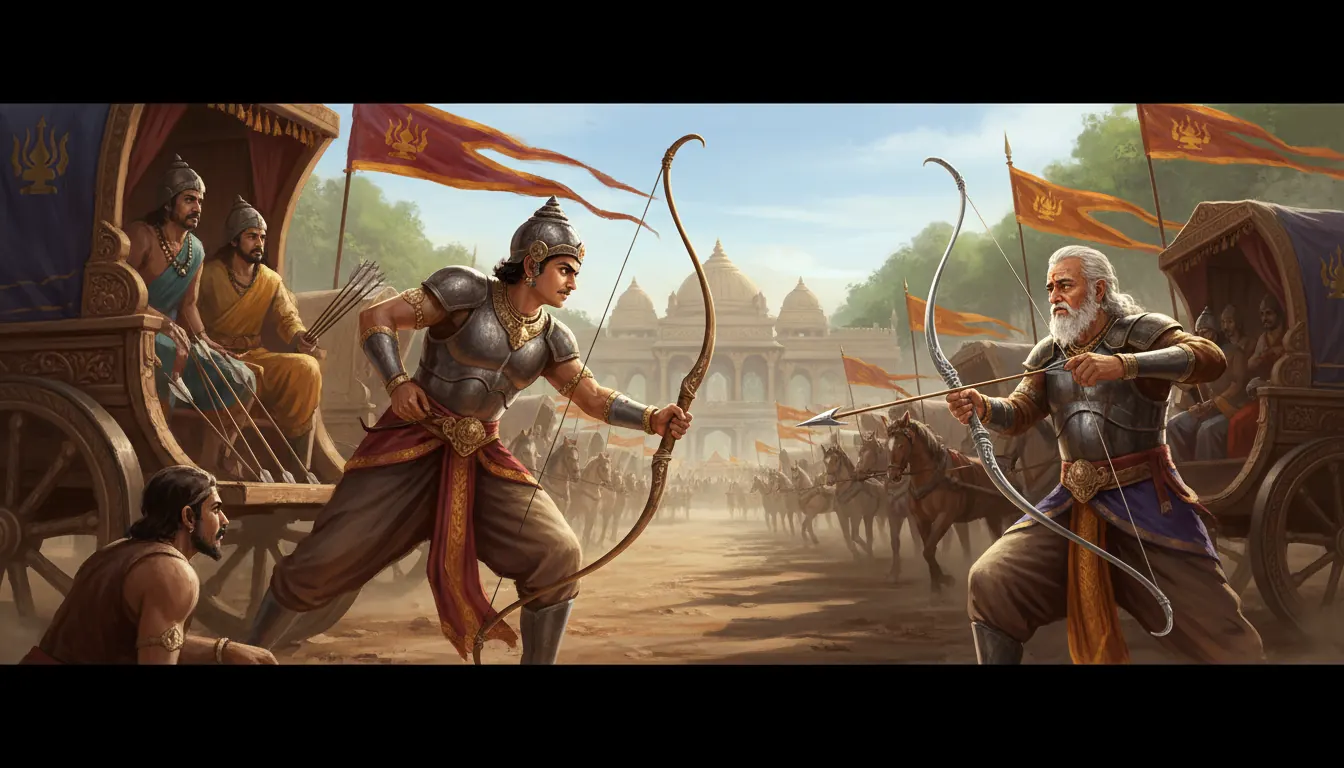
The Guard at the Wheel
Kumara of Panchala checks Drona in front of Yudhishthira's chariot, and pays for it
In short
On the evening of the eleventh day, with the Kaurava army broken and Vrishasena holding it together alone, Drona rallies his men and drives straight at Yudhishthira. He cuts the king's bow, and only Kumara, the Panchala prince set to guard the chariot wheels, stands in his way. Kumara checks him, strikes him in the chest, and is killed, and Drona then wounds every defender around the king and stands before his chariot like Death until Arjuna arrives at sunset.
Told in the Drona ParvaSet in Kurukshetra and Hastinapura13 min read
The Line That Held Alone
Sanjaya had been describing single combats all evening, and the blind king in the hall at Hastinapura kept asking for more of them, because listening was the only way he had of seeing.
The eleventh day of the war was ending. Drona had taken command that morning with a vow in his mouth, that he would seize Yudhishthira alive and bring him to Duryodhana, and the day had not gone the way the vow required. Shalya and Bhima had beaten each other senseless with maces and fallen at the same instant like two of Indra's poles, and Kritavarma had lifted the ruler of Madras onto his own chariot and carried him off the field writhing and unconscious. Dhritarashtra's sons and their elephants and foot-soldiers had watched the ruler of the Madras turn away from the fight, and they had begun to tremble.
Then the Kaurava army broke. Ground by the Pandavas, struck with fear, those warriors fled away in all directions like masses of cloud driven off by the wind, and the Pandavas stood in the middle of the wreck blowing conchs and beating drums, large and small, and cymbals, and roaring.
"Seeing that army of yours so badly broken," Sanjaya said, "the valiant Vrishasena, single-handed, began to protect it."
Vrishasena was Karna's son, a young man fighting his father's war, and what he did in that hour Sanjaya described as the illusion of his weapons. Thousands of arrows went out from that one chariot and flew in all directions, through men and horses and chariots and elephants. They blazed with light, and they came in thousands, like the rays of the sun in summer, and the chariot-warriors and horsemen of the Pandava host, struck and crushed by them, fell suddenly to the earth like trees broken by the wind. He felled great bodies of horses and chariots and elephants by the thousand.
One man, on a field where his own side had already run, holding open the space they had run through.
And the kings of the Pandava army, seeing that single warrior ranging fearlessly over the ground, stopped chasing the fugitives and joined together, and surrounded him on all sides.
The Sons Came for Their Brother
Satanika reached him first. He was Nakula's son by Draupadi, one of the five young men the brothers had begotten on their common wife and who were fighting that war as a set, and he pierced Vrishasena with ten arrows capable of penetrating into the vitals.
Karna's son cut off his bow, and then felled his standard.
That was the moment the battle stopped being about the broken army. The other sons of Draupadi, wanting to rescue that brother of theirs, rushed at Vrishasena together, and soon they hid Karna's son from sight under their showers of arrows. Against them, as they struck him, many chariot-warriors led by Drona's son Ashwatthama came in, and covered those mighty chariot-warriors, the sons of Draupadi, with arrows of many kinds, like clouds pouring rain on the breasts of mountains.
Then the Pandavas, from affection for their sons, quickly encountered those assailants.
It is worth noticing how the thing grew. A boy shot at a boy, and each side sent in what it had, and within a few moments the whole field was engaged, and nobody had ordered it. The battle between the Kaurava troops and those of the Pandavas was terribly fierce and made the hair stand on end, like the old war between the gods and the Danavas. They fought in a frenzy of rage, glaring at one another, enemies because of old offences, and the bodies of those heroes of boundless energy, driven by the wrath in them, looked like Garuda and the mighty nagas battling in the sky.
With Bhima and Karna and Kripa and Drona and Drona's son and Prishata's son Dhrishtadyumna and Satyaki all in it at once, Sanjaya said, the field of battle looked resplendent like the all-destructive sun that rises at the end of the Yuga.
And still the Kauravas lost ground. Yudhishthira's host, uttering a shout loud as that of the surging sea, began to slaughter the Kaurava troops, because the great chariot-warriors of that army had already fled and there was nothing behind the line to hold it.
There Is No Need to Run
Drona had spent the day trying to reach one man and had not reached him.
Now he looked at what was left of the host he commanded, broken and excessively mangled by the foe, and he said the only thing there was to say to men in that condition.
"Heroes, there is no need to run."
Then he did the thing himself. He owned red horses, and Sanjaya, who watched him do it, said he went in full of wrath, like a fierce elephant with four tusks. He drove into the Pandava host and rushed straight against Yudhishthira.
Understand what that meant on the eleventh evening. Drona had told Duryodhana that he would bring the son of Dharma out of the field a captive, and he had said in the same breath that it could not be done while Arjuna stood beside him. Arjuna was elsewhere on the field just then, cutting his way through the Kurus somewhere out of sight, and the teacher had perhaps a quarter of an hour of the day's light left and a clear line to the king.
Yudhishthira saw him coming and did not give ground. He pierced the teacher with many whetted arrows fitted with Kanka feathers, the arrows a king shoots at the man who taught him to shoot them.
Drona cut off his bow.
That is one motion in the text and it is the whole of the crisis. The king of the Pandavas stood in his chariot with a severed bow in his hands and an old brahmana coming at him impetuously with a vow to fulfil, and there was nothing at all between them.
There was one thing. There was a young man whose entire duty that day had been to stand at the wheel of that chariot and see that nobody reached it.
Kumara at the Wheel
His name was Kumara, and he was a prince of the Panchalas, Drupada's people, the house that had hated Drona for a generation and had bred a son out of the fire expressly to kill him. Sanjaya calls him the renowned prince of the Panchalas and the protector of Yudhishthira's chariot wheels, which is a post, not a compliment. Two men are assigned to the wheels of a king's chariot, and their work is to die there if it comes to that.
He received the advancing Drona, Sanjaya said, like the continent receiving the surging sea.
The comparison is exact and it is not flattering to either man. The sea is not stopped by the land. It is only made to break somewhere, and to keep breaking there, and the coast holds because it goes on holding.
Kumara held. When they saw Drona, that bull among brahmanas, held in check by him, loud lion-like roars went up across the Pandava host with cries of "Excellent, Excellent!" Men who had been fleeing an hour earlier stood in their chariots and cheered a wheel-guard.
Then Kumara, filled with rage in that great battle, pierced Drona in the chest with an arrow, and gave many lion-like shouts of his own.
It should be said plainly that this is a rare line. Drona was struck in the chest, by a young man nobody outside Panchala had heard of, in front of both armies. Then, with Drona checked, the mighty Kumara, tireless and light of hand, pierced him again with many thousands of arrows. Lightness of hand is the phrase the epic keeps for the very best archers. He kept virtuous vows and was accomplished in both mantras and weapons, which is to say he was a finished man and not a boy filling a slot in the order of battle.
And then that bull among men slew him.
Sanjaya gives it in a single sentence and moves on, the way the field moved on. The protector of Yudhishthira's chariot wheels went down at the wheel he was protecting, and the cheering stopped, and the way to the king was open again.
The Ring Around the King
What Drona did next was not a charge. It was arithmetic.
Penetrating into the midst of the Pandava host and careering in all directions, Bharadwaja's son became the protector of his own troops, and he went through the men standing around Yudhishthira one after another and wounded every one of them enough to occupy him.
Shikhandi took twelve arrows. Uttamaujas, one of the two brothers who guarded Arjuna's chariot wheels, took twenty. Nakula took five and Sahadeva seven. Yudhishthira himself took twelve. Each of the five sons of Draupadi took three. Satyaki took five, and Virata, the ruler of the Matsyas in whose kitchens and cow-pens the Pandavas had hidden through the thirteenth year, took ten.
Nine men and a king, in the time it takes to read the list. He agitated the entire host in that battle, Sanjaya said, and rushed against one after another of the foremost warriors of the Pandavas, and having emptied the ground around the chariot he advanced against Kunti's son Yudhishthira, intent on seizing him.
Seizing. Not killing. Everything Drona did that evening was shaped by the promise he had made to Duryodhana, that he would bring the son of Dharma in alive, and a man who intends to take a prisoner has to come close.
Then Yugandhara checked him.
He was a mighty chariot-warrior of the king's host, and he threw himself in front of Bharadwaja's son, who was by then filled with rage, like the very ocean lashed into fury by a storm. That is the second time in a quarter of an hour that the epic reaches for the sea to describe Drona, and the second time it puts one man in front of it.
Bharadwaja's son pierced Yudhishthira with many straight arrows, and then, with a single broad-headed shaft, knocked Yugandhara out of his place in the chariot.
Two guards in two minutes. The cries of "Excellent" did not go up for the second one.
Death Standing in Front of the Chariot
The kings came in then, all of them at once, because there was nothing else left to try.
Virata and Drupada, and the princes of the Kaikeyas, and Satyaki, and Sivi, and Vyaghradatta the prince of the Panchalas, and the valiant Singhasena, these and many others, desirous of rescuing Yudhishthira, surrounded Drona on all sides and impeded his way, scattering countless arrows.
Vyaghradatta pierced Drona with fifty keen-pointed arrows, and the troops uttered loud shouts at the sight. Then Singhasena also quickly pierced that mighty chariot-warrior and roared aloud in joy, and the sound of it struck terror into the hearts of mighty chariot-warriors, because a man does not roar like that unless he believes he has done something.
Drona expanded his eyes. He rubbed his bowstring. He produced the loud sound of slaps with his palms, which is what an old teacher does in the practice yard when the lesson is about to become serious, and he rushed at them.
Then the mighty son of Bharadwaja, putting forth his prowess, cut off with a couple of broad-headed arrows the heads, decked with earrings, from the trunks of both Singhasena and Vyaghradatta.
Two arrows, two heads, and the earrings still in them.
Harrying the other mighty chariot-warriors of the Pandavas with showers of arrows, he came through the last of them and stood in front of Yudhishthira's chariot, and Sanjaya, describing that old man of regulated vows standing there with his bow bent, could find no better comparison than all-destroying Death himself.
Loud cries were heard then among the warriors of Yudhishthira's army, from one end of that part of the field to the other.
"The king is slain."
And on the other side the Kaurava soldiers were saying to one another, with the sun almost down, "Today the royal son of Dhritarashtra will succeed. This very moment Drona will seize Yudhishthira and come back to us, full of joy, and into Duryodhana's presence, without a doubt."
They were still saying it when they heard the rattle of a chariot behind them.
The River That Came Between Them
Kunti's son came there quickly, filling the sky with the rattle of his chariot.
Sanjaya does not describe Arjuna arriving. He describes what Arjuna left behind him as he came, and the description is one long image that the blind king in the hall was made to sit through: that he created, owing to the carnage he caused, a river whose waters were blood, and whose eddies were chariots, and which was full of the bones and the bodies of brave warriors, and which carried creatures away to the place where the spirits of the departed dwell. Its froth was made of showers of arrows. Its fish were lances and other weapons. Routing the Kurus, the son of Pandu crossed that river he had himself made, and came up on Drona's divisions.
Then he covered them with a thick net-work of arrows and confounded the very senses of those that followed Drona. Incessantly placing his arrows on the bowstring and quickly shooting them, none could notice any lapse of time between the two acts.
Neither the four cardinal directions, nor the firmament above, nor the earth could any longer be distinguished, for everything became one dense mass of arrows. When the wielder of Gandiva caused that thick darkness, nothing could be seen in that battle at all.
And just then the sun also set, enveloped with a dusty cloud, and neither friend nor foe could be told apart, and the eleventh day was over.
Drona and Duryodhana and the others caused the withdrawal of their troops. Ascertaining the foe to be inspired with fear and unwilling to continue the fight, Arjuna slowly caused his own troops to be withdrawn.
The Pandavas and the Srinjayas and the Panchalas, filled with joy, praised Partha with delightful speeches, like the rishis praising the Sun. He went back to his tent in the rear of the whole army with Keshava beside him, standing on his beautiful chariot decked with the costliest sapphires and rubies and gold and silver and diamonds and corals and crystals, and he looked, Sanjaya said, as splendid as the moon in a sky spangled with stars.
Nobody praised Kumara. He had bought about as much time as it takes to bend a bow, and it had been enough, and the man he bought it for lived to be crowned.
Dharma Lesson
Kumara is named once, praised once and killed in the same paragraph, and the epic does not pause over him. But the whole of the eleventh day turns on the few moments he stood at that wheel, because Drona had sworn to take Yudhishthira alive and the sun was going down. Most of what keeps a life intact is done by people who are given a post rather than a choice, and who hold it long enough for someone else to arrive. The cheer that went up when he checked the teacher was the only reward he got, and he had it before he died.