In short
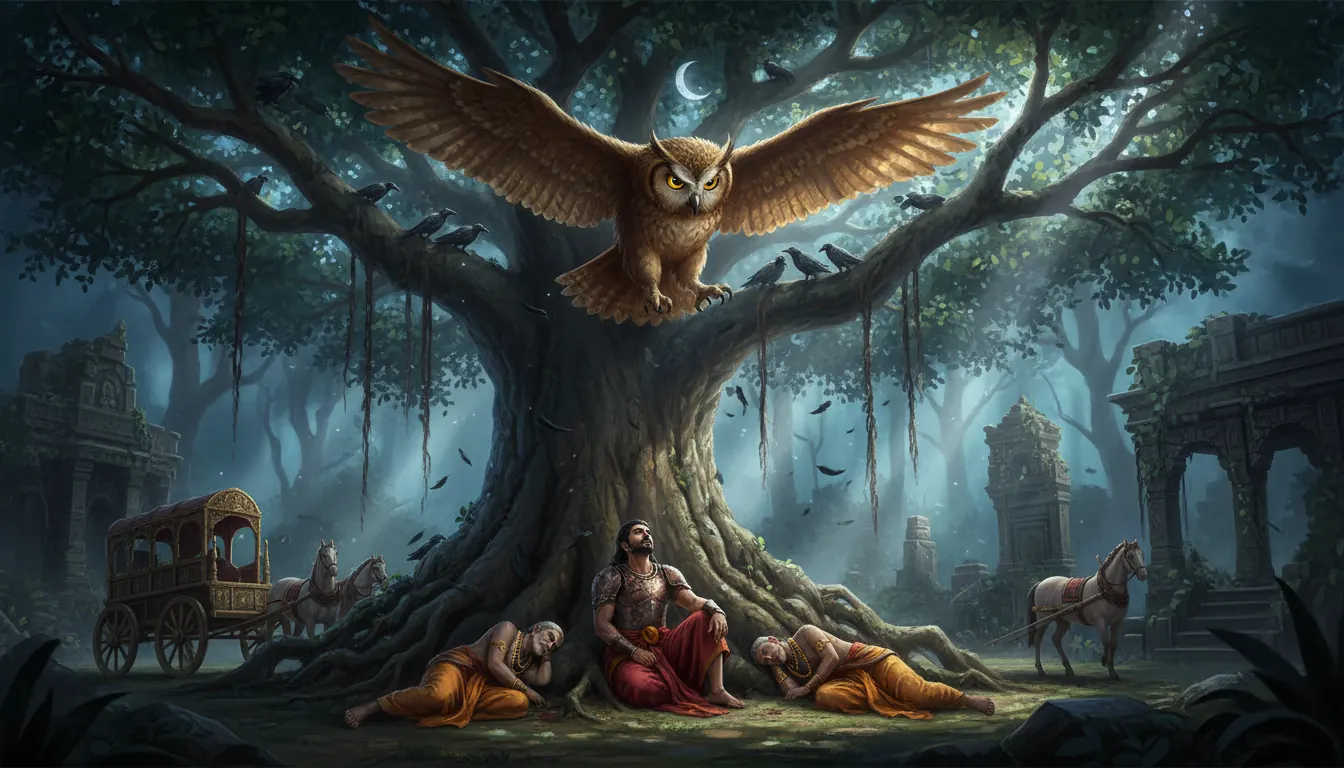
The three survivors of the Kaurava army hide in a forest at nightfall and sleep under a great banyan. Ashwatthama, too enraged to sleep, watches an owl butcher a tree full of roosting crows and takes it for instruction. Kripa argues that the sleeping and the surrendered are unslayable; Ashwatthama answers with every rule the Pandavas have already broken, and yokes his horses.
Told in the Sauptika ParvaSet in Kurukshetra and Pandava Camp20 min read
The Riders Who Went South
Sanjaya said, "They went south, the three of them, when the field was lost. At the hour of sunset they came to a spot near the Kuru encampment and let their animals loose, and standing there in the last of the light they became very much frightened.
They were cut and torn by many sharp weapons. They sighed long, hot sighs and thought of the Pandavas. Out of the east came the noise that victors make, and when they heard it they feared they were being pursued, and turned and fled eastward themselves, which is what men do when they no longer know where they are going. After a while their animals were spent and the men were thirsty. Those great bowmen were overcome by anger and the hunger for revenge, and they could not bear what had happened, burning as they were with grief at the killing of the king. So they halted, and rested for a while."
Dhritarashtra broke in. "What Bhima did seems incredible to me, Sanjaya. My son who was struck down had the strength of ten thousand elephants. He was in the prime of manhood. His body was like adamant. No creature could kill him, and yet he is dead."
"My heart too must be made of adamant, since it does not break into a thousand pieces even after hearing that my hundred sons have been killed. I have been the father of a king, and a king myself: how am I to spend my days now as a slave, obeying his orders? How will I bear the words of Bhima, who by himself has killed a full hundred of my sons? The words of the great-souled Vidura have come true, and my son would not listen to them."
Then, more quietly: "What did Kritavarma do, and Kripa, and Drona's son, after my son Duryodhana had been unfairly struck down?"
The Biggest Tree in That Forest
"They had not gone far, king, when they stopped," Sanjaya said, "for in front of them they saw a dense forest, thick with trees and creepers. They rested a little and watered their horses, and then drove their chariots into it.
It was a forest full of animals of every kind, and it teemed with birds. There were beasts of prey in it. It was dotted with pools and bright with flowers, and it had lakes overgrown with blue lotuses. Looking about them, the three warriors saw a gigantic banyan with thousands of branches, the biggest tree in that forest, and they went to it and sat in its shade. They climbed down from their chariots, let their animals loose, washed themselves as the rites require, and said their evening prayers.
Then the Sun sank behind the Asta mountains, and Night, the mother of the universe, came on. The sky, spangled with planets and stars, shone like a piece of embroidered brocade, a lovely sight for anyone with the heart to look at it. The cries of the creatures that roam at night grew terrible. The beasts of prey were full of glee, and as the night deepened it became dreadful.
At that hour Kritavarma and Kripa and Drona's son sat down together under the banyan, full of grief and sorrow, and they spoke their sorrow over the one subject there was: the destruction of both the Kurus and the Pandavas. Then sleep took two of them. Kripa and Kritavarma, men who deserved happiness and had done nothing to deserve such misery, lay down on the bare earth, utterly exhausted and badly torn by arrows. Indeed, king, those two who had always slept on costly beds now lay on the ground like helpless men, worn out with toil and grief."
What Came Out of the Dark
"But Drona's son could not sleep. Anger held him, and devotion to his dead father, and he kept breathing hard like a snake. He was burning with rage and could not close his eyes for a moment. The mighty-armed hero looked all round him at that terrible forest.
As he looked, he saw a large banyan covered with crows. Thousands of crows roosted in it that night, each on its own perch, apart from its neighbour, and they slept at ease, descendant of Kuru, as birds sleep when nothing has ever hunted them in that tree before.
While those birds slept safe on every side, Ashwatthama saw a terrible-looking owl suddenly appear. It had a frightful cry and a huge body, with green eyes and tawny feathers; its beak was very large and its talons long, and it came as fast as Garuda. Giving soft little cries, the bird crept up on the branches of the banyan.
That hunter of the sky, that killer of crows, settled on one of the branches and killed a great many of his sleeping enemies. He tore the wings off some. He cut off the heads of others with his sharp talons. He broke the legs of many. He was very strong, and he killed many that fell down before his eyes. The ground beneath the spreading branches of that banyan was thickly strewn on every side with the limbs and bodies of the dead crows.
Having slain them, the owl became filled with delight, like a slayer of foes who has behaved toward his foes exactly according to his pleasure. And in all that time not one crow woke, until it was too late to wake, and not one of them fought, because there had been nothing to fight."
This Owl Teaches Me a Lesson in Battle
"Drona's son watched what the owl had done in the night and saw a great deal in it. He began to think it over, wanting to shape his own conduct by that example. And he said to himself, sitting there in the dark with two sleeping men beside him:
'This owl teaches me a lesson in battle. I am set on destroying the enemy, and the time to do it has come. The victorious Pandavas are beyond my power to kill. They are strong and they are tireless, sure of aim and skilled at striking. Yet in the presence of the king I vowed to kill them. I have pledged myself to my own destruction, like an insect trying to fly into a blazing fire. If I fight them fairly, I will certainly lose my life. But by a trick I may still succeed, and a great destruction may fall upon my enemies.
Whatever blame and ill repute this deed may bring, a man who follows kshatriya ways ought to bear it. The Pandavas, whose souls are unclean, have at every step done ugly, shameful things full of trickery.'
And he found, as men in his condition always find, that there were verses for it. He said them over to himself, ancient verses, full of truth, sung by truth-seeing and righteousness-observing persons after a careful consideration of the demands of justice:
'An enemy's army may be struck down even when it is tired, or wounded by weapons, or eating, or withdrawing, or resting inside its camp. It may be treated the same way when it is heavy with sleep in the dead of night, or has lost its commanders, or is broken, or has made a mistake.'
When he had thought it through in this way, the valiant son of Drona made up his mind to kill the sleeping Pandavas and Panchalas that night. And having made that wicked resolve, and sworn to himself again and again that he would carry it out, he got up and went to wake the two men who were asleep."
Three Left Out of Eleven Akshauhinis
"He woke both his maternal uncle and the chief of the Bhojas and told them what he meant to do. Roused from sleep, those two great and mighty men heard Ashwatthama's plan through to the end. Then, filled with shame, neither of them gave any fitting reply at all.
He waited a short while for an answer that did not come, and then Ashwatthama said, with tearful eyes:
'King Duryodhana, that one hero of great might, the man for whose sake we were making war on the Pandavas, has been killed. He was lord of eleven akshauhinis, and yet he was abandoned and alone when that hero of spotless courage was struck down by Bhimasena and a crowd of wretches banded together against him. And the vile Vrikodara did another wicked thing: he touched with his foot the head of a man whose hair had received the sacred bath of coronation.
Listen. The Panchalas are roaring and shouting and bursting into laughter. They are blowing their conchs and beating their drums for joy. The din of their instruments, mixed with the blare of the conchs, is frightful to hear, and the wind is carrying it to every quarter. That deafening noise of men rejoicing as they march back to their quarters, and the clatter of their chariot wheels with it, comes to us from the east.
The Pandavas have made such havoc among the sons of Dhritarashtra that we three are the only ones left alive from that great slaughter. Some of the dead had the strength of a hundred elephants. Some were masters of every weapon. Yet the sons of Pandu have killed them. I take it as one of the reversals that Time brings about. This, truly, is where such a deed ends.
If your wisdom has not been driven away by stupefaction, then say what is proper for us to do in view of this calamitous and grave affair.'"
Rain on a Mountain, Rain on a Field
Kripa said, "We have heard everything you have said, mighty one. Now listen to a few words of mine.
All men are subject to two forces, Destiny and Effort, and are ruled by them. There is nothing higher than these two. Our deeds do not succeed through destiny alone, or through effort alone. Success comes from the two together. What comes of clouds pouring rain on a mountain? And what does not come of the same rain falling on a ploughed field? Effort when destiny is against us, and no effort when destiny is with us: both bear no fruit. When the rain soaks well-tilled soil as it should, the seed yields a great harvest. Human success works the same way.
But hear the rest of it, for this is the part that concerns us tonight. A man who wants success, who waits on his elders as he should, asks them what is for his good and follows their good advice, is never lost. When a man sets out to act, he should always seek the advice of men the old approve of. They are the sure root of means, and success depends on means. But a man who goes after his aims without regard or respect for those who could advise him well, driven by passion, anger, fear and greed, soon loses his good fortune.
This Duryodhana, stained by greed and blind to what lay ahead, took no counsel and foolishly set out on a plan he had never thought through. He ignored all who wished him well and listened only to the wicked, and though he was warned against it, he made war on the Pandavas, who are his betters in every good quality. He could not restrain himself. He would not do what his friends advised. And for all that, he now lies burning in grief and ruin. As for us, because we followed that sinful wretch, this great disaster has fallen on us too.
This great disaster has scorched my understanding. I think and think, and I cannot see what is for our good. So let us go to Dhritarashtra and Gandhari and the great-souled Vidura and ask them what we should do. When we ask them, they will tell us what is for our good after all that has happened, and we should do what they say. That is my firm resolve."
Every Man Praises His Own Understanding
Sanjaya said, "Kripa's words were wise and good, full of righteousness and sound sense, but when Ashwatthama heard them he was overwhelmed with sorrow and grief. Burning as though with a blazing fire, he made a wicked resolve, and then he spoke to them both.
'Understanding differs from man to man,' he said, 'and each man is pleased with his own. Every man thinks himself cleverer than others. A skilled physician first diagnoses the disease and then uses his judgment to prescribe a medicine that will cure it, and in the same way men use their judgment to get their work done, and then others find fault with what they have done.
So I will tell you the resolve that has taken hold of my mind today, because it may drive away my grief.
When the Creator had made his creatures, he gave each one its work, and gave each order its own share of excellence. To brahmanas he gave the greatest thing of all, the Veda. To the kshatriya he gave surpassing energy. To the vaishya he gave skill, and to the shudra the duty of serving the other three. So a brahmana without self-restraint deserves blame, and a kshatriya without energy is base.
I was born into a revered and lofty family of brahmanas. But by ill luck I am bound to the ways of a kshatriya. If, knowing a kshatriya's duties as I do, I now take up the duties of a brahmana, it would not be noble. In battle I hold a fine bow and fine weapons. If I do not avenge my father's killing, how can I show my face among men? So, honouring a kshatriya's duty and without hesitating, I will follow today in the footsteps of my great-souled father and of the king.
The Panchalas, flushed with victory, will sleep trustingly tonight, with their armour off, delighted, happy at the thought of the victory they have won, and worn out with toil. While they sleep at ease in their own camp, I will make a great and terrible attack on it. As Maghavat killed the danavas, falling on them while they lay senseless and dead with sleep, I will kill them all. As a blazing fire burns up a heap of dry grass, I will kill all of them gathered in one place with their leader Dhrishtadyumna. I will put out all my strength tonight and crush the head of Dhrishtadyumna, king of the Panchalas, as if he were a beast. I will send the Panchalas down the hard road that Duryodhana and Karna and Bhishma and the ruler of the Sindhus have gone. When I have wiped out their army tonight as it lies sunk in sleep, I will be truly happy, and I will feel that I have done my duty.'"
Four Things That Destroy Sleep
Kripa said, "By good luck, you whose glory never fades, your heart is set on vengeance today, and the wielder of the thunderbolt himself could not talk you out of it. But hear me on one small matter. In the morning the two of us will go with you, in armour and in our chariots. Take off your armour now, lower your standard, and rest for tonight.
You have stayed awake for many nights. Rest and sleep and come back fully refreshed, and then meet the enemy. Who would fight Drona's son when he goes out with Kripa beside him and Kritavarma guarding him, even if it were the king of the gods himself? Neither I, my son, nor Kritavarma will ever leave the battle until we have defeated the Pandavas. We will kill the angry Panchalas along with the Pandavas and come back, or they will kill us and we will go to heaven."
Addressed in these beneficial words by his maternal uncle, the son of Drona, with eyes red in rage, answered him.
"How can a man sleep if he is in pain, or in a rage, or if his mind is always busy with schemes for getting wealth, or if he is in the grip of desire? All four of these are true of me, and any one of them alone would destroy sleep.
How great is the grief of a man whose heart is always on the killing of his father. My heart burns day and night. I can find no peace. You all saw how those sinful wretches killed my father, of all men. The thought of it cuts me to the quick. How could a man like me live for even a moment after hearing the Panchalas boast that they have killed my father? I cannot bear the thought of going on living without killing Dhrishtadyumna in battle.
Who is so hard-hearted that he would not burn after hearing what I have heard, the laments of the king lying there with his thighs broken? With Vasudeva and Arjuna protecting them, I think even the great Indra could not overcome the Pandavas. I cannot hold back this anger rising in my heart. I see no one in this world who can calm it. When I have killed my enemies in their sleep, then I will rest, and then I will sleep without a care."
A Red Spot on a White Sheet
Kripa said, "A brave man without understanding may wait on a learned man all his life and still not learn his duties, like a wooden ladle that sits in a rich soup and never tastes it. But a wise man who waits on a learned man for even a moment learns his duties at once, as the tongue tastes the soup the instant it touches it.
Those who wish a man well try to hold him back from sin. As a man whose mind is disordered is calmed with gentle words, so a friend should be held back by those who wish him well. Set your heart on what is truly for your good, master yourself, and do as I say, my son, so that you will not regret it afterwards.
In this world the killing of sleeping men is not praised, for religion does not approve it. So too with men who have laid down their arms and stepped down from their chariots and horses. Nor may anyone kill those who say, 'We are yours,' or those who surrender, or those whose hair is loose, or those whose animals have been killed under them or whose chariots are broken. A crooked-minded man who attacked them then would sink into a deep and endless hell, with no raft but himself.
You have not yet committed the smallest wrong. When the sun rises tomorrow and its light shows everything clearly, you will conquer the enemy in battle, blazing like a second sun. This shameful deed, so unthinkable in a man like you, would look like a red spot on a white sheet. That is my opinion."
Ashwatthama said, "No doubt it is just as you say, uncle. But the Pandavas long ago broke the bridge of righteousness into a hundred pieces. I will count them for you.
In full sight of all the kings, before your own eyes too, my father laid down his weapons, and then Dhrishtadyumna killed him. Karna, the greatest of chariot warriors, was killed by the wielder of Gandiva after his chariot wheel had sunk and he was in great distress. Shantanu's son Bhishma had laid his weapons aside and was unarmed when Arjuna killed him, with Shikhandi placed in front. The mighty bowman Bhurishravas was sitting in the praya vow on the battlefield when Satyaki killed him, ignoring the cries of all the kings. And Duryodhana met Bhima in a mace fight and was killed unrighteously in full view of all the lords of the earth; the king was all alone, surrounded by a crowd of mighty chariot warriors, and that is how Bhimasena struck down that tiger among men.
That is what the Panchalas are like, unrighteous and sinful, men who have torn down the barrier of virtue. Why do you not blame them, when they have trampled on every rule?
Once I have killed the Panchalas, my father's killers, at night while they lie buried in sleep, I do not care if I am born a worm or a winged insect in my next life. The man is not yet born, and never will be, who can turn me from this resolve I have made to destroy them."
Three Fires Going Out to the Gate
Sanjaya continued, "When he had said this, king, the valiant son of Drona yoked his horses to his chariot in a corner of that place and set out toward his enemies.
Then the Bhoja chief and Sharadvata's son, those great-souled men, called after him. 'Why are you yoking your horses? What are you about to do? We are resolved to go with you tomorrow, bull among men. We share your joys and your sorrows. You should not mistrust us.'
Remembering his father's killing, Ashwatthama in his rage told them plainly what he had resolved to do.
'My father had killed hundreds and thousands of warriors with his sharp arrows, and when he had laid his weapons aside, Dhrishtadyumna killed him. Today I will kill his killer in the same state, when he has laid his armour aside. Today I will kill the sinful son of the Panchala king by a sinful act. I am resolved to kill that sinful prince like a beast, so that he does not reach the worlds that warriors win when they die by weapons. Put on your armour at once, take your bows and swords, and wait for me here, you great chariot warriors, scourges of your enemies.'
With these words Ashwatthama mounted his chariot and set out toward the enemy. Then Kripa, king, and Kritavarma of the Satvata clan both followed him. As the three advanced on the enemy they shone like three blazing fires at a sacrifice, fed with offerings of clarified butter.
They went on, lord, toward the camp of the Panchalas, where everyone was asleep. When he reached the gate, Drona's son, that mighty chariot warrior, stopped."
Dharma Lesson
A man who has already decided will find a teacher in anything he looks at, and the counsel of friends is worth nothing to someone who asks for it only after the decision is made. Kripa says everything that ought to have been said, in the right order, with the right examples, and it changes nothing, because Ashwatthama was not asking for advice but for company.