In short
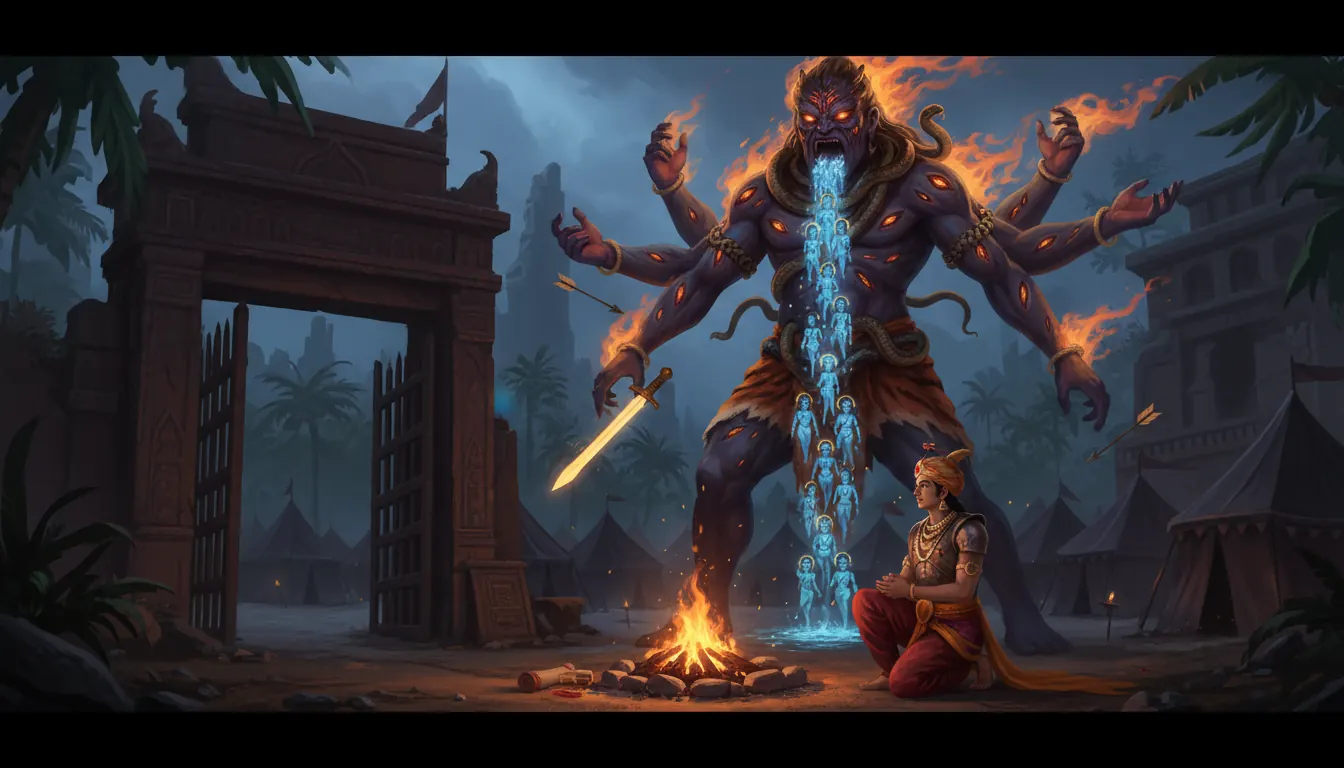
At the entrance to the sleeping Pandava camp Ashwatthama finds a giant guarding it, tiger-skinned and snake-girdled, with a thousand burning eyes and images of Krishna pouring out of its mouth. Every weapon he throws is swallowed. Disarmed, he builds an altar, makes his bow the fuel and his own soul the libation, and steps into the fire.
Told in the Sauptika ParvaSet in Pandava Camp and Kurukshetra16 min read
Two Men Left at the Entrance
Dhritarashtra said, "When Drona's son stopped at the gate of the encampment, Sanjaya, what did those two mighty chariot-warriors, Kripa and Kritavarma, do? Tell me this."
Sanjaya said, "He called them up to him, king. Drona's son, filled with rage, summoned Kritavarma and the mighty chariot-warrior Kripa and went up to the gate of the camp with them at his back, carrying the plan he meant to whisper to them there.
It was a plain plan, for men who had been beaten twice in a day: the two of them standing at the gate to kill whatever ran out, and one of them going in alone. And that would have been the whole of it, king, except that when he turned to go in he found that the gate was already guarded.
There stood before him a being of gigantic frame, enough to make the hair stand on end, shining like the Sun or the Moon. It was guarding the entrance. It had not been there when they rode up, and it did not speak, and it did not challenge him, and it did not move aside."
A Thousand Eyes and All of Them Burning
"Round its loins was a tiger-skin dripping with blood, and it wore a black deer-skin as its upper garment. For its sacred thread it wore a large snake. Its arms were long and massive and held many kinds of raised weapons, and another great snake was wound about its upper arms for armlets.
Its mouth seemed to blaze with flames of fire. Its teeth made its face terrible to look at. Its mouth gaped, dreadful. Its face was adorned with thousands of beautiful eyes. Its body was beyond describing, king, and so was its dress. The very mountains, on seeing it, would split into a thousand pieces.
Blazing flames seemed to pour from its mouth and its nose and its ears and from all those thousands of eyes. And out of those flames came hundreds and thousands of Hrishikeshas, armed with conchs and discs and maces, each one of them Krishna, each one of them looking at him.
Kripa saw it and Kritavarma saw it, and neither of them said a word, because there was nothing in the training of a chariot-warrior that covered it.
Drona's son looked at that extraordinary being, which could fill the whole world with terror, and felt no agitation. He was past the point where a man feels agitation. He covered it with showers of celestial weapons instead."
Everything He Threw
"But the being swallowed every arrow Drona's son shot. As the vadava fire swallows the waters of the ocean, it devoured the arrows one after another as fast as he could shoot them, and stood where it had stood before.
When he saw his showers of arrows come to nothing, Ashwatthama hurled at it a long dart blazing like a flame of fire. The dart's blazing point struck the being and broke into pieces, like a huge meteor at the end of the yuga that strikes the Sun, shatters, and falls from the sky.
Without losing a moment Ashwatthama drew from its sheath a fine scimitar, the colour of the sky, with a golden hilt. It came out like a blazing snake from its hole. The clever son of Drona hurled it at the being, and as it came near, the weapon vanished into its body like a mongoose vanishing into its hole.
Filled with rage, the son of Drona then hurled a blazing mace as big as a pole raised in honour of Indra. The being swallowed that mace too.
At last, when all his weapons were spent, Ashwatthama looked around him. There was nothing left in the chariot and nothing left in his hands. And the whole sky above the camp was thick with images of Janardana, standing in the air on every side of him, as many of them as there had been arrows."
The Words of Advising Friends
"Drona's son, stripped of his weapons, saw that wonderful sight and remembered the words of Kripa. And turning pale with grief, he said:
'A man who will not listen to the good advice of friends is forced to repent when calamity overwhelms him, as I am now, fool that I was to ignore my two well-wishers. The fool who ignores the way the scriptures point out and tries to kill his enemies falls from the path of righteousness and is lost in the trackless wilderness of sin.
One should not use weapons against cows, brahmanas, kings, women, friends, one's own mother, one's own teacher, a weak man, an idiot, a blind man, a sleeping man, a terrified man, one just woken from sleep, a drunk, a madman, or one who is off his guard. The teachers of old always taught men this truth. But I ignored the eternal way the scriptures point out and tried to walk a wrong path, and I have fallen into terrible distress.
The wise call it a terrible calamity when a man sets out to do a great deed and then falls back from it out of fear. I cannot do what I have vowed with my own skill and strength alone. Human effort is never thought more powerful than destiny. If a deed once begun fails through destiny, the doer becomes like one who has fallen from the path of righteousness and is lost in the wilderness of sin. The sages call it foolishness when a man begins a deed and turns away from it out of fear. This great calamity has come upon me because my attempt was wicked; otherwise Drona's son would never have been forced to hold back from battle.'
He stood there, king, in front of an enemy he could not touch, saying over to himself in the dark the exact argument that his uncle had made to him under the banyan and that he had answered so well."
The Raised Rod
"Then he looked at the thing in the gateway again, and understood what he was looking at.
'This being I see before me is most wonderful,' he said. 'He stands there like the raised rod of divine punishment. However deeply I think about it, I cannot tell who he is. Surely he is the terrible fruit of this sinful resolve of mine, which I tried to carry out unrighteously. He stands there to block it. So it seems that in my case this falling back from the fight was ordained by destiny. It is not for me to strive after my purpose unless destiny turns in my favour.
So at this hour I will seek the protection of mighty Mahadeva. He will drive away this dreadful rod of divine punishment raised before me. I will take shelter with that god, the source of all good, the lord of Uma, also called Kapardin, who wears a garland of human skulls, who plucked out Bhaga's eyes, who is also called Rudra and Hara. In austerities and in prowess he far surpasses all the gods. I will seek the protection of Girisha, who holds the trident.'
Mark the turn of it, king. He did not say that he had been wrong. He said that his purpose was true and that the obstacle was a technical one, and that there was a god who could remove obstacles. A man does not change his mind at that hour of the night. He only looks for a higher permission."
The Litany of Names
Sanjaya said, "When he had thought this over, the son of Drona stepped down from the platform of his chariot and stood with his head bowed to that supreme god. And he said:
'I seek the protection of Him called Ugra, Sthanu, Shiva, Rudra, Sharva, Ishana, Ishvara, Girisha; of that boon-giving god who is the Creator and Lord of the universe; of Him whose throat is blue, who is without birth, who destroyed the sacrifice of Daksha, and who is called Hara; of Him whose form is the universe, who has three eyes and many forms, and who is the lord of Uma; of Him who lives in the cremation grounds, who swells with energy, who is the lord of many tribes of ghostly beings; of Him who carries the skull-topped club, who wears matted locks, and who is a brahmacari.
I purify my soul, which is so hard to purify, and weak in energy as I am, I worship the Destroyer of the triple city and offer myself as the victim. You have been praised, you are worthy of praise, and I praise your glory.
Your purposes are never thwarted. You are robed in skins; your hair is red; your throat is blue; you are unbearable; you are irresistible. You are pure; you are the Creator of Brahman; you are Brahma; you are a brahmacari; you keep your vows; you are devoted to austerities; you are infinite; you are the refuge of all ascetics; you have many forms; you are the leader of many tribes of ghostly beings; you have three eyes; you are dear to Gauri's heart; you are the father of Kumara; you love the beings called your companions; the Lord of treasures always looks upon you; you are tawny; a bull is your noble mount; you are robed in fine clothing; you are most fierce; you delight in adorning Uma; you are higher than all that is high; nothing is higher than you; you bear weapons; you are immeasurable, and you protect all the quarters; you are cased in golden armour; the moon adorns your brow.
With my whole mind fixed on you I seek your protection, god. To cross this dreadful distress that is so hard to cross, I make a sacrifice to you, the purest of the pure, and offer for your acceptance the five elements of which my body is made.'"
What Came to Watch
"In answer to his resolve and to his wish to achieve his purpose, a golden altar appeared before the great-souled son of Drona. On the altar, king, a blazing fire appeared, filling every point of the compass, the main quarters and those between, with its splendour.
And out of the dark around that fire came the companions of the god, in their hundreds and their thousands. Many mighty beings with blazing mouths and eyes, with many feet and heads and arms, wearing armlets set with gems, their arms raised, looking like elephants and like mountains. Their faces were like those of hares and boars and camels and horses and jackals and cows and bears and cats and tigers and crows and apes and parrots. Some had the faces of mighty snakes, and others the faces of ducks. Some had faces like tortoises and alligators and porpoises and huge sharks and whales, and some like lions and cranes and pigeons and elephants and stags. Some had ears on their hands. Some had a thousand eyes. Some had no flesh, and some, Bharata, had no heads at all.
Some were armed with shataghnis, some with thunder, and some carried mushalas. Some had nooses, and some had maces. Some had quivers of fine arrows slung on their backs, and all were fierce in battle. Some held large nooses in their raised arms, some clubs and bludgeons, some stout posts, some scimitars, and some wore snakes with raised hoods for crowns. Some had matted locks, some five tufts of hair, and some bald heads. Some had lean bellies; some had four teeth, some four tongues, some ears straight as arrows, and some wore crowns on their brows. Some were covered with dust, some smeared with mud, and all were dressed in white robes and white garments. Some had blue limbs and others tawny ones. Some were very short, and some very tall.
Those beings, called companions, golden in complexion and full of joy, played on drums and horns and cymbals and jharjharas and anakas and gomukhas. Some sang and some danced about making loud sounds, and some leapt forward and cut capers and jumped sideways. They drank blood and fat, and lived on the flesh and entrails of animals. They do not know what fear is, and they can endure the frowns of Hara. They can bring the sky down upon the earth with the sun, moon and stars, and wipe out the four orders of created things. They always act as they please, and they are the lords of the lords of the three worlds. They possess the eight kinds of divine powers, yet are never puffed up with pride, and the divine Hara is always amazed at their feats. They worshipped the trident-bearing god with Vedic recitation, with brahmacarya, with austerities and with self-restraint, and so won the companionship of Bhava, and the divine Maheshvara, lord of the past, the present and the future, eats with them, as does Parvati.
Filling the universe with the sound of many kinds of instruments, with laughter, with shrieks and with roars like lions, they came at Ashwatthama from every side. They came to add to his honour and to the glory of the great-souled Hara, to find out how great his energy was, and also to see the slaughter in the hour of sleep. The very sight of them could fill the three worlds with dread. But the mighty Ashwatthama looked at them and felt no fear."
His Bow for Fuel, His Soul for the Libation
"Drona's son, bow in hand, his fingers in guards of iguana skin, offered up his own self as a victim to Mahadeva. Bows were the fuel, sharp arrows were the ladles, and his own mighty soul, Bharata, was the libation in that sacrifice.
Then the brave and wrathful son of Drona, with mantras to win the god's favour, offered up his own soul as the victim. When he had worshipped Rudra of fierce deeds with fierce rites, Ashwatthama joined his hands and said to that great-souled god:
'Born in Angirasa's line, god, I am about to pour my soul as a libation on this fire. Accept this victim, lord. In this hour of distress, Soul of the universe, I offer my own self as the sacrificial victim, out of devotion to you and with my heart fixed in meditation. All creatures are in you and you are in all creatures. All high qualities are gathered together in you. Lord, you are the refuge of all creatures. Since I cannot defeat my foes, I stand here as your libation. Accept me, god.'
With these words Drona's son climbed onto the altar where the fire blazed brightly, offered himself up as the victim, and entered the blazing fire.
Understand what was done there, king, and what it cost. He had come to the gate carrying a bow he could not use and a vow he could not keep. He put the bow into the fire as firewood, and the arrows in after it as the ladles that pour the butter, and then he put himself in after them. There was nothing of him left outside the flame to bargain with."
For Krishna's Sake, and No Longer
"When he saw him stand motionless with raised hands, an offering made of himself, the divine Mahadeva appeared in person and said with a smile:
'Krishna, whose deeds are pure, has worshipped me duly with truth, purity, sincerity, surrender, austerities, vows, forgiveness, devotion, patience, thought and word. That is why no one is dearer to me than Krishna. To honour him, and at his word, I have protected the Panchalas and shown many kinds of illusion. By protecting the Panchalas I have honoured him. But time has overtaken them. Their lives have run their course.'
So the guard at the gate had been the god himself, and the thousand faces of Janardana pouring out of that mouth had been the reason for the guard, and the reason had just expired.
With these words to the great-souled Ashwatthama, the divine Mahadeva gave him a fine polished sword and entered his body.
Filled by that divine being, Drona's son blazed up with energy. With that energy drawn from godhead he became all-powerful in battle, and what he had not been able to do with celestial weapons an hour before he was now able to do with an ordinary sword, because the difficulty had never been in the weapon. Many invisible beings and rakshasas went along at his right and his left as he set out, like the lord Mahadeva himself, to enter the camp of his foes.
And this, king, is the answer to the question you asked me. Kripa and Kritavarma did nothing at the gate while this passed. They stood where he had put them and they watched a man argue with a god and win, and then they watched him walk in with a new sword in his hand and a crowd of things at his shoulder that they could hear and could not see."
Dharma Lesson
A man can be given the power to do a thing and still be the one who chose it; divine permission does not transfer the guilt. Ashwatthama is stopped at the gate by the exact shape of his own resolution, and instead of taking that as an answer he goes looking for a higher authority who will let him past.