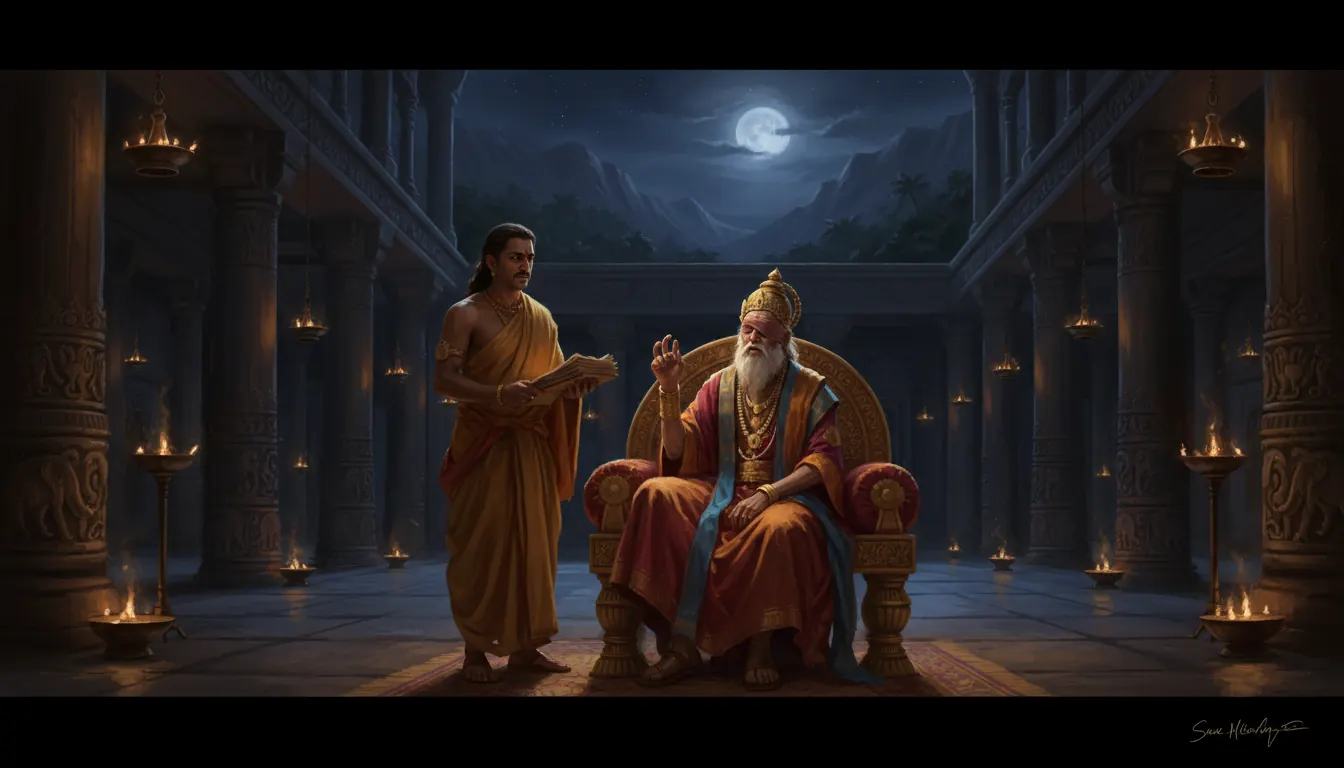
The Blind King Counts the Odds
A father adds up his enemies and hears whose fault it was
In short
Vyasa brings word to Hastinapura that Arjuna is living in Indra's house gathering celestial weapons, and Dhritarashtra begins reckoning aloud with Sanjaya. The thunderbolt leaves part of a mountain standing, he says, but Arjuna's arrows leave nothing; Karna is careless and Drona is old. Sanjaya answers without softening it: the king could have stopped his son and chose affection instead.
Told in the Vana ParvaSet in Hastinapura, Kamyaka Forest and Indraprastha16 min read
What Did the Old King Say?
"Those feats of Pritha's son were certainly marvellous," said Janamejaya, breaking in on the recitation. "He fought Sthanu himself in the guise of a hunter and was embraced for it. He went up to heaven in Indra's own chariot with Matali holding the reins. He sat on half the throne of the king of the gods. Brahmana, what did the wise Dhritarashtra say when he heard of that?"
"He heard it from Dvaipayana," said Vaishampayana. "Vyasa came to Hastinapura and told him plainly where Arjuna was living and what he was there to get. And when the sage had gone, the son of Ambika sent for his charioteer."
The hall at Hastinapura was not full. It was the hour when a king who cannot see sits with one man and asks him what the room looks like.
Arjuna had only lately gone up to heaven. Since the exile began the court had learned to speak of the exiles the way one speaks of a debt that is not yet due: rarely, and in the passive voice. Duryodhana had the revenues of two kingdoms and had grown easy in them. Karna went about being praised. Shakuni had gone quiet, as gamblers do when the throw has landed. Only two men in Hastinapura still did arithmetic about the forest, and one of them was blind.
"Charioteer," said Dhritarashtra, "do you know in detail the deeds of the clever Arjuna, which I have just heard from beginning to end?"
"I know them, king."
"Then sit," said the king, "and let us count."
Sanjaya sat. He had done this before, on other evenings, and he knew the shape of what was coming: the old man would lay out the whole disaster in order, name every piece of it correctly, arrive at the right conclusion, and then do nothing. It was the most reliable thing in the kingdom.
The Thunderbolt Leaves a Portion Standing
"My wretched and sinful son is even now following a policy of the basest kind," the king began. "Wicked as he is, he will surely empty the earth of people. And on the other side there is a man whose words are true even when he speaks in jest, and that man has Dhananjaya to fight for him. He is sure to win the three worlds. Who is so far beyond death and decay that he could stand before Arjuna when he scatters his barbed, sharp arrows whetted on stone? My sons, who must fight the invincible Pandavas, are doomed, every one of them.
"I think about it day and night, Sanjaya, and I do not see a warrior among us who can hold his ground in battle before the wielder of the Gandiva."
He was silent a moment, and then he said the sentence that Sanjaya remembered afterwards for the rest of his life, because it was said quietly, like a man reading out a measurement.
"The thunderbolt, falling on a mountain top, leaves a portion of it standing. But the arrows Kiritin shoots leave nothing at all behind. As the rays of the sun heat this universe of moving and unmoving things, so will the arrows from Arjuna's hands scorch my sons.
"It seems to me that the divisions of the Bharatas, terrified at the mere clatter of his chariot wheels, are already broken in every direction. Vidhatri has made Arjuna an all-consuming Destroyer. He stands against us in battle, pouring out swarms of arrows. Who will defeat him?"
Kind, Old, and Not Enough
Then the blind king audited his own army out loud, which no herald would have dared to do in that hall in daylight.
"If Drona, or Karna, or even Bhishma goes out against him in battle, a great calamity is likely to fall on the earth. But even then I do not see how we can succeed."
He held up one finger at a time, as if there were three counters on the arm of his chair.
"Karna is careless and negligent. Drona is old, and he is the boy's teacher besides. Arjuna is fierce in anger, and strong, and proud, and his prowess is firm and steady. All of them are invincible, so a terrible fight will take place between them, for all of them are heroes skilled in weapons and of great renown.
"And note this, charioteer, for it is the worst of it. Not one of them would want to rule the world if the price were defeat. Peace will come only with the death of these men, or of Phalguna. And the man who can kill Arjuna does not exist, nor does anyone who can defeat him."
"Then the king already knows the sum," said Sanjaya.
"The king knows the sum." Dhritarashtra put his hand flat on the arm of the chair. "Oh, how can that anger of his be calmed, when I am the one it is aimed at? Equal to the chief of the gods, he satisfied Agni at Khandava. He defeated all the kings of the earth at the time of the great Rajasuya. And now he is in the house of the king of the gods, learning what a mortal is not meant to learn. You have heard me call Karna careless. It is the report of a man weighing a shield and finding it thin."
Sanjaya Declines to Soften It
"Everything you have said about Duryodhana, king, is true," said Sanjaya. "Nothing you have said, lord of the earth, is untrue.
"The Pandavas, whose energy has no measure, were filled with rage at the sight of Krishna, their wedded wife of spotless name, brought into the middle of the assembly. And when they heard those cruel words of Dushasana and Karna, king, they were so enraged that they will not forgive the Kurus for my sake or for anyone's.
"I have heard how Arjuna pleased the god of gods, Sthanu of eleven forms, in battle with his bow. The illustrious lord of all the gods, wishing to test Phalguna, fought him disguised as a Kirata. And it was there that the guardians of the worlds showed themselves to that bull of the Kuru race in their own forms, to give him their weapons. What other man on earth would even try to see those gods as they are? And who will weaken in battle a man whom Maheshvara himself could not weaken?
"Your sons dragged Draupadi, and by that they enraged the sons of Pandu and brought this frightful calamity on themselves. When Duryodhana bared his thigh and showed it to her, Bhima said, with lips that would not stay still, 'Wretch, when thirteen years are over I will smash those thighs of yours with the fierce downward stroke of my mace.' All the sons of Pandu are the finest of fighters. All of them have boundless energy. All of them know every kind of weapon, and so even the gods cannot defeat them. Enraged by the insult to their wedded wife and driven by anger, they will kill every one of your sons in battle."
The King Blames the Right People
"What harm Karna did the sons of Pandu by speaking those cruel words," said Dhritarashtra. "Was the enmity stirred up by bringing Krishna into the assembly not enough? How can my wicked sons survive, when their eldest brother and guide does not walk the path of righteousness?
"Because I am blind and cannot act for myself, my wretched son thinks me a fool, charioteer, and does not listen to me. And those wretches who advise him, Karna and Subala's son and the rest, always pander to his vices, since he cannot understand things rightly.
"The arrows that Arjuna of boundless prowess might shoot without effort could destroy all my sons, let alone those he will shoot in anger. The arrows driven by the might of his arms, shot from that great bow and charged with mantras that turn them into celestial weapons, can punish the gods themselves.
"And there is worse than his arms. A man whose counsellor and protector and friend is the scourge of sinful men, the lord of the three worlds, Hari himself, meets nothing he cannot conquer. This is the most marvellous thing about Arjuna, that, as we have heard, he has been clasped by Mahadeva in his arms. And what Phalguna did long ago with Damodara's help, helping Agni burn the Khandava forest, the whole world saw. When Bhima and Partha and Vasudeva of the Satvata race are enraged together, my sons, with their friends and the sons of Subala, are no match for them."
He had now named, in order and without error, every element of his own destruction. Then he called for lamps to be lit, which he did not need, and the evening ended as those evenings always ended, with nothing done.
What Did They Eat?
"After sending the heroic sons of Pandu into exile," said Janamejaya, "Dhritarashtra lamented to no purpose at all. Why did the king allow his foolish son Duryodhana to enrage those mighty warriors so? And tell me this, brahmana, for I have wanted to ask it: what did the sons of Pandu eat while they lived in the woods? Food from the wild, or food grown in fields?"
"Of the wilderness," said Vaishampayana, "and it fed more mouths than you would think.
"Those bulls among men gathered what grew wild and killed deer with pure arrows, and they first set aside a portion of the food for the brahmanas and then ate the rest themselves. For while those heroes lived in the woods they were followed by brahmanas of both classes, those who worship with fire and those who worship without it, and there were ten thousand illustrious Snataka brahmanas, all versed in the means of salvation, whom Yudhishthira supported in the forest. Killing rurus and black deer and other clean animals of the wilderness, he gave the meat to them.
"And no one who lived with Yudhishthira looked pale, or ill, or was lean or weak, or was melancholy or terrified. The chief of the Kurus looked after his brothers as if they were his sons, and his relatives as if they were brothers born of his own mother. And Draupadi of spotless name fed her husbands and the brahmanas as if she were their mother, and ate her own food last of all.
"The king himself hunted toward the east, and Bhima toward the south, and the twins toward the west and the north, and each of them killed the deer of the forest every day with the bow in his hand, for meat. In this way the Pandavas lived five years in the woods of Kamyaka, anxious at Arjuna's absence, and busy all the while with study and prayers and sacrifices."
Not a Moment's Peace
That way of life, so far above the way of men, was reported to Hastinapura as everything was reported to Hastinapura, and when the son of Ambika had heard it he was filled with anxiety and grief. He sighed hot and long, and sent again for his charioteer.
"I do not have a moment's peace, Sanjaya, by day or by night. I think of the terrible wrongdoing of my sons that came out of that gambling, and I think of the heroism of the sons of Pandu, and their patience, and their great intelligence, and their unbearable prowess, and the extraordinary love they have for one another.
"Think only of the two youngest. Nakula and Sahadeva, born of gods, equal in splendour to the chief of the gods himself, are invincible in battle. They are steady with their weapons. They shoot from far off. They are resolute, remarkably quick of hand, slow to give up their anger, very steady and full of energy. With the prowess of lions, as hard to withstand as the Ashvins themselves, they will come onto the field with Bhima and Arjuna in front of them, and I see, Sanjaya, that my soldiers will all be killed, every last one.
"Add to them the mighty warriors of the Vrishnis, and the Panchalas of great energy, and the sons of Pritha themselves, led by Vasudeva, whose prowess is never checked. All the warriors on my side together cannot withstand the charge of the Vrishnis alone, when the Vrishnis are led by Rama and Krishna. And among them will move Bhima of terrible prowess, his iron mace held high, able to kill any hero. And high above the din will be heard the twang of the Gandiva, loud as the thunder of heaven.
"It is then, Sanjaya, after all my obedience to Duryodhana's voice, that I will have to remember the advice of my friends that I rejected. Advice I should have listened to in time."
This Has Been Your Great Fault
"This has been your great fault, king," said Sanjaya, "that though you could have done it, out of affection you did not stop your son from doing what he has done."
He said it without raising his voice and without any of the ornament a courtier uses to take the edge off a thing, and then he went straight on, because the king had asked for the report of the spies and the report was ready.
"When the slayer of Madhu heard that the Pandavas had been defeated at dice, he went to the woods of Kamyaka and comforted them there. Draupadi's sons came, headed by Dhrishtadyumna, and Virata came, and Dhrishtaketu, and the Kekayas, all of them mighty warriors. When Krishna met the Pandavas they asked him to become the charioteer of Phalguna in battle, and Hari, so requested, answered them, 'So be it.'
"And when Krishna saw the sons of Pritha dressed in deerskins, he was filled with rage, and said to Yudhishthira: 'The prosperity you won at Indraprastha, which no other king could win, which I saw with my own eyes at the Rajasuya, where the rulers of the Vangas and the Angas and the Paundras and the Cholas and the Dravidas, and the kings of the west by the hundred, and the Kiratas and the Yavanas and the men of Kashmira all came at your invitation and stood ready to serve, that prosperity, so unstable, now belongs to your enemy. I will give it back to you, and take that enemy's very life. With Rama and Bhima and Arjuna and the twins, and Akrura and Gada and Samba and Pradyumna and Ahuka and Dhrishtadyumna, I will kill in a single day Duryodhana and Karna and Dushasana and the son of Subala and all who fight beside them, and you will live at Hastinapura and rule this earth.'
"And Yudhishthira answered him, before all those heroes: 'Janardana, I accept these words of yours as true. But kill my enemies when the thirteen years are over. Promise me that truly, Keshava. I promised before the king to live in the forest, and I am living in it.'"
As Vidura Told Me Long Ago
"And there was more said in that camp," Sanjaya went on. "They spoke to Draupadi of pure deeds, in the hearing of Vasudeva himself. 'Lady, because of your anger Duryodhana will lay down his life. We promise it. So grieve no more. Those who mocked you when they saw you won at dice will reap the fruit of what they did. Beasts of prey and birds will eat their flesh, and jackals and vultures will drink their blood. You will see the bodies of those wretches who dragged you by the hair lying flat on the earth. Those who hurt you and scorned you will lie on the ground without their heads, and the earth herself will drink their blood.'
"These speeches and others like them were made there, king, by those bulls of the Bharata race, and all of them are full of energy and courage and bear the scars of battle. When the thirteenth year is over, those warriors, chosen by Yudhishthira and led by Vasudeva, will come to the field. Rama and Krishna and Dhananjaya, Pradyumna and Samba and Yuyudhana, Bhima and the sons of Madri, the Kekaya princes and the Panchala princes, accompanied by the king of the Matsyas, all of them illustrious and famous and invincible, will come with their followers and their troops. Who that wants to live will face them in battle, when they are like angry lions with their manes on end?"
The king did not answer that for a long time. When he did, he was not talking to Sanjaya at all.
"What Vidura told me at the time of the game of dice," he said. "'King, if you try to defeat the Pandavas at dice, the result will certainly be terrible bloodshed, ending in the destruction of all the Kurus.' I think it is about to come true. As Vidura told me long ago, a terrible battle will surely take place as soon as the Pandavas' pledged term is over."
And that, said Vaishampayana to the king at the sacrifice, is what Dhritarashtra of great wisdom said when he heard of the feats of Pritha's son. He said all of it correctly. He was the only man in the kingdom with the authority to act on any of it, and he sat in his chair and named the disaster to a charioteer, year after year, until it arrived.
Dharma Lesson
Dhritarashtra names every part of the coming ruin accurately and in order, and does nothing about any of it. A man who can describe the disaster in that much detail has not lacked knowledge; he has lacked will, and no counsellor can supply that for another man. Sanjaya's answer is the whole of the matter: you were able to stop your son, and from affection you did not.