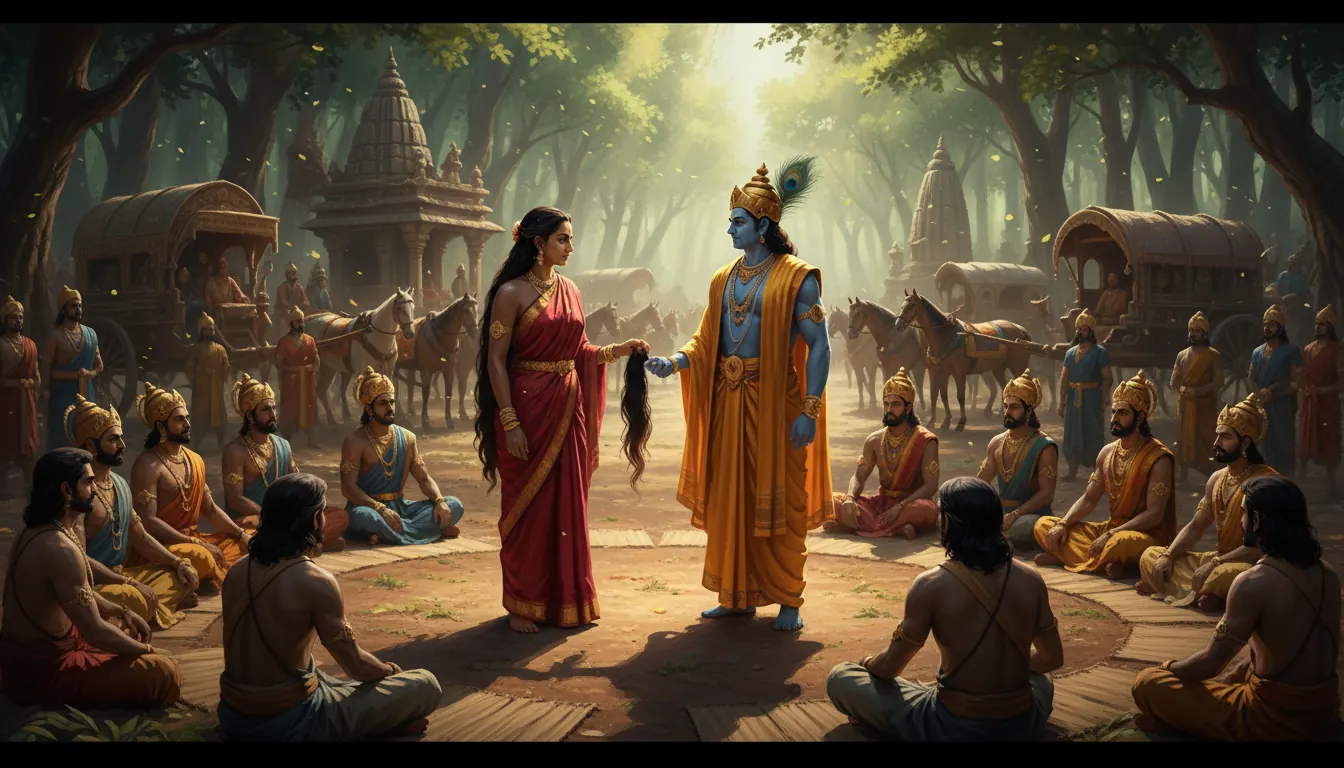
The Promise Made in the Kamyaka Woods
The allies arrive, and Draupadi asks Krishna what her friendship is worth
In short
The Vrishnis, Bhojas, Andhakas, Panchalas and Kaikeyas ride into Kamyaka to find the exiles, and Krishna opens with an oath that the earth will drink the blood of four men. Arjuna calms him by reciting his former lives. Then Draupadi comes forward, reads out the whole ledger of the house from the poison to the hand in her hair, and asks why five husbands and one friend all sat still.
Told in the Vana ParvaSet in Kamyaka Forest, Hastinapura and Dwaraka16 min read
The Road Into the Woods
"When word went out that the sons of Pandu had been banished," said Vaishampayana to Janamejaya, "the men who loved them did not wait to be sent for. They came."
The Bhojas came, and the Vrishnis, and the Andhakas, riding down into the great forest to find the heroes living in affliction there. The blood relations of Panchala came. Dhrishtaketu, king of Chedi, came. The Kaikeya brothers came, those celebrated and powerful men, and their hearts were on fire as they rode.
They found the camp at Kamyaka and they hardly recognized it. Bark instead of silk. Cooking done in the open on a fire of gathered wood. The queen of Indraprastha carrying water like any woman of a hermitage.
The visitors reproached the sons of Dhritarashtra aloud, in language that would have started a war if any Kaurava had been standing there to hear it, and then they turned to the only man whose answer mattered and asked the plain question.
"What should we do?"
They sat down in a ring around Yudhishthira the just, those bulls of the kshatriya race, and at their head sat Vasudeva. He greeted that greatest of the Kurus with full respect, as a guest should. Then he lifted his head, and what came out of him was not condolence.
The Earth Will Drink
"The earth will drink the blood of Duryodhana and Karna," Keshava said, "of Dushasana and the wicked Shakuni."
He said it mournfully, which was somehow worse than saying it in rage. He was not making a threat. He was describing a thing he had already decided upon and was now merely reporting.
"We will kill these four in battle. We will break their followers and their royal allies along with them. And then we will place Yudhishthira the just on the throne. The wicked deserve to be slain. This is not my temper speaking. This is eternal morality."
The circle of kings did not move. There was a quality to Janardana in that moment that even men who had fought beside him for twenty years had rarely seen and never wished to see twice. He had got into a passion on account of the wrongs done to Pritha's sons, and he seemed, sitting there on the forest floor among the leaves, like something that had begun to consider consuming all created things and was still weighing whether to stop.
One man in that assembly moved. Arjuna rose from where he sat and came and stood in front of his friend, and he did not argue and he did not soothe. He began, in the voice men use for scripture, to recite to Krishna the deeds of Krishna's own former lives.
It was the only thing anyone present could have done. You do not calm the fire by talking about the house. You remind the fire what it is.
Ten Thousand Years on Gandhamadana
"Long ago, Krishna," said Falguna, "you wandered on the Gandhamadana mountains for ten thousand years as a muni who made his home wherever the evening found him.
"Living on water alone, you stayed eleven thousand years by the lake of Pushkara. With your arms raised and standing on one leg you spent a hundred years on the high hills of Badari, living all that while on air. You laid aside your upper garment and let your body waste until you looked like a bundle of veins, and so you lived on the banks of the Saraswati, engaged in a sacrifice that ran for twelve years. And keeping your vow you stood on one leg for a thousand years of the gods on the plains of Prabhasa, which the virtuous should visit.
"Vyasa has told me that you are the cause of the creation and of its course. You are the lord of Kshetra, the mover of all minds, the beginning and the end of all things. All asceticism rests in you. You are the embodiment of all sacrifices, and the eternal one."
Krishna did not stop him. The kings sat and listened, and the fire in the middle of them settled a little, the way a fire settles when someone puts a hand on the ground beside it.
"You floated on the primordial waters," Arjuna went on, "and afterwards became Hari, and Brahma, and Surya, and Dharma, and Dhatri, and Yama, and Anala, and Vasu, and Vaishravana, and Rudra, and Kala, and the sky, and the earth, and the ten directions. Yourself uncreated, you are the lord of the moving and the unmoving universe."
The Count of the Deeds
"You killed the asura Naraka, the first-born son of the Earth," Arjuna said, "and took his earrings, and performed the first horse sacrifice, offering up that asura himself as the sacrificial horse. You killed the daityas and the danavas gathered for battle, and after giving the lord of Shachi the sovereignty of the universe, you took birth among men.
"Even as a child you filled heaven, the sky and the earth with only three steps, and dwelt in the body of the sun and overpowered him with your own splendour. You destroyed the Mauravas and the Pashas and killed Nisunda, and so made the road to Pragjyotisha safe again. You killed Ahvriti at Jaruthi, and Kratha, and Shishupala with all his followers, and Jarasandha, and Saivya, and Shatadhanva. In a chariot that roared like the clouds and shone like the sun you defeated Rukmi in battle and carried off the daughter of Bhoja for your queen. You killed Indradyumna, and the Yavana called Kaseruman. You killed Shalva the lord of Saubha, and then you destroyed the city of Saubha itself. At Iravati you killed the king of the Bhojas who was the equal of Kartavirya, and Gopati and Talaketu are dead by your hand too.
"You have made the sacred city of Dwaraka your own, rich and pleasing even to the rishis, and at the end you will sink it in the ocean.
"How can there be crookedness in you, Dasharha, who are without anger and without envy and without untruth and without cruelty? At the beginning of the Yuga, Brahma sprang from your lotus navel. When the dreadful danavas Madhu and Kaitava set out to kill him, you grew angry, and from your forehead sprang Shambhu the holder of the trident. Two of the greatest of the gods came out of your body to do your work. It was Narada who told me this."
And having said it, the illustrious Pandava, who was the soul of Krishna, went silent.
Nara and Narayana
Janardana answered him in front of them all.
"You are mine and I am yours, and all that is mine is yours too. He who hates you hates me as well, and he who follows you follows me. Unconquerable one, you are Nara and I am Narayana, or Hari. We are the rishis Nara and Narayana, born in the world of men for a particular purpose. You are from me and I am from you. No one can understand the difference between us."
That was the answer, and it was also the retraction of nothing. The anger had not been talked out of him. It had been given a shape and a name and set down in its place, and the kings sitting in that ring understood that they had just watched a thing be aimed.
So the assembly of brave men sat in the Kamyaka wood, all of them excited with anger, and it seemed for a moment that the matter had been settled between the two friends and was closed.
Then a woman came through the ring and stood in front of Krishna.
Panchali came surrounded by Dhrishtadyumna and her other heroic brothers, and she walked up to him of eyes like lotus leaves where he sat among his cousins, and she was not there to be comforted. She had listened to the whole of it, the oath and the hymn and the answer, and she had noticed what everyone else in that clearing had somehow failed to notice: that a great deal had been said about what Krishna was, and nothing at all about what he had not done.
What the Sages Call You
She began the way he had just been addressed, and every man there heard the edge under it.
"Asita and Devala have said that in the creation of all things you are named as the only Prajapati and the Creator of the worlds. Jamadagnya says that you are Vishnu, and that you are the sacrifice, the sacrificer, and he for whom the sacrifice is performed. The rishis call you Forgiveness and Truth. Kashyapa has said that you are Sacrifice sprung from Truth. Narada calls you the god of the Sadhyas and of the Shivas, the Creator and the Lord of all.
"And you play with the gods, with Brahma and Shankara and Shakra, as children play with their toys. The sky is covered by your head and the earth by your feet. These worlds are your womb. The rulers of the several worlds, the worlds themselves, the conjunctions of the stars, the ten points of the horizon, the moon and the sun, all rest in you."
Then she stopped, and changed her voice, and the change was terrible.
"That is why, slayer of Madhu, being what you are, and moved by the affection you bear me, you will now hear my griefs.
"How could one like me, the wife of Pritha's sons, the sister of Dhrishtadyumna, and your friend, be dragged into an assembly? During my season, stained with blood, with a single cloth on me, trembling all over and weeping, I was dragged into the court of the Kurus. And the wicked sons of Dhritarashtra looked at me standing there in my blood in the presence of those kings, and they laughed.
"While the sons of Pandu lived, and the Panchalas lived, and the Vrishnis lived, those men dared to say aloud that they wanted to use me as their slave. By the law I am the daughter-in-law of both Dhritarashtra and Bhishma. And they wanted to make a slave of me by force."
Shame on the Gandiva
"I blame the Pandavas," she said, "who are mighty and the best in battle, because they saw their own wedded wife, known all over the world, treated with such cruelty, and did not stir.
"Shame on the might of Bhimasena. Shame on the Gandiva of Arjuna. Both of them let little men disgrace me.
"This is the eternal course of morality, always followed by the virtuous: that the husband, however weak he is, protects his wedded wife. By protecting his wife a man protects his offspring, and by protecting his offspring he protects his own self. A man's own self is born of his wife, and that is why the wife is called Jaya. And the wife protects her husband in return, remembering that he must be born again in her womb.
"The Pandavas never abandon anyone who asks them for protection. They abandoned me, who asked.
"By my five husbands five sons have been born to me, of energy that cannot be checked: Prativindhya by Yudhishthira, Sutasoma by Vrikodara, Shrutakirti by Arjuna, Satanika by Nakula, and Shrutakarma by the youngest. They are mighty warriors, the best of bowmen, invincible by any foe, the equals of your own Pradyumna. For their sake, if for nothing else, I should have been protected.
"Why do these men bear the wrongs done to me by the sons of Dhritarashtra, whose strength is so contemptible? Robbed of their kingdom by deceit, the Pandavas were made bondsmen, and I was dragged into the assembly in my season with one cloth on. Shame on that Gandiva which no one can string but Arjuna and Bhima and yourself. Shame on the strength of Bhima and shame on the prowess of Arjuna, since Duryodhana, after what he did, has drawn breath even for a moment."
The Ledger of the House
Then she opened the account and read it out, item by item, in front of the assembled kings of the Vrishnis and the Panchalas, and nobody interrupted her.
"It was he who drove the guileless Pandavas and their mother out of the kingdom when they were still children, busy with their studies and their vows.
"It was that sinful wretch who mixed fresh and deadly poison, in full dose, into Bhima's food. Bhima digested the poison along with the meal and came to no harm, because his days had not yet run out.
"It was Duryodhana who, at the house standing by the banyan tree called Pramana, bound Bhima while he slept unsuspecting, threw him into the Ganges, and went back to the city. Bhima woke in the water, tore his bonds, and rose.
"It was Duryodhana who had deadly black cobras bite him all over his body, and that slayer of foes did not die. The son of Kunti woke, smashed the snakes, and with his left hand killed the man who had brought them, Duryodhana's own favourite charioteer.
"And it was he who set fire to the house at Varanavata while the children slept in it with their mother, intending to burn them to death. Who else could do such a thing?
"The illustrious Kunti, surrounded by the flames, cried out to the children, 'Alas, I am lost. How will we escape from this fire today? I will die, and my little children with me.' And Bhima comforted his mother and his brothers, saying, 'Like Garuda the son of Vinata, king of birds, I will spring up into the air. We have nothing to fear from this fire.' He took his mother on his left side and the king on his right, a twin on each shoulder and Bibhatsu on his back, and cleared the fire at one leap with all of them."
Seized by the Hair
"They went out that night with their famous mother and came near the forest of Hidimba," she said, "and while they slept a rakshasa woman came and took Bhima's feet into her lap to press them, and warned them to flee because her brother was coming to kill them, and Bhima said, 'I do not fear him. If he comes here, I will kill him.' And he did, after long fighting, and they took the sister with them, of whom Ghatotkacha was afterwards born.
"Then, with Vyasa for their counsellor, they went to Ekachakra, and there they killed another cannibal as terrible as the first. And from there they came to the capital of Drupada, and there, slayer of Madhu, as you won Rukmini the daughter of Bhishmaka, so Savyasachin won me. He won me at the swayamvara by a feat no other man could perform, and he fought the assembled kings for me.
"And this is how I live now, tormented by these griefs, with Dhaumya at our head and without the company of the revered Kunti. Why do these men, with all their strength and their lion's courage, sit by unmoved while enemies so despicable torment me? Am I to burn in this grief for so long, at the hands of evil-doers of such small strength?
"I was born of a great race. I came into the world in an extraordinary way. I am the beloved wife of the Pandavas and the daughter-in-law of the illustrious Pandu. I am the best of women and devoted to my husbands. And I was seized by the hair, in the sight of the Pandavas, each of whom is like Indra himself."
Then the mild-speeched Krishnaa hid her face in her soft hands, which were like the buds of lotuses, and wept. When she had wiped her eyes she spoke again, sighing between the words, in a choked voice and in anger.
"Husbands I have none. Nor sons, nor friends, nor brothers, nor father. Nor have I you, slayer of Madhu, for all of you see me treated so cruelly by lesser foes and sit still and unmoved. My grief at Karna's ridicule cannot be soothed. On four grounds I deserve your protection always: our relationship, your respect for me, our friendship, and your lordship over me."
The Heavens Might Fall
In that assembly of heroes Vasudeva spoke to the weeping Draupadi, and he did not begin with sympathy.
"The wives of the men you are angry with will weep just as you are weeping now, fair lady, when they see their husbands dead on the ground, weltering in blood, their bodies covered with the arrows of Bibhatsu.
"Weep no more. I will do everything in my power for the sons of Pandu. I promise you that you will be the queen of kings again.
"The heavens might fall. Himavat might split. The earth might be torn open, or the waters of the ocean dry up. My words will never be in vain."
Draupadi heard it, and then she looked sideways at her third husband, because a promise is worth what the men standing beside it are worth.
"You of the beautiful copper-coloured eyes," Arjuna said, "do not grieve. It will be exactly as the slayer of Madhu has said. It can never be otherwise."
And then her brother stood up and did the last thing that was needed, which was to turn a vow into a list of assignments.
"I will kill Drona," said Dhrishtadyumna. "Shikhandi will kill the grandfather. Bhimasena will kill Duryodhana, and Dhananjaya will kill Karna. With Rama and Krishna to help us, sister, not even the slayer of Vritra himself can defeat us in battle. What then are the sons of Dhritarashtra?"
The forest was very quiet after that. Every hero in the circle turned his face toward Vasudeva, waiting for him to speak again, and the twelve years that still had to be endured had acquired, in a single afternoon, a shape and a purpose and a set of names at the end of it.
Dharma Lesson
A promise made to the powerless in the hour they are least able to enforce it is the only kind worth measuring a friend by. Krishna does not tell Draupadi her grief is excessive, and he does not tell her to wait quietly; he tells her exactly what will be done and puts his own word at risk on it. The oath costs him nothing on the day he swears it, which is precisely why she is right to hold him to it for thirteen years.