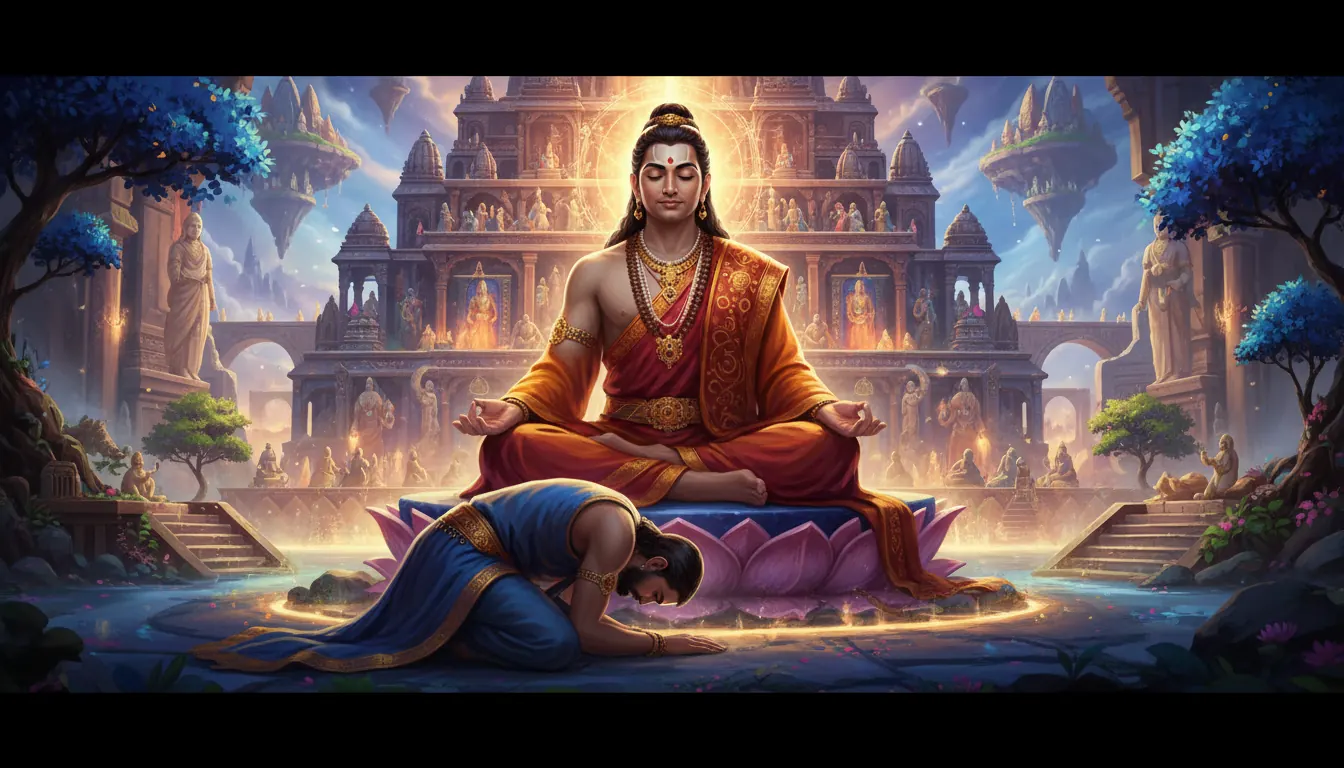
Does Consciousness Survive
Yudhishthira asks whether anyone is left awake in the emancipated state, and Bhishma answers out of the Sankhya of Kapila
In short
Having finished with Yoga, Bhishma sets out the Sankhya system for Yudhishthira: the inventory of all that beings desire, the ladder of refuges that ends in an Emancipation which leans on nothing, the five faults of the body and their remedies, and the ocean of life charted item by item. He then describes the ascent by which the Sankhyas are carried up through the Sun, the wind, Rajas and Sattwa to Narayana. Yudhishthira objects that the scriptures contradict one another about whether consciousness remains at the end, and points out that a dreamless sleeper has not lost his consciousness either. Bhishma calls the question proper, and answers it with the senses, the sleeping man, and what is handed back at the appointed season.
Told in the Shanti ParvaSet in Kurukshetra and Vaitarani21 min read
The Other Road
Bhishma had just finished with Yoga. He had given the king the diets and the fasts, the five faults that a Yogin cuts away, the fishes that break the net and the fishes that do not, the small fire that large logs put out and the same fire grown strong enough to scorch the universe like the sun that rises at the dissolution of the world. Then he stopped, and the field was quiet around the bed of arrows, and Yudhishthira asked for the other road.
"King, you have set out for me properly, as it should be done, the path of Yoga that the wise approve, as a loving teacher does for his pupil," he said. "I ask now about the principles of the Sankhya philosophy. Explain those principles to me in full. Whatever knowledge exists in the three worlds is known to you."
The two systems had already been weighed against each other on that field. Bhishma had said that he approved of both, that purity and compassion and the observance of vows are laid down in both alike, and that only the scriptures which point out their paths are different. Yoga puts its evidence in front of the senses. Sankhya rests on the books. A man may take whichever suits him, and neither is a wrong turning.
But Yudhishthira wanted the second one counted out to him from the beginning, and Bhishma gave it to him.
"Listen now to the subtle principles of the followers of the Sankhya doctrine," he said, "which were established by all the great and mighty Yatis, with Kapila first among them. In that doctrine, chief of men, no errors can be found. Its merits are many. In fact, there is no fault in it."
Kapila is the founder of the system and the first of the Yatis who taught it, and Bhishma names him and then does not tell a story about him. What follows is not a life. It is an inventory of everything the Sankhyas have looked at, and it is delivered as one long sentence that will not stop until the man who hears it has been made to look at the same things.
The Inventory of Everything That Wants
It begins with desire, and with the size of the company that shares it.
The objects of this world are hard to give up, and the Sankhya begins by understanding that they are flawed, and then by noticing who is busy with them. Human beings are caught up with those objects. So are pishachas and rakshasas and yakshas. So are snakes and gandharvas and the pitris. So are the creatures wandering in the lower orders, the birds and the animals, and the great birds such as Garuda. So are the Maruts, and royal sages, and twice-born sages, and asuras, and the Viswedevas, and the celestial rishis, and Yogins of supreme power, and the Prajapatis, and Brahman himself.
That is the list, and the shock of it is at the end. There is no rank of being in the three worlds that has been let off. The demon in the burning ground and the rishi in the sky are shown occupied with the same business, and the difference between them is a difference of scale and not of kind.
Having seen that much, the Sankhya then learns the limit of a man's span of life here, and what people mean when they call anything happiness, and what sorrows overtake, when the hour comes, all those who have anything to do with passing things. He learns the grief of those who have fallen into the lower orders and of those who have sunk into hell. He looks at heaven and sees its merits and also its faults. He looks at the declarations of the Vedas and marks the excellences that belong to them and the flaws that go with them as well. He recognises the faults and the merits of Yoga and of his own Sankhya both.
Then the counting begins. The quality of Sattwa has ten properties. Rajas has nine. Tamas has eight. The Understanding has seven, Space has six, and the Mind has five. Then he conceives it again from the other end, and the Understanding has four, Tamas has three, Rajas has two, and Sattwa has one.
Knowing all this, and knowing the road that every object takes when destruction comes for it, the Sankhyas attain the felicity of Emancipation as the rays of the Sun attain it, or the Wind taking refuge in Space.
The Ladder of Refuges
Then Bhishma set out the order in which things lean on one another, because a man who wants to climb out of the world had better know what the world is stacked on.
Vision is attached to form. The sense of scent is attached to smell, the ear to sound, the tongue to juices, and the skin to touch. Nothing perceives on its own account. Each of the five is fastened to the thing it was made for and cannot let go of it.
Above them the same rule holds, and the rungs are named one after another. The wind has Space for its refuge. Stupefaction has Tamas, which is Darkness, for its refuge. Cupidity has the objects of the senses for its refuge. Vishnu is attached to the organs of motion and Shakra to the organs of strength, so that the god of striding stands in a man's legs and the god of the thunderbolt in his arms. The deity of fire is attached to the stomach, which is where a man burns what he eats. Earth is attached to the Waters. The Waters have Heat for their refuge. Heat attaches itself to the Wind, and the Wind has Space for its refuge, and Space has Mahat, and Mahat has the Understanding for its foundation.
Now the ladder turns, because from here it climbs through the qualities themselves. The Understanding has its refuge in Tamas. Tamas has Rajas for its refuge. Rajas is founded upon Sattwa. And Sattwa is attached to the Soul.
The Soul has the glorious and mighty Narayana for its refuge.
That glorious deity has Emancipation for his refuge.
And Emancipation is independent of all refuge.
That last line is where the whole ladder is going. Everything below it is held up by something else, from the eye that cannot let go of a shape to the god who is the Soul of the universe, and at the top there is one thing that leans on nothing and is leaned on by everything, and it has no name of its own except freedom.
Everything Worth Watching Come Apart
The rest of the looking is grimmer, and Bhishma did not soften it for a man lying in the ashes of his own victory.
The Sankhya knows this body, with its sixteen possessions, to be a product of Sattwa. He knows the physical organism and the character of the Chetana that lives inside it. He recognises the one existent Being that dwells in the body, the Soul, which stands apart from every concern of the body and to which no sin can cling. He knows the seven vital breaths and the seven functions appointed for them, Prana and Apana and Samana and Vyana and Udana, and the two others, the one that goes downward and the one that moves upward.
Then he watches. He learns of the Prajapatis and the rishis and the many high paths of righteousness, of the seven rishis and the countless royal rishis and the great celestial rishis with the radiance of the Sun on them, and he sees all of these fall from their power in the course of long ages. He hears of the destruction of even the mightiest beings in the universe. He learns the end that creatures of sinful acts come to, and the miseries suffered by those who fall into the river Vaitarani in the realms of Yama, and the wanderings of creatures through one womb after another.
He is not spared the account of where he came from. Residence in the unholy uterus in the midst of blood and water and phlegm and urine and faeces, all of foul smell. Then a body made of blood and vital seed, of marrow and sinews, with hundreds of nerves and arteries running through it, an impure mansion of nine doors.
He sees the swallowing up of the Moon and the Sun by Rahu, and stars falling out of their fixed places, and constellations wandering from their orbits. He sees united objects separated, and creatures devouring one another, and infants without intelligence, and bodies deteriorating and breaking. He sees the waxing and waning of the Moon and the rising and ebbing of the seas, the loss of wealth and the getting of it again, the lapse of the Yugas, mountains destroyed, rivers dried up.
And among thousands of human beings he sees one who has resolved to struggle for Emancipation.
Five Faults in the Body
"You of boundless energy," Yudhishthira said, "what are the faults you see attached to the body? Please resolve this doubt for me fully and truly."
"Listen, slayer of foes," said Bhishma. "The Sankhyas, the followers of Kapila, who know all paths and are wise, say that there are five faults in the human body. They are Desire and Anger and Fear and Sleep and Breath. These faults are seen in the bodies of all embodied creatures."
Five, and every one of them is ordinary. There is nothing here about impiety or heresy or the neglect of rites. Four of the five are things a man does without deciding to, and the fifth is breathing.
Then the remedies, one to each, and they are as plain as the faults.
The wise cut the root of anger with Forgiveness. Desire is cut off by giving up all purposes, which is to say by wanting nothing further and not merely by wanting the present thing less. Sleep is conquered by cultivating the quality of Goodness. Fear is conquered by cultivating Watchfulness. And Breath is conquered by a sparing diet, because a man who eats less breathes less, and the Yogin who lives on powdered barley is working on the last of the five faults at every meal.
Having cut them, the Sankhya turns and looks at the world once more, and by now he understands gunas by the aid of hundreds of gunas and faults by hundreds of faults and causes by hundreds of causes. What he sees then is put down in a run of images that do not flatter it.
The world is like the froth of water. It is enveloped by hundreds of illusions flowing from Vishnu. It is like a painted edifice, and as unsubstantial as a reed. It is as terrible as a dark pit. It is as unreal as bubbles, for the years that make up its age are as short-lived, set against eternity, as bubbles are. It is exposed to immediate destruction, bereft of happiness, with certain ruin for its end and no escape from that end. It is sunk in Rajas and Tamas and utterly helpless, like an elephant sunk in mire.
Noting all this, the Sankhyas cast off even the affections that arise from a man's relation to his own children.
The Ocean With Sorrow For Its Water
With the weapon of knowledge and the bludgeon of penances, said Bhishma, these Yatis cut away every scent born of Rajas and every scent born of Tamas and every auspicious scent arising from Sattwa as well, and all the pleasures of the touch that inhere in the body, and then they cross the Ocean of life.
And then he described the ocean, piece by piece, until nothing in a man's life had been left off the chart.
Sorrow is its water. Anxiety and grief are its deep lakes. Disease and death are the gigantic alligators in it, and the great fears that strike the heart at every step are its huge snakes. Deeds inspired by Tamas are its tortoises, and deeds inspired by Rajas are its fishes. Wisdom is the raft. The affections entertained for objects of the senses are the mire, and decrepitude is the region of grief and trouble. Knowledge is its island. Acts are its great depth, and Truth is its shore. Pious observances are the verdant weeds floating on its surface.
Envy is its rapid and mighty current. The many feelings of the heart are its mines, and the many kinds of pleasure are the precious gems taken out of them. Grief and fever are the winds on it. Misery and thirst are the mighty eddies. Painful and fatal diseases are its huge elephants. The heap of bones makes its flights of steps, and phlegm is its froth. Gifts are its pearl-banks and the lakes of blood are its corals. Loud laughter is the sound of its roaring. The many sciences are what make it impassable, and tears are its brine.
Renunciation of company is the high refuge of those who mean to cross it. Children and spouses are its unnumbered leeches. Friends and kinsmen are the cities and towns along its shores. Abstention from injury, and Truth, are its boundary line. Death is its storm-wave, and the knowledge of Vedanta is the island that can shelter a man tossed on those waters. Acts of compassion towards all creatures are its life-buoys.
And Emancipation is the priceless commodity offered to those who voyage on it in search of merchandise.
Like the ocean with the equine head that disgorges flames under the sea, this one too has its fiery terrors. A man is meant to hear his own household in that catalogue, the wife and the children among the leeches, the friends on the shore, and to understand that he has been sailing on it since the day he was born.
Carried Up By the Sun and the Wind
Having risen above the bondage of living in the gross body, which is so hard to rise above, the Sankhyas enter pure space. And there Bhishma gave the stages of the ascent, and they are stages, each handing the traveller on to the next.
Surya bears them first. He bears those righteous men with his rays, and the image Bhishma used for it is the fibres of a lotus stalk, which draw the water up from below and deliver it to the flower into which they all converge. The Sun drinks all things out of the universe in that manner and conveys them to the good and wise.
Then the wind takes them. Their attachments are destroyed by now, they are rich in penances and crowned with success, and they are carried by that wind which is subtle and cooling and fragrant and delicious to the touch. It is the best of the seven winds, and it blows in regions of great bliss, and it carries them to the highest end in space.
Space carries them to the highest end of Rajas. Rajas carries them to the highest end of Sattwa. Sattwa carries them to the Supreme and mighty Narayana. And Narayana at last, through himself, carries them to the Supreme Soul.
Having reached the Supreme Soul, those stainless ones who have by then become the body of That reach immortality, and they never return from that state.
"That is the highest end, son of Pritha," said Bhishma, "reached by those great-souled men who have risen above the sway of all pairs of opposites."
It is a clean ending, and it is exactly the kind of ending that produces the objection Yudhishthira was about to make. Every stage of that ascent is described from the outside, the way a man on a shore describes a ship going out. Somebody is carried by the sun. Somebody is handed to the wind. Somebody arrives, and is stainless, and does not come back.
What Yudhishthira wanted to know was whether there is anyone left inside to know that he has arrived.
Does Anything There Remember
"Sinless one," Yudhishthira said, "when those men of firm vows have reached that excellent state, so full of power and bliss, do they have any memory of their lives, including birth and death? Please tell me properly what the truth is in this. I do not think it right to ask anyone but you."
Then he said what was actually troubling him, which was not the answer but the books.
"Looking at the scriptures that bear on Emancipation, I find this great fault in the subject." Some of them declare that consciousness disappears in the emancipated state. Others declare the very reverse. "If, having reached this high state, the Yatis go on living in consciousness, it would seem, king, that the religion of Pravritti is superior." If a man is still awake up there, then the path of works, of action and duty and life in the world, has not been beaten after all. "If, on the other hand, consciousness disappears from the emancipated state, and one who has been emancipated is only like a person sunk in dreamless sleep, then nothing can be more wrong than to say that there is really no consciousness in Emancipation." For in dreamless sleep nothing is lost. Consciousness is overshadowed and suspended and then it comes back when the man wakes. Call the highest state a dreamless sleep and you have not abolished consciousness, you have only put it to bed.
Bhishma did not brush it aside.
"However hard it may be to answer, the question you have asked, son, is a proper one. Truly, it is the kind of question that leaves even men of great learning bewildered when they try to answer it, chief of Bharata's race. For all that, hear the truth as I explain it. The great-souled followers of Kapila have set their high understandings on this point."
He began where the followers of Kapila begin, with the machinery. The senses of knowledge, planted in the bodies of embodied creatures, are employed each in its own work of perceiving. They are instruments of the Soul. It is through them that the subtile Being perceives, and nothing else in the arrangement perceives at all.
Disunited from the Soul, the senses are like lumps of wood. They are destroyed, in respect of the functions they serve, like froth on the bosom of the ocean.
What Comes Back at the Appointed Season
To show it, Bhishma took the case that Yudhishthira had raised himself, the sleeping man.
When the embodied creature sinks into sleep along with his senses, the subtle Soul roams among all things like the wind through space. During that sleep it goes on seeing all forms and touching all objects of touch and taking in the other perceptions as well, exactly as it does when the man is awake. The senses meanwhile cannot act, having lost their director. They are extinguished in their several places like snakes robbed of their poison. And the Soul, going into the place of each of them in turn, performs every one of their functions itself.
So the sleeping man is not the proof that consciousness stops. He is the proof that it does not depend on the instruments.
Then what happens at the end. All the qualities of Sattwa, all the attributes of the Understanding and of Mind and space and Wind, all the attributes of liquid substances and of Water and of Earth, these senses with these qualities, which live in Jiva-souls, are overwhelmed along with the Jiva-soul itself by the Supreme Soul. Acts too, good and bad, overwhelm that Jiva-soul. Like disciples waiting on their teacher with reverence, the senses wait on it. And when the Jiva-soul rises above Prakriti it reaches Brahma, which is without change, which is highest, which is Narayana, which is beyond all pairs of opposites.
Freed from merit and from demerit both, entering the Supreme Soul which is divested of all attributes and is the home of all auspiciousness, it does not return.
"What remains, son, is the mind with the senses," said Bhishma. "These have to come back once more at the appointed season to do the bidding of their great master."
That is the answer, and it is worth reading twice. What is emancipated does not come back. What comes back is the apparatus, the mind and the senses, returning at their season to be issued again to somebody. The knowing does not end. The equipment for knowing this world is handed in.
And soon after, when the body is cast off, the Yati who has striven for Emancipation attains that peace which belongs to one who has become bodiless.
The Praise of the Knowledge, and the Next Question
There is no knowledge equal to this one, Bhishma said, and he told the king not to yield to any kind of doubt.
The knowledge described in the system of the Sankhyas is the highest. It is immutable and eternally fixed. It is eternal Brahma in fulness, without beginning, middle or end, transcending all pairs of opposites, standing in fulness and without deterioration of any kind, uniform and everlasting. Creation and destruction and all modifications flow out of it. The great rishis applaud it in the scriptures. Learned brahmanas and righteous men regard it as flowing from Brahma, Supreme, Divine, Infinite, Immutable. Even those brahmanas who are still attached to objects of the senses praise it, though they praise it by ascribing to it attributes that belong to illusion. The Srutis declare that the Sankhya form of philosophy is the form of that Formless one.
Of the two kinds of creatures on earth, the moving and the unmoving, the moving are higher. And whatever high knowledge exists in those who know Brahma, in the Vedas, in the other scriptures, in Yoga, in the many Puranas, in the high histories, in the sciences of gaining wealth as the wise approve them, all of it is to be found in the Sankhya. Tranquillity of soul, great power, subtle knowledge, penances of subtle force and every kind of bliss are laid down in that system.
Those who fall short of its complete knowledge do not go unrewarded. They reach the status of gods and pass many years in bliss, lording it over the celestials as they please, and when the allotted period runs out they fall, not into the lower orders and not among sinful men, but among learned brahmanas and Yatis, to begin again nearer the top.
"He who fully knows the vast, high, ancient, ocean-like and immeasurable Sankhya system becomes equal to Narayana. When the time of Creation comes, He brings the Creation into life, and when the time for destruction comes, He swallows up everything. Having drawn everything back into his own body, he goes to sleep, that inner Soul of the universe."
Yudhishthira let that rest, and then asked what the Undeteriorating is, and what the Deteriorating is, and how a man is to tell them apart. And Bhishma, who had very few days left and knew it, said that he would answer with an old narrative, the discourse that took place between Vasishtha and King Karala of Janaka's race.
Dharma Lesson
Yudhishthira's objection is sharper than it looks: if nothing is awake at the end, the highest state is a sleep, and a sleep is not an achievement; if something is awake, then the ordinary life of works was never the lesser path. Bhishma refuses to escape between the two. He points instead at the sleeping man, where the senses lie useless as snakes without poison and the seeing goes on regardless, and says that perception never belonged to the instruments in the first place. What is given up in Emancipation is the equipment, the mind and the senses, which come back at their season to be issued to somebody else. What arrives does not come back, and it is not asleep.