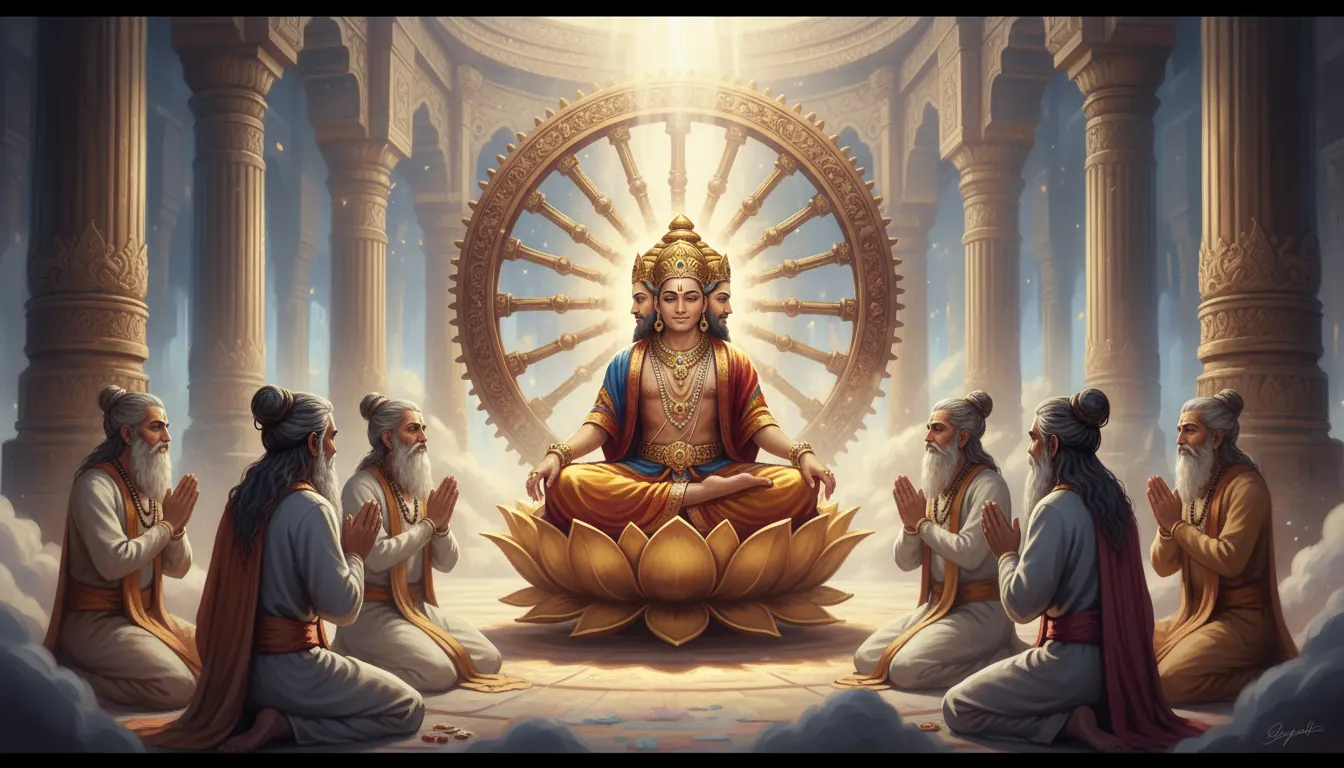
The Eight Who Questioned Brahma
The ladder from the Unmanifest down to a body
In short
Asked to expound Brahma, Krishna tells of eight great rishis who, tired of every path they had walked, went together to the Grandsire to ask where they were and what they were made of. Brahma sets out Darkness, Passion and Goodness, then the descent from the Unmanifest through the Great Soul and Egoism into the elements, and last the wheel of life.
Told in the Ashvamedhika ParvaSet in Brahmaloka, Indraprastha and Mount Meru20 min read
Where Am I, and Where Do You Come From
"Explain Brahma to me," Arjuna said, "for it is the highest thing there is to know. By your kindness my mind has taken delight in these subtle discussions."
"On this subject people tell an old story, a conversation between a teacher and his disciple about Brahman," said Krishna.
Once, he said, a bright disciple questioned his teacher, a brahmana of strict vows, as the teacher sat at his ease. The disciple was one of those who stay so constantly at the teacher's side that they have almost become his shadow. He was self-restrained. He lived the life of a Yati and a Brahmacharin. And when he had leave to ask, he did not ask one question, he emptied himself out.
"Where am I? Where do you come from? Explain the highest truth. From what source have all creatures sprung, moving and unmoving? What do creatures live by? What is the limit of their life? What is truth? What is penance, learned brahmana? What do the good call attributes? Which paths should be called auspicious? What is happiness? What is sin?
"Please answer these questions of mine rightly, truly and exactly. Who else in this world but you can answer them? My curiosity is great. You are famous in all the worlds as a master of the duties that lead to Liberation. No one but you can clear away every kind of doubt. We are afraid of worldly life, and we have come to long for Liberation."
It is worth marking the first two questions, because everything that follows answers them and not the rest. Where am I. Where do you come from. A man wanted to know his own position and the position of the person teaching him, and there is no way to answer that without giving the whole map.
"Twice-born one," the teacher said, "I will explain to you everything you have any doubts about."
Eight Who Had Travelled Every Path
"All this was declared long ago by Brahma himself, the Grandsire of all the worlds," the teacher said. "The greatest rishis have praised it and practised it. It rests on knowledge of the Vedas, and it is an inquiry into what is truly real.
"We hold knowledge to be the highest thing, and renunciation the best penance. The learned man who sees all things dwelling in one place, and sees them separate as well, and who sees unity in diversity, frees himself from misery.
"Understand that great tree rightly. The unmanifest is its seed and sprout, the understanding its trunk, the high sense of self its branches, the senses the hollows from which its twigs come out, the five great elements its flower-buds, and the gross elements its smaller boughs. It is always in flower. All things that exist depend on it. Its seed is Brahman, and it is eternal. A man who cuts through all things with the sharp sword of knowledge wins immortality and casts off birth and death."
And then he told his disciple where the teaching had come from, and the answer was not flattering to anybody.
"Long ago the rishis Brihaspati and Bharadwaja, Gautama and Bhargava, Vasishtha and Kashyapa, Vishvamitra and Atri came together to question one another."
Those are eight of the greatest names in the world. The priest of the gods. The father of Drona. The husband of Ahalya. The line of Bhrigu. The teacher of the solar house. Kashyapa, from whom the tribes descend. The kshatriya who made himself a brahmana. And Atri, who fathered the moon.
"They came together like this after they had travelled every path, and had grown tired of everything each of them had done."
They had done everything, and grown tired of it, and gathered to ask one another, and discovered that the eight of them together could not answer it. So, with the aged Angiras at their head, they went to the realm of the Grandsire. There they saw Brahma, wholly cleansed of sin. Bowing their heads to that great being as he sat at his ease, the great rishis, full of humility, asked him.
"How should a good man act? How can a man be freed from sin? Which paths are auspicious for us? What is truth, and what is sin? By what action does a man reach the two paths, the northern and the southern? What is destruction? What is Liberation? What is the birth, and what is the death, of all things that exist?"
It Is From Truth
"It is from Truth that all creatures, moving and unmoving, have been born," Brahma said. "They live by penance. Understand this, you of excellent vows. Through their own actions they live, rising above their own origin.
"For Truth, when it is joined with qualities, always has five marks. Brahman is Truth. Penance is truth. Prajapati is truth. It is from Truth that all creatures have sprung. Truth is the whole universe of being. That is why brahmanas who are always devoted to Yoga, who have gone beyond anger and sorrow, and who always hold Religion to be the causeway everyone must cross, take refuge in Truth.
"The wise say that Religion is one, though it has four quarters. I will now tell you of the path that is auspicious and brings good, the path that men of wisdom have always trodden to become one with Brahman. Understand, in all its details, what the highest seat is.
"The first step, it is said, is the life of the Brahmacharin. The second step is the life of the householder. After that comes life in the forest. And after that, know this, comes the highest step, which belongs to Adhyatma. Light, ether, sun, wind, Indra and Prajapati: a man sees these only until he reaches Adhyatma.
"I will now set out, exactly and with reasons, the elements that live in part in all things. The great soul, the unmanifest, egoism, the ten organs and the one, the five great elements, and the particular qualities of the five elements: these make up the eternal creation. The number of the elements is said to be twenty-four, and one more.
"Of all creatures, the wise man who understands how all these elements arise and pass away is the one who is never deluded."
They had asked how a good man should act. They were being handed an inventory.
Darkness
"What is unmanifest, indistinct, all-pervading, everlasting and unchanging becomes, you should know, the city of nine gates, with three qualities and five ingredients.
"Three channels run through it and hold it up. These are the three Nadis. They flow without ceasing, and their essence is the three qualities: Darkness, Passion and Goodness. These are joined to one another. They exist through one another. They take refuge in one another and follow one another. Where Darkness is held back, Passion is seen to flow. Where Passion is held back, Goodness is seen to flow.
"Darkness, you should know, has the night for its essence. Unrighteousness is its mark, and it is always present in every sinful act."
Then the Grandsire read out the list, and it is long, and it is worth hearing in full because a man who wants to know what he is made of should be able to recognise himself somewhere in it.
"Complete delusion, ignorance, meanness, indecision about what to do, sleep, arrogance, fear, greed, grief, finding fault with good deeds, loss of memory, unripe judgment, lack of faith, breaking every rule of conduct, lack of discernment, blindness, vile behaviour, boasting of deeds never done, pretending to knowledge in ignorance, unfriendliness, an evil disposition, stupid reasoning, crookedness, inability to live with others, sinful action, senselessness, dullness, lethargy, lack of self-control, degradation. All these qualities are known to belong to Darkness.
"Constant speaking ill of others, reviling the gods and the brahmanas, vanity, anger, unforgiveness and hostility to all creatures are also marks of Darkness, and so are undertakings without merit, gifts without merit, and eating for no purpose.
"I will now tell you the wombs in which such men must be born. They are bound for hell, and they sink in the order of being. They become unmoving things, or animals, or beasts of burden, or flesh-eaters, or snakes, or worms, insects and birds, or egg-born creatures, or madmen, or deaf or dumb human beings, or men struck by dreadful diseases and counted unclean. Their round of births always runs downward.
"After this I will tell you how they can improve and rise. Those born into orders other than the human may grow up within sight of the religious rites of brahmanas who keep the duties of their own order and wish to do good to all creatures. Through the help of such purifying rites they rise upward. Striving to better themselves, they at last reach the same worlds as those pious brahmanas.
"That, truly, is the mark of Darkness: seeing reality in what is not real."
Passion, and the Quality of Goodness
"Most blessed ones, do you understand which qualities belong to Passion?
"Injuring others, beauty, toil, pleasure and pain, cold and heat, lordship, war, peace, argument, discontent, endurance, might, valour, pride, anger, effort, quarrelling, jealousy, desire, malice, battle, the sense of mine, protecting others, slaughter, bonds and torment, buying and selling, lopping, cutting, piercing, and cutting through the coat of mail another man wears, fierceness, cruelty, abuse, pointing out others' faults, anxiety, enmity, lying, false or empty gifts, hesitation and doubt, boastful speech, blame and praise, prowess, defiance, tending the sick and the weak, obeying teachers and parents, service, cleverness of conduct, policy, heedlessness, contempt, possessions, and all the ornaments found in the world among men, women, animals, lifeless things and houses."
The list of Passion does not sound like a list of vices, and that is the point of it. Attendance on the sick is in it. Obedience to a teacher is in it. Peace is in it, next to war. And so is the whole apparatus of religion.
"Vows and rules, actions done in hope of a good result, every kind of public charity, the rites of Swaha and Swadha and Vashat, officiating at other men's sacrifices, teaching, performing sacrifices, study, giving gifts, accepting gifts, rites of expiation, auspicious acts, the wish to have this and that. All these are said to belong to Passion.
"Men on Earth who are devoted to the group of three, which is Religion, Wealth and Pleasure, and who act from desire and rejoice when they win plenty of everything they want, are said to be wrapped in Passion. Such men take the downward course. Born again and again in this world, they give themselves up to pleasure.
"After this I will speak to you of the excellent quality that comes third in our list. It does good to all creatures in the world, it is blameless, and it is the way of life of the good.
"Joy, contentment, nobility, enlightenment and happiness, freedom from meanness, freedom from fear, satisfaction, a disposition to faith, forgiveness, courage, harming no creature, evenness of mind, truth, straightforwardness, freedom from anger, freedom from malice, purity, skill, prowess. Freedom from the idea of mine, freedom from egoism, freedom from expectations, looking on all with an equal eye, and freedom from desire: these make up the eternal religion of the good.
"And the man devoted to the duty of Yoga, who holds knowledge to be vain, conduct to be vain, service to be vain and his mode of life to be vain, reaches what is highest in the world to come."
The Sun, the Heat, and the Eclipse
"The qualities cannot be described as wholly separate from one another," Brahma said. "Passion and Goodness and Darkness are seen to exist together. They are bound to one another. They depend on one another. They take refuge in one another. They follow one another too. As long as Goodness exists, so long does Passion exist. That is certain.
"Where Darkness is greater, in the lower creatures, Passion is smaller and Goodness smaller still. Where Passion is abundant, in creatures of the middle course, Darkness is smaller and Goodness smaller still. Where Goodness is abundant, in creatures of the upward course, Darkness is small and Passion smaller still.
"Those who abide in Goodness go upward. Those who abide in Passion stay in the middle. Those who abide in Darkness, marked by low qualities, sink downward."
Then he gave them the picture that makes it hold, and it is a single morning seen three ways.
"When they see the sun rise, men of evil deeds are filled with fear. Travellers on the road are overcome by the heat and suffer.
"The Sun is Goodness unfolded. The men of evil deeds stand for Darkness. The heat the travellers on the road feel is said to be a quality of Passion. And the darkening of the sun on Parvana days should be known to stand for Darkness.
"In the same way the three qualities exist in all bodies of light. They act by turns in different places and in different ways.
"The Day should be understood as threefold. The Night is ordained to be threefold. So are the fortnight, the months, the years, the seasons and the conjunctions. The gifts that are given are threefold. Threefold is the sacrifice that flows. Threefold are the worlds, threefold the gods, threefold is knowledge, and threefold the path. The past, the present and the future. Religion, Wealth and Pleasure. Prana, Apana and Udana.
"Whatever exists in this world, everything in it is full of the three qualities. Truly, the three qualities always act in an unmanifest form."
The Ladder Down
"From the unmanifest first sprang Mahat, the Great Soul, of great intelligence, the source of all the qualities. That is said to be the first creation.
"The Great Soul goes by these names, all meaning the same: the Great Soul, Intelligence, Vishnu, Jishnu, Shambhu of great valour, the Understanding, the means of perception, and also fame, courage and memory. It has hands and feet on every side, and ears on every side, and it stands pervading everything in the universe. That Being of great power dwells in the heart of all.
"That Mahat which was first produced is called Egoism. When it arose as I, it came to be called the second creation. That Egoism is said to be the source of all creatures, for they have sprung from its changes. It is what feels: I am all this.
"From Egoism were born the five great elements. They are earth, air, ether, water, and light as the fifth. In these five great elements, in sound, touch, colour, taste and smell, all creatures are deluded.
"I will now name one by one the organs called the eleven, which sprang from Egoism. They are the ear, the skin, the two eyes, the tongue, the nose as the fifth, the two feet, the lower duct, the organ of generation, the two hands, and speech as the tenth. These make up the group of organs, with the mind as the eleventh. A man should first master this group. Then Brahman will shine out in him."
And then, for every one of them, he named the same thing three times over: as it stands in the soul, as it stands in the world, and as the deity that presides between the two.
"Space is the first entity. Joined to the soul it is called the ear, joined to objects it is sound, and its presiding deity is the quarters. The Wind is the second. In the soul it is the skin, in the world it is the things we touch. The third is Light: in the soul the eye, in the world colour, and the sun is its deity. The fourth is Water: in the soul the tongue, in the world taste, and its presiding deity is Soma. The fifth is Earth: in the soul the nose, in the world scent, and its presiding deity is the wind.
"The two hands, joined to objects, are actions, and their presiding deity is Indra. Speech is what is spoken, and its presiding deity is Agni. The mind is the work of the mind, and its presiding deity is Chandramas. Egoism is the sense of self, and its presiding deity is Rudra. And the understanding, which drives the six senses, has for its object what is to be understood, and its presiding deity is Brahma.
"Birth comes in four ways. Some are born from eggs. Some are born from shoots that spring upward, piercing through the earth. Some are born from filth. And some are born from balls of flesh in the womb."
What Is First of Each Kind
"I will now tell you truly of all that has a beginning, a middle and an end, and has name and marks.
"It is said that the Day came first. Then Night arose. The Months are said to begin with the bright fortnight. The constellations begin with Sravana. The Seasons begin with the season of dews. Earth is the source of all smells, and Water of all tastes. Sunlight is the source of all colours, the Wind of all sensations of touch, and space is the source of sound.
"The sun is the first of all bodies of light. Fire is the first of all the elements. Savitri is the first of all branches of learning. Prajapati is the first of all the gods. The syllable Om is the first of all the Vedas, and the life-breath Prana is the first of all breaths. The Gayatri is the first of all metres. Of all sacrificial animals the first is the goat. Cows are the first of all four-footed beasts. The twice-born are the first of all human beings. The hawk is the first of all birds. Of sacrifices the first is the pouring of clarified butter on the fire. Of all reptiles the first is the snake. The Krita is the first of all the Yugas. Gold is the first of all precious things, barley of all plants, and water of all things that are drunk. Of all the mountains great Meru is said to be the first-born. Of all the points of the horizon the east comes first. Ganga of the three courses is the first-born of all rivers, and of all bodies of water the ocean. Of all the modes of life, the householder's is the first.
"Of all the Prajapatis I am the first. That is certain. The self-existent Vishnu, whose soul is beyond conceiving, is said to be above me."
And having ranked himself, and named the one above him, the Grandsire finished by ranking everything else out of existence.
"The Unmanifest is the source of all the worlds, and it is also the end of everything. Days end with the setting of the sun, and Nights with its rising. The end of pleasure is always sorrow, and the end of sorrow is always pleasure. Every heap that is gathered ends in exhaustion, and every rise ends in a fall. Every union ends in separation, and life ends in death. All action ends in destruction, and all that is born is certain to die.
"Sacrifice, gifts, penances, study, vows, observances: all of these end in destruction.
"Of Knowledge, there is no end."
The Wheel of the Great Elements
"The wheel of life turns," said Brahma, and this was the last thing he told them, and it was the answer to the disciple's first question, which was where am I.
"The understanding is its strength, the mind the pole it rests on, the senses its spokes, and the five great elements its rim.
"It is weighed down by old age and grief, and diseases and calamities are its children. Toil and effort are its noise. Day and Night are its turnings. Heat and cold surround it. Pleasure and pain are its joints, and hunger and thirst are the nails driven into it. Sunshine and shade are the ruts it cuts.
"It can be shaken in the time it takes to open and close an eyelid. It is wrapped in the terrible waters of delusion. It turns for ever and is without consciousness. It is measured out in months and half-months, and it moves through all the worlds.
"Penances and vows are its mud. The force of Passion drives it. It is lit by the great egoism and sustained by the qualities. Vexations are the fastenings that bind it round. It is large, stretched wide by attachments, and made unsteady by greed and desire. It is born of many-coloured Ignorance, attended by fear and delusion, and is the cause of the delusion of all beings. It is made of the entities that begin with Mahat and end with the gross elements. It is as fast as the mind, and the mind is its boundary.
"This wheel of life, bound up with the pairs of opposites and without consciousness, is what the universe, the immortals included, should cast away, shorten and check.
"Of all creatures, the man who always understands rightly how this wheel moves and stops is never deluded. Free of all impressions, rid of all the pairs of opposites, released from every sin, he reaches the highest goal."
The eight went home. They had asked for a rule of conduct and been given a machine, drawn out to its last fastening, with the great elements for its outermost rim.
"The householder, the Brahmacharin, the forest hermit and the mendicant," the teacher said to his own disciple, at the end of the account, "these four modes of life are all said to rest on the householder's. Whatever system of rules is laid down in this world, keeping it does good."
Dharma Lesson
Even the greatest of the seers had to travel every path, grow tired of it, and then go and ask. What they were given was not a comfort but a map: a count of how far a soul falls from the Unmanifest before it stands up in a body, and a wheel whose outermost rim is made of the very elements the body is built from.