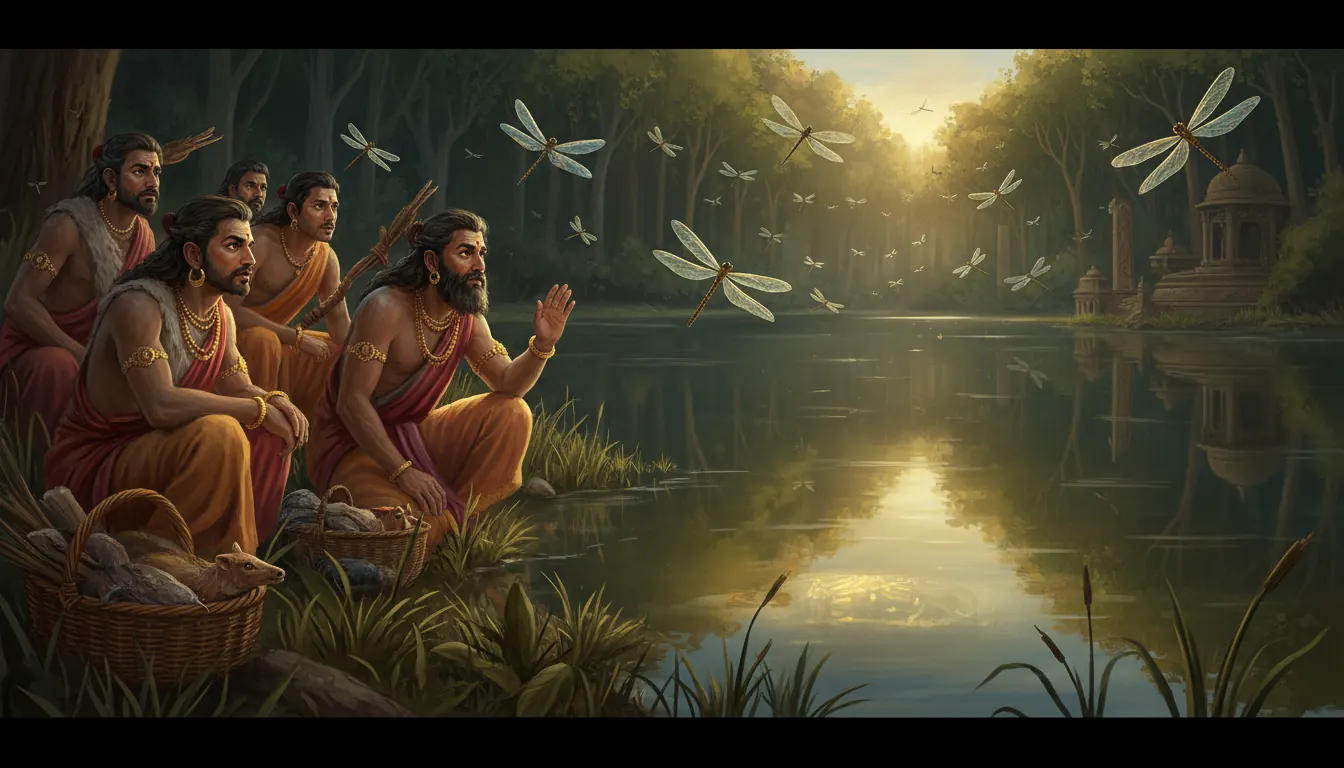
Duryodhana Rises from the Lake
Taunted in the water, the last Kaurava comes up armed and asks for one man at a time
In short
On the evening of the eighteenth day the Pandavas find Duryodhana lying under the enchanted waters of the Dvaipayana lake, and they stand on the bank and call him a coward. He answers that it was fatigue and not fear, offers Yudhishthira the widowed earth, and is told that no man can give away a kingdom who once refused to give up the land a needle's point would cover. Goaded past bearing, he rises through the solid water with his mace and offers to fight any one of the five, on foot, with the weapon of his choice.
Told in the Shalya ParvaSet in Dvaipayana Lake and Kurukshetra21 min read
The Water That Had Been Made Solid
Sanjaya was telling it to a blind man in a hall, as he had told all the rest of it, and by this point in the account there was very little left of the Kaurava army to tell about.
The eighteenth day had gone. Shalya was dead, and Shakuni, and the last of Dhritarashtra's hundred sons but one. The camp had emptied. Three men had come away from that field with any fight left in them, Kripa the teacher, Kritavarma of the Satvata race, and Ashwatthama the son of Drona, and they had gone looking for their king and found him where nobody would have thought to look for the lord of the earth.
He was at the bottom of a lake.
The lake was called Dvaipayana. It was wide as the ocean, Sanjaya said, and pleasant to look at, and its waters were cool and clear. Duryodhana had fled the field on foot with his mace in his hand and gone into it, and then, by illusion, by a wonderful method, he had made the water solid over himself and lay down under it to rest.
The three had begged him to come out and fight. He had told them he was mangled, that they were tired, that he would rest this one night and join them in the morning. Then hunters who carried meat to Bhima heard the whole conversation from the bank and went and sold it, and the noise of the Pandava army coming up the road reached the king lying in the water like the roar of clouds.
Kripa and Kritavarma and Ashwatthama heard it too. They said what men say. We will leave this place, you should know. Duryodhana said, so be it, and did not move, and they rode off far along the bank until they came to a banyan tree and stopped under it, unyoked their horses, and sat down to wonder what was going to happen to the king.
So when the Pandavas came to the water there was nobody at all on the bank.
Illusion Against Illusion
They stood on the bank and looked at it, the whole surviving strength of their side. Yudhishthira, Bhima, Arjuna, Nakula and Sahadeva, Dhrishtadyumna of the Panchalas, Shikhandi, Satyaki, the five sons of Draupadi, what was left of the Somakas, hundreds upon hundreds of foot-soldiers, and Krishna at the head of them. Underneath the calm surface, past the place where the water stopped behaving like water, lay one man with a mace.
Yudhishthira turned to Krishna.
"Look. Dhritarashtra's son has used his power of illusion on these waters. He has cast a spell on them and lies hidden inside, and now he has nothing to fear from any man. He is a master of every deception, and by a deception he has found this refuge. But he will not get away from me alive. Even if the wielder of the thunderbolt himself fights at his side, people will see him killed today."
Krishna answered him with a rule and then with a list.
"Use your own powers of illusion, Bharata, and destroy this illusion of Duryodhana's, for he is an expert in it. A man who works by illusion should be killed by illusion. That is the truth, Yudhishthira."
Then the list, which was his argument that there was no shame in it, because it had always been done this way.
Indra slew the Daityas and the Danavas with stratagems. Vali was bound by Upendra with the help of many stratagems. The great Asura Hiranyaksha was slain so, and Hiranyakashipu after him. Vritra also. Ravana of Pulastya's race, with his relatives and his followers, was slain by Rama that way. Taraka and Viprachitti, those two ancient Daityas of great energy. Vatapi and Ilvala. Trisiras. Sunda and Upasunda.
"Indra himself enjoys heaven because of stratagems. Such acts are very powerful, king, and nothing else is. So you must make use of one yourself."
The act Yudhishthira chose was to talk to him.
Where Is Your Pride Now
He was smiling when he began, which Sanjaya thought worth recording, since the eldest son of Pandu was not a man who enjoyed cruelty and had spent the war apologising for it.
"Suyodhana, you have brought every kshatriya to his death and wiped out your own race, so why have you gone into these waters? Why have you crept into this lake today, trying to save your own life? Get up, king, and fight us.
"Where is the pride you had, and your sense of honour? Where has it all gone, now that you have cast a spell on these waters and lie hidden in them? In every assembly men speak of you as a hero. I think all of that is completely untrue, since you are hiding under the water.
"Get up, king, and fight. You are a kshatriya born of a noble house, and a Kauraveya above all. Remember your birth. How can you boast of being born in Kuru's line when you have run from the battle in fear and hidden yourself at the bottom of a lake? Staying away from battle is not the eternal duty of a kshatriya. Honourable men do not run from a fight, and running does not lead to heaven."
He went at the one place where the man was thinnest, and he went at it again and again.
"You are always boasting of your courage, but you are no hero. You lie about yourself, you of wicked mind, when you tell the whole world you are a hero. Heroes never run at the sight of their enemies. Or tell us, hero, what kind of courage it was that made you flee the battle.
"You leaned on Karna, and on Shakuni the son of Subala, and thought yourself immortal, and in your folly you never understood yourself. Where is that manliness of yours now, and the pride you cherished? Where has your prowess gone? Where is your skill with weapons? Why are you lying in this lake?
"Either defeat us and rule the wide earth, or lie dead on the bare ground, killed by us. That is your highest duty, as the glorious Creator himself laid it down."
The water did not move. Then it answered.
It Was Only Fatigue
The voice came up out of the lake, and the first thing it did was to concede something, which Duryodhana had not done in eighteen days.
"It is no surprise, king, that fear should enter the hearts of living creatures."
That was all he would grant, and having granted it he took it back at once for himself.
"But I did not run from the field of battle, Bharata, out of fear for my life. My chariot was destroyed, my quivers were empty, and my Parshni drivers were dead."
The Parshni drivers are the two attendants who ride at the flanks of a great chariot-warrior and keep his wheels from being fouled. A king does not fight without them. He was reciting an inventory of what had been taken off him, piece by piece, and the last item on the list was other people.
"I was alone, without a single follower to stand by me in battle. That is why I wanted a little rest. It was not to save my life, it was not from fear, it was not from grief, king, that I went into these waters. I did it only because I was exhausted.
"Son of Kunti, rest a while with your followers. When I come up out of this lake I will certainly fight all of you."
It was the same answer he had given Ashwatthama on that bank an hour before, that he would fight tomorrow, that this was not the time for prowess. But Ashwatthama had come to him as a friend, and this was Yudhishthira, and Yudhishthira had no interest in the morning.
"We have all rested enough. We have spent a long time searching for you. So get up now, Suyodhana, and fight us. Either kill the Parthas in battle and make this kingdom and all its wealth your own, or die at our hands and go to the worlds kept for heroes."
There was nowhere further to put the thing off to. So Duryodhana, from under the water, offered him the earth.
The Widowed Earth
"Those Kurus for whose sake I wanted to rule, son of Kuru's race, my brothers, all lie dead on the field."
It is the only place in the whole of his life where he says out loud what he had wanted it for.
"And I no longer want to enjoy this earth. It has been stripped of its wealth and robbed of its best kshatriyas, and it has become like a widow."
Then, because he was who he was, the boast came up through the grief and stood next to it without either one cancelling the other.
"I still hope to defeat you, Yudhishthira, and to break the pride of the Panchalas and the Pandus. Yet there is no longer any need for battle, now that Drona and Karna have been silenced and our grandsire Bhishma has been slain.
"This stripped earth is yours now. What king would want to rule a kingdom emptied of friends and allies? I have brought about the deaths of such friends as mine, and of sons and brothers and fathers, and I see my kingdom taken by you. Who in my place would want to live?
"I would put on deer-skins and go into the woods. I have no desire for a kingdom, now that I have lost my friends and allies. This earth, robbed of nearly all its friends and allies, its heroes and its elephants, is yours, king. Enjoy her, and be happy. Friendless as I am, lord, I do not want even my life. Go, king, and rule the earth as you choose, an earth without lords, without warriors, without wealth and without citadels."
He was offering the Pandavas, from the bottom of a lake, exactly what he had refused them in the hall at Hastinapura, and offering it in the exact costume they had worn out of that hall. Deer-skins. Twelve years in the woods. He had watched five men walk into exile dressed that way, and now, with nothing left, he proposed to put the clothes on himself and hand over the kingdom, and it does not seem to have occurred to him that anybody standing on the bank would notice.
Yudhishthira noticed.
The Land the Needle Covers
"Do not rave in your sorrow from under the water, sire. I am not Shakuni. Words like these do not move me to pity for you, king."
That was the opening, and it was a knife. Shakuni was the one man in the world who had loved Duryodhana enough to ruin the world for him, and he was lying dead on the field behind them, and Yudhishthira was saying that the only ear that speech would have found was the ear of the man who had put him in the water.
Then the refusal, on grounds of law.
"You may be willing now to make me a gift of the earth. But I do not wish to rule an earth that you have given me. It would be a sin for me to accept it from you. Accepting gifts is not a duty laid down for a kshatriya. I will enjoy the earth after I have defeated you in battle.
"Why did you not give us the earth then, when we kept to the rules of righteousness and, for the good of our race, begged you for our share? You refused even the mighty Krishna when he asked, so why do you want to give the earth away now? What folly is this?"
And then the sentence the whole war had been fought over, put back in front of the man who had said it.
"Back then you would not give me even as much earth as the point of a needle would cover. How can you make me a gift of the whole of it now?
"You may want to give away the earth, but you will not escape me with your life. Your life, short-sighted man, is in my hands now. If I choose, I can let you live, but you cannot protect your own life.
"Once you tried to burn us to death, to kill us with snakes and other poisons, and to drown us. You wronged us when you took our kingdom, with the cruel words you spoke, and when you mistreated Draupadi. For all this, wretch, you must die. Get up, get up, and fight us. That will do you good."
And after that, Sanjaya said, they all did it. The Pandavas, flushed with victory, stood on the bank of that lake and rebuked and mocked him in that way, repeatedly, one after another, into the water.
A Man Who Could Not Stand in the Shade
Here the blind king in the hall stopped his charioteer and asked a question, and it is the best question Dhritarashtra asks in the whole of the war.
"Rebuked like this by his enemies, how did my heroic royal son behave, that scorcher of foes, who was quick to anger by nature? He had never listened to rebukes like these before. Everyone had always treated him with the respect due to a king.
"Once it pained him to stand in the shade of an umbrella, because he felt he had taken another's shelter. His pride was so sensitive that he could not bear even the brightness of the sun. How could he bear these words from his enemies?
"You have seen with your own eyes, Sanjaya, how the whole earth, even its Mlecchas and nomad tribes, depended on his favour. Now his followers and attendants were gone, and he lay hidden in that lonely place while the sons of Pandu rebuked him like this. Alas, what answer did he make? Tell me everything."
A father was explaining his son to the man who had watched him die, and the explanation was a good one. This was a prince who had disliked standing under an umbrella because the shade was somebody else's, and who could not bear the sun on him either, because the sun outshone him. There was no arrangement of the world in which such a man could be comfortable, and there was certainly none in which he could lie underwater and be called a coward by five men in daylight.
Sanjaya answered.
"King, when Yudhishthira and his brothers rebuked him like this, your royal son, lying in those waters, heard their bitter words and was deeply wretched."
He breathed hot and long sighs, one after another, down there in the dark under the solid water. He waved his arms, again and again, like a man arguing with nobody. And then he set his heart on battle, and spoke up through the lake.
The Debt He Meant to Pay
"All you Parthas have friends, and chariots, and animals. I am alone and joyless, without a chariot and without an animal. Alone and without weapons, how can I dare to fight on foot against so many enemies, all well armed and mounted on chariots?
"So fight me one at a time, Yudhishthira. It is not right for one man to fight many brave men in battle, especially when he has no armour, when he is tired and struck down by calamity, badly mangled in his limbs, and has neither animals nor troops.
"I am not the least afraid, king, of you, or Vrikodara, or Phalguna, or Vasudeva, or all the Panchalas, or the twins, or Yuyudhana, or any of the other troops you have. Alone as I am, I will stand in battle and hold off all of you.
"As the year meets each of the seasons in turn, I will meet all of you in the fight. As the sun at dawn puts out the light of all the stars with his energy, so today, weaponless and without a chariot, I will destroy all of you with your chariots and horses."
Then he named his creditors, and the naming is a roll of the dead of that war spoken by the man they had died for.
"Today I will free myself from the debt I owe to the many illustrious kshatriyas who have fallen for me: to Bahlika and Drona and Bhishma and the great-souled Karna, to the heroic Jayadratha and Bhagadatta, to Shalya the ruler of the Madras and Bhurishravas, to my sons, and Shakuni the son of Subala, to all my friends and well-wishers and kinsmen. Today I will pay that debt by killing you and your brothers."
With those words the king stopped speaking, and Yudhishthira gave him what he had asked for, and gave it gladly, four times over.
"By good luck, Suyodhana, you know the duties of a kshatriya. By good luck, mighty-armed one, your heart is set on battle. By good luck you are a hero, son of Kuru's race, and by good luck you understand battle, since you wish to take on all of us single-handed.
"Fight any one of us, with whatever weapon you like. The rest of us will stand here and watch. And I grant you this other wish of your heart as well, hero: if you kill any one of us, you will be king. Otherwise, die at our hands and go to heaven."
He Came Up Like a Prince of Elephants
He had been offered his choice of weapon, and he took the one thing he had left.
"Brave man that you are, if you give me the choice of fighting only one of you, then this mace in my hand is the weapon I choose. Let any one of you who thinks he is my match come forward and fight me on foot, armed with a mace. Many wonderful single combats have been fought on chariots. Let this one great and wonderful combat with the mace happen today. Men in battle like to change their weapons. With your permission, let the manner of the fight be changed today. I am not the least afraid, Yudhishthira, even of Shakra himself."
"Get up, get up, son of Gandhari, and fight me, Suyodhana. Alone as you are, mighty one, take us on one at a time with your mace. Be a man, son of Gandhari, and fight with care. Today you will have to give up your life, even if Indra becomes your ally."
Duryodhana could not bear it. He breathed long and heavy sighs from within the water like a mighty snake in its hole. Struck again and again with goads of words like these, Sanjaya said, he could not endure it at all, like a horse of high breed that cannot endure the whip.
Then the lake broke open.
Churning the waters with great force, he rose like a prince of elephants coming up out of a pool, breathing hard in his rage, holding the heavy mace that had the strength of adamant and was decked with gold. He pierced the solidified water from beneath and came up through it shouldering that iron club, like the sun himself scorching everything with his rays, and standing on the bank he began to handle it, turning the great weapon with its sling in his hands.
They looked at him. A man armed with a mace and resembling a crested mountain, or the trident-wielding Rudra casting angry glances upon living creatures, shedding a radiance about him like the scorching sun in the sky. As that mighty-armed chastiser of foes stood shouldering his mace after rising from the waters, every creature there saw in him the Destroyer himself with his bludgeon in his hand. The Panchalas saw the thunder-wielding Shakra, or Hara with the trident.
Let Him Take Up the Mace
And then, seeing him actually come out, the Panchalas and the Pandavas began to rejoice and to seize one another by the hands.
Duryodhana watched them do it and understood it as an insult, which it was. He rolled his eyes in wrath. He drew his brow into three furrows and bit his lower lip, and he looked at the Pandavas with Krishna standing in the middle of them as though he could burn them where they stood.
"You Pandavas will pay for these taunts. Killed by me today, you and the Panchalas will go to the house of Yama."
He stood on the bank with his limbs bathed in blood and drenched with water at once, so that his body looked like a mountain shedding water from within it, and the Pandavas thought he looked like the angry son of Surya armed with the bludgeon called Kinkara. With a voice deep as the clouds, or as a bull roaring in joy, he summoned them again to fight him one at a time, and told them to let the gods in heaven look on.
Yudhishthira answered that with a boy's name.
"Duryodhana, how is it that you did not know this when many great chariot-warriors banded together and killed Abhimanyu in battle? If it is your duty that one man must never be killed by many, why was Abhimanyu killed by many, on your advice? When they are in trouble, all creatures forget the claims of virtue.
"Put on your armour, hero, and bind up your hair. Tell us any boon we can grant you, hero, except your life."
So they armed him on the bank of the lake he had been hiding in. He cased his body in mail of gold and put on a beautiful helmet adorned with pure gold, and standing there in bright armour with the mace on his shoulder he looked, Sanjaya said, like a golden cliff.
"Let any one of you five brothers fight me with a mace. I am willing to fight Sahadeva, or Bhima, or Nakula, or Phalguna, or you, today. Today, with this mace wrapped in cloth of gold, I will bring these hostilities to their end, an end that is hard to reach.
"It is not right for me to speak such proud words about myself. But I will make these words of mine come true in front of you. Within this very hour they will prove either true or false.
"Let whichever of you will fight me take up the mace."
Dharma Lesson
Duryodhana goes into the water because he is tired and comes out of it because he is insulted, and the distance between those two reasons is the whole of the man. He can survive the loss of his brothers, his allies and his kingdom, and he cannot survive being laughed at from a bank. Yudhishthira, for his part, refuses the earth at the moment it is finally offered to him, on the ground that a kshatriya may not accept as a gift what he has not won, and the refusal is honest law and also the surest way to make the last man fight. Each of them chooses the battle over the settlement, and each of them is certain he is choosing duty.