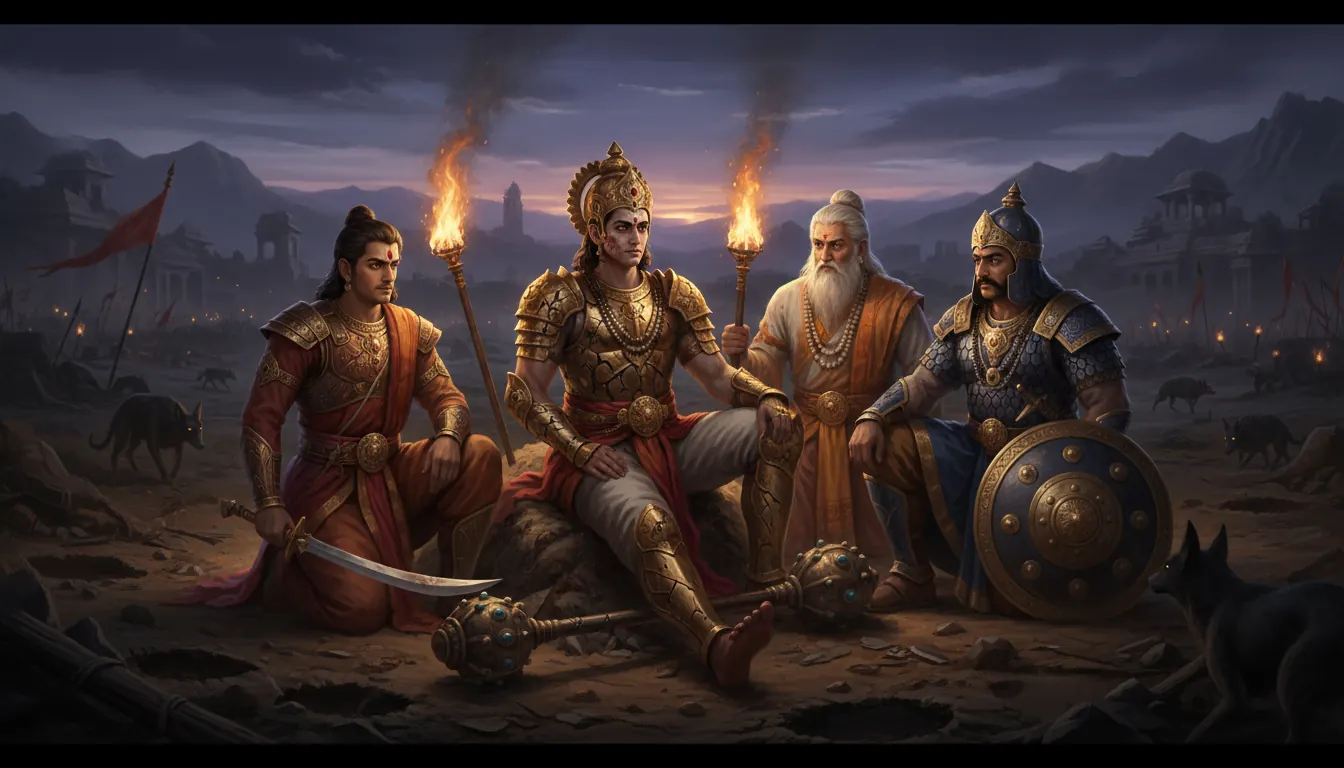
The Last Words of Duryodhana
Broken-thighed on the field, the Kuru king laments his dead, sends his last words home, and names a general with a dying man's hand.
In short
Struck down unfairly by Bhima's mace and left with his thighs broken on the field at Samantapanchaka, Duryodhana rages, then reckons his own life aloud, and sends messages to his parents and the three warriors still living on his side, and grieves for his sister. When Ashwatthama, Kripa, and Kritavarma find him, he answers their grief with a strange contentment, grants Ashwatthama leave for one last vow of vengeance, and has Kripa's hand install his teacher's son as commander before the night closes over him.
Told in the Shalya ParvaSet in Syamantapanchaka15 min read
What Duryodhana Said
Dhritarashtra could not see the field, but for the length of the war Sanjaya's eyes had been lent to him, and now the war had all but ended.
"Kicked on the head, his thighs broken, thrown down on the ground, and still so proud," the blind king said, "what did my son say then, Sanjaya? King Duryodhana was quick to anger, and his hatred of the sons of Pandu ran deep. When this great disaster fell on him, what did he say there on the field?"
It was the eighteenth day. At Samantapanchaka, where the two armies had gone down at last to a duel of maces between two kings, Bhima had hurled his weapon low and broken the thighs of Duryodhana, in contravention of the rules the mace-fighters swore to, and had set his own heel for a moment on the fallen head. The Kuru king lay where he had fallen, and the field around him, which an hour before had held the last of both armies, was already emptying toward the two camps.
"Listen, king," Sanjaya said, "to what your son said when that disaster fell on him.
"His thighs broken, covered in dust, the king gathered up his flowing hair and looked all around him. When at last, with great difficulty, he had gathered it up, he began to sigh like a snake. Full of rage, his tears running fast, he looked at me. For a while he beat his arms against the ground like a maddened elephant. Shaking his loose hair and grinding his teeth, he began to rail at your eldest nephew, and then, breathing heavily, he turned and spoke to me."
Dhritarashtra folded his hands in his lap and said nothing more. He had asked for this. Sanjaya went on.
The Foot on His Head
"Alas," Duryodhana said, "I had Shantanu's son Bhishma to protect me, and Karna, the greatest of all who bear weapons, and Gotama's son Kripa, and Shakuni, and Drona, the first of all who bear arms, and Ashwatthama, and the heroic Shalya, and Kritavarma, and alas, even I have come to this! Time, it seems, cannot be resisted. I was lord of eleven Chamus of troops, and yet I have come to this. Mighty-armed one, no one can rise above Time.
"Let those on my side who have come out of this battle alive be told how Bhimasena struck me down against the rules of fair combat. Many unfair and sinful deeds were done against Bhurishravas, and against Bhishma, and against the glorious Drona, and this is one more, and I am sure all righteous men will condemn the Pandavas for it. What pleasure can a righteous man take in a victory won unfairly? What wise man rejoices, as that sinful Vrikodara rejoices now, over a victory won by unrighteousness? What could be more astonishing than this, that Bhimasena in his anger should touch with his foot the head of a man like me, lying here with my thighs broken? Does a man deserve honour who treats like this a man of glory and fortune, who lived among his friends?"
He struck the earth again, once, with the flat of his hand, and the dust that had begun to settle over him rose and settled again.
"My parents know the duties of battle," he said. "Sanjaya, take these words from me to them in their grief."
And Sanjaya, sitting where he had been ordered to sit, at the edge of the trampled ground, understood that the king was no longer speaking to him, but past him, toward Hastinapura, toward two old people who could not see this any more than the man to whom he was dictating it could.
Who Is There More Fortunate
What Duryodhana had Sanjaya carry to his parents was not an apology and it was not a complaint, though it had passages that sounded like both. It was an accounting, made aloud by a man doing sums while the light was still in him to do them by.
"I have performed sacrifices," he said, "and kept a great host of servants as they should be kept, and ruled the whole earth to its seas. I stood on the heads of my enemies while they still lived. I gave wealth to my kinsmen as far as I was able, and did what pleased my friends. I stood up to all my enemies. Who is more fortunate than I am?
"I marched in state through hostile kingdoms and ordered kings about like slaves. I was generous to everyone I loved. Who is more fortunate than I am? I honoured all my kinsmen and looked after the welfare of all who depended on me. I pursued the three aims of human life, religion, wealth and pleasure. Who is more fortunate than I am? I gave orders to great kings, and I had honour no one else could reach. I always travelled behind the very finest horses. Who is more fortunate than I am? I studied the Vedas and gave gifts as the rules prescribe. My life has been happy. By doing the duties of my own order I have earned many blessed worlds hereafter. Who is more fortunate than I am?
"By good luck I was never beaten in battle and made to serve my enemies as my masters. By good luck my royal fortune leaves me only after my death, to go and serve another. The death that good kshatriyas long for is mine. Who is as fortunate as I am? By good luck I was never turned from the path of enmity and defeated like an ordinary man. By good luck I was not defeated after doing something base. I have been killed as a man is killed asleep, or off his guard, or by poison: unrighteously, against the rules of fair combat."
He was quiet a moment, gathering breath.
"Tell my words to the blessed Ashwatthama," he said, "and to Kritavarma of the Satvata clan, and to Sharadvan's son Kripa. Never put any trust in the Pandavas, those breakers of rules, who have done so many unrighteous things."
The Names He Sent Ahead of Him
Then, to the messengers who had gathered at what safe distance the field allowed, the king spoke a second time, and this speech was for the road, not for the record.
"Bhimasena has killed me in battle, and most unrighteously. Now I am like a traveller without a coin, and I will follow the road taken by Drona, who has already gone to heaven, and by Karna and Shalya, by Vrishasena of great energy, by Shakuni the son of Subala, by King Bhagadatta, by Jayadratha, king of the Sindhus, by all my brothers, my equals, led by Dushasana, by Dushasana's mighty son, by my own son Lakshmana, and by thousands of others who fought for me.
"Alas, how will my sister live, stricken and sorrowing, when she hears that her brothers and her husband have been killed! Alas, what will become of the old king my father, and of Gandhari, and of his daughters-in-law and granddaughters-in-law! The beautiful, large-eyed mother of Lakshmana, left without son or husband, will surely die soon herself. If Charvaka, the wandering ascetic who is a master of speech, learns all of this, that blessed man will certainly avenge my death. By dying on the sacred field of Samantapanchaka, famous throughout the three worlds, I will surely win many eternal worlds."
Thousands of men who had come close enough to hear fled in every direction, their eyes full of tears, at the king's lament. The earth, with her forests and her seas and all her creatures, moving and unmoving, shook violently and gave out a great roar as he spoke, and every quarter of the sky grew murky.
The messengers went, in the end, to the one place the king's words had pointed them: to Drona's son. They found him and told him everything about the mace fight and the fall of the king, and when they had told it they stood a long while lost in thought, and then went away in grief, the way they had come.
Three Wounded Men on Fleet Horses
Ashwatthama had had a hard day already. So had Kripa, who had taught half the warriors on both sides their bows, and so had Kritavarma of the Satvata clan, who had led the Bhoja horsemen since morning. All three were among the few of the Kaurava army still alive, and all three were badly wounded, with the marks of sharp arrows and maces and lances and darts still on them, when the messengers found them and told them Duryodhana had fallen.
They did not wait to be told twice, and they did not wait to have their wounds seen to. They rode their swift horses fast to the battlefield, to the place at Samantapanchaka the messengers had named.
They found him there. The great-souled son of Dhritarashtra lay stretched on the ground like a giant sala tree brought down in the forest by a storm. He was writhing where he lay, covered in blood, like a mighty elephant felled in the forest by a hunter, rolling in agony, bathed in streams of blood. He lay like the sun fallen to earth, or like the ocean dried up by a mighty wind, or like the full moon in the sky with its disc veiled by fog. Huge as an elephant, long-armed, the king lay on the earth covered in dust, and around him, drawn already by the smell of blood, were terrible creatures and beasts of prey, circling the way greedy hangers-on circle a monarch still in state. His brow was still knotted with rage, and his eyes still rolled in fury. He was a tiger among men, struck down like a tiger by hunters.
The three great archers, Kripa and the other two, saw the king lying on the ground and stood stunned for a moment in their chariots. Then they came to themselves. They climbed down from their chariots and ran to him, and all three sat down on the earth around him, the way men sit around a fire that is going out and that they mean, for as long as they can manage it, to keep from going out entirely.
Truly, There Is Nothing Stable
It was Drona's son who spoke first, with tearful eyes, breathing like a snake.
"Truly, nothing in the world of men is lasting," Ashwatthama said, "if you, tiger among men, lie on the bare earth, covered in dust. You were a king whose orders ran across the whole earth. Why then, greatest of kings, do you lie alone on the bare ground in such a lonely wilderness? I do not see Dushasana beside you, nor the great chariot warrior Karna, nor your hundreds of friends. What is this, bull among men? The ways of Yama are hard to understand indeed, if you, lord of all the worlds, lie like this on the bare ground, covered in dust.
"Alas, this scourge of his enemies used to walk at the head of every kshatriya whose hair had been sprinkled with holy water at his coronation. Alas, now he eats the dust. See how Time turns everything upside down as it goes. Where is your pure white umbrella? Where is your yak-tail fan, king? Where has your vast army gone, best of kings? The course of events is surely a mystery, when powers other than the ones we trusted are at work, if even you, who were master of the world, have been brought to this. The fortune of every mortal is very unsteady, if you, who were the equal of Shakra himself, have come to so sorry a state."
Duryodhana heard the whole of it. He wiped his eyes with his hands, and shed tears of grief anew, and when Ashwatthama had finished he turned his head, with what effort the watching men could see, and spoke to all three of them, Kripa and Kritavarma and the weeping son of his teacher, together.
"All living creatures must die, and that, they say, was ordained by the Creator himself," the king said. "Death comes to every being in time. Now that death has come to me, before the eyes of you all. I who ruled over the whole earth have come to this."
Do Not Grieve for Me
"By good luck," Duryodhana went on, "I never turned back from battle, whatever misfortunes came upon me. By good luck it was by deceit, above all, that those sinful men killed me. By good luck I always showed courage and persistence while the war lasted. By good luck I die in battle, along with all my kinsmen and friends. By good luck I see that you have come out of this great slaughter alive, safe and sound. That makes me very glad.
"Do not grieve for my death out of love for me. If the Vedas carry any authority, I have certainly won many eternal worlds. I know the glory of Krishna, whose energy is boundless. He has not made me fall away from the duties of a kshatriya. I have reached him. Do not grieve for me, any of you, on any account. You have done what men like you should do. You have always worked for my success. But destiny cannot be defeated."
When he had said this much, the king fell silent, his eyes brimming with tears, shaken by his agony.
Seeing him silent like that, in tears and grief after so composed a speech, Drona's son blazed up in anger like the fire seen at the destruction of the universe. Overwhelmed with rage, he clenched his hand, and in a voice hoarse with tears he spoke to the king.
"Those wretches killed my father by a cruel trick. But even that does not burn me as much as the state they have brought you to, king. Listen to what I say now, and I swear it by Truth itself, and by all my acts of piety, all my gifts, my religion and the merit I have won: today, in the very presence of Vasudeva, I will send every one of the Panchalas to the house of Yama, by any means I can. Give me your leave, king."
The Water and the Command
The words were highly agreeable to the Kuru king's heart, and he did not waste breath praising them. He turned instead to Kripa.
"Teacher," he said, "bring me a pot of water at once."
Kripa, that foremost of brahmanas, rose at once and brought a vessel full of water, and came and knelt with it beside the king. Duryodhana looked past him, at Ashwatthama.
"Foremost of brahmanas," he said, "blessings on you: if you want to do me good, let the son of Drona be installed as commander-in-chief at my command. At the king's command even a brahmana may fight, especially one who has taken up a kshatriya's ways. Those learned in the scriptures say so."
Hearing these words, Kripa, the son of Sharadvan, did what he had been asked. With the water he had brought to comfort a dying man, he installed Drona's son as commander-in-chief of what remained of the Kaurava host, at the command of the king who no longer had an army to command in any other way.
The installation was over quickly. There was no ceremony left to hold it with, no priests, no horses, no drums, only three exhausted, wounded men and a fourth who could not rise. Ashwatthama embraced the king where he lay, and then stood, and left the spot, and as he went he made the ten points of the compass ring with a lion's roar, the way a man announces to a battlefield that has already gone quiet what he intends to do to it before morning.
Duryodhana, greatest of kings, drenched in blood, was left to spend that night, so frightful to all creatures, where he lay. And the three who had found him, Ashwatthama and Kripa and Kritavarma, went quickly away from the battlefield, their hearts shaken by grief, and as they rode they began to think anxiously and hard about what they had just sworn themselves to.
Dharma Lesson
Duryodhana's last hours are not a conversion. He does not repent the war or ask forgiveness; he counts up his sacrifices, his gifts, his conquests, and calls himself fortunate to have died undefeated rather than as a suppliant. What the scene actually shows is how completely a man's self-account can survive the wreck of his body, and how a grievance nursed to the very end still has enough strength left in it to command an army. He spends his last free act, not on his family, but on unleashing one more act of vengeance through another man's hand.