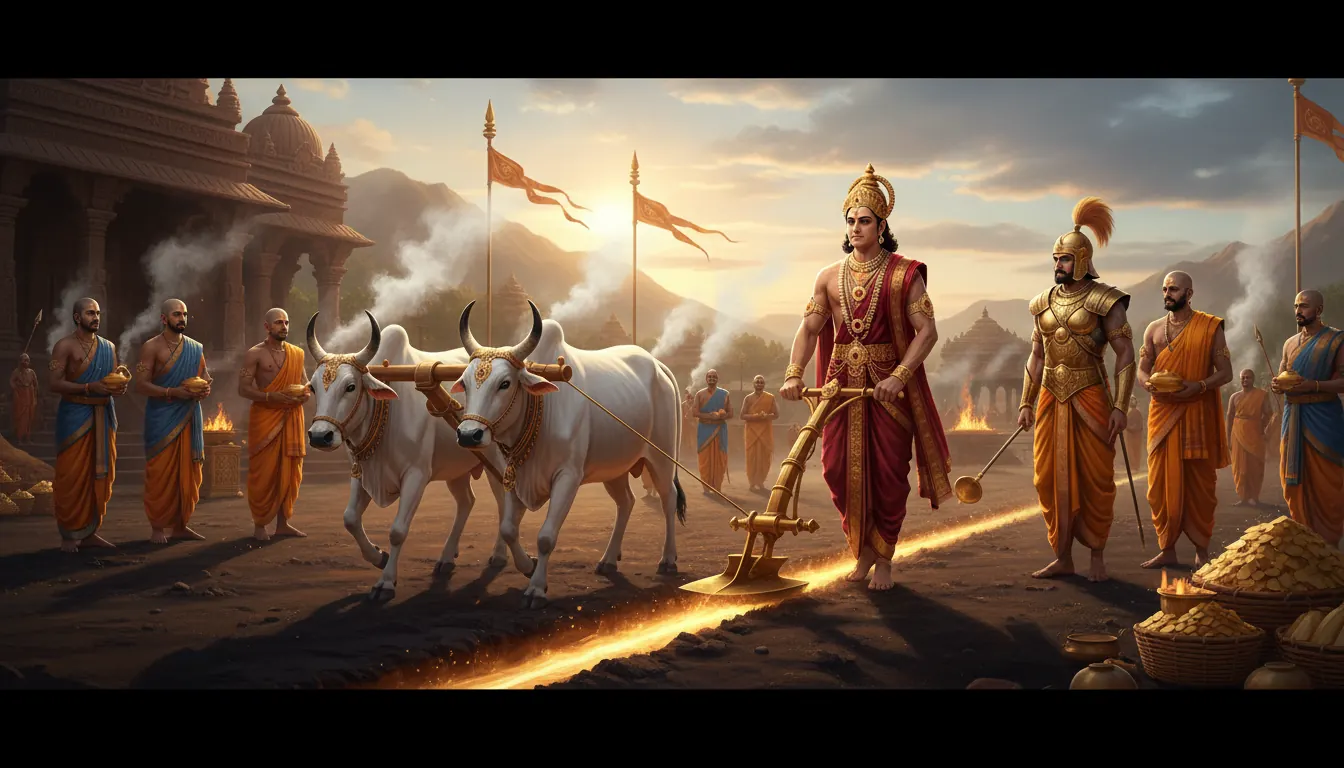
The Golden Plough
The sacrifice a king held because the one he wanted was forbidden him
In short
Flushed with Karna's conquest of the earth, Duryodhana orders a Rajasuya and is told he cannot have one while Yudhishthira and his own father live. The brahmanas offer the Vaishnava rite instead, its ground ploughed with tribute gold. The invitation to Dvaitavana brings back Bhima's promise about the clarified butter of his anger.
Told in the Vana ParvaSet in Hastinapura and Dvaitavana17 min read
The Return of the Suta's Son
Vaishampayana said: Hear now, Janamejaya, what your ancestors were doing in Hastinapura while the sons of Pandu were living on roots in the woods of Dvaita.
Karna came home at the head of a year's tribute. He had gone out with no ally and no partner in the glory, and he had reduced the Angas and the Bangas and the Kalingas and the Magadhas, and after them the Avasiras and the Yodhyas and the Ahikshatras. He had taken Vatsabhumi, and then Kevali and Mrittikavati and Mohana and Patrana and Tripura and Kosala, and made every one of them pay. In the south he had met Rukmi, and after they had fought dreadfully Rukmi lowered his bow and said, 'Greatest of kings, your might and your prowess please me. I will do you no wrong. I have only kept the vow of a kshatriya. I will gladly give you as many gold coins as you want.' He had gone on to Pandya and to the mountain Sri, and made Karala pay, and king Nila, and the son of Venudari. He had beaten the son of Shishupala and taken the neighbouring rulers with him. He had made peace with the Avantis, met the Vrishnis, and turned west, and in the quarter of Varuna the Yavana and the Varvara kings paid him too, and after them the Bhadras and the Rohitakas and the Agneyas and the Malavas, and the mighty charioteers headed by the Nagnajitas, and the Sasakas.
Then he came back to Hastinapura, and Duryodhana went out to meet him with his father and his brothers and his friends, and paid him homage in the road.
"What I never had from Bhishma," the king proclaimed, so that the crowd could hear it, "nor from Drona, nor from Kripa, nor from Bahlika, I have had from you. Why say more? You are my refuge, tiger among men. All the Pandavas and all the other kings in their prosperity do not come to a sixteenth part of you."
A clamour went up in the city at that, and sounds of Oh and Alas, and some of the kings present praised him, and some censured him, and some said nothing at all. Karna went on into the palace and found Dhritarashtra with Gandhari, and took hold of the blind king's feet as a son does, and Dhritarashtra embraced him with affection and dismissed him. From that day Duryodhana and Shakuni the son of Subala considered that the sons of Pritha had already been defeated in battle.
Rule Her Like Shakra
"Duryodhana of the Kurus," Karna said, when the road dust had been washed off him and the two of them were alone, "take to heart what I am going to tell you, and once you have heard it, act on it in every way. The earth is rid of your enemies. Rule her as the great-minded Shakra himself rules once his enemies are destroyed."
The king did not answer at once. When he did, it was not about ruling.
"Nothing is out of reach for the man who has you for his refuge," he said, "and has your loyalty, and whose good is your whole concern. So I will tell you something I mean to do, and you must hear it truly. I saw the Pandavas perform the greatest of sacrifices, the mighty Rajasuya. I stood in that hall and watched a man of my own blood take the water of the imperial consecration while I held nothing. A desire has grown in me. Son of a Suta, make it come true."
Karna took it the way a soldier takes an order, by turning it immediately into a list of things to be procured.
"Every ruler on earth is under your rule now," he said. "So summon the chief brahmanas, best of the Kurus, and gather everything the sacrifice requires, as the rules lay down. Let Ritwijas learned in the Vedas perform your rites as the ordinance prescribes. Let your great sacrifice begin, with food and drink in plenty, and splendid in every part. There is no king alive who can refuse you the tribute it will cost. I have seen to that myself."
So it was settled between them in an afternoon, as easily as a hunt is settled, and neither of them thought to ask a priest first whether the thing they had agreed upon was a thing that could lawfully be done.
While Yudhishthira Is Living
Dhritarashtra's son summoned the family priest and told him what he wanted, in the tone of a man ordering a chariot.
"Perform for me, properly and in due order, the greatest of sacrifices, the Rajasuya, with splendid Dakshinas. Let the gifts to the brahmanas be such that no one who receives them will ever be able to say he has seen better."
That best of brahmanas heard him out, and then answered him without softening any of it.
"Greatest of the Kauravas, while Yudhishthira lives, that greatest of sacrifices cannot be performed in your family. It cannot, prince of kings. And besides, king, your father Dhritarashtra, blessed with long life, is still alive. For that reason too, best of kings, you cannot undertake this sacrifice."
There it was, laid on the floor of the room in two sentences. The Rajasuya is not held twice in one house while the first celebrant breathes, and it is not held by a son over the head of a living father. Duryodhana had conquered the whole earth by proxy and could not buy the one rite he wanted, because of a man eating forest fruit five hundred miles away and a blind man sitting in the next hall.
He did not shout. Those who were in the room afterward said that what was frightening about him in that moment was how reasonable he stayed.
"Then you tell me," he said, "what a king in my position may lawfully have."
The Rite No One Has Held Since Vishnu
"There is another great sacrifice, my lord, like the Rajasuya," the priest said. "Perform that one, greatest of kings. Listen to what I say.
"All these rulers of the earth who now pay you tribute will pay it in gold, both pure and impure. Have the sacrificial plough made from that gold, best of kings. Then plough the sacrificial ground with it yourself, Bharata. And there let the sacrifice begin, with the proper rites and without any disturbance, sanctified with mantras and with food in plenty. That sacrifice, which is fit for the virtuous, is called the Vaishnava. No one but the ancient Vishnu has performed it before you. This mighty sacrifice rivals the greatest of sacrifices, the Rajasuya itself. It pleases us, and it is for your good as well. Besides, it can be performed without any disturbance. If you undertake it, your desire will be fulfilled."
He said that last part twice, without any disturbance, and everyone in the room understood the courtesy in it. The Rajasuya is a rite of challenge. It summons every king on earth to come and either bow or refuse, and a hall full of kings who have been beaten within the year is a hall in which something is likely to happen. The Vaishnava summons nobody. It has no tribute-taking at its heart, only tribute already taken, melted down and beaten into a share.
Duryodhana turned to Karna, and to his brothers, and to the son of Subala.
"The brahmanas' words please me entirely," he said. "If they please you too, say so at once."
"So be it," they said, all of them together, and no one asked what it meant that Vishnu was the last man to need this particular rite.
Then the king set each man to his task, one by one, and told all the artisans to make the plough. And bit by bit everything he had ordered was done.
The Golden Plough
The artisans came at last, with the principal counsellors, and with them came Vidura, who was the wisest man in that city and the least listened to.
"Everything is ready for the great sacrifice, king," they said, "and the time has come, Bharata. The precious golden plough is finished."
It lay on cloth to be looked at before it was used. It was made of the tribute, pure gold and impure together, and the men who had brought the metal in could still identify their own portions of it: Anga and Kalinga in the beam, Rukmi's coins somewhere in the share, the payments of the Yavana kings and the Varvara kings drawn out into the long curve of the handle. A plough is a farmer's tool and this one weighed what a year of the world's fear weighs, and it had never turned a furrow and never would again after that morning.
Duryodhana ordered that finest of sacrifices to begin. The mantras began. The son of Gandhari was duly initiated according to the ordinance, and took the plough in his two hands and walked the sacrificial compound behind it, opening the ground of the rite with the gold of every kingdom Karna had frightened.
And Dhritarashtra was delighted, and Vidura, and Bhishma and Drona and Kripa, and Karna, and the celebrated Gandhari, all of them felt great delight. It was the first thing in a long time that the whole house had been able to be glad about at once.
Then Duryodhana sent swift messengers to invite the princes and the brahmanas, and mounting fleet vehicles they went out to the directions assigned to them, each with his list of houses.
The Errand to Dvaita
To one messenger who was on the point of setting out, Dushasana gave a separate instruction, and he gave it where his brother could hear it.
"Go quickly to the woods of Dvaita," he said, "and in that forest invite the brahmanas in proper form, and those wicked men, the Pandavas."
So the man rode south and west out of the tribute-fed city and into a country with no roads in it, and came at last to a clearing by the lake in Dvaitavana where five men in bark and deerskin were sitting with a woman among them, and the fires of brahmanas were burning under the trees all around. Whatever he had been told to expect, he bowed down to all the Pandavas before he spoke, because a man raised in that court knows a king when he is standing in front of one, whatever the king is wearing.
"King," he said, "Duryodhana, best of kings and first of the Kurus, has won immense wealth by his own prowess and is holding a sacrifice. Kings and brahmanas are on their way there from every direction. The great-souled Kaurava has sent me. That king and lord of men, the son of Dhritarashtra, invites you. So please come and see that king's splendid sacrifice."
There was a silence in the clearing of the kind that has weather in it.
Then Yudhishthira the just answered him, and answered him pleasantly.
"How fortunate," he said, "that King Suyodhana, who adds to the glory of his ancestors, is holding this greatest of sacrifices. We would certainly come. But we cannot now. We have a vow to keep until the thirteenth year is over. Tell him that we wish his rite well, and tell him truly that it was courteously asked."
The Clarified Butter of His Anger
Bhima had been sitting with his back against a tree through all of it, and he stood up before the messenger could take his leave.
"King Yudhishthira the just will go there," he said. "He will go on the day he throws that man into the fire that weapons kindle. Tell Suyodhana this, in the words I give you. When the thirteenth year is over, and that lord of men, the son of Pandu, pours the clarified butter of his anger over the sons of Dhritarashtra in the sacrifice of battle, then I will come."
It was a whole rite laid out in one sentence, and every man there knew how to read it: the war itself would be the offering, the Kurus themselves the oblation poured into it, and Bhima would attend as a guest attends, when the fire was properly lit.
The other Pandavas said nothing unpleasant. They did not need to.
The messenger rode back the way he had come, and when he stood again in Hastinapura he told Dhritarashtra's son everything exactly as it had fallen out, the courtesy and the vow and the promise about the butter, leaving none of it out, because it did not occur to him to edit a king's words for a king's comfort.
Duryodhana heard it and did not have the man punished, and did not answer it either. There was a sacrifice to finish. The gates were already full of arriving chariots.
What Vidura Did With the Guests
They came in from everywhere, foremost of men, lords of various countries, and highly virtuous brahmanas by the thousand, and each was received in his proper order as the rules required, and they were all delighted and well pleased. Dhritarashtra sat surrounded by the Kauravas at the height of his joy, and it is worth saying plainly that the old man was happy that week in a way he had not been happy for years, because for once his son had done a thing that filled the house with priests instead of quarrels.
"Kshatta," he said to Vidura, "see to it quickly that everyone in the sacrificial grounds is served with food, and refreshed, and satisfied."
Vidura accepted that order and did it cheerfully, and did it better than anyone else in that kingdom could have. He entertained every order in proper measure, with food and drink, fragrant garlands and clothes of many kinds, each according to what was due to him and none slighted. He had pavilions constructed for their accommodation. He entertained the princes and the brahmanas by thousands, gave them wealth of many kinds, and said farewell to them.
So the Vaishnava sacrifice of Duryodhana was completed, without any disturbance, exactly as the priest had promised. Nobody was killed in the hall. Nobody stood up to object. No king refused a seat. When the last of them had gone the ground was trampled and the gold plough was carried away to a treasury, and Duryodhana entered Hastinapura surrounded by his brothers, with Karna on one side of him and the son of Subala on the other.
Not a Sixteenth Part
As he entered the city the bards went ahead of him singing the praises of the prince whose prowess never failed, and others took it up and praised that mighty bowman and greatest of kings. The citizens sprinkled fried paddy and sandal paste over him from the housetops.
"How fortunate, king," they called down, "that your sacrifice has been completed without any obstacle."
And then, from somewhere in that crowd, other voices. Some men there were reckless of speech, and being reckless of speech they were also reckless of consequences, and what they said to the king's face, in his own street, on the day of his triumph, was this:
"Surely this sacrifice of yours cannot compare with Yudhishthira's. It does not come to a sixteenth part of his."
A sixteenth part. It was the very measure Duryodhana himself had used in the road a season before, when he told Karna that all the Pandavas and all the kings of the earth did not come to a sixteenth part of him. The city handed it back to him with the same coin still warm.
His friends closed round him and talked over it at once, loudly.
"Your sacrifice has outdone all others," they said. "Yayati and Nahusha, and Mandhata and Bharata, were all made holy by performing such a sacrifice, and all went to heaven."
These kind words from his friends pleased the king, and he went on into the city and at last into his own house. There he worshipped the feet of his father and his mother, and of the elders headed by Bhishma and Drona and Kripa, and of the wise Vidura; and was worshipped in turn by his younger brothers; and that delighter of his brothers sat down upon an excellent seat with them all around him. A few men had told him the truth in the street and he had walked on past them, and everyone in the procession knew which sentence he had taken home.
The Asura Vow
Then the Suta's son rose in that room full of brothers.
"How fortunate, greatest of the Bharata line, that this mighty sacrifice of yours has been brought to a close," Karna said. "But when the sons of Pritha have been killed in battle and you have performed the Rajasuya, then, lord of men, I will honour you like this again."
"That is truly said," the king answered. "When the wicked Pandavas are dead, and I have performed the grand Rajasuya, then, hero, you will honour me like this again." He embraced Karna, and from that hour he began to think about the Rajasuya the way a man thinks about a woman he has been refused. He said aloud to the Kurus around him, "Kauravas, when will I kill all the Pandavas and perform that costly, greatest of sacrifices, the Rajasuya?"
And Karna answered him with the thing he had been carrying since the road.
"Hear me, elephant among kings. Until I have killed Arjuna, I will let no one wash my feet, and I will not taste meat. And I will keep the Asura vow: whoever asks me for anything, I will never tell him, I do not have it."
The sons of Dhritarashtra, mighty charioteers and bowmen, sent up a loud cheer at that, and they thought the Pandavas already conquered. Duryodhana left them and went into his own apartments like Kubera entering the garden of Chitraratha, and all those mighty bowmen went to their quarters.
In the forest it landed differently. The Pandavas had been uneasy since the messenger left, and then the spies came in with the rest of it, the vow about the feet and the meat and Vijaya's name in it. Dharma's son considered Karna of the impenetrable mail, and remembered every one of their woes, and knew no peace. He was so filled with anxiety that he made up his mind to leave the woods about Dvaitavana altogether, with their thickets full of ferocious animals, and to go elsewhere.
And Duryodhana ruled the earth, with his heroic brothers, and with Bhishma and Drona and Kripa, and with the Suta's son crowned in martial glory beside him; and he was intent upon the welfare of the rulers of the earth, and worshipped the foremost of brahmanas with sacrifices and generous gifts, and was engaged in doing good to his brothers. For he had concluded, and had concluded it for certain in his own mind, that giving and enjoying are the only use that riches have.
Dharma Lesson
Honours that must be improvised because the real one is out of reach announce the very lack they were meant to hide. A rite chosen for being incapable of disturbance buys quiet at the price of meaning, and the men in the street can tell the difference even when the king cannot.