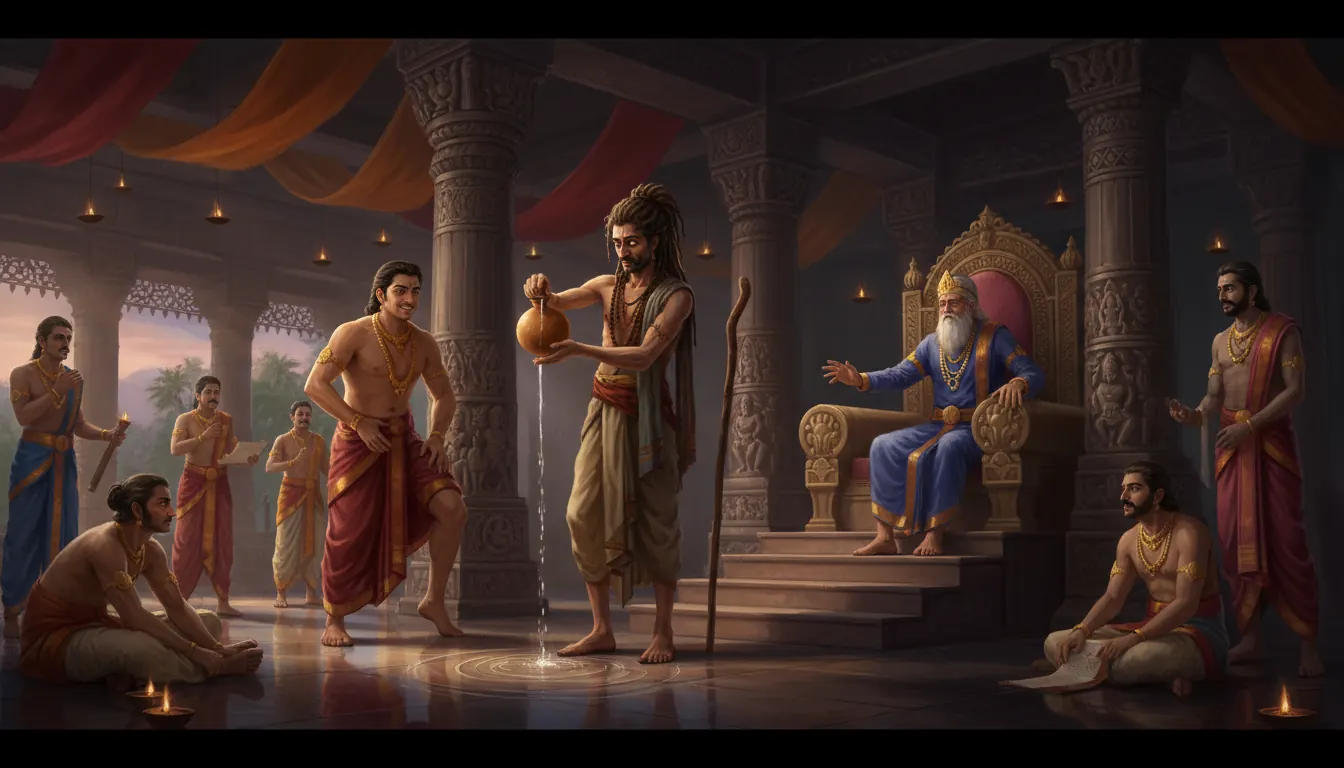
The Curse on Duryodhana's Thigh
A sage asks politely once, and is answered with a scratched foot
In short
Vyasa turns back the chariots setting out to kill the exiled Pandavas and warns Dhritarashtra that the sage Maitreya must be obeyed. Maitreya reports what he saw in Kamyaka and asks Duryodhana gently for peace. The prince slaps his thigh, smiles, and scratches the floor with his foot, and the insulted sage touches water.
Told in the Vana ParvaSet in Hastinapura and Kamyaka Forest16 min read
The Chariots That Turned Back
Vaishampayana said: The exile was only weeks old when Karna made his proposal in Duryodhana's hall, and he made it plainly, as a soldier states a window of opportunity.
"We cannot always act quickly for the king's good," he said, "because we depend on Dhritarashtra. But now let us put on our mail, take up our weapons, mount our chariots and go together to kill the Pandavas where they are living in the forest. Once they have been silenced and have gone on the unknown journey, then we and the sons of Dhritarashtra will have peace. While they are in distress, while they are in sorrow, while they have no one to help them, we are a match for them. That is what I think."
They applauded him again and again, and at last cried out together, "Very well." Each of them went to his chariot. They were confident of success. They rushed out in a body to kill five men who at that moment owned nothing but bark cloth and a bow apiece.
And Krishna-Dvaipayana Vyasa, knowing by his spiritual vision that they had set out, met them on the road and ordered them to stop.
That is all the text says of it, and it is enough. There is no fight in it. An old man in a rag stood in front of the chariots of the Kuru princes and told them to go back, and they went back, and the greatest archer of the age turned his horses round with the rest. Having sent them home, the holy one, worshipped by all the worlds, went quickly to the king whose intelligence served him for eyesight, and found him sitting comfortably, hearing nothing of any of it.
What Vyasa Told the Blind King
"Wise Dhritarashtra, listen to me," Vyasa said. "I will tell you what is for the great good of all the Kauravas.
"Mighty-armed one, I am not pleased that the Pandavas have gone to the forest, cheated at dice by Duryodhana and the others. When the thirteenth year ends, Bharata, they will remember all their woes and may rain deadly weapons on the Kauravas, like virulent poison. Why does your sinful son, with his wicked heart and his endless anger, want to kill the sons of Pandu for their kingdom? Hold the fool back. Make your son keep still. If he tries to kill the Pandavas in exile, he will only lose his own life.
"You are as honest as wise Vidura, or Bhishma, or ourselves, or Kripa, or Drona. You are a man of great wisdom: quarrels with one's own kin are forbidden, and sinful, and shameful. You must put a stop to such things. Duryodhana looks on the Pandavas with such jealousy that great harm will follow if you do not step in."
Then he offered a remedy so strange that the court remembered it for years afterward, and none of them ever knew whether he had meant it seriously.
"Or let this wicked son of yours go to the forest alone, with no one at all, and live there with the sons of Pandu. If living with him makes the Pandavas grow fond of Duryodhana, then good fortune may yet be yours, king of men." And then, in the same breath, Vyasa took the remedy away again. "But that may not happen. For they say that a man's inborn nature does not leave him until he dies.
"But what do Bhishma and Drona and Vidura think? And what do you think? What is good must be done while there is still time, or your purposes will come to nothing."
Why the Cow Wept
"Holy one," said Dhritarashtra, "I did not like this business of gambling. But I think fate drew me into agreeing to it. Bhishma did not like that game of dice, nor did Drona, nor Vidura, nor Gandhari. It was certainly born of folly. And though I know all this, a father's love sways me, and I cannot cast off my senseless son Duryodhana."
"What you say is true," said Vyasa. "We know well that a son is the best of all things, and that nothing is as good as a son. Even Indra learned from the tears of Surabhi that a son is worth more than any other possession. I will tell you what passed between them.
"Long ago Surabhi, the mother of cows, was weeping in heaven, and Indra took pity on her and asked her why. 'No harm has come to you that I can see,' she said. 'But I am grieving for my son, and that is why I weep. Look, king of the gods: that cruel farmer over there is beating my weak son with a wooden stick and weighing him down with the plough, so that my child, shaking with agony, is falling to the ground at the point of death. The stronger of the pair carries the heavier load with ease, but the other is lean and weak, all veins, and carries his with difficulty. It is for him that I grieve. The whip has hurt him badly, he is driven beyond endurance, and he cannot bear his load, and it is for him that these tears of pity run from my eyes.'
"'Fair one,' said Shakra, 'thousands of your sons are oppressed every day. Why do you grieve for this one?'
"'I have a thousand children, and I love them all equally,' Surabhi said. 'But I feel more pity for the one who is weak and innocent.'
"Indra was greatly surprised, and became convinced that a son is dearer than one's own life. The chastiser of Paka suddenly poured down heavy rain on that field and put a stop to the farmer's work.
"And just as Surabhi said, king, your love goes equally to all your sons. Let it be greater toward those who are weak. You are to me what my son Pandu was, and so is Vidura of deep wisdom. It is out of love that I tell you all this. You have a hundred and one sons, Bharata, and Pandu has only five, and they are in a bad way, passing their days in sorrow. How they are to save their lives, how they are to thrive: these thoughts give my soul no rest. King of the earth, if you want all the Kauravas to live, let your son Duryodhana make peace with the Pandavas."
There Is a Sage on the Road
"Muni of deep wisdom, it is just as you say," the king answered. "I know it well, and so do all these kings. Indeed, Vidura and Bhishma and Drona have all pointed out to me what you think is good for the Kurus." He turned his blind face toward the voice. "And if I deserve your favour, and if you have any kindness for the Kurus, then speak to my wicked son Duryodhana and urge him yourself."
It was the whole of Dhritarashtra in one sentence. He agreed with everything. He had been told the same thing by three men already. And what he asked for was not the strength to command his son but another visitor who might succeed where he had not tried.
Vyasa did not refuse him. He gave him something instead, and he gave it as a warning.
"King, the holy rishi Maitreya has seen the Pandava brothers and is coming here to see us. That mighty rishi will admonish your son for the good of this race. And whatever he advises, Kauravya, must be followed without question. For if what he recommends is not done, the sage will curse your son in anger."
Saying that, Vyasa departed, and did not stay for the visit.
So the household had it in advance, in plain words, from the one man in the world none of them had ever caught in an error: a sage is on the road, obey him, or your son is cursed. There was time to prepare. There was time to speak to Duryodhana. Nobody did either.
The Arghya at the Door
Maitreya came in dusty and travel-worn, and the king with his son received him respectfully, with the offering of the Arghya and the other rites. Water for the feet, water for the hands, honey and curds, a seat. It was done properly. Whatever else that court had lost, it had not lost its manners at a door.
Then Dhritarashtra, the son of Ambika, spoke to the sage respectfully and asked three questions in a row, and every one of them was the question of a man who wants to be told that nothing has happened.
"Holy one, did you have a pleasant journey from the Kuru-jangala? Are those heroes, the five Pandavas, living happily? Do those bulls of the Kuru race mean to see out their time?"
And then a fourth, which was the only one he really cared about.
"Will the brotherly love of the Kauravas ever be broken?"
Duryodhana sat beside him and said nothing. He knew who this was. He could guess what the old man had come for, and he had decided in advance how he would receive it.
What I Saw in the Woods of Kamyaka
"I set out on a pilgrimage to the various shrines and came to Kuru-jangala," Maitreya said, "and there, in the woods of Kamyaka, I happened to see Yudhishthira the just."
He described what he had seen, and he did not describe it kindly, because he was not making conversation.
"Many Munis had come there to see that great-souled man, who lives in a hermitage, dressed in deer-skin, with matted hair. It was there, king of kings, that I heard of the grave wrong your sons have done, and of the calamity and the terrible danger the dice have brought on them. That is why I have come to you, for the good of the Kauravas, because my affection for you is great and I am pleased with you.
"King, your sons must on no account quarrel with one another while you and Bhishma are alive. You are the post the bulls are tied to when they tread out the corn. You have the power to punish and to reward. Why then do you ignore this great evil that is about to overtake everyone?"
And then he said the sentence that the son of Ambika would have given his kingdom not to hear, and he said it in the voice a man uses for reporting weather.
"And, descendant of the Kurus, because of the wrongs that were done in your court, which were like the acts of wretched outcasts, the ascetics do not think well of you."
Not condemned. Not cursed. Simply no longer well thought of, in the quiet rooms in the forest where such things are discussed, by men who had once come to the Kuru gate to be honoured. Whatever the hall had gained in the dicing, it had spent that.
Soft Words to Duryodhana
Then the illustrious rishi turned to the angry prince, and he began with three courtesies, which is worth noticing in a man who was about to be insulted.
"Mighty-armed Duryodhana. Best of all eloquent men. Illustrious one. Listen to what I say for your good. King, do not look for a quarrel with the Pandavas. Look to your own good, and theirs, and that of the Kurus, and of the world.
"Those tigers among men are all heroes of great prowess in war. They have the strength of ten thousand elephants. Their bodies are hard as the thunderbolt. They keep their promises, and they are proud of their manhood. They have killed those enemies of the gods, the Rakshasas who can take any form they please, led by Hidimba and by Kirmira.
"Think what happened when those great-souled men left here. That fierce Rakshasa blocked their path in the night like an immovable hill, and Bhima, strongest of all men and always glad of a fight, killed the monster as a tiger kills a little deer. Think too, king, how Bhima, on his campaign of conquest, killed in battle that mighty warrior Jarasandha, who had the strength of ten thousand elephants.
"And what man who must grow old and die would take on such men in battle, when they are kin to Vasudeva and have the sons of king Drupada for brothers-in-law? Bull of the Bharata race, let there be peace between you and the Pandavas. Take my advice, and do not give yourself up to anger."
It was a careful speech. Every argument in it was one that a man of Duryodhana's temper could accept without losing face, because none of it asked him to admit that he had done wrong. It only asked him to count.
The Answer of a Foot on the Floor
Duryodhana heard him out. He was in his own hall, with his father beside him and his brothers along the wall, and he had been given the courtesy of three honorifics and a way to agree without apologising.
He began to slap his thigh.
It was the thigh that people compared to the trunk of an elephant, and he struck it slowly, the way a man does who is pleased with what he is sitting on, and while he did it he smiled. Then he lowered his eyes and began to scratch the floor with his foot, dragging the sole of it back and forth across the stone.
He did not say a word. He hung down his head, and went on scratching.
There is no rudeness in the world quite like that one. To refuse aloud is to enter into an argument, and an argument grants the other man standing. Duryodhana did not grant him standing. He simply waited, with his eyes on the floor and his hand on his leg, for the old man to finish being present. Everyone in the room understood it, including the blind king, who could hear the sole of a foot on stone as well as any of them.
And the rishi Maitreya, who had walked from Kamyaka to say what he had said, sat there and was slighted, and became angry.
Water Touched in Anger
As though fate had sent him for it, that best of Munis, overwhelmed with wrath, made up his mind to curse the prince. He reached for the vessel beside him and touched the water, which is the act that makes such a thing binding, and his eyes were red.
"Since you slight me and refuse to do as I say," Maitreya said, "you will soon reap the fruit of your insolence. In the great war that will grow out of the wrongs you have done, mighty Bhima will smash that thigh of yours with a blow of his mace."
That thigh. The one he had been slapping while the sage spoke, the elephant's trunk of a thigh, the pride of a mace-fighter who had trained under Balarama. It was to be smashed with a mace, by the one man in the world he had never been able to intimidate, at the end of a war that had not yet been declared.
Dhritarashtra was on his feet, all courtesy now, trying to calm the sage so that what had been spoken might not come to pass. He begged. It is one of the very few moments in the whole history of that house where the old king moved quickly.
Maitreya did not withdraw the curse. But he did something better, and it is the part of this story that is usually forgotten.
"King, if your son makes peace with the Pandavas, this curse of mine will not take effect, child. Otherwise it must be as I have said."
So the thing was not sealed. It was left standing open for thirteen years, with the latch on Duryodhana's own side of the door, and every embassy that came to Hastinapura afterward, Sanjaya's and Krishna's and all the rest, was in some sense a hand on that latch. He never once lifted it.
I Will Not Speak Again
There was a silence in the hall after that, and the first thing the blind king did with it was to ask about something else entirely.
He wanted to know about Bhima. Wishing to learn the might of the man who was to break his son, the father of Duryodhana turned to the sage and said, "How was Kirmira slain by Bhima?"
It is a fair question and a father's question, and Maitreya would not answer it.
"I will not speak to you again, king," he said, "for your son does not heed my words. When I have gone, Vidura will tell you everything."
And saying that, he went away to the place he had come from, still dusty, having been in that house perhaps an hour.
Duryodhana also went out. The text says he was disturbed, and it is careful about the reason: not by the curse, which he had heard laid on him in his own hall and had not answered, but by the news of Kirmira's death. That was the sentence that had gone in. Somewhere in the forest his cousin had walked into a Rakshasa on a black road and killed it with his hands, and the news of it had reached him sideways, in a speech he had been refusing to listen to.
Vidura was left with the errand, as Vidura usually was, and in a little while he sat down with the old king and began at the beginning: how the Pandavas came by night into the Kamyaka woods, and what met them there, and what Bhima did to it.
And the curse stood where it had been set down, waiting eighteen days of war and one afternoon on the bank of a lake, thirteen years off, when a mace would come round low and a man who had slapped his thigh in a council chamber would find out that sages keep accounts.
Dharma Lesson
Contempt shown in silence is still an answer, and a man who will not speak his refusal has chosen its consequences all the same. The curse was left conditional, revocable by a single act of peace, which means the thigh was broken not in that hall but in every year afterward that Duryodhana declined to lift the latch.