The Ones Who Would Not Turn Back
The city walks out with its kings, and a sage answers the weeping
In short
The Pandavas leave Hastinapura by the Vardhamana gate and the citizens follow, arguing that a man takes the character of the company he keeps. Yudhishthira sends them home, but the mendicant brahmanas refuse to be dismissed, and the king weeps at the thought of holy men feeding themselves for his sake. Saunaka answers him.
Told in the Vana ParvaSet in Hastinapura, Pramanakoti and Ganga21 min read
The Question About the Twelve Years
"Best of the twice-born," said Janamejaya, "my ancestors the sons of Pritha were cheated at dice by the sons of Dhritarashtra and their counsellors, enraged by those wicked men, and spoken to in cruel words. What did they do then? How did those princes, equal to Shakra in prowess, suddenly stripped of their wealth and overwhelmed with misery, pass their days in the forest? Who followed men sunk in such distress? How did they conduct themselves, how did they find their food, and where did they stay? How did those twelve years pass? And that princess, the best of women, devoted to her husbands and always truthful, who deserved no pain at all, how did she endure it? Tell me all of it in detail, illustrious ascetic, for I am very eager to know."
Vaishampayana said: Then listen, king, and I will begin where it begins, which is not in the forest at all. It begins in a street.
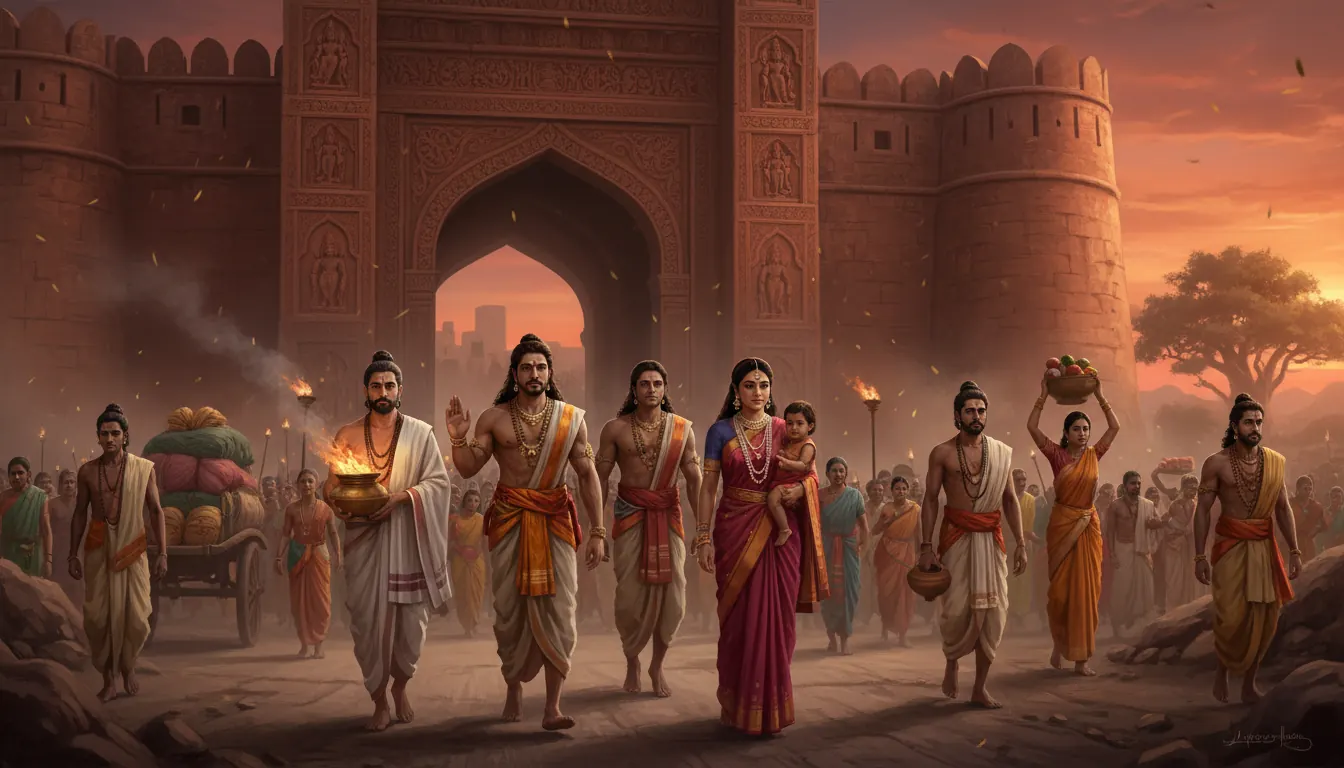
The defeat had been taken and the terms read out, and the sons of Pritha, enraged by the wicked sons of Dhritarashtra and their counsellors, set out from Hastinapura. They went out of the city by the Vardhamana gate, carrying their weapons, with Draupadi walking among them, and turned north. Indrasena and the others followed in swift chariots, fourteen servants in all, with their wives, and their household priest went ahead of them. That was the whole procession of the men who had ruled Indraprastha.
What nobody in that house had reckoned on was the city.
What Was Said in the Streets
When the citizens learned of the departure they were overwhelmed with sorrow, and the first thing the sorrow turned into was blame. They condemned Bhishma. They condemned Vidura, and Drona, and Kripa of Gautama's line. Four men who had sat in that hall and had authority and had let the thing happen.
Then they gathered, in the streets and at the gates, and spoke to one another without any fear at all of who might be listening.
"Alas, our families, and we ourselves, and our homes are all lost," they said, "now that wicked Duryodhana, backed by the son of Subala and by Karna and Dushasana, is reaching for this kingdom. Our families, our ancestral customs, our virtue and our prosperity are all doomed when this sinful wretch, propped up by wretches just as sinful, reaches for the kingdom. And how can there be happiness where these are gone? Duryodhana bears malice towards all his elders. He has abandoned good conduct. He quarrels with his nearest kin. He is greedy and vain and mean, and cruel by nature. The whole earth is doomed when Duryodhana becomes its ruler."
And having said that much they said the rest of it, which was not a complaint but a decision.
"So let us go where the merciful, high-minded sons of Pandu are going, men who keep their passions in check, who conquer their foes, who are modest and renowned, and who are devoted to pious ways."
Then they went out of their houses after the Pandavas on the northern road, and not as a delegation. They went as a city.
Where Will You Go, Leaving Us
They caught the Pandavas on the road and came round them, and stood with their hands joined, and addressed the sons of Kunti and Madri all together.
"Blessings on you. Where are you going, leaving us in grief? We will follow you wherever you go. We were truly distressed to learn that ruthless enemies have beaten you by deceit. You must not abandon us, your loving subjects and devoted friends, who always seek your welfare and work to please you. We do not want to be swept into certain destruction by living in the Kuru king's domain."
Yudhishthira began to answer, and they would not let him, because they had an argument prepared and they meant to make it.
"Bulls among men, listen while we tell you what good comes of keeping good company, and what harm comes of keeping bad. As cloth, and water, and the ground, and sesame seeds take on the scent of the flowers they lie among, so a man's qualities are the product of the company he keeps. Keeping company with fools produces a delusion that entangles the mind, while daily fellowship with the good and the wise leads to the practice of virtue. Those who seek emancipation should keep company with those who are wise and old and honest and pure in conduct. They should attend on those whose three possessions, their knowledge of the Vedas, their birth and their deeds, are all pure; and such company is better even than the study of the scriptures.
"We do no religious acts ourselves. We know it. But we will still earn religious merit by keeping company with the righteous, exactly as we would earn sin by attending on the sinful. The very sight of the dishonest, their touch, talking and keeping company with them, all wear away virtue, and men fated to these never reach purity of mind. Company with the base dulls the understanding; company with the indifferent makes it indifferent; fellowship with the good always lifts it up. All the qualities that the world calls the sources of religious merit and worldly prosperity, which the people respect and the Vedas praise and the well-behaved approve, are found in you, each of you and all of you together. So, wanting our own good, we wish to live among you, who have them."
It was not a lament. It was a reasoned case, made by shopkeepers and cartwrights standing in the dust, that a man becomes what he stands next to.
The One Thing He Asked of Them
"We are blessed," Yudhishthira said, "since the people, with the brahmanas at their head, moved by affection and compassion, credit us with merits we do not have."
He let that stand a moment. Then he asked them for the thing he wanted, and it was not their company.
"My brothers and I would ask all of you to do one thing. You must not, out of affection and pity for us, do otherwise than I say. Our grandfather Bhishma is in the city of Hastinapura. The king is there. Vidura is there. My mother is there, and most of those who wish me well are there. So, if you mean to seek our welfare, look after them with care, all of you together, for they are overwhelmed with sorrow and distress. You have come a long way in your grief at our going. Go back now, and turn your hearts with tenderness towards the relatives I leave in your keeping. This, above all things, is the one act my heart is set on, and by doing it you would give me great satisfaction and show me your highest regard."
He had turned their own argument round and handed it back. If a man takes the character of the company he keeps, then the people who most need good company are the ones being left behind in the house of Duryodhana: an old blind king, a grandsire who had sat silent in that hall, a minister who had already been called a traitor once for speaking, and Kunti in a widow's rooms with all five of her sons walking away up the north road.
At these words of Yudhishthira the just, the people raised a loud wail all together, crying, Alas, king. And stricken and overwhelmed with sorrow, remembering the virtues of Pritha's son, they turned round unwillingly and took leave of the Pandavas, and went back to the city they had just decided to abandon.
The Banian Tree Called Pramana
Once the citizens had stopped following, the Pandavas mounted their chariots and went on, and that evening they reached the place of the mighty banian tree called Pramana, on the banks of the Ganges.
They came to it at the close of day. They purified themselves by touching the sacred water, and spent the night there, and that night they took nothing but water. It was the first of the nights, and it set the shape of what was coming: the water of the Ganges, a tree instead of a roof, and five men and a woman lying down on ground they did not own.
But they were not alone under the banian. Some brahmanas had followed them out of Hastinapura, of both kinds, those who kept the sacrificial fire and those who did not, and they had brought their disciples and their relatives, and they spent that night there too.
So the fires were lit under the branches, and with those reciters of Brahma all around him the king shone in the middle of them, though he had nothing left to shine with. And that evening, which was at once beautiful and terrible, the brahmanas chanted the Vedas and talked with one another, and with voices as sweet as a swan's they spent the whole night comforting that best of the Kurus.
He lay awake through most of it doing sums. No revenues, no stores. A bow, four brothers, a wife, fourteen servants, and a following of holy men who ate.
Our Path Is the One You Are Taking
When that night had passed and day broke, the brahmanas who lived by begging stood up in front of the Pandavas, who were about to go into the deep woods. They stood there in a body to make it plain that they were coming.
Yudhishthira spoke to them.
"Robbed of our prosperity and our kingdom, robbed of everything, we are about to go sorrowing into the deep woods, where we will live on fruit and roots and what we can hunt. The forest is full of dangers too, and swarms with snakes and beasts of prey. It seems to me that you will certainly suffer great hardship and misery there. The sufferings of brahmanas could overpower even the gods. It is all too certain they would overwhelm me. So, brahmanas, go back wherever you please."
"King, our path is the very one you are setting out on," they answered. "So you must not abandon us, your devoted admirers, who practise the true religion. Even the gods have compassion on their worshippers, and above all on brahmanas of disciplined lives."
"Twice-born ones, I too am devoted to the brahmanas," he said. "But this destitution that has come upon me has left me bewildered. These brothers of mine, who would have to gather the fruit and the roots and hunt the deer for you, are stunned with grief, from their own troubles and from Draupadi's distress and the loss of our kingdom. Alas, distressed as they are, I cannot set them to hard tasks."
"Do not let any anxiety about feeding us find a place in your heart, king," they said. "We will find our own food and follow you, and by our meditation and our prayers we will work for your welfare, and with pleasant talk we will entertain you and cheer ourselves."
They had answered every objection he had. He made one more, and it was not an objection but a confession.
"No doubt it must be as you say, for I always take pleasure in the company of the twice-born. But my fallen state makes me see myself as a thing to be reproached. How can I look at all of you, who do not deserve hardship, painfully living out of love for me on food you have gathered by your own labour? Oh, shame on the wicked sons of Dhritarashtra."
And as he said this, the king wept, and sat down on the ground.
Saunaka Begins
Then a learned brahmana came forward out of that company, Saunaka by name, versed in self-knowledge and skilled in the Sankhya system of yoga, and he did not lift the king up or console him. He argued with him.
"Thousands of causes of grief, and hundreds of causes of fear, overwhelm the ignorant day after day," Saunaka said, "but not the wise. Sensible men like you surely never let themselves be led astray by acts that go against true knowledge, that are full of every kind of evil, and that destroy salvation. In you, king, lives that understanding with the eight qualities, which is said to guard against every evil, and which comes from the study of the Sruti and the scriptures. Men like you are never stunned by the arrival of poverty, nor by trouble that falls on their friends, whether it is of the body or of the mind.
"Listen. I will tell you the verses sung long ago by the illustrious Janaka, on the control of the self. This world is afflicted by two kinds of suffering, of the body and of the mind, and I will show you the means of easing both. Disease, contact with painful things, toil, and the lack of what one desires: these are the four causes of bodily suffering. Disease can be eased by medicine, while the ailments of the mind are cured by trying to forget them in meditation. That is why sensible physicians first try to ease their patients' mental suffering with pleasant talk and the offer of things they desire. And as a hot iron bar thrust into a jar makes the water in it hot, so grief of the mind brings on agony of the body. And as water puts out fire, so true knowledge calms the troubled mind. When the mind is at ease, the body is at ease too."
The king was still sitting on the ground. But he had stopped weeping, because a man cannot weep and follow an argument at the same time, which is the oldest reason in the world for giving a grieving man something difficult to think about.
The Root Is Affection
"It seems that affection is the root of all sorrow of the mind," Saunaka went on. "It is affection that makes every creature miserable and brings every kind of woe. From affection spring all our purposes, and from affection springs the love of worldly goods, and both of these are sources of evil, though the first is worse than the second. As a little fire thrust into the hollow of a tree burns up the tree down to its roots, so affection, however small, destroys both virtue and profit.
"A man who has merely withdrawn from the world's possessions cannot be said to have renounced the world; the man who lives in real contact with the world and sees its faults has truly renounced it. Like the lotus leaf, which is never soaked by the water it lies on, the souls of men who can tell the passing from the everlasting, who are devoted to the pursuit of the eternal and purified by knowledge, can never be moved by affection.
"The man ruled by affection is tormented by desire, and from the desire that springs up in his heart his thirst for possessions grows. This thirst is sinful, and the source of every anxiety, and it always leans towards unrighteous acts. It has neither beginning nor end. Living within the heart, it destroys creatures like a fire with no body, and a person of impure soul is burnt up by the greed born in his own heart, as a log is burnt up by the fire it feeds.
"And as living creatures always dread death, so men of wealth live in constant fear of the king and of the thief, of water and of fire, and even of their own relatives. As a scrap of meat may be eaten by birds if it is in the air, by beasts of prey if it is on the ground, and by fish if it is in water, so the man of wealth is in danger wherever he may be. Wealth alone is the root of meanness and boastfulness and pride and fear and anxiety. Men suffer endless miseries getting it and keeping it, spending it brings grief, and sometimes life itself is lost for its sake; and even those whom a man's wealth supports become his enemies because of it.
"So, since owning wealth brings such misery, one should not mind losing it. Only the ignorant are discontented. The wise are always content. The thirst for wealth can never be quenched. Contentment is the highest happiness, and that is why the wise regard contentment as the highest goal. And, Yudhishthira, you must not covet anything. If you want virtue, free yourself from the desire for worldly possessions."
But I Have Guests
"Brahmana," said Yudhishthira, "this desire for wealth in me is not a wish to enjoy it once I have it. I want it only to support the brahmanas, and not because I am driven by greed. What is the point of someone like me living a householder's life at all, if he cannot cherish and support those who follow him? All creatures are seen to share the food they find with those who depend on them. In the same way, a man living a householder's life should give a share of his food to the Yatis and the Brahmacharins, who have given up cooking for themselves.
"The houses of good men can never lack four things: grass for a seat, space to rest, water to wash in and to quench thirst, and fourth, kind words. To the weary, a bed; to one tired of standing, a seat; to the thirsty, water; and to the hungry, food: these should always be given. A guest is owed pleasant looks, a cheerful heart and kind words. The host should rise, go towards the guest, offer him a seat, and duly honour him. This is the eternal morality.
"No one should cook food for himself alone. Nor should one eat food that has not been duly offered to the gods and the pitris. By scattering food on the earth, morning and evening, for dogs and Chandalas and birds, a person should perform the Viswedeva sacrifice. What is left of a sacrifice after the offering to the gods and the pitris is held to be ambrosia, and what is left after feeding a guest is called Vighasa, and is equal to ambrosia itself. Whoever eats the Vighasa is held to be eating ambrosia. Feeding a guest is equal to a sacrifice, and the pleasant looks the host gives his guest, the attention he pays him, the kind words he speaks to him, the respect he shows by walking after him, and the food and drink he treats him to, are the five Dakshinas of that sacrifice. Whoever gives food freely to a tired traveller he has never seen before earns great merit. What, brahmana, do you think of this?"
He had gone the whole way round and come back to where he started, and everyone under the banian understood what he had done. He had not asked for his kingdom. He had asked whether a man who has been stripped of everything is still permitted to be a householder.
The Eight Duties
"Alas, this world is full of contradictions," Saunaka said. "What shames the good delights the wicked. Driven by ignorance and passion, slaves of their own senses, even fools do many acts that look meritorious so as to satisfy their appetites in a life to come. With their eyes open these men are led astray by their seductive senses, as a charioteer who has lost his wits is led astray by restive, vicious horses.
"When any of the six senses meets its own object, a desire springs up in the heart to enjoy it, and a wish forms, which in turn gives birth to a resolve. And at last, like an insect that falls into a flame for love of the light, the man falls into the fire of temptation, pierced by the arrows of enjoyment shot by the desire that was the seed of the resolve. From then on, blinded by pleasure, which he seeks without limit, and sunk in a dark ignorance that he mistakes for happiness, he does not know himself. And like a wheel that never stops rolling, every creature, through ignorance and deed and desire, falls into one state after another, wandering from birth to birth, and passes through the whole circle of existence from a Brahma down to the tip of a blade of grass, now in water, now on land, and now in the air.
"That is the course of those without knowledge. Now listen to the course of the wise, who are set on virtue that bears fruit and long for emancipation. The Vedas command action, but renounce any interest in action. So you should act, renouncing the sense of I and mine. Sacrifice, study of the Vedas, gifts, penance, truth in both word and deed, forgiveness, mastery of the senses, and renunciation of desire: these eight are declared to be the cardinal duties that make up the true path. Of these, the first four open the way to the world of the pitris and should be practised without any sense of self; the last four are kept by the pious to reach the heaven of the gods.
"It was by renouncing desire and aversion that the gods themselves won prosperity. It is by the wealth of their yoga that the Rudras and the Sadhyas and the Adityas and the Vasus and the twin Ashvins rule over creatures. So, son of Kunti, like them, give up entirely all action done with a motive, and strive for success in yoga and in austerities. You have already won the success owed to your ancestors, male and female, and the success that comes from sacrifices. Now strive for success in penances, so that you can serve the twice-born. Those who have attained ascetic success can, by that success, do whatever they please. So practise asceticism, and fulfil all your wishes."
And there was the answer to the question he had actually asked. Not that he should stop wanting to feed them, but that there was more than one way to get the food.
So the king rose from the ground, and the fires were put out under the banian, and they went on into the woods together, the five brothers and the daughter of Drupada and their priest, and behind them a crowd of holy men who would not be sent away.
Dharma Lesson
Grief by thousands overwhelms the ignorant and not the wise, because grief is fed by attachment rather than by loss. A ruler who cannot bear to be served has not yet understood that those who follow him are choosing their own dharma, and that refusing their choice is another kind of pride.