The Cow Who Wept for the Weaker Calf
Indra learns why a mother's love is not divided equally
In short
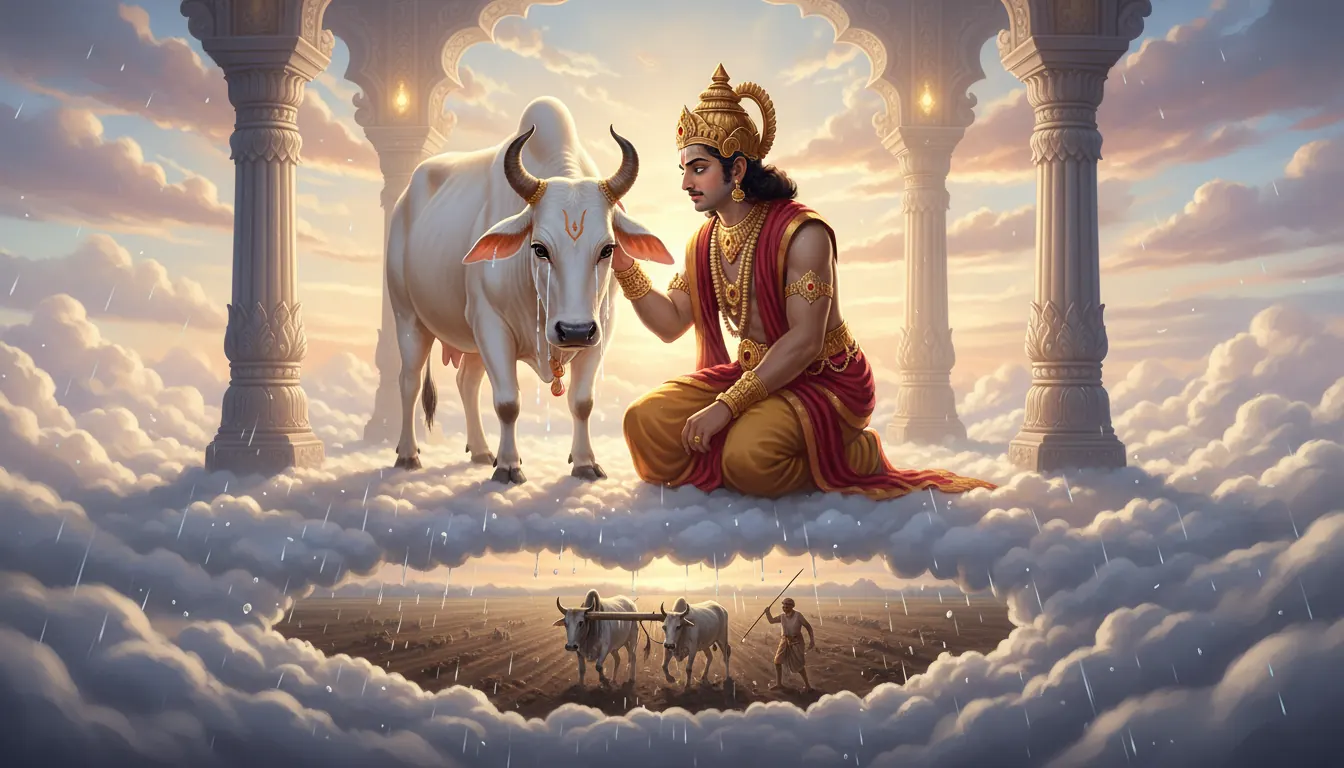
Vyasa turns back Duryodhana's chariots, then presses the blind king to restrain his son and hears him plead that he cannot cast one off. So he tells of Surabhi weeping in heaven over a single lean bullock, and of Indra, who asked why one calf out of a thousand and answered her tears with a downpour that stopped the plough.
Told in the Vana ParvaSet in Hastinapura, Amaravati and Kamyaka Forest16 min read
The Riders Who Never Reached the Forest
Word went round the palace that Vidura had come back and that the king had taken him on his lap and asked his forgiveness, and Duryodhana, hearing it, began to burn.
He summoned the son of Subala, and Karna, and Dushasana, into a room with the doors shut.
"The learned Vidura, my father's minister, has come back," he said. "He is the friend of the sons of Pandu and is always busy doing what benefits them. Before this Vidura can persuade the king to bring them back, all of you must think of what will benefit me. If I ever see the sons of Pritha return to this city, I will waste away again, giving up food and drink. I will take poison, or hang myself, or enter the fire, or kill myself with my own weapons. I will never be able to look on the sons of Pandu in prosperity."
Shakuni told him to be calm: the Pandavas had given a particular pledge, and men who abide by the truth do not come home early. Dushasana agreed with his uncle, as he always agreed with his uncle. And then Karna lost patience with the whole conversation.
"Princes, hear my view," he said. "We are all servants of the king, waiting on him with joined palms, and we cannot always serve his welfare quickly. But let us now put on our armour, take up our weapons, mount our chariots, and go together and kill the Pandavas living in the forest. As long as they are in distress, as long as they are in sorrow, as long as they have no one to help them, we are a match for them. That is what I think."
They applauded him again and again, and at last cried out, very well. Each of them mounted his chariot. Confident of success, they rushed out together to kill the sons of Pandu.
They did not get far. Knowing by his spiritual vision that they had gone out, Krishna Dvaipayana came upon them on the road and commanded them to desist, and sent them back the way they had come. Then the holy one went in to the king, who was sitting at his ease and knew nothing of any of it.
What Waits at the End of Thirteen Years
"Wise Dhritarashtra, hear what I say," said Vyasa. "I will tell you what is for the great good of all the Kauravas."
The blind king turned his face toward the voice and composed it into the expression of a man about to be told something he already knew.
"Mighty-armed king, it has not pleased me that the Pandavas have gone to the forest, dishonestly defeated at dice by Duryodhana and the others. Bharata, when the thirteenth year is over, they will remember all their sufferings, and they may rain deadly weapons on the Kauravas like deadly poison."
He did not say it as prophecy. He said it as arithmetic. Thirteen years is a long time to be a strong man with nothing to do but remember.
"Why does your sinful, wicked-hearted son, always burning with anger, try to kill the sons of Pandu for their kingdom? Let the fool be restrained. Let your son keep quiet. If he tries to kill the Pandavas in exile, he will only lose his own life. You are as honest as the wise Vidura, or Bhishma, or we ourselves, or Kripa, or Drona. You are very wise: quarrels with one's own kin are forbidden, sinful and shameful. So, king, you must stop such acts."
Then the muni offered him a strange remedy, and offered it seriously.
"Or let this wicked son of yours, king, go to the forest by himself, alone, and live with the sons of Pandu. Then, if living together makes the Pandavas grow fond of Duryodhana, good fortune may yet be yours."
He paused, and took the hope back with his next breath.
"But that may not happen. For we have heard that the nature a man is born with does not leave him until death. But what do Bhishma and Drona and Vidura think? And what do you think? What is good must be done while there is still time, or your purposes will come to nothing."
Drawn By Fate
Dhritarashtra did what he did best, which was to agree completely and change nothing.
"Holy one, I did not like this business of gambling," he said. "But I think, muni, that I was drawn by fate into agreeing to it. Neither Bhishma, nor Drona, nor Vidura, nor Gandhari liked this game of dice. No doubt it was born of folly."
He had the whole list ready, and every name on it was a name that had told him no. He recited them like a man producing witnesses to his own good character, and did not appear to notice that the list was, in fact, the case against him: four people of sense had objected, and the thing had happened anyway, in his hall, at his word, and there had been nobody in the world with the authority to permit it except himself.
Then he came to the sentence he had been walking toward the whole time, and his voice went out of the register of statecraft altogether.
"And, illustrious one, you who delight in keeping vows: I know all this, and yet, ruled by a father's love, I cannot cast off my senseless son Duryodhana."
There it was, laid on the floor between them. Not a defence of the boy. Not even a claim that the boy was right. Simply the confession of an old man who could see the ruin coming down the road toward his house and could not make his hands do the one thing that would have turned it aside.
Vyasa was quiet for a moment. He was the father of this king, though the court did not often say so aloud, and he had been told a great many things by a great many men in trouble.
"King, son of Vichitravirya," he said at last, "what you say is true."
Nothing So Good As a Son
"We know well," Vyasa went on, "that a son is the best of all things, and that nothing is as good as a son. I am not going to argue you out of loving him. It is not an error. It is the one true thing you have said this evening.
"But you have taken a true thing and used it as a licence, and that is a different matter. So let me put it to you the way it was once put to the king of the gods, who also had to be taught it, and who was not a fool either. Taught by the tears of Surabhi, Indra learned that a son is worth more than every other precious thing. King, on this subject I will tell you that excellent story, the best of stories, the conversation between Indra and Surabhi."
The lamps were lit around the chamber. Somewhere out beyond the doors the household was going about its evening, and in the hall behind them the dicing board had long since been carried away and the floor swept. The blind king turned his ear toward the sage and sat still, which was the thing he did well, and waited.
"Long ago," said Vyasa, "Surabhi, the mother of cows, was weeping in the heavens."
Weeping in the Heavens
She was the mother of all cattle that walk the earth, and she stood in heaven, among the immortals, in a place where grief has no obvious business, and she was weeping.
Indra saw her, and Indra took compassion upon her, and went to her; and because he was the king of that place and had a king's habit of mind, his first thought was that something had gone wrong with the administration of the worlds.
"Gracious one, why are you weeping?" he asked. "Is all well with the gods? Has any misfortune, however small, come upon the world of men, or of serpents?"
It is worth marking what he had reached for. A goddess in tears must mean a breach somewhere: a war among the gods, a plague among mortals, some disorder in the lower regions. He had run through the whole map of creation looking for the size of catastrophe that would account for what he was seeing on her face.
"No evil has come upon you that I can see," said Surabhi. "But I am grieving for my son, and that, Kaushika, is why I weep."
Indra waited for the rest of it, for the name of the demon or the disease. It did not come. Instead she turned her head and looked down, past the floor of heaven, past the clouds, at a field.
The Pair at the Plough
"Look, chief of the gods," she said. "That cruel farmer is beating my weak son with a wooden stick and crushing him under the weight of the plough, so that my child, writhing in agony, is falling to the ground and is close to death."
Indra looked where she was looking, and there was nothing there worth the notice of the lord of the three worlds: a man, a field, a plough, and two bullocks under one yoke, at the ordinary work of the ordinary earth on an ordinary afternoon.
"When I see this, lord of the gods, I am filled with pity, and my mind is in turmoil."
Then she made him look properly, and told him what to look at, and it was in the difference between the two animals that the whole of the thing lay.
"The stronger of the pair carries his burden of greater weight with ease. But the other, Vasava, is lean and weak, nothing but veins and arteries. He carries his burden with difficulty. It is for him that I grieve. Look, Vasava, sorely beaten with the whip and driven past endurance, he cannot carry his burden. It is for him that I weep with a heavy heart, moved by grief, and these tears of pity run down from my eyes."
One yoke. One field. One driver, with one stick, laying it about him impartially. And under the beam, two creatures of the same birth and the same mother, of whom one was managing and one was going down.
Why One, When You Have Thousands
Shakra put to her the question that any sensible administrator of the universe would have put, and it was not a cruel question. It was the arithmetic of scale, which is the arithmetic that kings and gods are trained in.
"Lovely one," he said, "when thousands of your sons are ill-treated every day, why do you grieve for one who suffers?"
It was, on its face, unanswerable. She was the mother of every cow in the world. At that hour there were beasts being goaded in ten thousand fields, beasts falling in harness, beasts driven past their strength on every road between the mountains and the sea. If she was going to weep for them, she would have to weep for all of them, and if she wept for all of them she could not possibly be weeping like this for one lean bullock in one field in the afternoon. Grief on that scale is not grief. It is weather.
Surabhi answered him without any difficulty at all, because she was not reasoning about it. She was only reporting what was true.
"I have a thousand children, and my love flows equally to all of them. But, Shakra, I feel greater pity for the one who is weak and innocent."
There is the whole teaching, in two clauses, and the second does not contradict the first. Love is not the thing being divided. Love goes out to all of them at once and undiminished. What moves, what leans, what goes where it is needed, is the other thing: the pity, the attention, the hand that reaches down. And that does not distribute itself evenly at all. It goes to the one who is failing, and it goes there for the plain reason that he is failing.
The Shower That Stopped the Plough
When Indra heard these words of Surabhi, he was greatly surprised.
He was the wielder of the thunderbolt, the chastiser of Paka, the slayer of the demon hosts, and he had just been instructed in something by a cow. He did not resent it. He became convinced, Vyasa told the Kuru king, that a son is dearer than one's own life; and once convinced, he did what only he was equipped to do about it.
He made it rain.
Not a sign, not a portent, not a voice out of the sky rebuking the ploughman for his cruelty. The illustrious chastiser of Paka thereupon suddenly poured down there a thick shower, and caused obstruction to the husbandman's work.
Down in the field the man straightened up, looked at the sky in disgust, and swore, because the weather had turned against him for no reason that any farmer could see. The furrow filled. The oxen stood in the wet with the beam gone slack across their shoulders. He unhitched them and drove them off the sodden ground, and the lean one, that had been at the point of death an hour before, walked off the field alive.
That was the whole of the divine intervention. No miracle was announced and no one on earth knew that anything had happened. The king of the gods had been told about one weak animal, and had reached down and taken the weight off him for an afternoon, and had gone back to his throne.
Your Hundred and One, and His Five
Vyasa let the rain stop, and then turned the whole thing around and set it down in front of the blind king with the point outward.
"And as Surabhi said, king, your love flows equally to all your sons. Let it be greater toward those who are weak."
Dhritarashtra said nothing.
"And as my son Pandu is to me, so are you, my son, and so is Vidura of deep wisdom. I tell you all this out of love."
He had not raised his voice once in the entire evening, and he did not raise it now.
"Bharata, you have a hundred and one sons. Pandu has only five. And they are in a sorry state, passing their days in sorrow. How can they save their lives, how can they thrive? Such thoughts about the suffering sons of Pritha trouble my soul without end."
There was the yoke, then, laid across the Kuru house. One team, one field, one father holding the stick. On one side a hundred and one sons in a walled city with the granaries and the treasury and the army and the elephants, carrying their burden of greater weight with perfect ease. On the other side five men in a forest, and a woman with her hair unbound, eating roots.
"King of the earth," said Vyasa, "if you want all the Kauravas to live, let your son Duryodhana make peace with the Pandavas."
Everything But the Doing of It
"Muni of deep wisdom, it is just as you say," said Dhritarashtra. "I know it well, as do all these kings. Indeed, what you think is good for the Kurus was pointed out to me, muni, by Vidura and Bhishma and Drona."
It was the same answer he had given before the dice and would give again before the war: yes, and everyone has told me so, and I understand it perfectly. He had heard the parable. He had taken the point of it entire. He had even conceded that the good men of his court had said the same thing first. And then, at the very end of his agreement, he handed the work back.
"And if I deserve your favour, and if you feel kindly toward the Kurus, then please counsel my wicked son Duryodhana."
A man who cannot cast off his son also cannot correct him, and so he asked another man to do it. Vyasa did not argue. He had known this king a long time.
"King, the holy rishi Maitreya, who has been to see the Pandava brothers, is coming here to see us. That mighty rishi will admonish your son for the good of this house. And, Kauravya, what he advises must be followed without question, for if his advice is not taken, the sage will curse your son in anger."
Saying this, Vyasa departed.
So the parable was told in full, and heard in full, and agreed with in full, and the one act it asked for was passed along to a guest who had not yet crossed the threshold. Out in the Kamyaka woods the five weak ones went on eating what the forest gave them. Their father's brother sat in a lamplit room in Hastinapura, weeping easily, loving all his sons equally, and reaching down to help none of them.
Dharma Lesson
Partiality that runs toward the weak is compassion; partiality that runs toward the strong is only appetite wearing a father's face. Affection may flow equally to every child at once, but the hand that reaches down has to choose, and it belongs to whichever of them is going under the yoke. Dhritarashtra agreed with every word of this and still did nothing, which is the other half of the lesson.