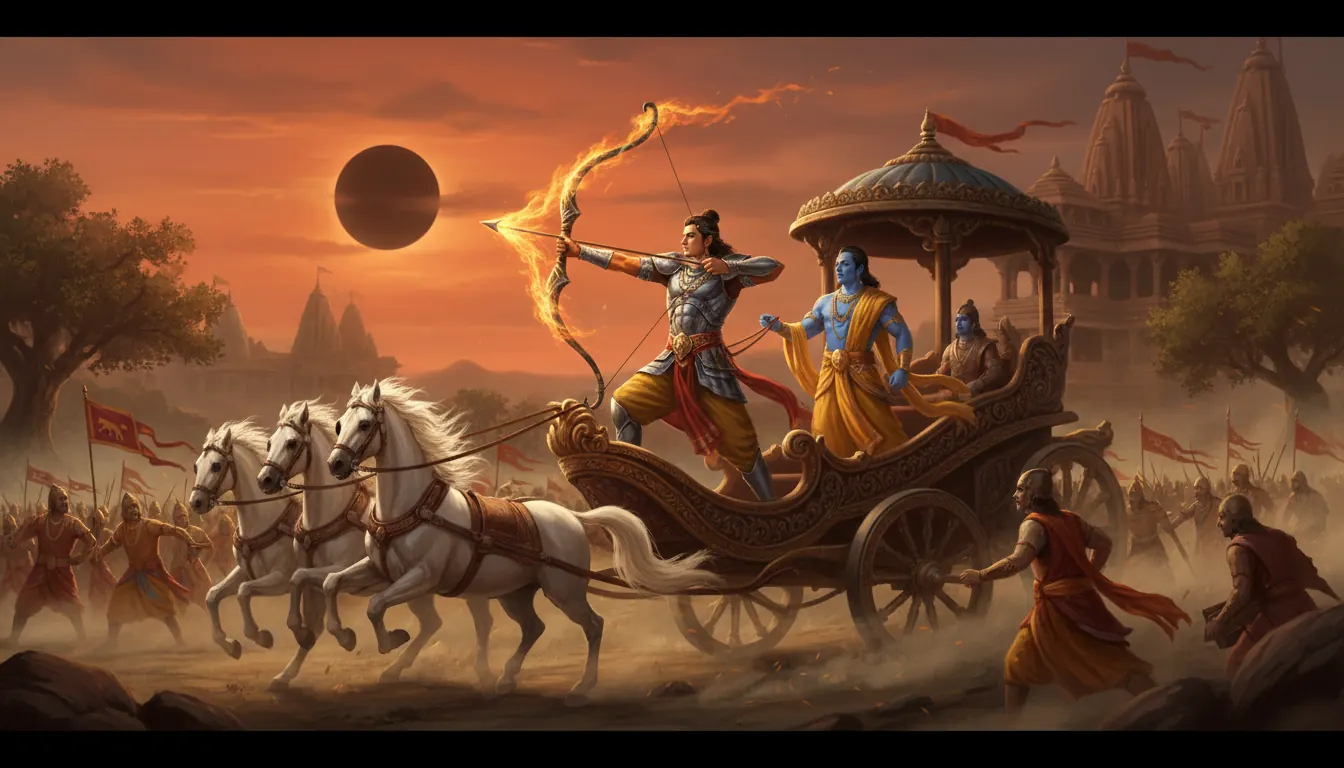
Four Duels on the Fourteenth Day
Kshemadhurti, Viradhanwan, Niramitra and Vyaghradatta go down before Drona's division
In short
On the afternoon of the fourteenth day, while Arjuna drove for Jayadratha, the battle in front of Drona's division came apart into single combats. Brihatkshatra of the Kaikeyas takes Kshemadhurti's head, Dhrishtaketu of the Chedis kills Viradhanwan with an iron dart, and Sahadeva strips Durmukha of his chariot and then kills the Trigarta prince Niramitra whose chariot Durmukha borrows. Nakula beats Vikarna in a moment, and Satyaki, made invisible by Vyaghradatta's arrows, comes out of the cloud and destroys the Magadhas until Drona himself leaves the line to come for him.
Told in the Drona ParvaSet in Kurukshetra, Trigarta and Magadha11 min read
The Order in Which It Happened
Dhritarashtra sat in his hall and had the fourteenth day brought to him piece by piece, and Sanjaya told it in the order in which it happened, because that is the only way a battle can be told to a man who cannot see it.
Far ahead in the dust Arjuna was going after Jayadratha with the sun already past its height, and between him and that man stood the whole Kaurava host, and at the head of it stood Drona. The teacher had drawn up the array himself and stood in the mouth of it. Everything the Pandavas had was being spent on the work of getting through him.
So the kings who followed Arjuna came up against that division one after another, each with his own quarrel and his own opponent, and for a stretch of that afternoon the great battle came apart into single combats, the way a river coming down on a rock comes apart into separate streams.
They were not the famous names. They were the allies, the men who had brought their own troops from their own countries and who are remembered in the epic for one hour each: a prince out of the Kaikeyas, the ruler of the Chedis, the two sons of Madri who were the youngest of the five brothers, and the grandson of Shini who had followed Krishna's house into this war.
Against them Drona had put up the princes of his own side, sons of Dhritarashtra and sons of the Trigartas and sons of the Magadhas, men whose fathers had sworn oaths that were now coming due.
"Kshemadhurti, king," Sanjaya said, and began.
What follows is a list, and every item on the list ends with a man on the ground. The blind king listened to all of it. He had asked to be told, and Sanjaya was not in the habit of softening the count.
The Head With the Ear-rings
Kshemadhurti struck first, and struck well. He pierced the advancing Brihatkshatra in the chest with many arrows, and Brihatkshatra, prince of the Kaikeyas and a man of great valour, took them and kept coming, because what he wanted was not this duel but the thing behind it. He was trying to pierce through Drona's division.
Being struck in the chest, he answered with ninety straight shafts, all at once, quickly, the way a man answers when he is in a hurry to be somewhere else.
That filled Kshemadhurti with rage. He took a sharp broad-headed shaft, well tempered, and cut the bow of the high-souled prince of the Kaikeyas in two, and then, before the other could reach behind him, put a sharp, straight arrow through that greatest of all bowmen.
It should have ended there. It is the shape every one of these fights has: the bow goes, and then the man goes.
But Brihatkshatra took up another bow, and Sanjaya says that he smiled while he was doing it.
Then he shot. The horses went first, and then the driver came out of his niche, and then the chariot itself was broken under the man standing on it, and Kshemadhurti, who had been a mighty chariot-warrior a moment before, was without horses, without driver and without chariot in the middle of Drona's division with nothing left to do.
And with another broad-headed shaft, well tempered and sharp, Brihatkshatra cut off from the trunk of his royal antagonist the head that blazed with a pair of ear-rings.
It came off wearing everything a king wears above the neck and nothing else, graced only with its locks and its diadem, and it fell down on the earth, and Sanjaya, telling this to a father who was losing sons in that same battle, said that it looked resplendent, like a luminary fallen out of the firmament.
Having slain his foe, Brihatkshatra was filled with joy, and fell with great force upon the Kaurava troops for the sake of the Parthas.
The Dart With the Golden Staff
The next man to come up against Drona was Dhrishtaketu, the ruler of the Chedis, whose father Shishupala had been killed by Krishna at Yudhishthira's sacrifice years before and whose son had brought the whole country over to the Pandava side anyway.
The great bowman Viradhanwan resisted him, and would not let him past.
They were both quick men, both full of energy, and Sanjaya says they had arrows for their fangs. They struck each other with many thousands of arrows. Two tigers among men, he calls them, fighting like two leaders of elephant herds meeting in fury in the deep woods, like two enraged tigers in a mountain cave with no room in it for either to give way.
That combat became exceedingly fierce, and it became something else as well. It became worth watching. The Siddhas and the Charanas came in large numbers and stood in the air above that patch of the field and looked down at the two of them with wonder-waiting eyes, which is a thing they did not do for every duel fought that day.
Then Viradhanwan, with a laugh, cut Dhrishtaketu's bow in twain with broad-headed arrows.
Again the same moment, and again the answer was not the one the shape of the thing required. The ruler of the Chedis threw the broken bow away and reached for a dart instead, a fierce thing made of iron and equipped with a golden staff.
He bent it with his hands toward the chariot of Viradhanwan. Sanjaya is careful about how it was thrown: carefully, and with great force, which are two things that are hard to do at once and which he did.
That hero-slaying dart went through Viradhanwan's heart, and he came down off his chariot onto the ground straight away.
He was a mighty chariot-warrior among the Trigartas, and upon his fall the whole Kaurava army in that quarter was broken by the Pandavas.
The Brother Striking the Brother
Durmukha found Sahadeva in the press and sent sixty shafts into him, and then shouted, loudly, so that the whole quarter of the field would know that a son of Dhritarashtra had challenged a son of Pandu.
The son of Madri was filled with rage. He pierced Durmukha with many keen arrows, and he smiled the whole time he was doing it, and Sanjaya, who had a phrase for this and used it, called it the brother striking the brother. They had grown up in the same city. They had been taught by the same teacher, who was two hundred paces away holding the line they were fighting over.
Durmukha kept fighting furiously and struck Sahadeva with nine shafts, and Sahadeva then began taking his enemy apart in the order in which a chariot-warrior is taken apart.
The standard came down first, cut with a broad-headed arrow, so that the men behind Durmukha would no longer know where he was. Then four arrows for the four horses. Then one more broad-headed arrow, well tempered and sharp, which cut the head of the charioteer from his trunk, and Sanjaya notices that this head too was shining with a pair of ear-rings, because a prince's driver in that army was himself a man of rank.
Then a razor-faced arrow cut Durmukha's large bow, and five arrows went into Durmukha himself.
He was standing on a wreck now, with nothing under him that could move and nothing in his hands that could shoot, and Sahadeva was ten paces away and unhurried.
What Durmukha did next Sanjaya reports without a word of blame. Distressed, with his horses dead, he jumped down from that horseless chariot, and he ran, and he climbed up onto the chariot of the man fighting nearest him.
That man was Niramitra.
Two Sons of Madri, Two Princes
Niramitra was the son of the ruler of the Trigartas, a prince fighting in the middle of his own division with his own people around him, and he had done nothing that afternoon except hold his place. Durmukha climbing onto his chariot was the whole of his part in this.
Sahadeva, filled with rage, killed him where he stood with one broad-headed arrow.
Prince Niramitra fell down from that chariot in the midst of his division, and the Kaurava army was afflicted with great grief, and among the Trigarta warriors, who had sworn together and marched together and now watched their king's son go down for nothing, there rose loud cries of Oh and Alas.
Having slain him, said Sanjaya, the mighty-armed Sahadeva looked resplendent, like Rama the son of Dasaratha after the slaying of the Rakshasa Khara. It is a large comparison to make for the quietest of the five brothers, and Sanjaya makes it without qualification, to a hall full of Kauravas.
A little way off, at almost the same moment, the other twin was fighting the one Kaurava the Pandavas had no wish to kill.
Vikarna of the large eyes was the son of Dhritarashtra who had stood up in the dice hall when Draupadi's question was put to the assembly and had said out loud, in front of his brothers, that she had not been won. Nobody had thanked him for it. He had stayed on his own side of the war regardless, as a kshatriya does, and here he was in front of Nakula with a bow in his hands.
Sanjaya gives it one sentence, and it is the shortest notice any combat gets in the whole of this stretch.
Nakula, in a moment, vanquished Vikarna.
Then he adds three words of his own, which are the nearest thing to an opinion he permits himself all afternoon.
This seemed highly wonderful.
He does not say that Vikarna was killed. He was not, not by Nakula. Nakula beat him and let the moment pass, and it was Bhima who would bring Vikarna down, later on that same fourteenth day, and grieve for him when he had done it.
The Grandson of Shini, and the Teacher Who Came For Him
The last of the duels was the one that changed the shape of the field.
Vyaghradatta, prince of the Magadhas, came at Satyaki with straight shafts and did to him what nobody had managed to do to Satyaki that day. In the midst of his own division, with his own men watching, he made the grandson of Shini invisible. The horses went out of sight, and the driver, and the standard, and the man himself, all of it buried under arrows so thick that the place where Satyaki had been was simply a cloud.
The cloud opened.
Satyaki checked those shafts with great lightness of hand, which is Sanjaya's way of saying that a man who has been shot at by Bhurishravas and by Drona is not going to be finished by a prince of the Magadhas, and then with his own arrows felled Vyaghradatta with his horses and his driver and his standard together, so that the whole chariot came down as one thing.
Upon the fall of their prince the Magadhas did not break. They struggled vigorously and rushed against Yuyudhana from all sides at once, scattering shafts and lances by thousands, and sharp arrows and spears and mallets and thick clubs, everything a desperate division can throw, all of it aimed at one chariot.
Satyaki, that bull among men, laughing all the while, defeated them all with the greatest ease.
The Magadhas were nearly exterminated. A small remnant fled from the field.
And the Kaurava army, watching that happen and already stricken by Yuyudhana's arrows, broke. That greatest of Madhu's race stood among the wreckage he had made and shook his bow, and looked, said Sanjaya, resplendent, and frightened by that hero of long arms not one man in that host would come near enough to fight him.
Not one, until the teacher himself saw what was happening at the edge of his own array.
Then Drona, filled with rage and rolling his eyes, left the line he had been holding all day and rushed impetuously toward Satyaki, whose feats could not be checked.
Dharma Lesson
Every one of these combats has the same shape, and the shape is the lesson: a man's bow is cut, and what he does in the next breath decides everything. Brihatkshatra takes up a second bow and smiles; Dhrishtaketu drops the broken one and picks up a dart; Durmukha, who does neither, jumps onto a friend's chariot and costs the Trigartas their king's son. The epic keeps the names of these men, who are nobody's heroes and get one hour each, with the same care it gives to Arjuna, because dharma on a battlefield is not measured by how large a part you were given but by whether you held the place you were standing in.