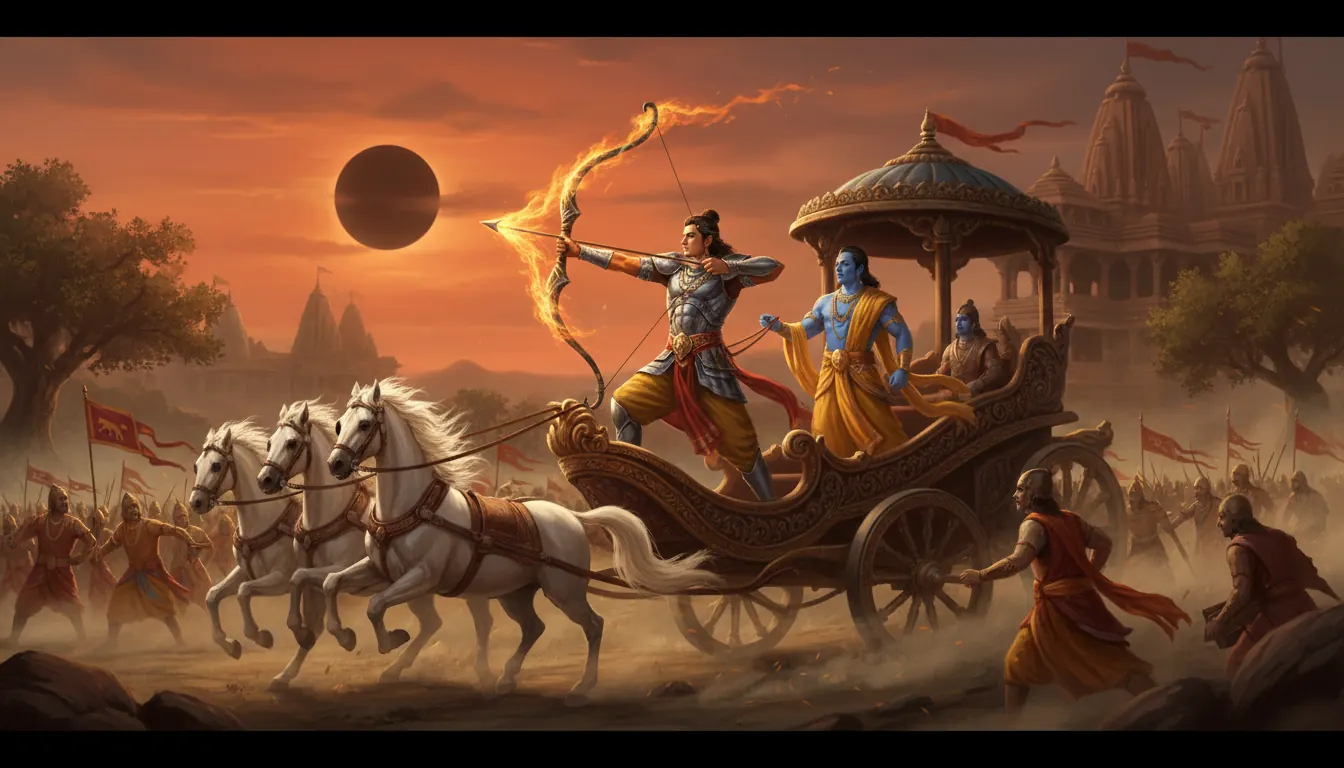
The Stones and the Golden King
Satyaki kills Sudarshana on the road to Arjuna, and cuts the mountaineers' stones out of the air
In short
On the fourteenth day, riding alone through the Kaurava host to reach Arjuna, Satyaki is checked by the king Sudarshana and takes his head with a razor-faced arrow. He cuts down the Yavanas and Kambojas, drives Duryodhana off the field by killing his charioteer, and is then met by mountaineers who fight with stones, a mode of war no chariot warrior knows. He breaks the stones in the air, and the falling fragments kill the men who threw them.
Told in the Drona ParvaSet in Kurukshetra20 min read
We Have Only Slain the Dead
Sanjaya was still telling the fourteenth day, and the fourteenth day would not end.
Arjuna was far ahead somewhere in the dust, hunting the ruler of the Sindhus with the sun going down on his vow, and Yudhishthira, unable to bear not knowing, had sent Satyaki of the Vrishnis after him. One chariot. The whole Kaurava army in between.
He had gone through it. He had fought Drona at the gate of the array until the teacher's horses ran away with the chariot and traced a thousand circles on the field like a sun in motion, and Drona, seeing his array broken behind him, had let him go. He had gone past Kritavarma, the son of Hridika, and past the division of the Bhojas and the sea of Jalasandha's troops, and none of them had held him.
And when he had beaten all of them, that bull among the Shinis laughed, and spoke to the man holding his reins.
"Suta, our foes had already been consumed by Keshava and Phalguna. In beating them again we have only been the means. That bull among men, the son of the king of the gods, had already slain them. We have only slain the dead."
It is worth stopping on that, because it is the only boast Satyaki made all afternoon that was not a boast. He had just beaten Drona. He said the men he was cutting through were corpses that Krishna and Arjuna had made before he arrived, and that his own hand was the instrument and nothing more.
Then he scattered his arrows on every side with great force and went forward like a hawk in search of prey.
The Kuru warriors attacked him from all sides and could not resist him. His horses were white as the moon, white as a conch, and they carried him through ranks that closed and broke and closed again, and Sanjaya, who was watching for the king's sake and not for Satyaki's, said plainly that no one who fought on Dhritarashtra's side that day was able to stop him. He looked, said Sanjaya, like the autumn sun standing in the sky.
The King in the Golden Mail
One man came out of that host to stand in front of him.
His name was Sudarshana. He was a king, and Sanjaya calls him the grandson of a prince, one of the many royal sons who had brought their fathers' levies to Duryodhana's side and whose names are heard once in the epic and never again. He knew every mode of warfare. He wore a golden coat of mail. He was armed with bow and arrows and he was filled with rage, and he advanced against the rushing Satyaki and set himself to check his course.
Nobody else on that part of the field had tried it.
The encounter that followed was fierce in the extreme, and both armies stopped to applaud it. The Kauravas praised it and the Somakas praised it, which does not often happen in the same sentence, and the comparison the watchers reached for was the oldest one they had: Vritra and Vasava, the demon and the king of the gods, the fight at the beginning of the world.
Sudarshana was not overmatched at first. He tried to pierce the great Satvata with hundreds of keen arrows, and Satyaki struck them down in the air before they could reach him. Standing on his fine chariot, he cut the shafts that Satyaki sped at him into two and three fragments as they came, and for a while the sky between the two chariots was full of broken arrows falling.
Then he saw that his own arrows were being checked by the force of Satyaki's, and he changed his way of fighting. As if to consume his enemy, he shot beautiful arrows winged with gold. Three of them, drawn to the ear and like fire itself, went through Satyaki's armour and into his body. Four more, blazing, struck Satyaki's four horses, which were white as silver.
He had drawn blood on a man who had just walked through Drona. For a moment, on that field, Sudarshana was winning.
The Head Graced With Earrings
Stung by those arrows, the grandson of Shini answered with everything he had.
He killed Sudarshana's horses with his keen arrows, and roared aloud. Then he took a broad-headed arrow with the force of Shakra's thunder and cut off the head of Sudarshana's driver, so that the king stood alone on a chariot with no horses and no one to turn it.
Then he took a razor-faced arrow like the fire that comes at the end of a Yuga, and cut the head from Sudarshana's trunk.
Sanjaya, telling this to the blind king in the hall at Hastinapura, does not hurry past the head. He describes it as it went. It was graced with earrings. It resembled the moon at full. The face on it was exceedingly radiant. This is how the epic marks a man who was nothing to the story until the moment he died in it: it makes you look at his face once, at the exact instant it is no longer attached to him.
And for the comparison Sanjaya went back to the same old war he had used a moment before. It was as when the wielder of the thunder, long ago, cut off the head of the mighty Vala in battle.
When that high-souled bull among the Yadus had slain the grandson of a prince, he was filled with delight, and shone like the king of the gods himself.
Then he did not stay to be admired. He turned his chariot onto the track Arjuna had taken before him, which was easy to find because it was made of the dead, and he went along it holding back the Kaurava troops with clouds of arrows as he went.
The warriors assembled there applauded the feat, even the ones he was killing. He consumed all foes that came within reach of his arrows, said Sanjaya, like a conflagration consuming everything in its way.
The Ocean Already Forded
When Sudarshana was dead, Satyaki spoke to his charioteer again, and what came out of him was a description of what he had just survived.
"We have crossed the almost uncrossable ocean of Drona's division," he said. "It teems with chariots and horses and elephants. Its waves are arrows and darts, its fish are swords and scimitars, and its alligators are maces. It roars with the whiz of arrows and the clash of every kind of weapon. It is a fierce ocean that destroys life, its touch is cruel and unbearable to warriors who want victory, and its shore is haunted by fierce cannibals, the force of Jalasandha. After that, I think the part of the array that is left can be crossed as easily as a poor, shallow stream.
"So drive the horses on without fear. I think I am very close to Savyasachin now. Fear never comes into my heart, even when I see countless foes in front of me. To me they are like a heap of straw and grass before a forest fire."
Then he told the man to look at the ground.
"Look, the track the diadem-crowned Arjuna has taken is uneven with great numbers of foot-soldiers and horses and chariot-warriors and elephants lying dead on it. Look, that high-souled warrior has routed the Kaurava army and it is fleeing. Look, charioteer, at the dark brown dust raised by those retreating chariots and elephants and horses."
He listened, and heard something under the dust.
"Listen. I can hear the familiar twang of Gandiva, whose power has no measure. From the omens I see, I am sure that Arjuna will slay the ruler of the Sindhus before the sun sets."
That is the only prophecy Satyaki makes in the war, and he makes it out of a sound. Then he told the driver to spare the horses and go slowly, because ahead of them, waiting with their faces turned towards him, were Duryodhana and the Kambojas and the Yavanas and the Sakas and the Daradas and the Barbaras and the Tamraliptakas and countless other Mlecchas, armed with every kind of weapon and resolved to fight him.
The Charioteer Who Was Not Afraid
Charioteers in this epic are rarely brave in their own right. This one answered like a warrior.
"Vrishni, I have no fear. If you had Jamadagni's son himself before you in his wrath, or Drona, the greatest of chariot-warriors, or the ruler of the Madras, even then fear would not enter my heart, as long as I am under the shadow of your protection. You have already beaten countless Kambojas in mail, men of fierce deeds and hard to defeat, and many Yavanas, and Sakas and Daradas and Tamraliptakas, and many other Mlecchas armed with all kinds of weapons. I have never felt fear in any battle before. Why should I feel any fear in this wretched fight?
"Which way should I take you to reach Dhananjaya? With whom are you angry, Vrishni? Who are the men who will flee from the battle when they see you looking like the Destroyer himself at the end of the Yuga? Who are the men King Vaivaswata is thinking of today?"
He was asking his master to name the men who would be dead by evening, and Satyaki named them.
"As Vasava destroyed the danavas, I will slay these warriors with shaved heads. By slaying these Kambojas I will fulfil my vow. Take me there. Today I will show my teacher, the high-souled Pandava of the white horses, the skill in weapons I learned from him."
That is the sentence to hold on to. Everything else he said in that speech was about Duryodhana, and he said a great deal: that Suyodhana would be inspired with grief, that Suyodhana would see the bow in his hands resemble a circle of fire, that Suyodhana would see two Arjunas on the field today. But underneath the boasting was a pupil going to find his teacher, wanting to be seen doing well.
"Today I will slay thousands of kings," he finished, "and show my love and devotion to those high-souled men, the royal sons of Pandu. Today the Kauravas will know the measure of my might and energy, and my gratefulness."
Gratefulness. He was a Vrishni. He owed the Pandavas nothing but friendship, and he was paying it in the only currency he had.
The Shaved Heads
The charioteer urged those moon-coloured horses to their utmost speed, and they went as if devouring the very sky, and carried Yuyudhana to the place where the Yavanas were.
The Yavanas were quick. They were many, and quick of hand, and they came at him without falling back and covered him with showers of arrows. Satyaki cut all of it out of the air with his own straight arrows, and then began to work.
With very sharp arrows, winged with gold and vulture's feathers, he cut off their heads and their arms. Many of the arrows went through coats of mail made of iron and brass and buried themselves in the earth beyond. Drawing his bow to its fullest stretch, shooting in continuous lines, he began to kill five and six and seven and eight of them at a time. Thousands of Kambojas, and Sakas, and Barbaras went the same way.
Sanjaya, describing the field afterwards, does not make it beautiful. He says Satyaki made the earth impassable and miry with flesh and blood. He says the ground was strewn with the head-gears of those men and with their shaved heads, which because of their long beards looked like featherless birds.
Then, having said that, he reaches for one image that is beautiful, and it is the worst line in the passage: that the field covered with headless trunks dyed all over with blood looked lovely, like the sky covered with coppery clouds.
The small remnant of those mail-clad troops, in despair, their lives about to be taken, urged their horses with goads and whips and fled in all directions.
And Satyaki, crowned with victory, who had routed the invincible Kamboja host and the Yavanas and the great force of the Sakas, said one word to his driver.
"Forward."
The charanas and the gandharvas in the sky above the battle applauded that feat, which no one else had ever achieved. Even the Kaurava warriors watching him, said Sanjaya, were filled with delight at his heroism, which is a strange thing to record about a man who was destroying their army, and Sanjaya records it anyway.
A Bull in a Cow-Pen
He came on towards Arjuna right through the middle of the host, and for a little while Sanjaya stops the fighting altogether to describe him, because the old man in Hastinapura could not see and had to be told.
His bow, the back of its staff decked with gold, was very tough and adorned with many golden moons, and he shook it with force as he came. His arms were decked with golden Angadas. His head-gear was adorned with gold. His body was clad in golden mail, and his standard and his bow were embellished with gold, so that he shone like the summit of Meru and looked like a second sun in autumn. He had the shoulders and the tread and the eyes of a bull, and he moved through that army, said Sanjaya, like a bull in a cow-pen.
Warriors came at him eager to kill, the way a tiger comes at the leader of an elephant-herd standing proudly in the middle of his herd with his temples running.
They came in numbers now. Duryodhana came, and Chitrasena and Dushasana and Vivinsati, and Shakuni and Duhsaha, and the youthful Durdharshana, and Kratha, and many other brave warriors difficult to defeat, and they followed him from behind as he went. The uproar among the troops was like that of the ocean at full tide lashed into fury by a tempest.
Satyaki looked back at all of it and smiled and told his driver to slow down.
"Go slowly. This Dhartarashtra force is rushing at me, swelling with rage and pride, teeming with elephants and horses and chariots and foot-soldiers, filling the ten points of the compass with the deep roar of its chariots and making the earth and the sky and the very seas tremble. I will hold back this sea of troops in great battle, as the land holds back the ocean when it swells to its greatest height at the full moon. Watch my prowess, charioteer. I will consume this hostile force with my whetted arrows."
They came shouting as they came, "Slay, Rush, Wait, See, See!"
Of those brave warriors who said those words, Satyaki with his sharp arrows killed three hundred horsemen and four hundred elephants before they reached him.
The King's Chariot Taken Away
The passage at arms that followed was like the old war between the gods and the asuras, and Sanjaya says one thing about it that he says about no other fight in the whole book.
Not an arrow of Satyaki's failed in effect.
That sea of troops, full of chariots and elephants and horses, with waves made of foot-soldiers, stood still as soon as it touched the shore that was Satyaki. The host wandered this way and that, panic-stricken, slaughtered on all sides by the arrows he turned round and shot again, as if struck by the chilling blasts of winter. We did not see, said Sanjaya, a foot-soldier or a chariot-warrior or an elephant or a horseman or a horse that was not struck by Yuyudhana's arrows.
And then, to Dhritarashtra, who had asked all his life for one honest sentence about his sons' chances: not even Phalguna caused such a carnage there as Satyaki caused among those troops. That bull among men, with his great quickness of hand and his utmost skill, fights better than Arjuna himself.
The princes did what they could. Duryodhana pierced the charioteer of the Satvata with three keen shafts and his four horses with four, and Satyaki himself with three and then with eight. Dushasana pierced him with sixteen. Shakuni with twenty-five. Chitrasena with five. Dushasana again with fifteen in the chest. Satyaki, struck by all of them, proudly pierced every one of them with three arrows each in return.
Then he cut off the bow of Subala's son and the leather guard on his hand, and put three shafts into the centre of Duryodhana's chest. A hundred arrows into Chitrasena. Ten into Duhsaha. Twenty into Dushasana. They came back at him and he took it, five arrows returned to each of them, wheeling over the field as fast as a hawk.
Duryodhana pierced Madhava with seventy-three arrows and his charioteer with three more.
And Satyaki answered by killing Duryodhana's charioteer with a single broad-headed shaft.
The man fell dead from the chariot, and the horses, with nobody holding them, carried the king of the Kauravas out of the battle as fast as the wind. Dhritarashtra's other sons, and the warriors with them, saw the king's chariot going away, and fled after it in hundreds.
The Blind King Asks
In the hall at Hastinapura the recital stopped, because Dhritarashtra could not hold his question any longer.
"When they saw the grandson of Shini going towards Arjuna, grinding down that great force as he went, what did those shameless sons of mine do, Sanjaya? How could Satyaki, famous as he is through the world, pass through them in battle? How, while my sons were alive, could the grandson of Shini go into battle at all? What you have told me is truly wonderful, this fight between one and many, and the many all mighty chariot-warriors.
"Suta, I think Destiny has now turned against my sons. My army is no match for even one warrior, Yuyudhana in his wrath. Let all the Pandavas hang up these weapons. Satyaki has beaten Drona himself, and he will slay my sons as a lion slays smaller animals. Many heroes, Kritavarma first among them, could not slay him. Phalguna himself did not fight the way the famous grandson of Shini has fought."
Sanjaya did not comfort him.
"All this, king, has been brought about by your evil counsels and by what Duryodhana has done. Listen carefully to what I say."
At Duryodhana's command the Samsaptakas rallied and resolved on fighting fiercely. Three thousand horsemen headed by the king, with Sakas and Kambojas and Bahlikas and Yavanas and Paradas, with Kalingas and Tanganas and Ambashthas and Pishachas and Barbaras and mountaineers, inflamed with rage and armed with stone, all rushed at the grandson of Shini like insects against a blazing fire. Five hundred more warriors rushed at him after them. Then another body: a thousand chariots, a hundred great chariot-warriors, a thousand elephants, two thousand horses, and countless foot-soldiers.
Dushasana urged them on, saying, "Slay him," and surrounded Satyaki with all of it.
What we saw of Shini's grandson then was grand and wonderful, said Sanjaya, for he fought those innumerable foes alone and without fear.
And he killed them. The chariot-warriors, the elephant force, the horsemen, all of it. Like the autumn sky spangled with stars, the field became strewn with broken chariot wheels and shattered axles and crushed elephants and fallen standards, with coats of mail and shields scattered about, with garlands and ornaments and robes lying in the dirt among the tuskers, huge as hills, that lay there deprived of life.
The Men Who Fought With Stones
Dushasana shouted after his running men.
"Warriors who know nothing of right conduct, fight! Why are you retreating?"
They paid no heed. So he turned to the mountaineers, kshatriyas of the hills whose way of fighting was not the way of the plains, and told them something perfectly true.
"You are skilled at fighting with stones. Satyaki knows nothing of this way of fighting. None of the Kauravas know it either. Rush at Satyaki. Do not be afraid. Satyaki will not be able to get near you."
Urged on like this, those men of the mountains came towards Satyaki like ministers towards a king, and stood before his chariot with stones huge as elephants' heads uplifted in their hands.
Satyaki sent showers of keen arrows at them, and with those arrows that looked like snakes he cut the dense shower of stones to fragments in the air.
That was the flaw in Dushasana's plan. The fragments came down. Splinters of rock, looking like a swarm of blazing fire-flies, fell into the Kaurava ranks and killed many men there, and cries of oh and alas went up from the field.
Then five hundred warriors with huge stones lifted over their heads fell to the ground with their arms cut off. Then a full thousand more. Then, says Sanjaya, a hundred thousand, their arms with the stones still in their grasp shorn away before they could come near him.
Many went back and hurled stones again, and Daradas and Tanganas and Khasas and Lampakas and Pulindas threw swords and lances, and he cut those out of the air too. The noise of stones breaking overhead was so fierce that chariot-warriors and horses and elephants fled from it, and men struck by the flying chips felt as if bitten by wasps.
Far off, Drona heard a sound like the ocean at full tide and spoke to his own charioteer.
"That great chariot-warrior of the Satvata race is tearing our army to pieces like the Destroyer himself. Take the chariot to where that furious uproar is coming from. Without doubt Yuyudhana is fighting the mountaineers who battle with stones."
The charioteer answered like a man who had counted the odds honestly.
"The Kaurava troops are fleeing, and the Panchalas and the Pandavas together are rushing in from all sides, eager to kill you. Decide which of these tasks should come first. As for Satyaki, he is far ahead of us now."
While he was still speaking, Satyaki came suddenly into view, killing chariot-warriors. The troops broke and ran towards Drona's division, and the men Dushasana had brought ran with them, and the road to Arjuna was open.
Dharma Lesson
Satyaki was given a weapon he had no training against, and he did not try to answer it in kind. He answered it with the thing he was already good at, and the stones came apart over the heads of the men who threw them. Dushasana had reasoned correctly that his enemy was ignorant of that mode of war, and lost his troops anyway, because a plan built on the other man's ignorance is only as strong as his unwillingness to improvise. There is also the small thing Satyaki said before any of it began: that the foes he was cutting down had already been slain by Krishna and Arjuna, and that he was only the means. A man who can say that while winning is unlikely to be ruined by winning.