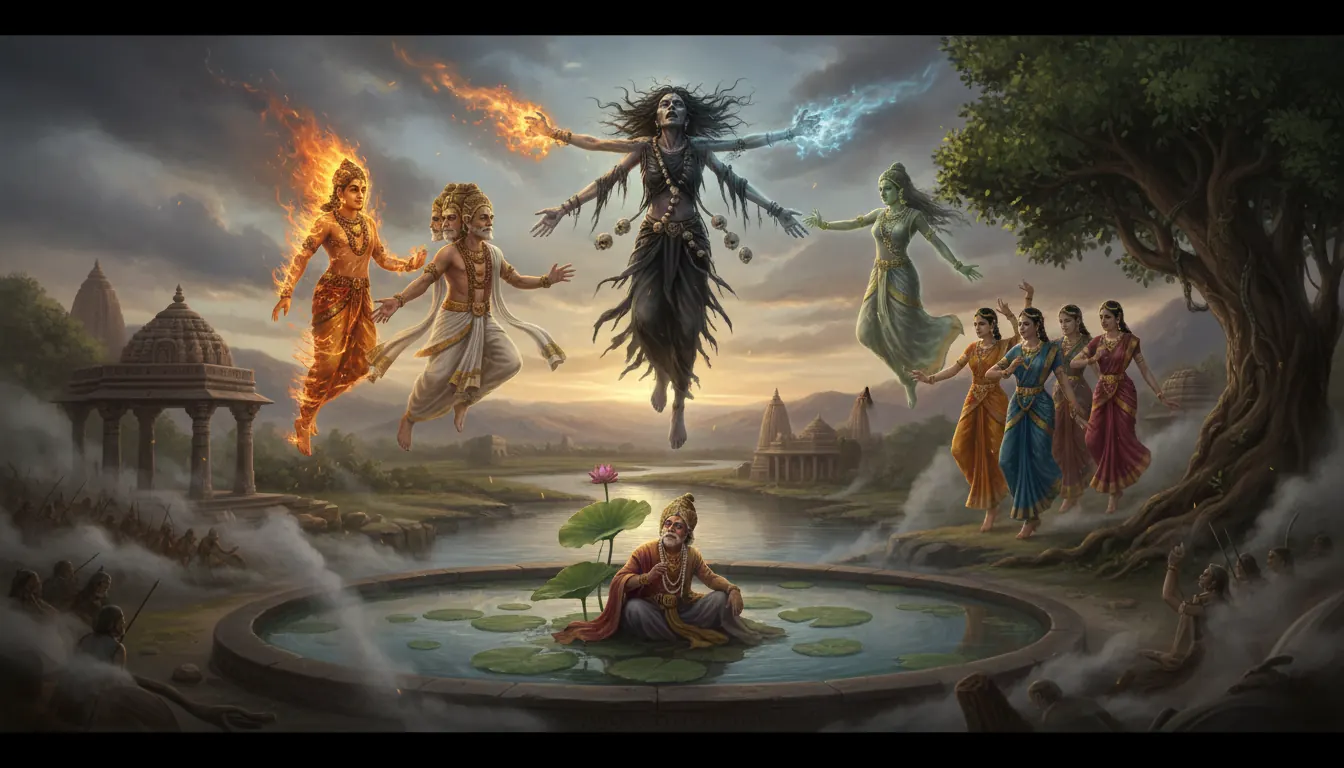
The Four Shares of a Sin
Who agreed to carry a quarter of Indra's guilt, and what it cost them
In short
When Indra strikes down Vritra with a thunderbolt pervaded by Vishnu, the sin of brahmanicide steps out of the corpse as a hag in a garland of skulls and fastens on him, and the king of heaven hides for years in the fibre of a lotus stalk. Brahma will not destroy her. He divides her into four and persuades Fire, the trees, the apsaras and the waters each to hold a quarter, and each accepts only after he names the human act that will carry it away.
Told in the Shanti ParvaSet in Amaravati, The Ocean and Brahmaloka17 min read
The Symptoms of a Fever
"You have told me how the fever went into him," Yudhishthira said. "Tell me what it did."
He had asked for the story of Vritra three days running, and the old man had noticed which part of it the king kept circling back to. It was not the battle. Yudhishthira had been at a battle. It was the killing of a brahmana, and what becomes of the man who does it, and whether anything in the whole apparatus of sacrifice and gift and penance can be made to take such a thing off a person; and Bhishma knew perfectly well that somewhere behind the question stood a chariot on the seventeenth day, and an old teacher sitting down in it to die, and a true sentence spoken in a voice pitched to be misheard.
Bhishma lay on his arrows with his head tilted back on the three shafts, and did not open his eyes to answer. "Listen then, king, to the symptoms that appeared on the body of Vritra when he was overtaken by that fever, which was born of the energy of Mahadeva.
"The heroic asura's mouth began to give off flames of fire. He became very pale, he who had been the colour of a storm. His body trembled all over and could not be made to stop. His breath came hard and thick. The hairs of his body stood on end. And then his memory came out of his mouth, Bharata, in the form of a jackal, fierce and dreadful and inauspicious, and went away from him across the field, and he did not know afterwards what he had known before.
"Burning and blazing meteors fell on his right hand and on his left. Vultures gathered, and kanakas, and cranes, and they wheeled over Vritra's head uttering fierce cries, as birds do over a thing that is finished but has not yet been told so.
"And in that encounter Indra, adored by the gods and armed with the thunderbolt, looked hard at the Daitya as he sat there on his chariot. He did not strike. He watched, the way a man watches a wall he has undermined, waiting for the crack to run.
"Then the mighty asura, in the grip of that violent fever, yawned. He yawned, monarch, and uttered cries that were not the cries of anything human."
"And Indra struck while his mouth was open," Yudhishthira said.
"While his mouth was open," said Bhishma.
The Bolt Pervaded by Vishnu
The thunderbolt that Shakra hurled was not merely his own. Vishnu had entered it and lay along its length, and it went out from the god's hand with tremendous energy, like the fire that destroys the creation at the end of the Yuga.
It overthrew Vritra of gigantic form in a trice. There was no second blow. The asura who had stood over the three worlds like weather went down in the time it takes a stone to fall, and the field was suddenly very quiet.
Then the gods shouted loudly on every side, once more, as they had shouted at the beginning of the war and had not shouted since. Maghavat, the famous foe of the Danavas, had slain Vritra, and he went up into heaven with the thunderbolt still in his hand.
"He had won," Bhishma said. "Understand that clearly, son of Kunti, because everything that follows depends on it. He had not lost. The gods were cheering him. The enemy of the worlds was dead on the ground, and every deity in the sky agreed that the deed was necessary and rightly done, and there was no one anywhere to accuse him of anything.
"And just then, out of the body of the slain Vritra, something stood up."
What Stood Up Out of the Corpse
The sin of Brahmanicide came out of the dead demon in her embodied form, fierce and awful and inspiring all the worlds with dread.
She had terrible teeth. She was hideous for ugliness, and her colour was dark and tawny together; her hair hung dishevelled about her, and her eyes were dreadful to look into. Round her neck she wore a garland of skulls. She was covered all over with blood, and clad in rags and in the barks of trees, and she looked, Bharata, exactly like an Atharvan incantation that had been given a body and told to walk.
Of such form and such mien she came out of Vritra's body, and she looked about the field for the wielder of the thunderbolt, because a sin does not attach itself to the thing that was killed. It attaches to the hand.
A little while afterward the slayer of Vritra was proceeding toward heaven upon some errand connected with the good of the three worlds. That is the detail I want you to hold, Yudhishthira: he was on an errand for the benefit of everyone alive when she found him. She saw Indra of great energy going by upon his business, and she seized the chief of the deities, and from that moment she stuck to him.
He could not shake her off. He was the king of the gods, and he had killed the enemy of the gods with the approval of the gods, and he walked into his own heaven with a hag of skulls fastened to his back, and the shouting stopped.
The Fibre of a Lotus Stalk
When the sin of Brahmanicide had fastened on him like this and filled him with terror, Indra did what the king of the gods would not have believed himself capable of. He ran, and then he hid.
He entered the fibres of a lotus stalk and dwelt there, small as a thread inside a green tube in the water, and he stayed there many long years while heaven went on without its king.
It did him no good. The sin of Brahmanicide pursued him closely into the water and into the stalk and into the fibre. In her grip, the chief of the gods lost all his energies; the power went out of him as heat goes out of a room. He made great efforts to drive her from him, one after another, and every one of those efforts failed.
"Consider what he tried," Bhishma said. "He is Shakra. He had the thunderbolt. He could not strike her, for what would he strike? He could not out-run her, for she was on him. He could not out-wait her; he had already spent years being a thread in a plant. There is nothing in the armoury of the king of heaven that answers a thing like that."
So at the last, seized by her still, he came out of the water and presented himself before the Grandsire, and bent his head low, and worshipped him, saying nothing about it at all.
Brahman understood without being told that Shakra was possessed by the sin of Brahmanicide. And the Grandsire began to think about how to free his suppliant.
The Grandsire Does Not Destroy Her
He could have unmade her. That was the first thing Yudhishthira thought of, and he said so.
"He could," Bhishma agreed. "He is the Self-create. He made the ordinance under which she exists. And he did not do it, and he never explains why, and I have thought about that for a great many years."
What the Grandsire did instead was to speak to her in a sweet voice, as one speaks to a person one intends to bargain with, from the desire of pacifying her.
"Gentle one," said Brahman, "let the chief of the celestials, who is a favourite of mine, be freed from you. Tell me what I can do for you. What wish of yours shall I fulfil?"
And Brahmanicide answered him with perfect courtesy, and every word of her answer was a knife.
"When the Creator of the three worlds, the illustrious god adored by the universe, has been pleased with me," she said, "I count my wishes already fulfilled. Let a dwelling now be appointed for me. It was to preserve the worlds that you made this rule. It was you, lord, who brought in this important ordinance. Since you are pleased with me, righteous Lord, mighty Master of all the worlds, I will certainly leave Shakra. But grant me a home to live in."
"She did not ask to be spared," Bhishma said. "She asked for an address. She reminded the Creator that she was his own law walking about, made for the preservation of the worlds, and that a law cannot simply be told to stop existing because its operation has become inconvenient to the king of heaven.
"And the Grandsire answered Brahmanicide: So be it."
The First Quarter: Fire
The Self-create recollected the high-souled Agni, and Agni immediately presented himself, because that is what happens when the Grandsire remembers you.
"Illustrious and divine Lord, you who are without any flaw," said the eater of oblations, "I have come before you. Tell me what I must do."
"I will divide this sin of Brahmanicide into several portions," said Brahman. "To free Shakra, take a fourth portion of that sin."
Agni did not refuse. He also did not agree. What he said was the question that every one of the four asked in turn, and it is the most practical question in the whole of this story.
"How am I to be rescued from her, Brahman? Mighty Lord, appoint the way. I want to know the means of my own rescue, and I want to know it in detail, you whom all the worlds adore."
"Hear it, then," said Brahman. "There is a man who, overwhelmed by the quality of Tamas, will look on you in your blazing form and will not offer you seeds and herbs and juices as an oblation. The portion of Brahmanicide that you take on yourself will pass into that man at once. It will leave you, and it will live in him. Carrier of oblations, let the fever of your heart be dispelled."
Agni, the eater of oblations and sacrificial offerings, accepted the Grandsire's command, and a fourth part of that sin then entered him, king, and he stood there carrying it, and burning as he had always burnt.
"Hear what he was actually given," Bhishma said. "He was not given a cure. He was given a debtor. Somewhere in the world there is a man who will sit before a fire in its blazing form and grudge it the handful of seed and herb and juice that is its due, and on the day he does it, a quarter of the death of a brahmana will get up out of Agni and go and live in that man, and Agni will be clean again, and the man will never know what has moved into him or that he has performed the office of a drain."
The Second Quarter: The Trees
Then the Grandsire summoned the trees, and the herbs, and all the kinds of grass, and asked them to take upon themselves a fourth of that sin.
They became as much agitated as Agni had been, and they answered him together, and theirs is the only reply in the story with any bitterness in it.
"How are we ourselves to be rescued from this sin, Grandsire of all the worlds? You should not afflict us, who have already been afflicted by the fates. God, we always have to endure heat, and cold, and the showers of the clouds driven upon us by the winds; and in addition to all that we endure the cutting and the tearing that we suffer at the hands of men. We are willing, Lord of the three worlds, to take a portion of this sin of Brahmanicide at your command. But let the means of our rescue be shown to us."
"They said yes first," Yudhishthira observed. "They complained, and then they said yes."
"They are trees," said Bhishma. "They have been saying yes to everything since the beginning, and being cut for it."
"This sin that you take," said Brahman, "will possess the man who, in the dullness of his judgment, cuts or tears any of you when the Parva days come."
At these words of the great-souled Brahman, the trees and the herbs and the grasses worshipped the Creator, and then went away without lingering, carrying their quarter with them into every wood in the world; and from that day the axe laid to a tree on a sacred day has been a different act from the axe laid to it on any other.
The Third Quarter: The Apsaras
The Grandsire of all the worlds then summoned the apsaras, and he gratified them first with sweet words before he asked them for anything, which he had not troubled to do with the trees.
"This foremost of ladies, Brahmanicide, has come out of Indra's body," he said. "At my request, take a fourth portion of her into yourselves, to save the Chief of the gods."
"Lord of all the gods, at your command we are fully willing to take a portion of this sin," said the apsaras. "But, Grandsire, think of the means by which we ourselves may be freed from the effects of this understanding we make with you."
"Let the fever of your hearts be dispelled," said Brahman. "The portion of this sin that you take on yourselves will leave you at once, and will possess the man who seeks the company of women in their season of uncleanness."
At these words of the Grandsire, the many tribes of the apsaras went back with cheerful hearts to their own places, and began again to play in delight, and were no more troubled about it than a merchant is troubled by a contract he has read and understood.
"They bargained like the others," Bhishma said. "Note the shape of it, Yudhishthira, for it is the same shape four times. Nobody accepts the sin. Each of them accepts a rule. The Grandsire is not asking these beings to bear the guilt; he is asking them to hold it, and every one of them requires him to name the door by which it will leave them, and every door he names is a human act."
The Fourth Quarter: The Waters
The illustrious Creator of the three worlds, rich in ascetic merit, then called the Waters to mind, and the Waters immediately came to him. They bowed before Brahman of immeasurable energy and said, "We have come before you, chastiser of foes, at your command. Mighty Master of all the worlds, tell us what we are to do."
"This dreadful sin has taken hold of Indra because he slew Vritra," said Brahman. "Take a fourth part of Brahmanicide."
"Let it be as you command, master of all the worlds," said the Waters. "But you should think, mighty Lord of ours, of the means by which we in our turn may be rescued from the consequences of this understanding. You are the Lord of all the deities and the supreme refuge of the universe. Who else is there whom we can worship, so that he may relieve us of our distress?"
"There is a man," said Brahman, "who, dull of understanding and holding you cheap, will throw phlegm and urine and excrement into you. This portion will pass into that man at once, and from then on it will live in him. This, I tell you truly, is how your rescue will come about."
And so the account was closed. Fire held a quarter, and the trees and herbs held a quarter, and the apsaras held a quarter, and the Waters held the last, and every quarter had a door standing open in it, and behind each door a man going about his ordinary carelessness.
Then the sin of Brahmanicide left the chief of the deities and went to the homes that had been ordained for her at the Grandsire's command, and Indra stood up straight for the first time in many years.
The Cocks Born From the Blood
With the Grandsire's permission Indra then resolved to perform a Horse-sacrifice, and it is heard, monarch, that he who had been possessed by the sin of Brahmanicide was afterward cleansed of her through that sacrifice. He regained his prosperity. He slew his thousands of foes again as he had done before, and great was the joy that Vasava obtained.
"And out of the blood of Vritra, son of Pritha, there were born high-crested cocks," Bhishma said. "That is why those fowls are unclean as food for the twice-born classes and for ascetics who have undergone the rite of initiation. Everything in that story left something behind it. Nothing in it was simply cancelled."
Yudhishthira sat still on the trampled ground. Somewhere behind him a horse shifted its feet.
"Then the sin was never destroyed," he said. "It was housed."
"It was housed," said Bhishma. "Four quarters, four keepers, and four rules by which it comes out again. The Creator did not abolish his own ordinance for the sake of the king of heaven; he only found it lodgings, and he made the lodgings temporary, and he wrote into each lease the name of the act by which some man not yet born would take the burden off the fire and the tree and the dancer and the river and carry it away in his own body. That is what a sacrifice does and what it does not do. It moves what is on you. It does not unmake it."
"Then a man in my position," Yudhishthira said, "should be told plainly what he is carrying."
"You are being told," the old man said. "And you also, son of Kunti, unvanquished on earth, will become another Indra, and the slayer of all your foes, and you will find the office heavier than the war was. Those men who on every Parva day recite this narrative of Vritra in the midst of brahmanas are never stained by any sin. I have given you one of the greatest and most wonderful of the feats of Indra. What else do you wish to hear?"
Dharma Lesson
Guilt is not erased by ritual; it is redistributed, and the price of another's absolution is a rule that binds you. The Creator would not unmake his own ordinance even to free the king of heaven, and every quarter of the sin was lodged with a door standing open in it. What a sacrifice does is move what lies on a man. It does not unmake it.