The Sweat That Became Fever
A drop from Shiva's forehead, and the disease scattered through the world
In short
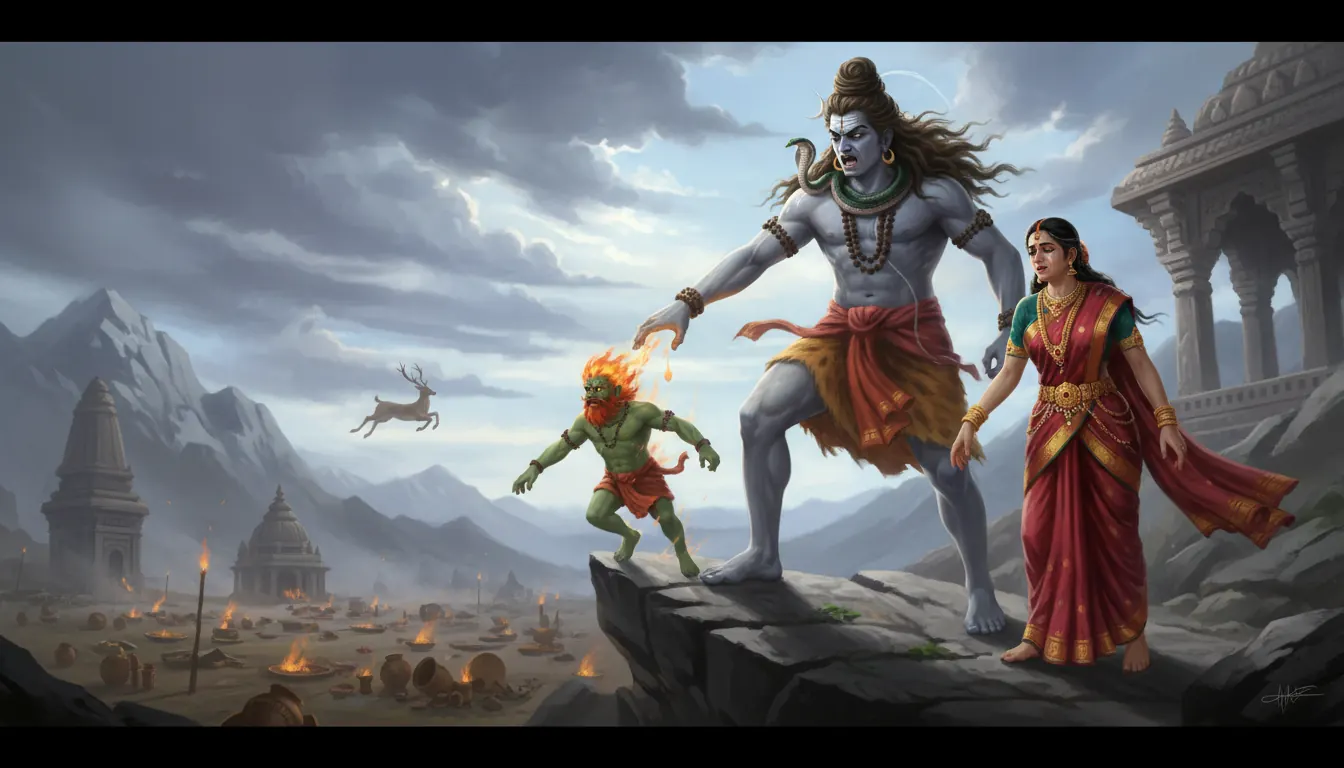
Uma asks why the gods are all riding to Daksha's horse sacrifice while her husband stays on the mountain, and learns that no share of any offering has ever been assigned to him. Her grief shakes her from head to foot. Shiva breaks the sacrifice, which flees as a deer, and from the sweat of his wrath a short green bearded being springs up and begins to burn the world.
Told in the Shanti ParvaSet in Mount Meru, Himavat and Kurukshetra16 min read
A Question Left Over From Vritra
The story of the slaughter of Vritra had ended, and Yudhishthira had gone on sitting beside the arrow bed with a loose thread of it still in his hand.
"Grandfather," he said at last, "you have great wisdom and you know every branch of learning, and out of this very narrative a wish has come into my mind to ask you something. You said, ruler of men, that Vritra was first stupefied by Fever, and that only then was he slain by Vasava with the thunderbolt.
"You passed over it in a single breath, as though it were a servant who opens a door. But the thunderbolt was not the first thing to touch him. Something else reached that Asura before Vasava did, and put him out of his own guard, and only then did the weapon go in. What is it that can stupefy a being who had overwhelmed the three worlds? How did this Fever arise, and where did it come from? I have seen it walk into a camp and take more men in a week than an enemy takes in a day, and nobody can point to the hand that throws it. Sinless one, I want to hear in detail about the origin of Fever."
Bhishma lay looking up at the sky over Kurukshetra, which had been full of vultures a short while ago and was clear now.
"Listen, king," he said. "The origin of Fever is famous all over the world, and I will speak of it in detail and explain fully how Fever first came into being. It did not begin as a disease. It began as a drop of sweat on the forehead of a god who had been insulted at a family sacrifice, and everything that has ever shivered under a blanket, every horse with a swollen throat and every peacock on a wall, carries a piece of that afternoon."
The Summit Called Savitri
"Long ago, king, there was a peak of the mountains of Meru named Savitri. It was worshipped by all the worlds, full of great splendour, adorned with every kind of jewel and gem. It was immeasurable in extent, and no one could go there.
"On that summit the divine Mahadeva used to sit in splendour, as though upon a bedstead adorned with gold, and beside him sat the daughter of the king of mountains, shining.
"They came to wait on him, and I will tell you who. The high-souled gods. The Vasus of boundless energy. The Ashvins, those greatest of physicians. King Vaishravana, lord of the Yakshas, attended by many a Guhyaka, who has his own abode on the summit of Kailasa and left it to come. The great sage Ushanas. The greatest of rishis led by Sanatkumara, and the celestial rishis led by Angiras. The Gandharva Viswavasu. Narada and Parvata. The diverse tribes of Apsaras.
"A pure and auspicious breeze blew there carrying every kind of perfume, and the trees were adorned with the flowers of all the seasons at once. Vidyadharas and Siddhas and ascetics came in great numbers. Many ghostly beings of strange forms were there, and dreadful Rakshasas, and mighty Pishachas of diverse aspects, mad with joy, with their weapons uplifted, every one of them resembling a blazing fire, for that is the train Mahadeva keeps. The illustrious Nandi stood at the command of the great god, blazing with his own energy and holding a lance that looked like a flame. And Ganga, greatest of all rivers, born of all the sacred waters in the universe, waited there in her embodied form upon that deity.
"So he lived on that summit of Meru, adored by the celestial rishis and by the gods, and lacking nothing at all except one thing, which he had never mentioned to his wife."
Where Are They All Going
"After some time had passed, the Prajapati Daksha began to perform a Sacrifice according to the ancient rites laid down in the Vedas. All the deities, with Shakra at their head, assembled and resolved to go to it. It has been heard by us that they took Mahadeva's permission first, and then mounted their celestial chariots, which were like fire or the sun in splendour, and set off for that spot on the Himavat from which the Ganges is said to issue.
"The excellent daughter of the king of mountains watched them go. Chariot after chariot lifting off the summit and turning toward the Himavat, the whole court of heaven emptying out in an afternoon, and her husband sitting exactly where he had been sitting.
"So she said to him, 'Illustrious one, where are those gods going, with Shakra at their head? Tell me truly, you who know the truth, for a great doubt has filled my mind.'
"And Maheshvara said, 'Greatly blessed lady, the excellent Prajapati Daksha is honouring the gods with a Horse sacrifice. These dwellers in heaven are going there.'
"He answered exactly what she asked and not one word more, in the way of a man who is hoping the conversation will stop there.
"She let a little time go by, and the last of the chariots went out of sight, and the summit was quieter than she had ever known it.
"Uma said, 'Mahadeva, why do you not go to that Sacrifice? What stands in the way of your going?'
"It was not an accusation. She was the daughter of the king of mountains and she had grown up among people who were invited to things, and it had genuinely not occurred to her that the greatest of the gods might be the one name left off a list."
No Share in Any Offering
"Then he told her.
"'Greatly blessed lady, long ago the gods made an arrangement, and because of it no share of the offerings in any Sacrifice was assigned to me. In keeping with that arrangement, and following the old custom, they give me no share of the sacrificial offerings.'
"That is all he said, and he said it evenly. He had lived with it so long that it had stopped being an injury to him and become a fact of the weather. He was the greatest of them and they poured nothing into his name, and he sat on his mountain and did not raise it.
"But she had not lived with it, and she heard it for the first time, and it went into her like a spear.
"Uma said, 'Illustrious one, among all beings you are the first in power. In merit, in energy, in fame, and in prosperity you yield to none, and you are indeed above them all.'
"And then her voice changed. 'Because you are denied a share, sinless one, I am filled with great grief, and I tremble from head to foot.'
"When she had said those words to her divine husband, the goddess fell silent, and sat there with her heart burning in grief. She asked for nothing. She made no demand and set him no task. She simply shook, where he could see her shaking.
"Then Mahadeva understood what was in her heart, and what her thoughts were, and how the disgrace might be wiped away. He turned to his attendant and said five words. 'Wait here by the goddess.'"
The Sacrifice Broken
"Summoning all his Yoga power, that lord of all lords of Yoga, that god of gods, the wielder of Pinaka, a god of mighty energy, went quickly to the place where Daksha was sacrificing, and took his terrible followers with him.
"They destroyed that Sacrifice.
"Some of them uttered loud cries. Some laughed terribly. Some, king, put out the sacrificial fires with blood. Others, with awful faces, pulled the sacrificial stakes out of the ground and began to whirl them around their heads. Others simply began to devour the priests who were ministering at the rite. It took no time at all. The most solemn machinery in the world, the fires and the stakes and the measured chanting, was pulled apart by a crowd in an afternoon.
"And then the Sacrifice itself, afflicted on every side, did a thing that nothing in the story prepares you for. It took the form of a deer and tried to escape through the sky.
"Understand what that means. The rite had a body. When the rite was attacked past bearing, that body chose the shape of the most frightened animal there is and ran.
"Mahadeva saw it going and knew it, and he took up his bow and arrow and went after it through the air, hunting the sacrifice that had refused him his portion.
"He had not gone for Daksha. Mark that, Yudhishthira. He had come to break the rite and not the man, because it was the rite that had left him out, and it was the rite that ran."
One Drop of Sweat
"Because of the anger that filled the heart of that greatest of all gods as he chased it, a dreadful drop of sweat appeared on his forehead.
"That is the whole of it, Bharata. Not a curse, not a weapon, not a word spoken in anger. One bead of sweat on the brow of a god who was running.
"When that drop fell down upon the earth there appeared at once a blazing fire, like the all destructive conflagration that comes at the end of a Yuga. And out of that fire issued a being.
"He was of very short stature. His eyes were blood red and his beard was green. His body was covered entirely with hair like a hawk's or an owl's, and the hair of his head stood erect. His complexion was dark and his attire was blood red, and his aspect was dreadful.
"He was small, king. That is the detail I would have you keep. Everything else on that field was enormous, the god and the gods and the broken altar, and the thing that came out of the fire was a squat hairy creature the size of a child, and it was the only thing there that nobody could stop.
"He had no name yet, and no purpose that anyone had given him, and no quarrel of his own with anybody. He was simply the overflow of a god's exertion, walking.
"Like a fire burning a heap of dry grass or straw, that being of great energy quickly consumed the embodied form of Sacrifice. The deer was eaten by the sweat of the hunter. And having accomplished that, he turned and rushed at the deities and the rishis who were still assembled there."
The Earth Trembles at His Tread
"The deities were filled with fear and fled in all directions. There is no dignity in it and I will not pretend otherwise: the assembled gods of the universe ran from a short creature with a green beard, and they were right to run.
"Under that being's tread, king, the earth began to tremble. Not where he struck. Where he walked. Every step he took, the ground under the whole world moved, and the exclamations of Oh and Alas arose throughout the universe, from creatures who had no idea what was happening to them and only knew that something had begun which was not going to stop.
"He had come from a wrath that had a cause. Daksha had wronged a god, and the gods before Daksha had wronged him, and the wrong was real and old. But wrath that has been let out whole does not remember what it was about. It was not going to burn Daksha and then sit down. It was going to burn until there was nothing left to burn, because it was made out of one drop and had no measure in it anywhere.
"Seeing this, the mighty Grandsire showed himself to Mahadeva, and came and stood in front of him, and began to negotiate."
Break Him Into Pieces
"Brahman said, 'Mighty one, from now on the gods will give you a share of the sacrificial offerings. Withdraw this anger of yours, Lord of all the gods. Scourge of your enemies, look at them: those gods and those rishis are in turmoil because of your anger.
"'And this being that has sprung from your sweat, greatest of gods, will wander among creatures, righteous one, under the name of Fever.
"'But hear the rest of it, mighty one. If the energy of this Being remains all collected together, then the entire earth herself will not be able to bear him. Let him therefore be distributed into many parts.'
"He did not begin with the creature at all. He began with the grievance, because he had looked at the fire and seen what it was made of.
"Two things were offered and one was asked. The first was the grievance settled: a share of every offering, given at last, which was the whole of what Uma had trembled over. The second was the naming of the creature, so that a thing which had come out of nowhere would at least have a name that men could say. And what the Grandsire asked in return was not that the wrath be taken back, because it could not be taken back, but that it be broken small.
"When Brahman had said these words, and when his proper share of the sacrificial offerings had been appointed to him, Mahadeva replied to the Grandsire of great energy and said, 'So be it.'
"And the wielder of Pinaka, Bhava, smiled a little, and became filled with joy, and accepted the share. That is all it had ever wanted, all those ages on the mountain: a portion poured into his name like anybody else."
Where He Put the Pieces
"Then Mahadeva, who knows the nature of everything, distributed Fever into many portions for the peace of all creatures. Listen, son, to how he did it, because you have walked past every one of these and never known what you were looking at.
"The heat that is perceptible in the heads of elephants. The bitumen that oozes from mountains. The moss that floats on standing water. The slough a snake leaves behind it. The sores that appear in the hoofs of bulls. The sterile tracts of earth that are full of saline matter and grow nothing. The dullness of vision that comes over all animals. The disease that appears in the throats of horses. The crest on the head of a peacock. The eye disease of the koel. The liver disease of sheep. The hiccup of parrots. And the toil that tigers undergo, righteous king, for that also is a form of it.
"Each of these was named Fever by the high souled Mahadeva. This is what has been heard by us.
"And among men, Fever enters all bodies at the time of birth, and at the time of death, and on other occasions between.
"So the thing was made bearable. It was not destroyed and it was not forgiven; there was no way to do either. It was cut into pieces small enough for the world to carry, and scattered so widely through the ordinary furniture of creation that a man may spend his life among its fragments and call them weather, or bad luck, or the way a peacock happens to look.
"This thing called Fever is the dreadful energy of Maheshvara. He has authority over all creatures, and for that reason he should be held in respect and worshipped by all."
The Yawn of Vritra
"And now, king, you have your answer to the question you began with.
"It was by him, by that scattered thing, that Vritra was overtaken. That most virtuous of beings yawned, and Fever went into him in the moment his guard was down, and it was then, and only then, that Shakra hurled the thunderbolt at him.
"The thunderbolt penetrated the body of Vritra, Bharata, and divided him in two. So the mighty Asura, possessed of great Yoga powers, went to the region of Vishnu of immeasurable energy. It was in consequence of his devotion to Vishnu that he had succeeded in overwhelming the whole universe, and it was in consequence of that same devotion that he ascended, when slain, to the region of Vishnu. The best of Indra's enemies was brought down by a bead of another god's sweat and by his own tired mouth opening, and went upward anyway.
"So, son, by way of the story of Vritra, I have told you the history of Fever in detail. What else would you have me speak about?
"And this much more, before you ask the next thing. The man who reads this account of the origin of Fever with close attention and with a cheerful heart will become free from disease, and will always have happiness for his share. Filled with gladness, he will achieve every wish he sets his heart on."
Yudhishthira sat with that for a while. He had asked where a sickness came from and had been told, quite plainly, that it came from a woman shaking with grief at an insult nobody had bothered to correct in time, and that the whole trembling of the world had followed from a share not given.
Dharma Lesson
An injury left unrepaired does not stay quiet; it waits until someone who loves the injured party trembles, and then it burns. Wisdom lies in settling the grievance and in breaking what has already caught fire into pieces small enough for the earth to carry.