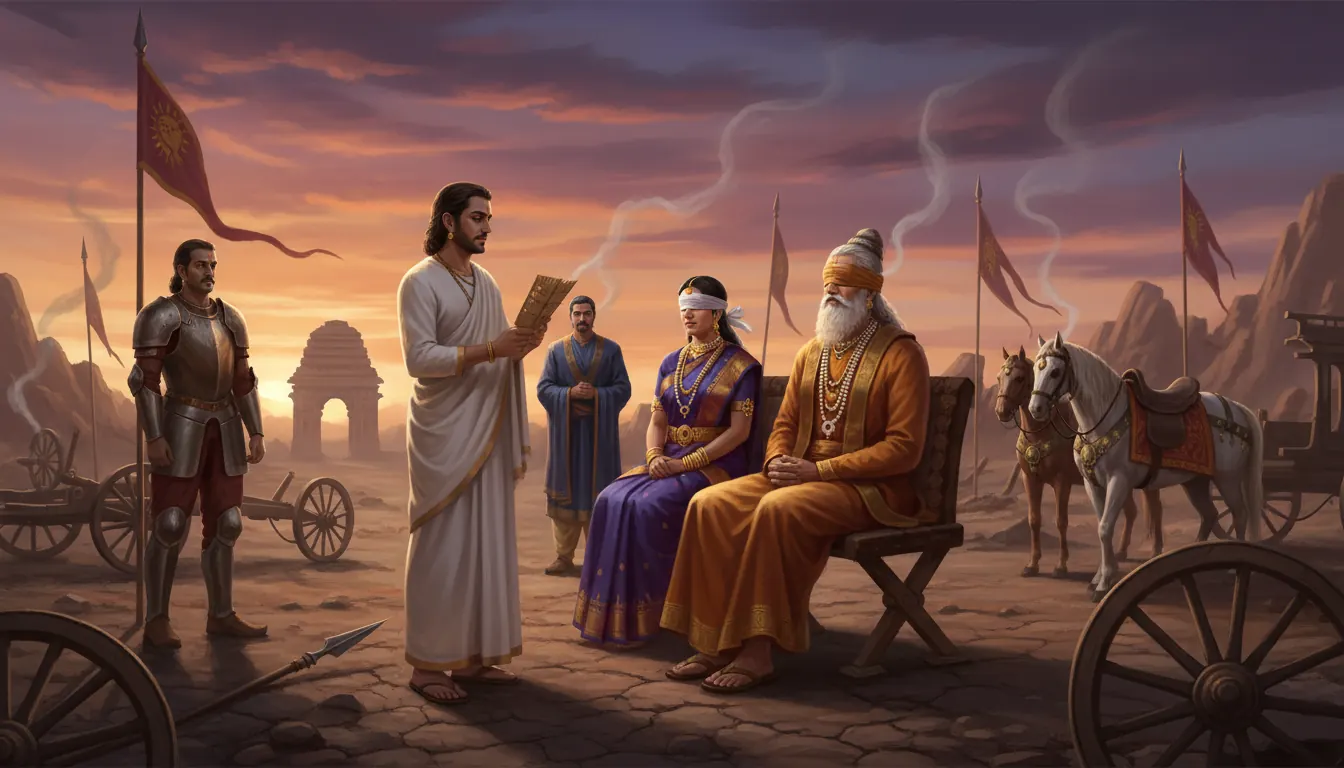
What Gandhari Saw
The blind queen, given sight for one afternoon, walks Kurukshetra naming the dead of both armies
In short
Given eyes by Vyasa for a single day, Gandhari walks the field with Krishna and describes it to him body by body. She goes past her own hundred sons into the enemy dead and the allied dead alike: Abhimanyu with Virata's daughter in her seventh month of marriage, Karna eaten small, Jayadratha with her widowed daughter hunting the field for his head, Shalya and Bhagadatta, Bhishma alive on his bed of arrows, Drona burnt on a pyre of bows by his students with Kripi at their head, and the wives of Bhurishravas holding his severed arm in their laps. At the end of the catalogue her fortitude gives way and she spends a lifetime of merit on a curse.
Told in the Stri ParvaSet in Kurukshetra21 min read
The Sight She Was Given
Vaishampayana said that the queen had been walking the field for a long time before she came to the strangers.
Gandhari, wife of Dhritarashtra, had bound her eyes with a cloth on the day she was married to a blind man and had never once taken it off. Now, by the grace of Vyasa, she was seeing Kurukshetra, and she was seeing all of it at once, the whole eighteen days laid out under the sun with the birds settled on it. She walked with Krishna beside her, and she talked to him the entire way.
She had begun with her own. Duryodhana first, and then the rest of them in the order in which she came upon them: Vikarna in the middle of the dead elephants like the moon in an autumn sky, his young wife trying and failing to drive the vultures off his bow hand; Durmukha with his face half eaten and still handsome; Chitrasena with the ladies sitting around him among the beasts of prey; Vivinsati stained with dust; Duhsaha covered with arrows like a mountain overgrown with flowering karnikaras. A hundred sons, and she named the ones she came upon, and she did not spare herself one of them.
But the field did not end where her sons ended.
What she does next is the thing that makes this lament different from every other lament in the epic. She keeps walking. She goes on past her own dead into the dead of the other side, and she looks at the boy her sons had killed, and at the men who had killed her sons, and at the widows of both, and she describes them all to Krishna in the same voice, with the same eye for what each man had been and what was now being done to his body by birds.
She had been blindfolded for a lifetime, and now she had sight, and she spent it on this.
"Look, Madhava," she kept saying. It is the refrain of the whole passage. Look. Look at it. Look at what is here.
The Girl Who Was Married Six Months
"His might and courage were reckoned half again greater than his father's and yours," she said. "Alone he pierced my son's impenetrable formation. He was the death of many. And there he sleeps, fallen to death himself."
Abhimanyu. Arjuna's son by Subhadra, sixteen years old, dead on the thirteenth day inside a formation he knew how to enter and not how to leave. Gandhari looked at him and told Krishna what she could not help noticing, that the splendour of that boy had not been dimmed even by dying.
Beside him knelt the daughter of Virata.
Uttaraa had been given to Abhimanyu after the year the Pandavas hid in her father's city, and she had been his wife for six months. She had taken off his golden coat of mail with her own hands and she was rubbing his blood-stained body gently, the way you touch someone who is only asleep, and she was talking to him.
"You were brought up in every luxury. You used to sleep on soft skins of the ranku deer. Does not your body feel pain today, lying on the bare ground? Why do you not speak to me, when I am weeping? I do not remember ever offending you. You used to speak to me even when you saw me at a distance."
Then she gathered his blood-dyed hair in her hands and put his head in her lap and asked him how it had been done. "How could those great chariot warriors kill you in the thick of battle, you who are the son of Vasudeva's sister and the son of the wielder of gandiva? Shame on those warriors of wicked deeds who took your life, Kripa and Karna and Jayadratha and Drona and Drona's son. What was in their minds when they surrounded a boy of tender years?"
Gandhari repeated the list to Krishna without altering a name in it. All five were her own side's champions. One of them was her son-in-law.
"Our union in this world was ordained to last six months only," the girl said, "for in the seventh your life has been taken from you."
The women of Matsya came and dragged her away, weeping harder than she was, because they had just found Virata.
The Fire That Was Put Out
"Then the mighty Karna, that great bowman, lies on the ground. In battle he was like a blazing fire. That fire has now been extinguished by the energy of Partha."
She did not pretend he had been anything less than he was. He had slain many atirathas before he was stretched out on the bare ground, drenched with his own blood. Her sons had gone into battle placing him at their head from fear of the Pandavas, the way a herd of elephants goes forward behind its leader, and he had been the protector of Dhritarashtra's son, and he was killed by Savyasachi the way a tiger is killed by a lion.
"So anxious was King Yudhishthira the just at the thought of that warrior," she told Krishna, "that for thirteen years he could not get a wink of sleep."
That is the measure she offers of Karna, and she offers it in front of the man who arranged his death. Not what he did, but what he cost the other side in sleep.
Now he lay like a tree flattened by wind, his waist still encircled with its belt of gold, and the carnivorous creatures feeding on him had reduced that great body to very small dimensions. The sight, said Gandhari, was not a gladdening one. It was like the moon on the fourteenth night of the dark fortnight, almost entirely eaten away.
His wives sat around him with their hair unbound. One of them, the mother of Vrishasena and of Sushena, kept falling to the ground and getting up again and falling, and what she said as she fell was not a lament but an accusation, and it was aimed at nobody in particular.
"There is no doubt your teacher's curse has followed you. When the Earth swallowed the wheel of your chariot, the cruel Dhananjaya cut off your head with an arrow. Alas, shame on it."
Burning with grief for her son as well as her husband, the woman came and smelled her lord's face, the way a mother smells the head of a child.
My Daughter Is Looking for a Head
She moved on along the line of the allied kings.
The lord of Avanti, slain by Bhimasena, lay with vultures and jackals and crows feeding on him: a man who had had many friends in life and was utterly friendless now. Bahlika, son of Pratipa, one of the oldest men on the field, had been killed with a single broad-headed shaft and lay like a sleeping tiger, and the colour of his face was still as bright as the full moon of the lighted fortnight.
Then she came to her son-in-law.
"Look at Jayadratha, whom the illustrious Drona protected, slain by Partha, who was set on fulfilling his vow, after Partha had pierced through eleven akshauhinis of troops."
Inauspicious vultures were feeding on the lord of the Sindhus and the Sauviras. His Kamboja and Yavana wives stood over the body trying to keep the animals off it, and could not, and the beasts were dragging what was left of him away toward a thicket nearby.
Gandhari stopped there and said the one thing in the whole lament that is addressed to Krishna as a reproach before the curse.
"When Jayadratha, with the help of the Kekayas, tried to carry off Draupadi, he deserved to be killed by the Pandavas. Out of regard for Dussala, they set him free that time. Why, Krishna, did they not show some regard for Dussala once more?"
She knew the answer. She was not asking for one. Her daughter of tender years was a widow, and every one of her daughters-in-law was lordless, and she asked Krishna what grief could be greater than that.
And then, because she was seeing everything, she saw Dussala.
"Look, my daughter has cast off her grief and her fear, and is running here and there searching for her husband's head."
Arjuna had struck it off with an arrow that carried it out of the field entirely and dropped it in the lap of Jayadratha's father, who sat at his evening prayers just outside the field. The girl did not know that. She was going up and down the field in the sun, looking.
The Uncle Who Drove the Chariot
"There lies Shalya, the maternal uncle of Nakula himself, slain in battle by the pious and virtuous Yudhishthira."
The ruler of the Madras had been the Pandavas' own kinsman, tricked into the Kaurava army by Duryodhana's hospitality on the road, and he had used the one advantage his position gave him: when he took up the reins of Karna's chariot on the seventeenth day, he had spent the whole battle damping the energy of the man he was driving, to give victory to the sons of Pandu. Gandhari knew this and said it aloud. She also remembered his boasting. He used everywhere, she said, to claim that he was Krishna's equal as a charioteer.
His face was smooth and beautiful as the moon and the crows had got at it. His tongue, the colour of heated gold, had rolled out of his mouth and the birds were eating it. The ladies of the royal house of Madra sat around him wailing, like a herd of she-elephants gathered around their leader sunk in a slough.
Beyond him lay Bhagadatta, the ruler of a mountainous kingdom, the greatest of all who wielded the elephant-hook, with the garland of gold still bright on his head while the beasts fed on the rest of him. Gandhari described the fight he had made against Arjuna as one that made the hair stand on end, like the battle of Shakra with the asura Vritra. He had reduced Arjuna to great straits before he was killed.
She was cataloguing them by their best hour. That is what the lament does, over and over. Each man is given back, for one sentence, the thing he was famous for, and then the sentence ends where he is now.
Golden-tongued Shalya, eaten by crows. The great elephant-rider, wearing his garland, with nothing under it.
The Sun Fallen Out of the Sky
"He had no equal on earth in heroism and energy, that doer of terrible feats in battle. Bhishma lies there, his life gone from him."
He was not dead. That is the strangeness of this part of her lament and she does not resolve it, because it could not be resolved. The son of Shantanu had been struck down on the tenth day and had held his life in his body ever since by his own will, waiting for the sun to turn north, and he would go on lying there for weeks yet with the war finished around him. Gandhari, given sight for one day, saw him as he was: a man both fallen and not fallen, like the Sun himself dropped out of the firmament at the end of the yuga, still burning where he lay.
"Look at that hero stretched on a bed of arrows, a bed so worthy of heroes. He has spread his own fine bed of barbed and unbarbed shafts, and he lies on it like the divine Skanda on a clump of heath."
She noticed the pillow. The son of Ganga was resting his head on three arrows, driven into the ground by the wielder of gandiva to complete the bed his other arrows had made, because the grandsire had refused the silken cushions the kings brought him and asked his grandson for a pillow fit for the couch he was on.
"To obey his father's command, this illustrious man drew up his vital seed."
She said that as an epitaph, and it is one. Everything on that field came out of the vow he took as a young man so that an old fisherman would let his father marry a girl, and he was lying there at the end of it with the whole line he had preserved lying dead around him.
"Truthful in speech, this righteous hero, when the Pandavas asked him, told them the means of his own death."
Then the practical grief, the one that comes to a queen of a house rather than to a widow.
"Whom, Madhava, will the Kurus ask about religion and duty now that this bull among men has gone to heaven?"
Nobody answered her. In a few days Yudhishthira would go and lie in the dust beside that bed and ask him, and the answers would take a very long time.
The Bow Still in His Hand
"Look at Drona, that greatest of brahmanas, the teacher of Arjuna and of Satyaki and of the Kurus, lying on the ground."
He had been as skilled in the four kinds of arms as the chief of the celestials, or as Shukra of Bhrigu's race. Through his grace Arjuna had achieved the most difficult feats there are. The Kauravas had put him at their head and challenged the Pandavas with him. And at the end, said Gandhari, his weapons refused to come when he called them, and that greatest of all who wield weapons was mangled with weapons.
She looked at the body closely and reported two details.
The handle of the bow was still in his grasp. The leather guards still covered his fingers. Though slain, he looked as if he were alive.
And his feet, which were fit to be adored and which had in fact been adored every morning by bards and eulogists and disciples, were being dragged by jackals.
Kripi had come out to him. The sister of Kripa, the wife of Drona, the mother of Ashwatthama, she lay on the earth beside her husband with her hair loose and her face hanging down, out of her senses with grief, and then she got up, because there was a thing that had to be done and she was the only one left to do it.
His students helped her. Brahmacharis with matted locks on their heads gathered round the body in its armour, which Dhrishtadyumna's shafts had rent through and through, and they built the pyre out of what the field provided: bows, and darts, and the boxes of chariots, and every kind of shaft they could collect. Then they laid the brahmana on that heap of weapons and lit it.
Consuming Drona on that fire, said Gandhari, like fire poured into fire.
Those who could sing sang the three Samas that are sung on such occasions. The others wept. Then the whole company turned and went off toward the banks of the Ganga, keeping the pyre on their left, with the delicate and cheerless Kripi walking at their head.
The Arm in Their Laps
Somadatta lay looking at the sky, and his son Bhurishravas lay near him, pecked at and torn by birds. Gandhari said the dead father seemed to be censuring Yuyudhana.
Bhurishravas's mother was speaking to her husband. She had found that the only way to say what she had to say was to congratulate him on being dead.
"By good luck, king, you do not see this terrible slaughter of the Bharatas, this destruction of the Kurus, this sight like the end of the yuga. By good luck you do not see your heroic son, who bore the sacrificial stake on his banner and performed sacrifices with lavish gifts, slain on the field. By good luck you do not hear the wails of your daughters-in-law, like the screams of a flight of cranes on the bosom of the sea. Your daughters-in-law, robbed of husbands and of sons, are running here and there, each in a single piece of cloth, each with her black hair loose. By good luck you do not see your son, that tiger among men, deprived of one of his arms, overthrown by Arjuna, and even now being devoured by beasts."
Then she stopped congratulating him.
"Why did Arjuna, whose deeds are pure, do such a blameworthy thing, striking off the arm of an unguarded warrior who was brave and devoted to sacrifice? Satyaki did something still more sinful, for he took the life of a self-restrained man who was sitting in observance of the praya vow. You lie on the ground, righteous one, slain unfairly by two foes."
His wives had found the arm.
They were sitting in a ring with the lopped-off arm across their laps, and one of them held it and spoke about it.
"Here is the arm that used to invade our girdles and touch the navel and the thighs, and loosen the ties of what we wore. Here is the arm that slew enemies and drove away the fears of friends, that gave away thousands of cows. In the presence of Vasudeva himself, Arjuna lopped it off while you were unguarded, fighting another man."
Then she turned and put the question to Krishna directly, and Gandhari passed it on to him word for word.
"What, Janardana, will you say of this great feat of Arjuna when it is spoken of in the midst of assemblies? What will the diadem-decked Arjuna himself say of it?"
With these words of reproach, said Gandhari, that noblest of ladies has fallen silent at last. Her co-wives were lamenting along with her, as though she were their daughter-in-law and not their equal.
The Reversals Time Has Brought About
Her brother Shakuni lay not far off, fanned in life with gold-handled fans and fanned now by birds with their wings. He had won a kingdom at dice by guile, and Sahadeva had now won his life-breaths. Gandhari said the regions of bliss he had earned by dying at the edge of a weapon frightened her, in case that crooked person should get in among her confiding sons and start something there too.
Then she went on down the line of the kings who had come from far away.
The ruler of the Kambojas, bull-necked, lying in the dust when he deserved Kamboja blankets, his wife weeping over arms that used to be smeared with sandal-paste. "Held in the clasp of those two arms," the queen said, "I never lost my joy for a moment. What will my end be?"
The ruler of the Kalingas with the angadas still on his arms. Jayatsena of Magadha, with women worthy of costly beds lying round him on bare ground, their ornaments displaced, and Gandhari said their sweet voices stupefied her heart. Brihadbala of the Kosalas, with his wives pulling out of him the shafts Abhimanyu had put there, fainting, and going back to it.
The young sons of Dhrishtadyumna, garlanded, in golden angadas, killed by Drona. They had fallen on that teacher like insects into a blaze, for his chariot was a chamber of fire with the bow for its flame and shafts and maces for its fuel. The five Kekaya brothers lay beyond them, faces turned toward Drona, killed by the same fire.
And Drupada, overthrown at the last by Drona like a forest elephant killed by a lion, his white umbrella still shining above him like the moon in an autumn sky. His women had burnt him already and were walking away from the pyre, keeping it on their right.
Dhrishtaketu of the Chedis lay uprooted like a tree, his son beside him. The boy had never deserted his father while his father fought. Mark, said Gandhari, that he does not desert him even in death. Then, in the same tone: even so has my son's son followed his father Duryodhana.
Then she stopped and drew the account.
"The Pandavas, Krishna, and you with them, surely cannot be killed, since they and you have escaped from Drona, from Bhishma, from Karna the son of Vikartana, from Kripa, from Duryodhana, from the son of Drona, from Jayadratha, from Somadatta, from Vikarna, and from the brave Kritavarma. Look at the reversals Time has brought about. Those bulls among men, who could have slain the celestials themselves, have themselves been slain.
Thirty-Six Years
"My sons were slain already, Krishna, on the day you returned unsuccessful to Upaplavya. Shantanu's son and the wise Vidura told me then: stop cherishing your children. Their words could not come to nothing. Soon enough my sons have been burned to ashes."
Having said these words, Vaishampayana continued, Gandhari fell down on the earth.
She had held her fortitude all the way across that field, from her hundred sons to Abhimanyu to Karna to the bed of arrows to the arm in the women's laps, and it went out of her at the end of the catalogue. When she got up she was no longer describing. She was filled with wrath, and she laid every fault at Keshava's door.
"The Pandavas and the sons of Dhritarashtra have both been burnt. While they were being wiped out, Janardana, why were you indifferent to them? You were able to prevent the slaughter. You have a large number of followers and a vast force. You had eloquence, and you had the power to bring about peace. Since you deliberately stood aside from this universal slaughter, slayer of Madhu, you must reap the fruit of this act."
Then she spent what she had. Not an army, because she had none left. The merit of a lifetime of waiting dutifully upon a blind husband, which she had accumulated the way other people accumulate treasure, and which she now put on the fire in a single sentence.
"By the little merit I have earned by serving my husband, merit so hard to win, I will curse you, wielder of the discus and the mace. Since you stood by unmoved while the Kurus and the Pandavas killed each other, you, Govinda, will be the slayer of your own kinsmen. In the thirty-sixth year from now, after bringing about the slaughter of your kinsmen and your friends and your sons, you will perish by a loathsome means in the wilderness. And the women of your race, robbed of sons and kinsmen and friends, will weep and cry just as these women of the Bharata race are weeping."
Krishna heard her out. Then he answered the venerable Gandhari with a faint smile.
"There is no one in the world but me who can destroy the Vrishnis. I know this well. I am working to bring it about. By uttering this curse, lady of excellent vows, you have helped me accomplish that task. The Vrishnis cannot be killed by others, whether men or gods or danavas. So the Yadavas will fall by one another's hands."
The Pandavas, standing there, were stupefied. Every one of them became hopeless of life.
Dharma Lesson
Gandhari has the strongest possible claim to a partisan grief, and for most of this passage she refuses it. She names the boy her son-in-law helped to kill and the men who killed her sons in the same voice, gives each of them back his best hour in one sentence before saying what the birds are doing to him, and asks Krishna the question that Bhurishravas's widow asked about Arjuna rather than softening it. That evenness is the achievement, and the epic then shows what it costs: at the end of the catalogue she falls down, gets up in wrath, and spends a lifetime's merit on a curse that Krishna tells her he had wanted anyway. Seeing everything is not the same as being able to bear it, and the queen who managed the first for an afternoon could not manage the second for a sentence longer.