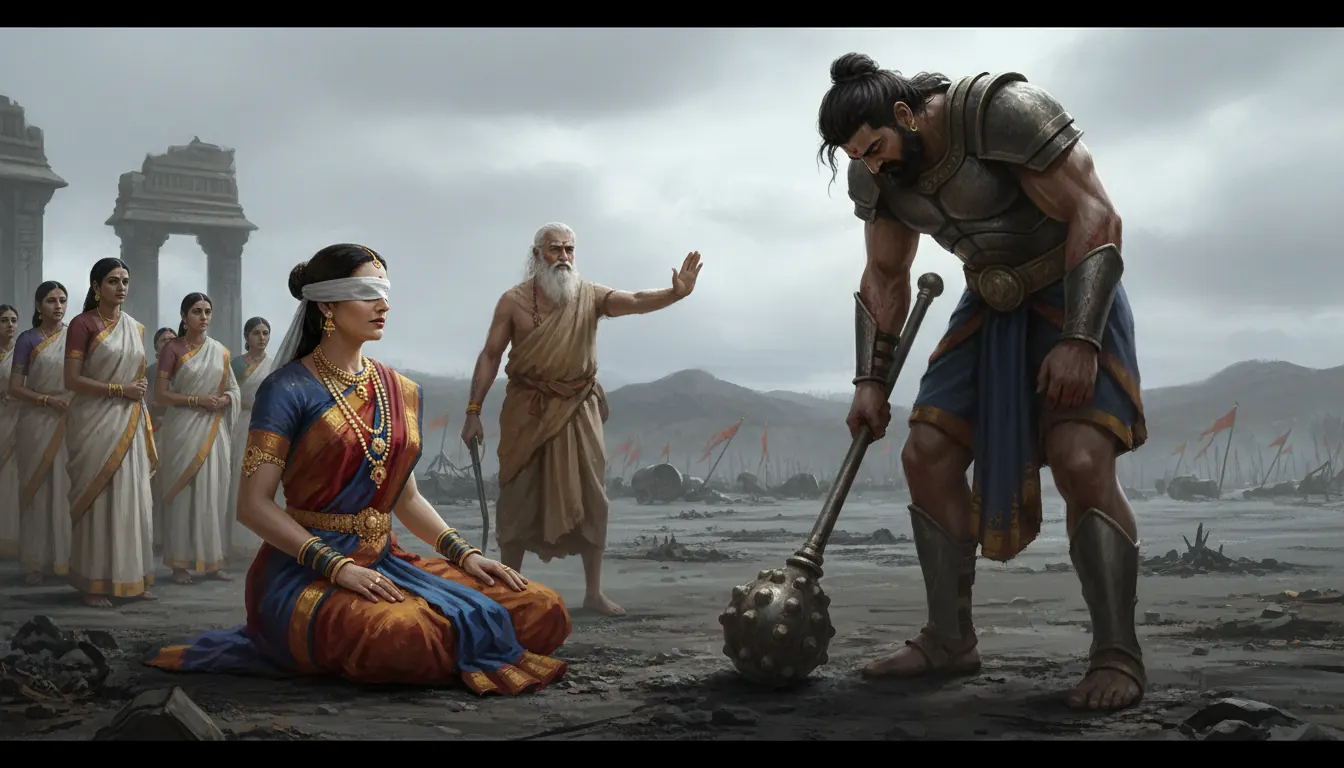
Gandhari Shows Krishna the Field
With the sight Vyasa gave her, the blindfolded queen walks Krishna through the dead of Kurukshetra
In short
Standing away from the battlefield with a cloth still over her eyes, Gandhari is given spiritual sight by Vyasa's boon and sees the whole of Kurukshetra at once. When the house of Kuru goes out to the field, she takes Krishna through it body by body: the heroes sleeping in the dust where beasts of prey mistake the armoured ones for living men, the women fitting severed heads to the wrong trunks, Duryodhana lying among the vultures who had once been fanned by ladies, Dushasana with his blood drunk, her fallen sons named one after another, and Abhimanyu with Virata's daughter holding his head in her lap. It is the longest look anyone in the epic takes at what the war actually produced.
Told in the Stri ParvaSet in Kurukshetra20 min read
The Eye That Vyasa Gave Her
Vaishampayana, telling the story to king Janamejaya, said that when Gandhari had finished speaking to Kunti and to the princess of Panchala, she was still standing on ground at some distance from the field of battle.
She could see none of it. A cloth had covered her eyes for as long as she had been Dhritarashtra's wife. Devoted to her husband, she had kept high vows, she had undergone the severest penances, and she had never in her life been known to speak an untruth. Through a boon given her by the great rishi Vyasa, whose deeds were holy, she had come to possess spiritual knowledge and spiritual power, and that morning the boon opened.
The Kuru lady, whose intelligence was great, saw the field of the slain from far away, but as though she were standing in the middle of it.
It was terrible to see and full of strange sights. It was scattered all over with bones and hair and covered with streams of blood, and strewn on every side with thousands upon thousands of dead bodies. It was a mire of the blood of elephants and horses and chariot-warriors and men of every other kind, and it teemed with headless trunks and with heads that had no trunks under them. It rang with the cries of elephants and horses and men and women together. It was full of jackals and cranes and ravens and kankas and crows. It was the playground of rakshasas that feed on human flesh. It swarmed with ospreys and vultures, and the howls of jackals came up out of it from every quarter, and there was nothing auspicious in the sound.
She saw all of it at once, in a single unbroken sight, the way no one else on that field would ever see it. And she stood there in her blindfold and began to lament aloud.
The Road Out to the Field
Then Vyasa gave the order, and the whole house went out to look at what it had done.
King Dhritarashtra went at the command of the rishi. All the sons of Pandu went, with Yudhishthira at their head. Vasudeva went with them, and behind them came the ladies of the Kuru race, every one of them bereaved of a husband or a son or a father or a brother, riding out in costly vehicles toward Kurukshetra.
They reached the field and found their dead lying where they had fallen, being eaten. Beasts of prey were at them, and wolves, and ravens and crows, and ghosts and pishachas and rakshasas and many other creatures that roam at night. The carnage before those women looked like nothing so much as the playground of Rudra.
They screamed aloud. They climbed down quickly from their fine carriages, not waiting to be helped, and went in among the bodies. They had never in their lives seen anything like it. The Bharata ladies felt the strength go out of their limbs and fell to the ground where they stood. Others were so stunned that they lost their senses altogether. The Panchala women and the Kuru women, who had come out that morning from opposite sides of a quarrel, were plunged together into one distress for which there is no word.
The field rang in every direction with the crying of those women.
Gandhari, the daughter of Subala, who knew every duty, heard it and saw it and turned to the one person on that field who could be expected to bear being told. She spoke to the lotus-eyed Keshava, the foremost of men, and began to describe to him what he was already looking at.
Look at These Daughters-in-Law of Mine
"Look at these daughters-in-law of mine, lotus-eyed Madhava," she said. "They have lost their husbands, their hair is unbound, and they are crying out piteously like a flock of female ospreys. Every body they come upon brings back the memory of some great chief of the Bharatas. They are running here and there in large bands, toward their sons and their brothers and their fathers and their husbands.
"See, mighty-armed one, the field is covered with the mothers of heroes, and not one of those mothers has a child left. And those other parts of it are covered with the wives of heroes, and not one of those wives has a husband left.
"See how the battlefield is lit up by those tigers among men, by Bhishma and Karna and Abhimanyu and Drona and Drupada and Shalya, as a place is lit up by blazing fires. It is adorned too with the golden armour of great warriors, and with their costly gems, their angadas and keyuras and garlands. It is strewn with darts and spiked clubs hurled by heroic hands, and with swords, and with bows, and with sharp arrows of every kind. Beasts of prey have gathered on it in packs, and they stand about, or play, or lie down as they please. That, mighty hero, is what the battlefield is like. The sight of it, Janardana, sets me on fire.
"In the destruction of the Panchalas and the Kurus, slayer of Madhu, I think the five elements themselves have been destroyed.
"Fierce vultures in their thousands are dragging away those bloodstained bodies, seizing them by the armour, and devouring them. Who could ever have imagined the death of such heroes as Jayadratha and Karna and Drona and Bhishma and Abhimanyu? They could not be killed, and they have been killed. Look: vultures and kankas and ravens and hawks and dogs and jackals are feasting on them."
The Beds of Heroes
"There, Krishna, those tigers among men who fought on Duryodhana's side and took the field in anger lie like fires that have gone out.
"Every one of them was worthy of sleeping on a soft and clean bed. Plunged into distress, they sleep today on the bare ground. Bards who recited their praises used to delight them at the proper hours; they are listening now to the fierce and inauspicious cries of jackals. Those illustrious men who used to sleep on costly beds with their limbs smeared with sandal paste and powdered aloe are sleeping in the dust, and these vultures and wolves and ravens have become their ornaments. The creatures utter their harsh cries and drag the bodies about.
"And yet they loved battle, and they look cheerful still. Their sharp arrows lie beside them, and their well-tempered swords, and their bright maces, as if life had not yet left any of them. Many of them, handsome and fair-skinned and wearing garlands of gold, sleep on the ground while beasts of prey drag at them and tear them. Others, with massive arms, sleep with their maces clasped to them, as if the maces were beloved wives. Others are still in their armour and still holding their bright weapons, and the beasts are not tearing those, Janardana. They think they are alive.
"The beautiful garlands of pure gold that hung on the necks of other great heroes lie scattered on every side as the flesh-eating creatures drag the bodies from place to place. There, fierce wolves in their thousands are tugging at the golden chains round the necks of men whom death has stilled.
"Many of these were men whom skilled bards used to wake every morning with hymns and solemn songs of praise. This morning they are surrounded by fair ladies stricken with grief, weeping and crying around them in their sorrow, tiger of the Vrishnis."
This Is Not This One's
"The faces of those beautiful ladies, Keshava, are pale, and yet they shine still, like a cluster of red lotuses.
"They have stopped weeping now, those Kuru women, with their attendants and companions around them. They are filled with anxiety. Overwhelmed with sorrow, they run from one place to another, and weeping and anger have made their faces as bright as the morning sun, or as gold, or as burnished copper. They call out to one another in sentences that do not finish, and because of the loud wailing on every side they cannot understand one another. Some of them sigh long and deep, and lament, and lament again, and are stunned by grief, and give up their life-breath where they stand. Others, coming upon a body, weep and wail aloud. Others beat their own heads with their own soft hands.
"The earth is strewn with severed heads and hands and other limbs mingled together and gathered into large heaps, and it looks splendid with all this havoc on it.
"At the sight of headless trunks of great beauty, and heads without trunks, those fair women have lain senseless on the ground a long while. They fit particular heads to particular trunks, and then find their mistake and say, 'This is not this one's,' and weep more bitterly than before. Others fit back arms and thighs and feet that arrows have cut off, and lose their senses again at the sight of the forms they have restored. Some of the Bharata ladies, looking at the bodies of their own husbands, torn by animals and birds and with their heads cut off, cannot recognise them.
"The earth is a mire of flesh and blood and cannot be crossed, with arms lying on it that still grip their swords, and heads that still wear their earrings.
"Beyond doubt I must have committed great sins in my former lives, Keshava, since I see my sons and my grandsons and my brothers all killed by their enemies."
And while she was speaking in this way, Gandhari's eyes fell upon her son.
Duryodhana Among the Vultures
At the sight of Duryodhana, Gandhari lost her senses with grief and fell suddenly to the earth like a plantain tree torn up by the roots.
She soon came to herself, and began to weep, and wailed aloud again and again at the sight of her son lying on the bare ground covered with blood. She put her arms round him. She drenched with her tears that body with its massive shoulders, still wearing its garlands and its collar. Alas, my son, she said. Alas, my son.
Then she spoke to Hrishikesha, who was standing near.
"On the eve of this battle that has wiped out our family, mighty one, this foremost of kings said to me, 'Mother, in this war among kinsmen, wish me victory.' And I, knowing that a great calamity had come upon us, said this much to him and no more: 'Where righteousness is, there is victory. And since your heart is set on battle, you will surely win the worlds that are won by weapons, and take your pleasure there like a god.' Those were the words I said to him. I did not grieve for my son then. I grieve now for the helpless Dhritarashtra, robbed of his friends and his kinsmen.
"Look at him, Madhava: fierce, skilled in weapons, unstoppable in battle, asleep on the bed of heroes. See the reversals that Time brings about. This scourge of his enemies, who used to walk at the head of all crowned kings, sleeps in the dust. Ill-omened jackals now entertain that prince, who used to be entertained by the loveliest of ladies sitting round him. He who was surrounded by kings competing to please him is surrounded by vultures. He who was fanned with beautiful fans by fair ladies is fanned by flesh-eating birds with the beating of their wings.
"He had gathered eleven akshauhinis of troops, Keshava, and his own evil policy has killed him. He ignored Vidura, and he ignored his own father, and this reckless, foolish prince has gone to his death for his contempt of his elders. He ruled the earth without a rival for thirteen years. Not long ago, Krishna, I saw the earth full of elephants and cows and horses, and ruled by Duryodhana. Today I see her ruled by another, and empty of elephants and cows and horses.
"What use is life to me, Madhava?"
The Mother of Lakshmana
"And look at this sight, more painful to me even than my son's death. Look at these fair ladies weeping beside the slain.
"Look at the mother of Lakshmana, Krishna, with her hair dishevelled, Duryodhana's dear wife, who is like a sacrificial altar of gold. Surely, while her mighty-armed husband was alive, this wise young woman used to take her pleasure in the embrace of his handsome arms. Why does this heart of mine not break into a hundred pieces at the sight of my son and my grandson killed in one battle?
"That faultless lady is smelling the head of her son, which is covered with blood. Now she gently strokes Duryodhana's body with her fair hand. One moment she grieves for her husband and the next for her son. One moment she looks at her husband and the next at her son. Look, Madhava, she beats her head with her hands and falls upon the breast of her heroic husband, the king of the Kurus. With her skin like the filaments of the lotus, she is beautiful still, like a lotus herself. The unhappy princess strokes now the face of her son, and now the face of her husband.
"If the scriptures and the shrutis are true, then beyond doubt this king has won the blessed worlds a man may win by weapons.
"Look, Madhava, at my hundred sons, whom no effort in battle could tire, all killed by Bhimasena with his mace. And what grieves me more today than that is this: these young daughters-in-law of mine, robbed of their sons, with their hair loose about them, are wandering over this field. They used to walk only on the terraces of fine mansions, with ornaments on their feet. Now, in great anguish of heart, they must set those feet on this hard earth, a mire of blood. They stagger in their sorrow and wander like people who have been made drunk, and they can barely drive away the vultures and the jackals and the crows."
Dushasana, and the Advice She Gave
"Look at that lady of faultless limbs and slender waist, falling down overwhelmed at the sight of this carnage. My heart is torn at the sight of her. These beautiful women, some seeing their brothers, some their husbands, some their sons lying dead on the bare ground, fall down themselves, clutching the arms of the dead. Listen, unconquered one, to the wailing of the old women among them and of those of middle age. Worn out, they are resting, leaning against broken chariot-boxes and the bodies of dead elephants and horses. Look at that one, holding up some kinsman's severed head with its beautiful nose and its earrings, standing there in grief.
"Our acts, righteous or unrighteous, cannot come to nothing, scion of the Vrishnis.
"Look, Govinda, at the shields decked with a hundred moons, the standards bright as the sun, the golden armour, the gold collars and breastplates and the helmets of my sons, scattered on the earth and blazing like sacrificial fires on which clarified butter has been poured.
"There Dushasana sleeps, struck down by Bhima, who drank the blood of all his limbs, that heroic slayer of his enemies. Look at that other son of mine, killed by Bhima with his mace, urged on by Draupadi and by the memory of his own wrongs at the dice game. This Dushasana, wanting to please his elder brother and Karna, spoke to the princess of Panchala, won at dice, in the middle of the assembly and said to her, 'You are a slave's wife now. Come into our household now, lady, with Sahadeva and Nakula and Arjuna.'
"At that time, Krishna, I said to King Duryodhana, 'Son, cast off the angry Shakuni. Understand that your mother's brother is utterly wicked and loves a quarrel. Cast him off at once and make peace with the Pandavas. Foolish one, do you never think of Bhimasena in his rage? You are piercing him with your arrows of words like a man striking an elephant with burning brands.'
"He ignored my words and spat his poison of words at them, as a snake spits its poison at a bull, at men who had already been pierced by his darts of words. There Dushasana sleeps, his two massive arms stretched out, killed by Bhimasena as a mighty elephant is killed by a lion. And Bhimasena in his fury did a most horrible thing, drinking his enemy's blood in battle."
She Names Them One by One
"There, Madhava, my son Vikarna, whom the wise praised, lies on the bare ground, killed by Bhima and horribly mangled. He lies dead among the slain elephants like the moon in an autumn sky surrounded by blue clouds. His broad palm, in its leather guard and scarred by constant use of the bow, is so hard that the vultures who want to feed on it can barely pierce it. His helpless young wife is trying, and failing, to drive those vultures off. He was young and brave and handsome, raised in luxury, deserving every kind of good fortune, and he sleeps in the dust. Clothyard shafts and barbed arrows and nalikas have pierced all his vital parts, and even so his beauty has not left this best of the Bharatas.
"There my son Durmukha, who destroyed whole bands of his enemies, sleeps with his face toward the enemy, killed by the heroic Bhimasena in fulfilment of his vow. His face, Krishna, half eaten away by beasts of prey, looks more handsome for it, like the moon on the seventh day of the bright fortnight. How could that son of mine, before whom no enemy could stand, be killed by enemies and made to eat the dust?
"Look at that other son of Dhritarashtra, Chitrasena, lying dead, who was the model of all bowmen. Those young women, stricken and crying piteously, sit round his fair body with its wreaths and garlands, and the beasts of prey sit there with them. These wails of women and these roars of beasts together seem to me a most strange thing, Krishna.
"Young and handsome, always attended by the most beautiful of ladies, my son Vivinsati sleeps there, stained with dust, his armour pierced with arrows, and now the vultures attend him. He broke into the ranks of the Pandava army, and he lies on the bed of a hero, which is to say on the bed of a noble kshatriya. Look at his beautiful face, Krishna, with the smile still playing on it, with its fine nose and its fair eyebrows, like the Moon himself.
"And who could ever endure my son Duhsaha, that slayer of heroic foes, that ornament of assemblies, that resister of enemies? His body, covered over with arrows, looks splendid, like a mountain overgrown with flowering karnikaras. With his garland of gold and his bright armour on him, Duhsaha, though he is deprived of life, looks splendid yet, like a white mountain on fire."
The Girl Who Had Him Six Months
"He whose might and courage were reckoned, Keshava, to be one and a half times greater than his father's and yours, he who alone and without a follower broke through my son's impenetrable array, he lies there, himself fallen to death. And I see, Krishna, that the splendour of that son of Arjuna, of Abhimanyu, has not been dimmed even by death.
"There is the daughter of Virata, the daughter-in-law of the wielder of Gandiva, overwhelmed at the sight of her heroic husband. She strokes him gently with her hand. She has taken off his golden armour, and she is gazing at the bloodstained body beneath it. And she turns to you, Krishna, and says, 'This hero whose eyes were like yours has been killed. In might and energy and prowess he was your equal, sinless one, and he sleeps on the ground, killed by the enemy.'
"Then she speaks to him. 'You were raised in every luxury and used to sleep on the soft skins of the ranku deer. Does your body not hurt today, lying on the bare ground? Why do you not speak to me, when I am weeping like this? I cannot remember ever having offended you. Noble one, where will you go, leaving behind you Subhadra and my own wretched self?'
"Look at her, Krishna, gathering her husband's bloodstained locks in her hands and laying his head in her lap and speaking to him as though he were alive. 'How could those great chariot-warriors kill you, you who are the sister's son of Vasudeva and the son of the wielder of Gandiva? Shame on Kripa and Karna and Jayadratha and Drona and Drona's son, who took your life. What was in their minds when they surrounded a boy and killed him? No one can die before their hour has come, for I, wretch that I am, still draw breath after seeing you killed. Our union in this world was ordained, it seems, for six months only, for in the seventh, hero, you have lost your life.'
"The ladies of the royal house of Matsya are dragging Uttaraa away as she laments like this, and they are more stricken than she is, for they have seen Virata lying torn by Drona's arrows, surrounded by screaming vultures and howling jackals. They are trying to turn the body of the Matsya king over, and are too weak with grief to do it.
"See also, Madhava, the other children besides Abhimanyu: Uttara, and Sudakshina the prince of the Kambojas, and the handsome Lakshmana, all lying on this field."
Dharma Lesson
Gandhari has been blind by her own choice for a lifetime, and the first thing her sight is used for is this. She does not look away from any of it, and she does not spare herself either: the mother who told her son that victory follows righteousness also remembers that she never made him give up Shakuni, and she says so to Krishna while standing over the body. The epic gives her no consolation in this hour and offers none to the reader. It simply insists that somebody count the dead properly, one name at a time, with their wives in the frame, before anyone is allowed to call the outcome a victory.