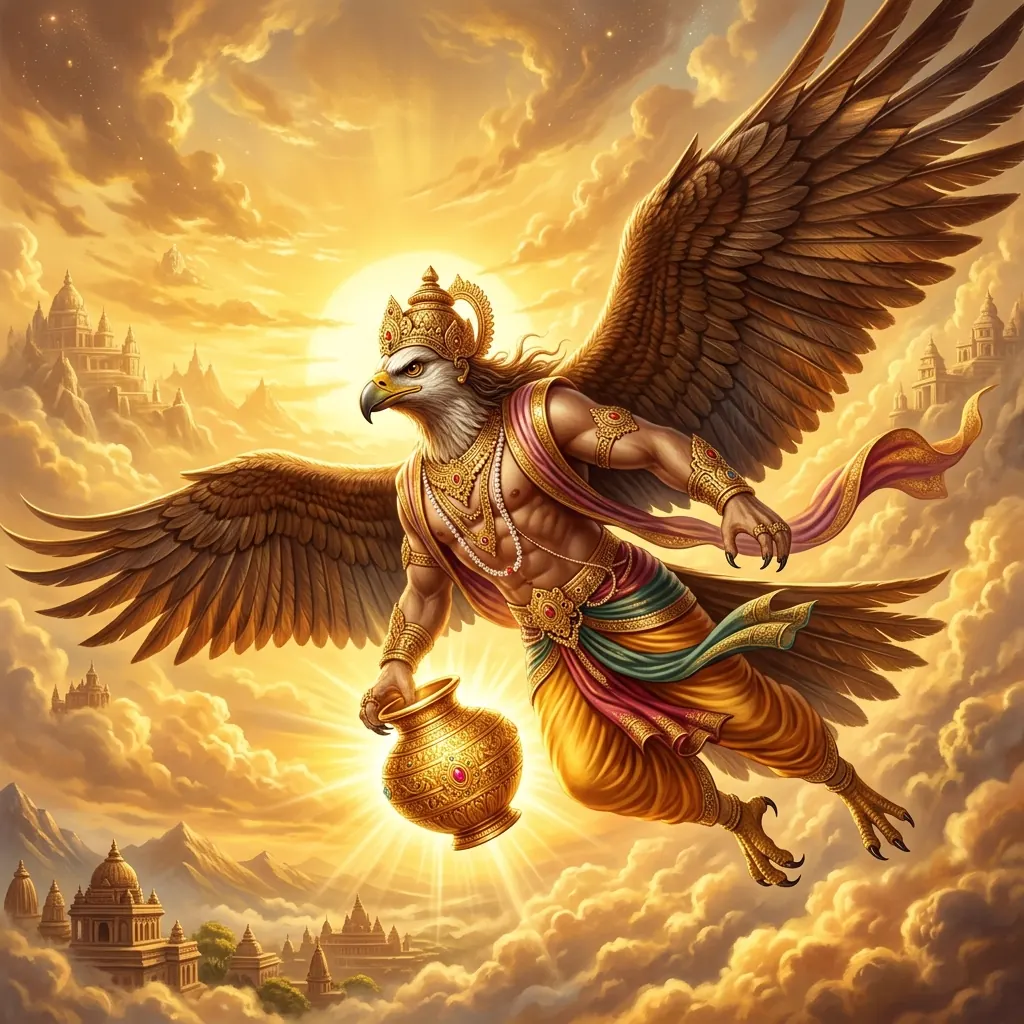
Garuda's Pact and the Forked Tongues
How the snakes lost the nectar and got their split tongues
In short
Carrying the stolen amrita through the sky, Garuda is offered friendship by Indra and strikes a bargain with him: he will keep his promise to the snakes by setting the nectar down, and Indra may take it back the instant he does. In exchange he asks that the snakes become his food, and Vishnu sanctions it. Garuda places the vessel on kusa grass, tells the sons of Kadru to bathe before drinking, and frees his mother Vinata; while they wash, Indra carries the amrita back to heaven. The snakes return to an empty bed of grass and lick it for what remains, and their tongues are split.
Told in the Adi ParvaSet in Naimisharanya, Amaravati and Forest Hermitage13 min read
The Question Asked in the Air
In the forest of Naimisha, where Saunaka's long sacrifice was still burning, Sauti was telling the assembled brahmanas the story of the bird, and he had brought him as far as the open sky above heaven.
Garuda had gone in through the ring of fire. He had shrunk his enormous body and slipped between the spokes of the revolving wheel of steel that the gods had built to cut robbers of the Soma into pieces. He had thrown dust into the eyes of the two guardian snakes whose glance burned whatever it fell on, and torn them apart unseen, and taken up the amrita, and broken the machine that held it, and come out again into the air with the nectar of immortality in his hold and not one drop of it in his mouth.
That was the part the gods could not account for. He had not drunk.
Narayana met him on the road of the sky and was so pleased by that act of self-denial that he offered a boon, and Garuda asked for two: to stay above Vishnu, and to be immortal and free from disease without drinking the amrita at all. Vishnu said, "So be it," and then took a boon in return, and made the bird the carrier of his chariot, and set him on the flagstaff, so that both things were true at once. The bird was above him, and under him, and had asked for nothing to swallow.
Then Indra threw the thunderbolt at him.
It struck, and Garuda laughed, and spoke in sweet words to the god who had thrown it. "I will honour the rishi from whose bone the vajra was made." That was Dadhichi, the ascetic who gave up his own skeleton so that the gods would have a weapon at all. "I will honour the vajra too, and you as well, lord of a thousand sacrifices. I let fall this feather of mine, whose end you will never find. Your thunderbolt struck me, and I did not feel the slightest pain."
And he let one feather go.
All creatures were glad when they saw it fall, and it was so beautiful that from that day they called him Suparna, the bird of fair feathers. Purandara of the thousand eyes watched it come down, thought this must be some great being, and did what a king does when he cannot win.
"Best of birds, I want to know the limit of your great strength. And I want your friendship for ever."
What the Good Do Not Say About Themselves
Garuda accepted the offer, and then he took his time over the question attached to it.
"Purandara, let there be friendship between us, as you wish. As for my strength, it is hard to bear."
He could have stopped there and been within the rule. Instead he said the rule aloud before he broke it.
"The good never approve of praising their own strength, and they do not talk of their own merits. But since you have made me your friend, and you ask me, friend, I will answer you, though self-praise without reason is always improper."
Without reason. He was not arguing that boasting had become proper; he was arguing that a friend's direct question was a reason, and that a man who is asked plainly and answers evasively is doing something worse than boasting. So he answered plainly.
"On a single feather of mine, Shakra, I can carry this Earth, with her mountains and forests and the waters of the ocean, and you standing on it as well."
The last clause is the one to hold. Not the mountains, which are heavy, and not the ocean, which is heavier. The king of the gods, added to the load at the end of the list like one more object standing on it, spoken to his face in the middle of a conversation about friendship. Garuda had just been hit with that king's thunderbolt and had shed a feather for politeness, and now he was putting him on a feather along with the world.
"Understand that my strength is such that I could carry all the worlds put together, with everything in them, moving and unmoving, and never tire."
Sauti said that when the bird of great courage had spoken, the chief of the gods, wearer of the celestial crown, always intent on the good of the worlds, did not dispute a word of it.
"It is as you say. Everything is possible for you. Now accept my sincere and heartfelt friendship."
He had come to measure a strength and had found it unmeasurable, and having found that out, he stopped talking about strength altogether and began talking about the nectar.
Set It Down, Not Give It
"And if you have no use for the Soma yourself," Indra said, "give it back to me. Those you would give it to would always oppose us."
That is the whole of the god's case, and it is a good one. Indra did not say the theft was wrong, or threaten a second thunderbolt, or claim the amrita by right. He named the consequence. The nectar was going to a people who were the enemies of heaven, and once they had drunk it they would be enemies who could not be killed. A god who has spent his existence putting down what rises against him understands exactly what an immortal snake would be.
And Garuda, who had crossed the worlds for that vessel and had refused to drink from it, did not hand it over.
"I have a reason for carrying the Soma. I will not give it to anyone to drink."
He had made a bargain with the sons of Kadru: the amrita in exchange for his mother Vinata's freedom, since Kadru had won Vinata by a trick of a wager and held her sister in slavery, and Garuda had been born into the debt. He had not promised that the snakes would swallow it. He had promised to bring it, and he was going to bring it, and every word of what he said next was true and none of it was honest.
"But, thousand-eyed one, once I have set it down, you, lord of the heavens, can pick it up and carry it straight away."
Set it down, is what he offered. Not give. He would carry the nectar to the snakes and put it in front of them with his own claws and keep his side of the agreement to the letter, and Indra would be standing there when he did.
"Egg-born one, I am delighted with what you have just said. Best of all who fly the skies, take from me any boon you wish."
The two of them had been friends for the length of one conversation, and they had already arranged a theft.
The Boon He Had Been Saving
Garuda took a moment before he answered, and Sauti says what he was doing with it. He was thinking of the sons of Kadru, and remembering too his mother's slavery, which had come of a deception.
The deception was old. Kadru and Vinata had wagered on the colour of the tail of the horse Uchchaihshravas, and Kadru's snake sons had darkened the tail by clinging to it, and Vinata had lost and become a slave. Aruna, Vinata's first son, born half formed because she broke the egg too early, had cursed her to exactly that servitude before he flew away. So there was a curse under the trick, and a trick over the curse, and beneath both of them a mother who had been carrying water and doing errands for her sister for as long as her second son had been alive.
Garuda had been sent for the amrita by the people who owned her. He had gone. He had won it. And now the king of the gods was standing in the sky offering him anything he wanted.
"Though I have power over all creatures, I will do as you ask," he said. "Let the mighty snakes become my food, Shakra."
Nothing in it for himself. He did not ask for empire, or for a weapon, or for the death of Kadru, who was the one who had cheated. He asked that a whole species be turned into a diet, and that this be granted as a favour by the god who had just told him those creatures were dangerous to heaven.
The slayer of the Danavas said, "So be it."
Then, because a thing of that size is not settled by one god alone, he went to Hari, the lord of yogis, the god of gods of great soul, and Vishnu approved everything that had been said. There was now no power above the birds that the snakes could appeal to.
The illustrious lord of heaven came back and repeated the arrangement so there would be no mistake about it. "I will carry off the Soma when you set it down."
Then he said farewell, and the bird of fair feathers went to his mother with great speed.
The Vessel on the Kusa Grass
The snakes were waiting where they had sent him from, and Garuda came down among them in joy, and every word he said to them was kept.
"Here, I have brought the Amrita."
There it was, in front of them, after everything. The nectar that the gods keep behind fire and a razor wheel and two serpents whose look is death, brought out of heaven by a bird and set down in a clearing where the sons of Kadru could put their heads over it.
"Let me place it on some Kusa grass."
He cut the grass and laid the vessel on it, which is the correct thing to do, because kusa is the grass of the sacrifice and nothing sacred is set down on bare ground. Everything he did was proper. That is what makes the scene terrible to read a second time.
"Snakes, you who are sitting here, drink of it once you have bathed and performed your religious rites."
Also correct, and also fatal. No one comes to the amrita filthy. A man does not eat the offering without washing, and a snake about to drink immortality certainly bathes first and says his prayers. Garuda was not tricking them into a delay. He was telling them the rule, and the rule was the trap, and he had arranged with Indra beforehand that the rule would be the trap.
"As you promised, let my mother be free from this day, for I have done what you asked."
That was the only clause he cared about, and it was performed on the spot. The snakes said, "So be it," and Vinata's slavery ended in that sentence, in front of witnesses, before anybody had drunk anything.
Then they went off to the water to wash.
Sauti gives the next event in one line, with no drama in it at all, because none is needed. Meanwhile Shakra, taking up the Amrita, went back to heaven.
The clearing was empty. The grass lay there with the shape of the vessel still pressed into it, and the snakes were down at the river performing their ablutions and their daily devotions and their other sacred rites, thoroughly, as men do when something enormous is about to be given to them.
What They Found When They Came Back
They came back in joy, wet from the river, in a body, wanting to drink.
The bed of kusa grass was bare.
Sauti names what had happened to them in the exact words he used for what had happened to Vinata. The Amrita had been taken away by a counter-act of deception. They had won a mother by cheating at a wager, and they had lost immortality by being cheated in turn, and the balance of it was struck without a single blow.
What they did then is the thing everyone remembers, and it is not rage. They went to the grass and began to lick it.
Not to punish anyone. Not to search. The nectar had rested on those blades, and where a thing has rested some trace of it may remain, and they were creatures who had just been promised deathlessness and had walked back from the water to find nothing, and so they put their tongues down on the empty grass where it had been and licked at the place, all of them.
The kusa was sharp. Their tongues, by that act, became divided in two.
That is the account. Every snake alive carries the shape of that afternoon in his mouth, and the split tongue is not a curse laid on the species by an offended god, but the mark left on them by their own last effort to get what they had already lost. And the grass took the other half of the exchange, for the kusa, from the contact with the amrita, became sacred from then on, and has been used in every sacrifice since by men who mostly do not know why.
Thus did the illustrious Garuda bring the amrita from the heavens for the snakes, and thus were the tongues of snakes divided by what Garuda did.
He himself went into those woods with his mother, free at last, and enjoyed himself there, greatly delighted, deeply revered by all the creatures of the sky. And he pleased her, Sauti says, by devouring the snakes, which was the boon he had asked of Indra and had never once mentioned to them.
Then Sauti looked at the brahmanas around the fire in Naimisha and said that the man who listens to this history, or reads it out to an assembly of good brahmanas, acquires great merit from the recitation of the feats of Garuda, and surely goes to heaven.
Dharma Lesson
Garuda keeps every word of his agreement and breaks all of it. He was asked to bring the amrita and he brought it; he was never asked to let anyone drink, and the ritual rule that sends the snakes to the river to wash is a true rule used as a snare. The epic does not applaud him for it, and it does not condemn him either. It simply notes that the mother was won by deception and the amrita lost by a counter-act of deception, and that the mark of the exchange is still in the mouth of every snake alive.