In short
A sick fire god, gorged on twelve years of sacrificial butter, is sent to eat the forest of Khandava and is put out seven times by the creatures of the forest. Told that Nara and Narayana walk the earth as Arjuna and Krishna, Agni asks their help, and Arjuna answers that he has the skill but not the tools.
Told in the Adi ParvaSet in Khandava Forest, Yamuna and Brahmaloka16 min read
The Brahmana Who Ate Too Much
The pleasure party had gone out from the new city to the woods along the Yamuna, and the whole bank of the river had been made over into a second Amaravati for a day. There were high mansions raised among the trees, and in them costly dishes and well-flavoured drinks, floral wreaths and perfumes of every kind. Women danced in the water and in the woods and under the roofs, and Draupadi and Subhadra, exhilarated with wine, went among them giving away their own robes and ornaments to whoever pleased them. Flutes and guitars and kettledrums sounded from the mansions, and the place looked like Prosperity herself standing in a grove.
Krishna and Arjuna had walked away from it to a charming spot not far off and sat down on two costly seats, talking of old feats of arms and of whatever else came into their heads, as easy in each other's company as the two Ashvins in heaven.
A brahmana came toward them out of the trees. He was tall as a Sala tree, and his complexion was the colour of molten gold. His beard was bright yellow with a tinge of green in it, his locks were matted, his clothing was rags, and he had the look of the morning sun about to clear the horizon. His eyes were like lotus petals and tawny, and he seemed to be blazing rather than merely shining.
Both of them rose from their seats at once and stood waiting, as men stand when they do not yet know what is being asked of them.
"You two, staying so near Khandava," the brahmana said, "are the greatest heroes on earth. I am a brahmana with a huge appetite. I always eat a great deal. Hero of the Vrishnis, and Partha, satisfy me by giving me enough food."
"Tell us what kind of food will satisfy you," they answered, "and we will try to give it."
"I do not want to eat ordinary food," he said. "I am Agni. Give me the food that suits me."
Why the Fire Was Hungry
Here Janamejaya broke in upon the recital. "Why did the illustrious Agni want to consume a forest full of living creatures and protected by the king of the gods? When a god burns a wood in wrath there is a grave cause behind it."
"There was a cause," said Vaishampayana, "and it was not wrath. It was surfeit.
"A king named Swetaki, whom nobody on earth surpassed in sacrifices or in charity, wore out his priests until they walked away from his fires with their eyes ruined by the smoke, and when they would not come back he went to Kailasa and stood six months with his arms raised until Mahadeva agreed to help him on one condition: twelve years of libations of clarified butter poured without a single break, and the life of a Brahmacharin all the while. He did it. Durvasa was sent down to conduct the rite. And into Agni's mouth at that sacrifice clarified butter was poured in a continuous stream for twelve years.
"After drinking so much of it, Agni was glutted, and did not wish to drink butter again from anybody's hand at any other sacrifice. He went pale. He lost his colour and could not shine as he had shone. His energy fell away from him by degrees, and a sickness that no fire ought to know settled into him."
When he understood that his splendour was going out of him, Agni went to the sacred abode of Brahman and stood before the Grandsire on his seat.
"Swetaki has fed me to excess, exalted one. I am suffering from a surfeit I cannot shake off. My splendour and my strength are wasting away. By your grace, I want to regain my own lasting nature."
The Creator of all things heard him out and smiled at the complaint, the way one smiles at a strong man laid low by his own good fortune.
"For twelve years you have eaten a continuous stream of sacrificial butter poured into your mouth. That is why this illness has seized you. Do not grieve over it. There is the dreadful forest of Khandava, the old refuge of the enemies of the gods, which you once burned to ashes at the request of the gods. Since then it has become the home of countless creatures. When you have eaten the fat of those creatures you will be cured. Go there quickly and consume that forest with everything living in it."
Medicine, then, in the only form a fire can take it. Hutasana went out from that place with great speed and came to Khandava in his vigour.
Put Out Seven Times
He arrived and blazed forth in anger with Vayu beside him, and the dwellers in that forest made great efforts to put him out, and they succeeded.
Elephants by hundreds of thousands came speeding in rage with their trunks full of water and threw it over the flames. Thousands of many-hooded snakes, angry themselves, scattered water from every hood they had. The other creatures of the wood found their own appliances and their own labours, and among them all the fire was smothered.
Agni blazed in Khandava seven times. Seven times the forest put him out.
And behind the elephants and the snakes there was a hand he could not reach at all. Khandava was protected by Indra, and Indra protected it for the sake of one dweller in it: the naga Takshaka, who lived there with his followers and his family and was the friend of the wielder of the thunderbolt. For Takshaka's sake all the other creatures were shielded too. Whenever Agni rose and showed his blazing form, Indra poured water upon him from the clouds, and the fire went down hissing among the wet leaves with his hunger still on him.
That was the whole of it, and that was what the brahmana of the molten gold complexion had come out of the trees to say beside the Yamuna. "This forest is always protected by Indra," he told Krishna and Arjuna, "and while he protects it I always fail to consume it. So I have come to you, since you are both skilled in weapons. If you help me, I will surely consume it, for this is the food I want. When I begin, stop those showers from falling, and stop any of the creatures from escaping."
Nara and Narayana Are on the Earth
It had not been Agni's own thought to ask them. He had gone back once more to the Grandsire, in anger and disappointment, with his ailment uncured, and told him everything that had happened, and the illustrious deity reflected for a moment and then said a thing that changed the shape of an age.
"Sinless one, I see a way for you to consume the forest of Khandava today, before Indra's very eyes. Those ancient gods Nara and Narayana have been born in the world of men to carry out the work of the gods. On earth they are called Arjuna and Vasudeva, and they are staying even now in the forest of Khandava. Ask them to help you consume it. Then you will consume the forest even though the gods protect it. They will certainly keep the creatures of Khandava from escaping, and they will hold Indra off as well. I have no doubt of this."
So the fire took the shape of a hungry brahmana and went to look for two men sitting on costly seats in a wood, and asked them for a meal.
When Agni had finished, Krishna and Arjuna looked at each other for a while and did not answer at once, and it was Bibhatsu who spoke first, and what he said was not a refusal.
I Have the Skill and Not the Tools
"I have numberless excellent celestial weapons," Arjuna said, "and with them I can fight even many wielders of the thunderbolt. That is not what is lacking.
"But I have no bow suited to the strength of my arms, none that can bear the might I would put forth in a battle of that kind. My hands are light and quick, and so I need arrows that will never run out, for I will empty any quiver you can name before the work is half done. My chariot cannot carry the load of arrows I would want beside me; it is not built for it. I want heavenly horses of pure white with the speed of the wind in them. I want a chariot with the splendour of the sun, whose wheels make a clatter like the roar of clouds when it moves.
"And there is no weapon anywhere in my keeping that is suited to Krishna's energy, nothing with which Madhava can slay nagas and pishachas, and those are precisely the creatures that will come up out of that wood at us.
"Exalted one, give us the means to succeed, the means to hold Indra off when he pours his showers on that great forest. We are ready to do everything that manliness and prowess can do. All we ask is that you give us the means."
It was an honest inventory, and a strange one to hear from the archer whose name was already a byword. He was not asking to be made greater than he was. He had the weapons of the gods in his memory already, mantras and all, and he did not ask for one more of them. Every item on his list was a piece of ordinary soldier's gear that happened to need to be made of something better than wood and horn: a bow that would not break under him, arrows that would not run out, horses, a chassis that could carry the ammunition. He was asking for equipment.
Varuna Called Out of the Waters
The smoke-bannered god heard him and wished to speak with Varuna, and he called to mind that son of Aditi, the fourth of the Lokapalas, the deity who guards one of the points of the heavens and has his home in the water and rules that element. Varuna knew at once that Pavaka was thinking of him, and appeared.
Agni welcomed the ruler of the waters with reverence and then wasted no words on courtesy.
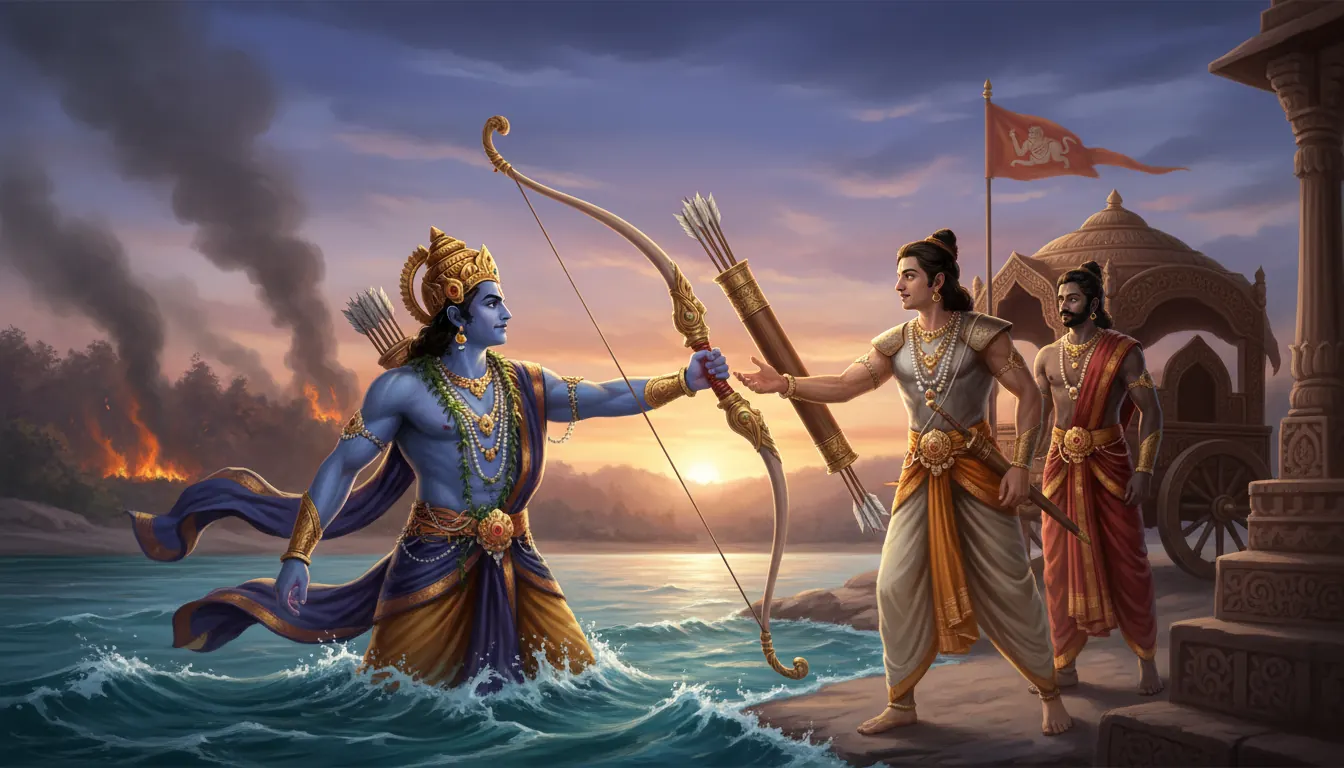
"Give me at once that bow and that quiver, and the ape-bannered chariot too, which came to you from King Soma. Partha will achieve a great task with Gandiva, and Vasudeva with the discus. Give both to me today."
"Well," said Varuna. "I am giving them."
He brought out that wonderful jewel of a bow, full of great power. It was the enhancer of fame and of achievements. No weapon could injure it. It was the chief of all weapons and the grinder of them all, the destroyer of hostile armies, alone equal to a hundred thousand bows. It multiplied kingdoms. It was variegated with excellent colours and well adorned and beautiful to look at, and nowhere upon it, from horn to horn, was there a mark of weakness or injury. Celestials worshipped it, and gandharvas worshipped it. Brahma had made it, long ago, before there was any archer alive who could have used it.
After the bow, Varuna gave two quivers that could not be exhausted, however fast the hands that emptied them.
It is worth noticing how little discussion there was. The lord of the waters had kept these things since Soma left them with him, and he did not ask what they were wanted for, or for how long, or what would come back to him afterwards. A god who had been thought of once came up out of the water, handed over the greatest bow in the three worlds to a stranger's errand. Everything that Kurukshetra would be decided with changed hands in the time it takes to say two sentences.
The Ape on the Flagstaff
Then came the chariot, and it was the chariot that made the onlookers go quiet.
It was furnished with celestial weapons, and its banner bore a large ape. Yoked to it were horses white as fleecy silver clouds, born in the region of the gandharvas, decked with golden harness, as swift as the wind or the mind. It could not be vanquished by celestials or by asuras. Its splendour was so great that no one could gaze upon it, and the sound of its wheels was tremendous, and yet it delighted the heart of every creature that looked at it. Vishvakarma, the architect of the universe and one of the lords of creation, had made it after severe ascetic meditation. Resplendent as it was, it looked like an evening cloud holding the light of a sun already down. It was the very chariot from which the lord Soma had once defeated the danavas.
Upon its excellent flagstaff of golden colour sat a celestial ape whose form was fierce as a lion's or a tiger's. Placed high above the yoke, the creature seemed bent on burning up everything it looked at. On the other flags were beasts of large size whose roars and yells would make enemy soldiers faint where they stood.
Arjuna put on his mail and took his sword and covered his fingers in leather gloves. He walked round that chariot with its many flags, and bowed to the gods, and climbed into it as a virtuous man climbs into the heavenly chariot that carries him to heaven.
Then he took up Gandiva, that first of bows created by Brahma of old, and bowed to Hutasana, and set the string to it and drew, and strung it forcibly. The noise of that stringing went out across the water and the trees, and those who heard it quaked with fear and did not know why.
The Discus and the Mace
Pavaka turned then to Krishna and gave him a discus with an iron pole attached to a hole in its centre, a fiery weapon that became his favourite from that hour.
"With this, slayer of Madhu," said Agni, "you will without doubt be able to defeat in battle even foes that are not human. With this you will be stronger in battle than men and gods, rakshasas and pishachas, daityas and nagas. With this you will certainly be able to strike down all of them. And, Madhava, when you hurl it at your foes, this weapon will slay the enemy without fail and then come back into your hands."
The lord Varuna, after that, gave Krishna a mace named Kaumodaki, able to slay any daitya, and producing when hurled a roar like the roar of thunder.
The two of them stood there with everything they had asked for and more than they had asked for, and Arjuna and Achyuta were filled with joy.
"Exalted one," they said to Pavaka, "now that we have weapons and know their use, and chariots with flags and flagstaffs, we can fight all the gods and the asuras together, let alone the wielder of the thunderbolt when he comes out to fight for the sake of a naga."
"While Hrishikesha moves on the field of battle with this discus in his hand," Arjuna added, "there is nothing in the three worlds that he cannot consume by hurling it. And now that I have the bow Gandiva and this pair of quivers that never run out, I am ready to conquer the three worlds in battle. So blaze up as you like, lord. Surround this large forest on every side. We are quite able to help you."
Lent for an Afternoon
When Dasharha and Arjuna had spoken, the illustrious god put forth his most powerful form and prepared to eat. He surrounded the wood on all sides with his seven flames and caught it everywhere at once with a roar like the roar of the clouds, and every creature within it trembled. He showed the form he keeps for the end of a Yuga. The burning forest, seen from the plain, looked like Meru, king of mountains, with the rays of the sun fallen upon it and blazing there.
"And that," said Vaishampayana, "is how the arms came out of the water.
"Consider what was handed over that afternoon, king, and for what. A bow that Brahma made and Varuna kept, equal by itself to a hundred thousand bows. Two quivers that no hand could empty. A chariot built by Vishvakarma out of ascetic meditation, in which Soma had beaten the danavas, with an ape on its flagstaff that would one day be seen from one end of Kurukshetra to the other and would tell every man on that field, without a herald, whose chariot was coming. A discus that returns. A mace named Kaumodaki. Your great grandfather's whole armoury, and Krishna's, given to them for the burning of a wood, because a god had eaten too much butter at the sacrifice of a king nobody now remembers.
"They did not buy these things and they did not win them in a contest. They were lent them because a third party was hungry. Gandiva was Brahma's before it was Prajapati's and Indra's and Soma's, and Soma's before it was Varuna's, and Varuna's before it was Arjuna's, and when the work was finished at the end of everything it went back into the water again. A man holds the instruments of his life's great labour the way a bowstring holds a bow, tightly, and only for as long as the work lasts."
Dharma Lesson
The instruments of a life's great work are given before the work is named, and they are handed over for a reason that has nothing to do with the fame they will later win. Gandiva belonged to Brahma, then to Prajapati, to Indra and to Soma, then to Varuna, and only then to Arjuna, and it was lent for the burning of a wood. Nothing a man wields is truly the property of the hand that holds it.