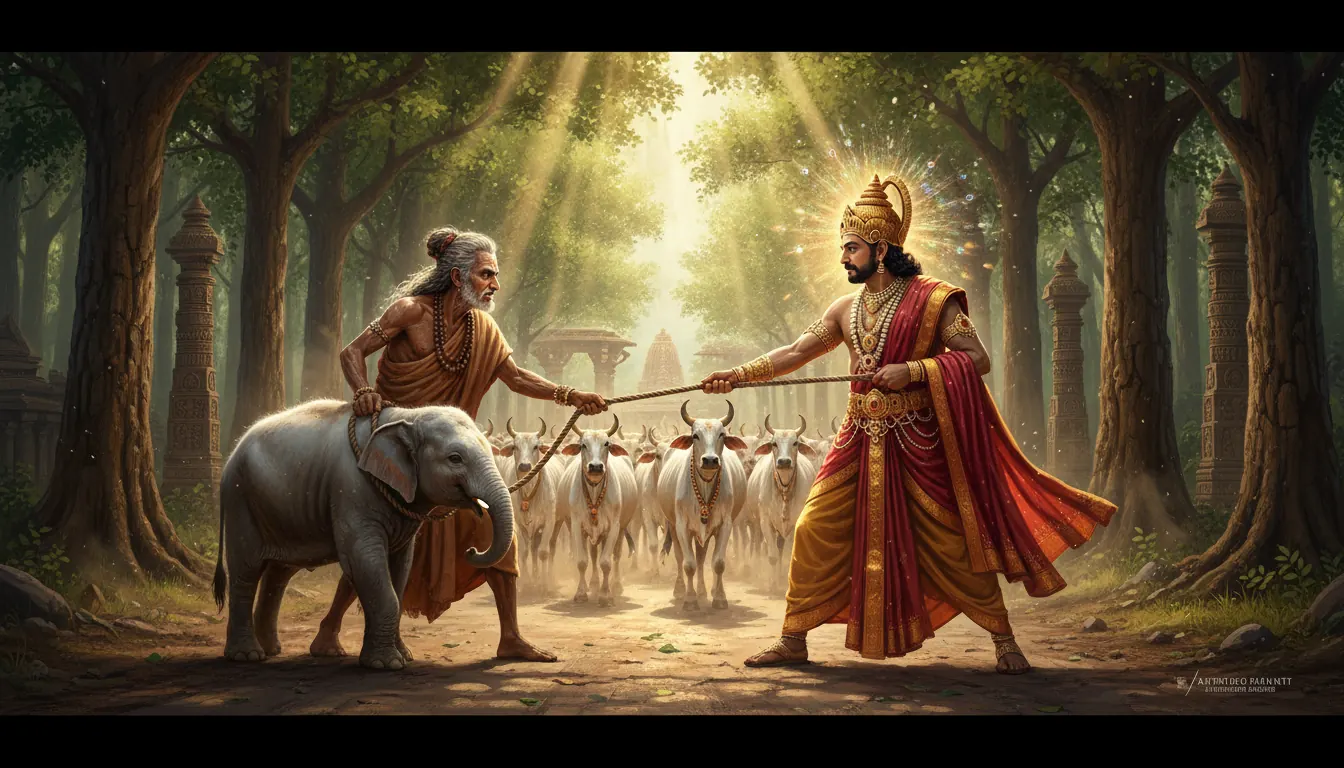
The Elephant the Sage Called Son
Gautama argues his way through every heaven for a stolen calf
In short
Bhishma answers whether the pious are ranked after death by telling a quarrel over an elephant. The ascetic Gautama raises a motherless calf as his own son, and a king who is Indra in disguise drags it away, offering a thousand cows for it. Gautama refuses and swears to follow the thief through every world, naming region after region until he sees the god beneath the king.
Told in the Anushasana ParvaSet in Kurukshetra, Forest Hermitage and Mount Meru19 min read
Do All the Good Go to the Same Place
"Grandfather," said Yudhishthira, "it has been said that all good men reach the same place after death. Is it true, Bharata, that there are differences of position or rank among them?"
It is the question of a man who has buried a great many people at once. On the Kurukshetra plain the good and the bad had gone into the same fire on the same evening, and the king wanted to know whether the sorting happened afterwards.
"By different deeds, son of Pritha, men reach different worlds," said Bhishma. "Those whose conduct is righteous reach worlds of happiness, while the sinful reach worlds full of misery."
He could have stopped there. What he did instead was give the king the whole map, tier by tier, and he gave it in the form of a quarrel about an elephant.
"On this point the old story is told of the conversation between the ascetic Gautama and Vasava. Listen, and you will hear every heaven there is named out loud, one after another, by a man who was not interested in any of them."
Yudhishthira settled himself to listen. He had asked about the ranking of the blessed dead. He was going to be told about a brahmana who owned nothing, a god who wanted a beast, and a young white elephant that had been raised by hand.
The Calf That Had Lost Its Mother
"A brahmana named Gautama," said Bhishma, "gentle and self-restrained, with all his senses under complete control, saw a baby elephant that had lost its mother and was utterly forlorn because of it.
"Consider how little there is in that sentence and how much hangs on it. A man walking in the woods comes upon a calf standing where its mother is not. It is white, and it is very young, and it has stopped making any noise, which is what a young animal does when it has given up. Nobody is watching. There is no merit to be gained. The nearest witness is a tree.
"Full of compassion, and steady in keeping his vows, the ascetic nursed the young animal.
"That is the whole of the beginning. He fed it and it lived. After a long time the little beast grew up into a large and mighty elephant, and it grew up inside the hermitage, under the eye of the man who had fed it, and it learned the work of the place as a child learns the work of a house. It carried the fuel. It carried the water. When the ascetic was away, the elephant stayed and guarded the hermitage. It was very docile and obedient to its master, careful to do every task its teacher gave it, gentle and well trained, and grateful.
"That last word is the one to keep hold of. Grateful. The animal had not forgotten who had come along the path that day, and neither, as it turned out, had anybody in heaven."
A King on the Forest Road
"One day," said Bhishma, "Indra took the form of king Dhritarashtra and seized that mighty elephant, which was as huge as a hill and had juice trickling down from its split temples.
"Not our Dhritarashtra. It was a name the god put on, the way a man puts on a coat, and there was a king somewhere who had lent it without knowing. What arrived at the hermitage looked in every particular like royalty: a king, an escort, an authority that did not expect to be questioned, and a hand laid on the halter of a full-grown bull elephant in must, with the dark juice running down from its temples, which is the season when such an animal is worth the most and is hardest to hold.
"When he saw the elephant being dragged away, the great ascetic Gautama, strict in his vows, spoke to him.
"'Ungrateful Dhritarashtra, do not rob me of this elephant. I look on it as a son, and I raised it with great pains. It is said that between good people friendship springs up if they exchange only seven words. You should see to it, king, that the sin of injuring a friend does not touch you.
"'You should not, king, take away by force this elephant that brings me my fuel and water, that guards my hermitage when I am away, that is very docile and obedient to its master, that is careful to do every task its teacher gives it, that is gentle and well trained, and that is grateful and very dear to me. You should not carry it off, ignoring my protests and cries.'
"Seven words," said Bhishma. "That is the price of a friendship, by the old reckoning, and the ascetic and the king had already spent more than that on each other standing in the road."
A Thousand Cows and a Hundred Maidservants
"The king made the offer that kings make," said Bhishma.
"'I will give you a thousand cows, a hundred maidservants and five hundred pieces of gold. I will also give you, great rishi, many other kinds of wealth. What use can brahmanas have for elephants?'
"Hear the shape of it. A thousand cows is not a bribe, it is a fortune; it is the standing wealth of a small kingdom, and it was being handed to a man who lived on what the forest dropped. And with it came the argument that the offer is reasonable, which is always the more dangerous half.
"'Keep your cows and maidservants, king, and your gold coins and gems and many other kinds of wealth,' said Gautama. 'What, monarch, have brahmanas to do with wealth?'
"He gave back the king's own question with the terms exchanged, and that is the hinge of the whole story. The king had asked what a brahmana wants with an elephant, meaning that an elephant is a thing of a certain class and belongs with that class. The ascetic answered that if things belong with their classes then the gold belongs with the king, and he did not want the gold, and what he wanted had never been a thing at all.
"The king tried the point again, because it was a good point and he was used to winning with it.
"'Brahmanas have no use for elephants. Truly, learned brahmana, elephants are meant for those of the royal order. In taking an animal, this finest of elephants, to ride on, I cannot be thought to be committing any sin. Stop standing in my way like this, Gautama.'
"And there the ascetic, who had no army, no gold, no rank and no remedy, opened the only door that was left to him, which went straight down out of the world."
To the World of Yama, Then
"'Illustrious king,' said Gautama, 'even if I must go to the world of Yama, where the righteous live in joy and the sinful in grief, I will take this elephant of mine back from you there.'
"He had begun to follow. Not to fight, not to curse, which he could have done and which every ascetic in these stories does sooner or later. To follow. The threat was that death would not end the pursuit, and the king answered it like a man declining an invitation.
"'Those who have no religious acts to their name, who have no faith and deny the gods, whose souls are sinful and who live only to gratify their senses, only they have to go to the world of Yama and endure the misery he inflicts. Dhritarashtra will go to a higher world, and not there.'
"'The world of Yama is a place where men are held in check,' said Gautama. 'No lie can be told there. Only truth prevails in that place. There the weak persecute the strong. I will go there and force you to give this elephant back to me.'
"That is why he named Yama first, son of Pandu. It is the one court in the universe where a man with nothing may prevail against a man with an army, and he wanted the case heard there.
"'Only those who, drunk with pride, treat their eldest sister and their father and mother as enemies have to go to such a world,' said the king. 'I will go to a higher world. Dhritarashtra will certainly not have to go there.'
"'The world called Mandakini, belonging to king Vaishravana, is reached by those greatly blessed people who are granted every joy and comfort. Gandharvas and yakshas and apsaras live there. Even if you go there, king, I will force you to give this elephant back to me.'
"'Those who treat hospitality to guests as a vow, who give shelter to brahmanas, and who eat what is left after everyone who depends on them has been fed, are the ones who grace the Mandakini of Kubera. A higher world is kept for me.'"
Meru, and the Woods That Belong to Narada
"So it went, rung by rung, and neither of them raised his voice," said Bhishma. "The ascetic named a heaven and said he would come there for his elephant. The king described the men who earn that heaven, agreed that they were fine men, and said he was going higher.
"'If you go to those lovely flower-decked woods on the summit of Meru, which echo with the sweet voices of the Kinnaris and are graced with beautiful Jamvu trees with spreading branches, I will follow you even there and force you to give this elephant back to me.'
"'Those brahmanas who are gentle by nature, devoted to truth and deeply learned in the scriptures, who are compassionate to all creatures, who study the Puranas with all the histories, who pour offerings on the sacred fire and give gifts of honey to brahmanas, go to such worlds. I will go to a higher world. If you know of any other famous world of happiness, name it, for I will go even there.'
"Mark that last line. The king was now helping. He had begun to enjoy it.
"'If you go to the woods that Narada owns and holds dear, which are adorned with flowers, which echo with the sweet songs of the prince of the Kinnaras, and which are the eternal home of gandharvas and apsaras, I will follow you there.'
"'Those who never beg for alms, who cultivate music and dancing and always wander about in joy, go to such worlds. I will go to a higher world.'
"'If you go to that world where the Uttara-Kurus shine in beauty and spend their days in gladness in the company of the gods themselves, where beings born of fire, beings born of water and beings born of mountains live in happiness, where Shakra rains down the fulfilment of every wish, where women live in perfect freedom, bound by no rules of any kind, and where there is no jealousy between the sexes, I will follow you even there.'
"'Those who are free of desire for every kind of pleasure, who abstain from meat, who never take up the rod of punishment, who have made themselves the soul of all creatures, who are wholly free of the idea of "mine", and who look on gain and loss, and praise and blame, as equal, only they go to such worlds. I will go to a higher world.'"
Soma, the Sun, and the Lord of Waters
"'Beyond these shine those eternal worlds, fragrant with fine perfumes, free of every passion and without sorrow,' said Gautama. 'They are the home of the great-souled king Soma. If you go there, I will follow you even there and force you to give this elephant back to me.'
"'Those who always give and never receive a gift, who never accept service from others, who own nothing that they cannot give away to a worthy person, who are hospitable to all creatures, who are inclined to show kindness to everyone, who are forgiving by nature, who never speak ill of others, who protect all creatures by throwing over them the shroud of compassion, and who are always righteous in their conduct, only they go to such worlds. Truly, Dhritarashtra will not go there.'
"Every one of those descriptions, son of Pandu, is a portrait of the man he was talking to. He who owns nothing that he cannot give away. He who protects creatures by throwing over them the shroud of compassion. The god was reading out the ascetic's own character in the form of an excuse, and the ascetic was too busy following an elephant to notice.
"'Beyond these shine other worlds that are eternal, free of passion and darkness and sorrow, which lie at the feet of the great-souled god of the Sun.'
"'Those who are diligent in the study of the Vedas, who are devoted to serving their teachers, who keep penances and excellent vows, who are firm in truth, and who never say anything that smacks of disobedience or hostility to their teachers, go to such worlds. I will go to a higher world.'
"'They are the home of the great-souled king Varuna. If you go there, I will go there too.'
"'Those who worship the gods by keeping the vow called Chaturmasya, who perform a thousand sacrifices, who pour offerings on their sacred fire every day, with devotion and faith, for three years as the Vedas ordain, and who carry the burden of all their duties without flinching, only they go to such worlds. Truly, Dhritarashtra will not go there.'"
The World of the Cows
"'Above them are the worlds of Indra, free of passion and sorrow, hard to reach and longed for by all men,' said Gautama. 'I will go even to the home of mighty Indra himself, king, and force you to give this elephant back to me.'
"He said it without any suspicion at all, and the god standing in front of him kept his face.
"'Those who live for a hundred years, who are heroic, who study the Vedas and who perform sacrifices with devotion, go to the world of Shakra. I will go to a higher world.'
"'Above the heavens are the worlds of the Prajapatis, of still greater happiness, belonging to those powerful beings from whom creation sprang.'
"'Those kings who have bathed at the completion of the Rajasuya sacrifice, whose souls are righteous, who have protected their subjects well, and who have washed their limbs in consecrated water at the completion of the horse sacrifice, go to such worlds. Truly, Dhritarashtra will not go there.'
"'Beyond those shine those eternal worlds, fragrant with delicious perfumes, free of passion and beyond all sorrow. They are the worlds of the cows, hard to reach, where oppression can never be.'
"And here the king, who had answered ten questions in ten sentences, suddenly could not stop talking.
"'Whoever owns a thousand cows and gives away a hundred every year, or owns a hundred and gives away ten every year as far as he is able, or owns only ten or even five and gives away one cow from them; and those who live to a ripe old age keeping the vows of Brahmacharya all their days, who obey the teachings of the Vedas and who go on pilgrimage to sacred waters and shrines, live in happiness in the world of the cows. Those who go to Prabhasa and Manasa, the lakes of Pushkara, the great lake called Mahatsara, the sacred woods of Naimisha, Vahuda, Karatoya, Ganga, Gayasiras, Vipasa, Sthulavaluka, Krishna, the five rivers, the wide lake called Mahahrada, Gomati, Kausiki, Champa, Saraswati, Drishadvati and Yamuna, those illustrious brahmanas, steady in keeping their vows, who go to these sacred waters, go to the worlds you speak of. With celestial bodies and celestial garlands, always giving off the most delightful perfumes, those blessed people go to those worlds of joy and gladness. Truly, Dhritarashtra will not go there.'
"A god who is holding a stolen elephant," said Bhishma, "had just recited the whole pilgrim road of the world from memory, in order, without being asked."
Where There Is Neither Righteousness Nor Sin
"There was one place left," said Bhishma, "and the ascetic named it.
"'Beyond these are worlds where there is no fear of the least cold or heat, no hunger, no thirst, no pain, no sorrow, no joy, no one pleasant or unpleasant, no friend and no enemy: where old age and death do not exist, and where there is neither righteousness nor sin. I will go even to that world which is free of passion, which is full of untroubled happiness, and where there is wisdom, even to that sacred home of the self-born Brahman, and force you to give this elephant back to me.'
"Hear what he was saying. He would go to the last place there is, where there is no pleasure and no pain and no right and no wrong and nothing left of a man that could want anything, and there he would still want his elephant back. It is either the most foolish sentence in all my teaching or the truest thing ever said about love, and I have lain here a long time and I have not decided.
"'Those who are free of all attachments, whose souls are purified, who are steady in keeping the highest vows, who are devoted to the Yoga of stilling the mind, those people given to the quality of Sattwa reach the sacred world of Brahman. Great ascetic, you will not be able to find Dhritarashtra there.'
"And with that the ladder was finished. Every region had been named. There was nowhere above the abode of Brahman to which a thief could withdraw, and the ascetic, who had been climbing all this while with his eyes on the elephant, at last looked at the man he had been climbing after.
"'Where the finest of the Rathantara hymns is sung, where altars are strewn with sacred Kusa grass for the Pundarika sacrifices, where Soma-drinking brahmanas travel in vehicles drawn by excellent horses, I will go even there and force you to give this elephant back.
"'I think you are the slayer of Vritra, the god who has performed a hundred sacrifices, roaming through all the worlds of the universe. I hope no weakness of mind has led me to wrong you in the words I have spoken.'"
It Sniffs Your Feet
"'Yes, I am Maghavat,' said the god of a hundred sacrifices. 'I came to the world of men to seize this elephant. I bow to you. Command me. I will gladly do whatever you wish to say.'
"The god had come down to take a beast and had ended by asking a man in a bark robe for orders. And the ascetic, who had just been offered anything in the three worlds by the king of the gods, asked for the thing he had been asking for all along.
"'Give me, chief of the gods, this elephant, which is white and still so young, for it is only ten years old. I have raised it as my own child. Living in these woods, it has grown up under my eye and has been a dear companion to me. Set free this child of mine whom you have seized and want to drag away.'
"'This elephant, which has been a son to you, best of brahmanas, is coming to you and looking at you longingly,' said Indra. 'See, it sniffs your feet with its nostrils. My salutations to you. Pray for my welfare.'
"That is the picture to keep, son of Pandu. Not the ladder of heavens. The trunk coming down and moving over the old man's feet, smelling him, the way an animal makes certain of a person it has been afraid of losing.
"'Chief of the gods, I always wish you well. I always worship you. Give me your blessing too, Shakra. I accept this elephant as your gift.'
"'Among all the great-souled and foremost rishis who hold firmly to truth and carry the Vedas in their hearts, you alone have been able to recognise me. That is why I am greatly pleased with you. Come with me quickly, with this son of yours. You deserve to reach many worlds of great happiness without even a single day's delay.'
"Then the wielder of the thunderbolt took Gautama with him, placing him in front with his son, the elephant, and went to heaven, which even the righteous find hard to reach.
"You asked me whether the pious are ranked, king. They are, and there are more shelves in that house than you would think, and I have just recited them to you in order. But note where this brahmana was put. He did not earn a shelf. He was carried up through the whole of it in a single day with his elephant walking beside him, because he would not be bought and because he alone knew a god when one stood in the road in front of him and lied. He who would listen to this history every day, or would recite it with his senses restrained, proceeds after death to the region of Brahman, even as Gautama himself."
Dharma Lesson
A creature you have raised is not property to be priced, and no exchange of cattle or gold can settle a debt that was never made of goods. Gautama answers the king's question about what a brahmana wants with an elephant by returning it: if things belong with their classes, then keep the gold, because what he wants was never a thing. Love that is willing to follow through every heaven turns out to be a stronger claim than any right of rank, and the god who tested it carried both sage and beast up in a single day.