In short
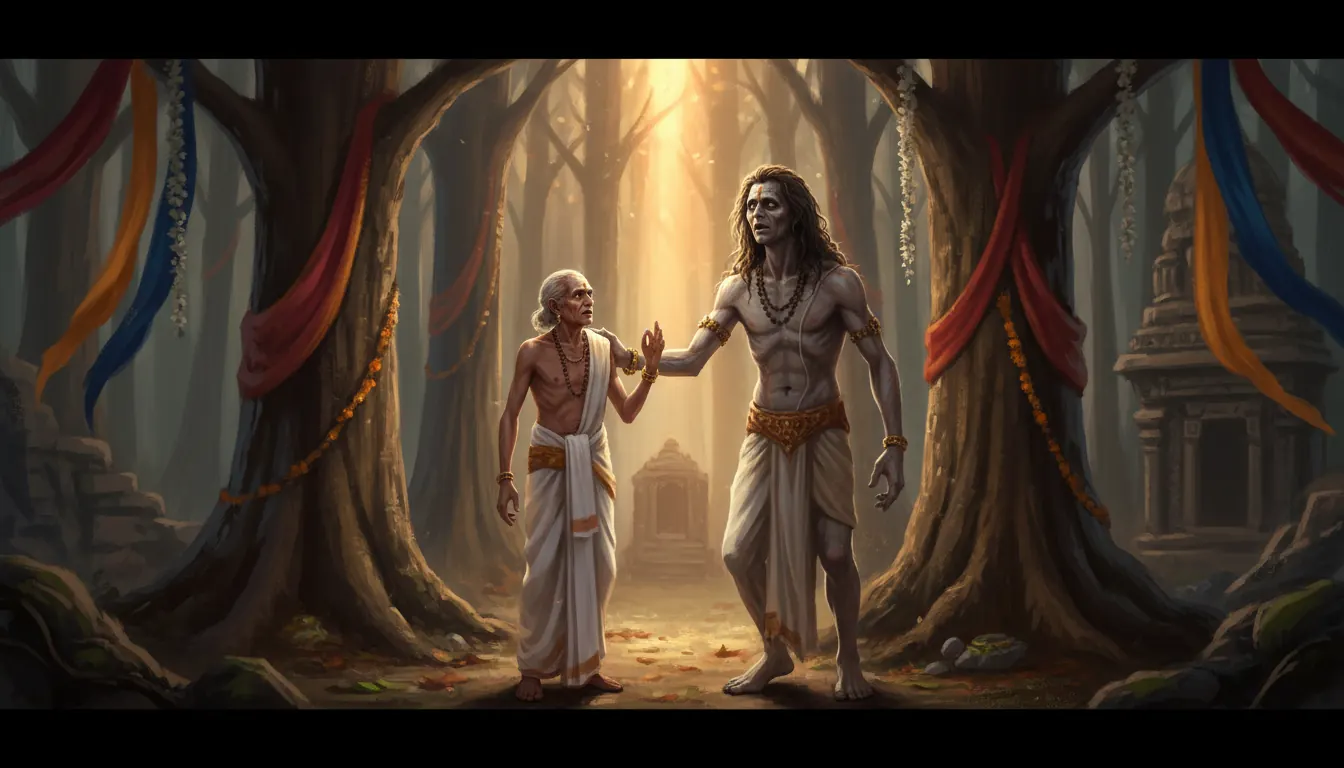
Asked by Yudhishthira whether conciliation or gifts accomplishes more, Bhishma tells of a brahmana caught in a lonely forest by a rakshasa who offers him his life for one answer: why is his captor so pale and so lean? The brahmana replies with a long roll of griefs that thin a creature, and the rakshasa, hearing its own life described, frees him, befriends him, and loads him with wealth.
Told in the Anushasana ParvaSet in Kurukshetra and Forest Hermitage16 min read
Conciliation or Gifts
The old man lay on his bed of arrows at Kurukshetra with his head unsupported, and the sons of Pandu sat around him in the short cool before the sun climbed, waiting on his voice. Yudhishthira had been turning over a list of questions through the night, and when Bhishma's breathing steadied he asked the one at the top of it.
"Which works better, conciliation or gifts?" he said. "Tell me, chief of Bharata's race, which of these two is the more effective."
"Some men are won over by conciliation," Bhishma said, "and others by gifts. Every man, by his own nature, leans to the one or the other, and a king who cannot tell which man is which will empty his treasury and still be hated. But listen, and I will explain to you the merits of conciliation, so that you may understand that even the most furious creatures alive can be appeased by it.
"There is an old narrative that belongs here. A brahmana was seized in a lonely forest by a rakshasa who meant to feed on him, and he came out of that forest alive. More than alive. He came out with the rakshasa's friendship and with the rakshasa's wealth, and he had bought neither with anything but words."
"He had no gift to offer?" Yudhishthira asked.
"He had no gift, no weapon, no kinsman within a day's walking, and no road out that his legs were fast enough to take. He had his learning and he had the presence of mind to use it while a hand was already closed around his arm. Listen to how it went, and notice where the turn comes, for the turn does not come where you will expect it."
Seized in a Lonely Forest
The brahmana of that story (said Bhishma) was a man of eloquence and intelligence, and he was crossing a stretch of forest where no smoke rose and no cart track ran, the kind of country a traveller crosses quickly and does not stop in. He had not seen another human being since morning, and he had been walking since before the light.
The rakshasa took him without warning, the way such creatures take men, out of the standing shade and across the path in one movement, and then simply held him, unhurried, the way a man holds a bird he has already caught. It was a terrible cannibal to look at. But the brahmana, possessed of understanding and of learning, was not at all agitated. He did not cry out and he did not struggle, because he could see with his own eyes that neither would answer, and he did not allow himself to be stupefied at the sight of the thing that had hold of him.
Instead, in the small space he had, he thought the matter through. He had nothing in his cloth worth a demon's notice. He had no army behind him and no god at his elbow. Of the ways by which a man in danger may still save himself, he possessed exactly one: he could speak. So he resolved to apply conciliation, and to see what conciliation would do to a rakshasa.
And while he resolved it he did what few men in that grip would have thought to do. He looked at his captor. He looked carefully, the way a physician looks. And what he saw was strange. The creature that held him was pale of hue, and it was lean. It was not the glossy, gorged, red-mouthed thing that a man-eater in a forest full of travellers ought to have been. Something was eating this eater.
You Shall Escape, But Tell Me
Then the rakshasa spoke, and it saluted the brahmana respectfully, at least so far as words went, for its hand did not open.
"You shall escape," it said. "I give you that. But first tell me this. Why am I pale, and why am I so lean?"
The brahmana reflected for a brief space of time. He understood at once what had been laid in front of him. He had been asked a riddle by a creature that could break him, and the riddle was not really a riddle; it was a wound, and the rakshasa was holding it out the way a man holds out a hand with a thorn in it, wanting someone to look. To answer it as a physician answers, with one cause and one cure, would be to guess, and a wrong guess would be the end of the conversation and the end of him. To flatter would be worse, for flattery is a gift, and this creature had not asked for a gift.
So he accepted the question. That was the whole of his art, Bhishma said: he accepted it, entirely, as if nothing in the world were more worth an hour of a learned man's attention than the exact reason why this particular rakshasa in this particular forest had grown thin.
"I will tell you," the brahmana said, "and I will not tell you once. A lesser man would give you one answer and stake his neck upon it. There is no single cause for what has happened to you. A body does not go pale from one grief. Let me name them as they come, and you can stop me when I name yours."
And he began to speak in well-chosen words, without haste, as though he were seated on a clean mat in a hall of learned men, and not standing in a wood with a demon's fingers around his arm.
A Place That Is Not Your Own
"There is a first cause, and it is the plainest one," the brahmana said, "and I will begin with it because I think you have been carrying it longest. You are living in a place far from your own home. You move in a world that is not your own. You are cut off from the company of your friends and your kinsmen, and in that far place you are enjoying great wealth. A man may grow rich in such a country and grow thin in it at the same time. That is why you are pale and lean.
"Nor is that all. Your friends, though you treat them well, are still not well disposed towards you, and the fault is not in your treatment of them but in their own vicious nature, which no kindness of yours will ever mend. You have learned that a good turn does not manufacture a good man. That is why you are pale and lean.
"You have merit, and wisdom, and a well-ordered soul. Yet it is your lot to stand and watch while others who have neither merit nor wisdom are honoured above you. That is why you are pale and lean.
"There are people with far more wealth and riches than you, and far fewer accomplishments, and they ignore you. They do not even trouble to be your enemies. That is why you are pale and lean.
"And though you are in distress for want of the very means to live, the loftiness of your own soul leads you to scorn the means that lie open to you for earning your keep. You will not stoop to what would feed you. That is a hunger no meal cures. That is why you are pale and lean."
The rakshasa had not moved and had not answered. But its hand had not tightened either.
The Enemy With a Friendly Tongue
"Because of your righteousness," the brahmana went on, "you once stinted yourself for the good of another. You went without so that he should not go without. And this other, righteous rakshasa, thinks his superior intelligence deceived you and made you his tool. He believes he outwitted you into your own generosity. That is why you are pale and lean.
"I think, too, that you are grieving for those people whose souls are overwhelmed by lust and by anger and who suffer misery in this world because of it, and that you grieve for them although they have never once asked you to. That is why you are pale and lean.
"Though you have wisdom, you are mocked by others who have none of it at all, and people of wicked conduct sit in judgment and condemn you. That is why you are pale and lean.
"And there was some enemy of yours with a friendly tongue. He came to you and behaved at first like a righteous man, and you opened your house to him, and then he left you, having cheated you like a rogue. You have not been able to decide since which of the two men he was. That is why you are pale and lean.
"You know well how the affairs of the world go. You are well skilled in all the mysteries. You are capable, and those who know perfectly well that you are do not respect you or praise you aloud. That is why you are pale and lean.
"You have stayed in the midst of bad men engaged together in some enterprise, and you spoke to them and cleared away their doubts and set the thing straight for them, and for all that they would not admit your superior merits. They took the counsel and kept the credit. That is why you are pale and lean."
What the Kinsmen Would Not Allow
"Though you have no wealth, and none of the sharpness men call intelligence, and no Vedic lore," said the brahmana, "you still want to accomplish something great by your energy alone. You have nothing to build with and you intend to build. That is why you are pale and lean.
"It seems to me also that although you are resolved to retire into the forest and undergo severe austerities, your kinsmen do not look kindly on this plan of yours, and you have not gone. That is why you are pale and lean.
"Some neighbour of yours, rich, young and handsome, covets your dear wife. You have said nothing about it to anyone. That is why you are pale and lean.
"The words spoken by you in the midst of wealthy men, even when they are excellent words, are not regarded by them as wise or as well timed. The same sentence out of a richer mouth would have been carried through the hall. That is why you are pale and lean.
"Some dear kinsman of yours, who has no intelligence though he has been taught the scriptures again and again, has become angry with you, and you have not managed to calm him, and you go on trying. That is why you are pale and lean.
"And somebody who first set you to work on something you wanted is now trying to snatch the fruit of it out of your grasp, at the very moment when the thing has ripened. That is why you are pale and lean."
The forest around them was entirely silent. The brahmana noticed, without letting it slow his voice, that the rakshasa had sat down.
The Purpose You Cannot Speak
The rakshasa's face had changed. It had not softened, exactly; it had the look of a man in a crowd who hears his own name called from somewhere he cannot see. The brahmana marked it and did not hurry.
"Though you have excellent accomplishments," he said, "and everyone honours you for them, your own kinsmen think you are honoured for their sake and not for your own. They take your honour as a household ornament. That is why you are pale and lean.
"Shame keeps you from speaking of some purpose in your heart, and you are troubled too by the delay that must come before it can be done, so you say nothing, year after year. That is why you are pale and lean.
"You want to use your intelligence to bring under your influence many people with many kinds of understanding and many inclinations, all of them at once, and by argument alone. It cannot be done, and you are still attempting it. That is why you are pale and lean.
"Without learning, without courage, and without much wealth, you still seek the kind of fame that is won by knowledge and by prowess and by gifts. Truly, that is why you have become pale and lean.
"You have not been able to get something you set your heart on a long time ago, or else what you are trying to do is being undone by somebody else as fast as you do it. That is why you are pale and lean.
"And without being able to see any fault at all upon your own part, you have been cursed by somebody. You have gone over the day a hundred times and you cannot find what you did. That is why you are pale and lean."
Righteousness Languishing
"With neither wealth nor accomplishments," said the brahmana, "you try in vain to drive away the grief of your friends and the sorrows of sorrowing men. You have nothing to give them and you go to them anyway. That is why you are pale and lean.
"Seeing righteous people living as householders, and unrighteous people living the forest life, and emancipated people attached after all to home and to fixed dwellings, you have become pale and lean, for the orders themselves seem to you to have changed places.
"Your acts connected with Righteousness, with Wealth, and with Pleasure, and the well timed words that you have spoken, do not bear fruit. Not one of the three roads pays you. That is why you are pale and lean.
"Though you are wise, you want to live, and so you live on wealth you were given by somebody of evil conduct, and you know exactly what it is you are eating. That is why you are pale and lean.
"Seeing unrighteousness growing on every side, and righteousness languishing, you are filled with grief. That is why you are pale and lean.
"Urged by time, you seek to please all your friends even when they are disputing and are ranged upon sides opposite to one another, and you will lose them all, and you know it, and you go on. That is why you are pale and lean.
"And seeing people with Vedic lore doing improper things, and people of learning unable to keep their own senses under control, you are filled with grief. That is why you are pale, and that is why you are lean."
"I could go further," he said, "for the list of things that thin a creature is longer than the list of things that fatten one, and any man who has lived to my age could add to it. But I think I have named yours. I think I named it some while ago, and you did not stop me, which is how I know."
Then he stopped. He had come to the end of what he had to say, and he stood in the forest with his arm still in a demon's hand and waited to learn what his own words had bought him.
The Rakshasa Makes a Friend
The rakshasa let him go.
Then, praised in this way, that man-eater worshipped the learned brahmana in return, with the honours paid to a guest and to a teacher, and made him his friend, and gave him wealth enough as a gift, and let him off without devouring him. The man walked out of that forest richer than he had walked into it.
"Consider what happened there," Bhishma said. "The brahmana did not beg. He offered no ransom, for he had none. He did not threaten, and he had no power to threaten with. He did not lie, and this is the point of the whole story, for a flatterer would have told that rakshasa it was handsome. He told it the truth about itself, at length, in order, and without contempt, and there was not one line of it that the creature could deny.
"That is what conciliation is, son of Kunti. It is not sweet words. Sweet words are cheap and every ear knows them. Conciliation is the labour of understanding another being so exactly that when you speak, he hears his own life described by a stranger, and the loneliness that made him dangerous goes out of him. A man will forgive almost anything of one who has understood him. Even a man-eater will.
"You asked me which is superior, conciliation or gifts. Gifts bought that brahmana nothing, because he had none. Conciliation bought him his life, and then it bought him a friend, and then the gifts came to him afterwards, from the hand that had been about to kill him. Remember the order of those things when you sit in judgment over men who hate you, and do not reach for the treasury first, and never reach for the rod first."
Yudhishthira sat with that a while. "And if a man will not be understood?" he said.
"Then use the other means," said Bhishma. "Gifts first, and then the sowing of division among his party, and the rod last of all, when everything gentler has been spent. But you will find that they are needed far less often than kings believe."
Dharma Lesson
Being accurately understood disarms even a creature that meant to devour you, which is why conciliation reaches further than either gifts or force. Flattery is a gift and can be refused; the truth about a man, spoken without contempt, cannot. Understand your enemy exactly enough and the loneliness that made him dangerous goes out of him.